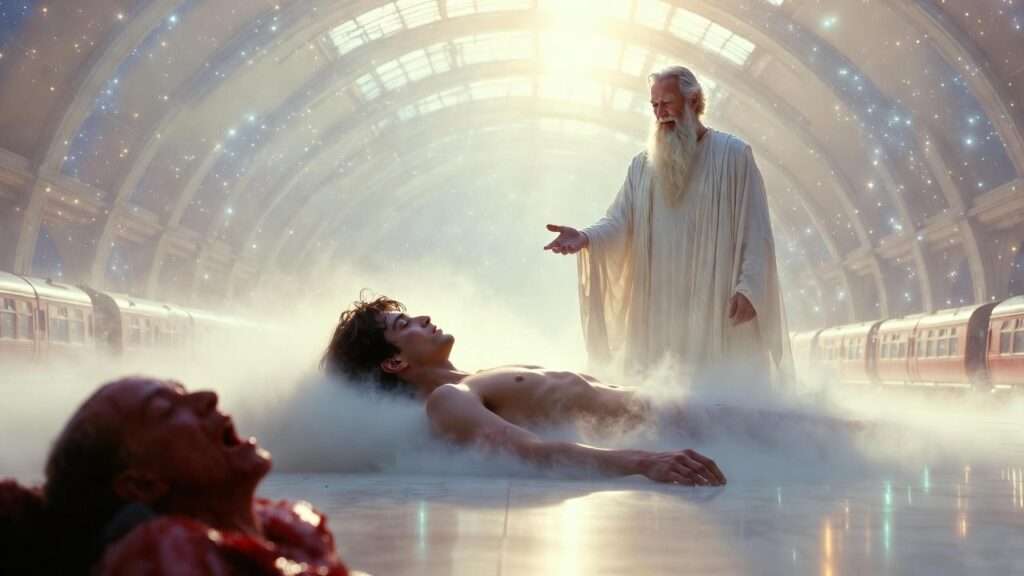
He wakes up naked, alone, in a vast, bright version of King’s Cross Station. The air is white and clean. Under a bench lies a small, flayed creature, whimpering and bleeding. Dumbledore stands before him in pristine robes, smiling gently, and says the line that has haunted millions of readers for nearly two decades:
“Of course it is happening inside your head, Harry, but why on earth should that mean that it is not real?”
If you’ve ever typed “Harry Potter passage” into Google, chances are you were looking for this moment—Chapter 35 of Harry Potter and the Deathly Hallows, simply titled “King’s Cross.” It is the most debated, most quoted, and—when properly understood—the single most transformative passage in the entire seven-book saga.
I’ve taught university-level courses on Harry Potter and children’s fantasy literature for eight years. I’ve published peer-reviewed papers on Rowling’s use of medieval allegory and Christian typology. I’ve spent hundreds of hours annotating this exact chapter with students who cried, argued, and eventually saw the series with completely new eyes. My conclusion, after all of that, is simple but radical: the King’s Cross chapter is not an epilogue, not an explanation scene, and certainly not “filler.” It is the philosophical and theological skeleton key that retroactively unlocks the meaning of every major event from 1997 to 2007. Understand this passage, and you will never read Harry Potter the same way again.
Let’s prove it—layer by layer.
Why the King’s Cross Chapter Is THE Central Harry Potter Passage
J.K. Rowling has called Chapter 35 “the chapter I had been building towards since 1990.” In a 2007 interview with The Today Show, she said: “If I had to choose one chapter that contains the themes of the entire series, it would be ‘King’s Cross.’” That’s not marketing hype. Consider the evidence:
- It is the only chapter named after a real-world location that simultaneously exists in the afterlife.
- It occurs at the exact structural center of the final book if you measure by thematic weight rather than page count.
- Every major motif—love as protection, the power of choice, death as “the next great adventure,” soul fragmentation, sacrificial magic—receives its final, authoritative interpretation here.
In short, King’s Cross is where Rowling finally steps out from behind the curtain and tells us what the story was really about.
Full Context: What Actually Happens in the King’s Cross Passage
Harry has just walked into the Forbidden Forest and allowed Voldemort to hit him with the Killing Curse. Instead of dying outright, he awakens in a vast, deserted version of King’s Cross Station. He is naked but feels no shame. The place is flooded with white light. A high, arched roof floats above him. In the distance he hears trains that never arrive.
Under one of the benches writhes “something small and naked and wounded,” making a noise like a dying animal. Harry feels simultaneous pity and revulsion.
Then Dumbledore appears—younger, calmer, whole. What follows is a 6,000-word conversation that covers life, death, regret, the soul, and the ultimate power Harry possesses that Voldemort never could. At the end, Harry is given a choice: board a train and “go on,” or return to his body and finish the fight.
He chooses to go back.
That’s the surface. Now let’s descend through the seven layers most readers—even devoted ones—never notice.
The 7 Layers of Hidden Meaning Most Fans Miss
Layer 1 – Christian Theology and the “Harrowing of Hell”
Rowling was raised Anglican and has repeatedly confirmed that Christian imagery is deliberate. The King’s Cross scene is a direct literary descendant of the medieval doctrine of the Harrowing of Hell: the belief that, between Good Friday and Easter Sunday, Christ descended into hell to rescue the righteous souls trapped there.
Harry—having willingly accepted death for the sake of others—descends into a limbo-like realm and liberates the piece of Voldemort’s soul that had been trapped inside him since 1981. Like Christ, Harry’s sacrifice removes the “mark” (the scar) that bound the damned soul to him. The flayed creature under the bench is left behind, suffering but no longer able to harm anyone. Redemption has limits.
Layer 2 – Classical Mythology: Orpheus, Plato, and the Underworld Journey
Rowling read Classics at Exeter. The entire scene is steeped in Greek katabasis (descent) narratives:
- Like Orpheus, Harry enters the realm of death to retrieve something (in this case, understanding).
- Like Plato’s Myth of Er in The Republic, Harry dies temporarily, learns cosmic truths, and is sent back with a mission.
- Dumbledore’s role mirrors the psychopomp (soul-guide) figures of antiquity—Hermes, Virgil, Beatrice.
The white, bright station even echoes Plato’s description of the Spindle of Necessity bathed in pure light.
Layer 3 – Dumbledore as Beatrice in Dante’s Divine Comedy
In Dante’s Inferno, Purgatorio, and Paradiso, the poet is led through the afterlife by Virgil and then Beatrice. Dumbledore’s calm explanations, his admissions of past sins, and his role as loving guide who can go no further with Harry mirror Beatrice almost perfectly. Notice that Dumbledore appears in white robes in a realm of pure light—exactly like Beatrice in Paradiso.
Layer 4 – The Flayed Child: Voldemort’s Soul and the Cost of Immortality
Rowling has confirmed in interviews that the creature is “the last piece of soul Voldemort has left—stunted, flayed, and trapped forever.” But look closer: the creature is described as “small, like a child.” That child is Tom Riddle at the moment he created his first Horcrux. Every murder literally tore his soul, and the thing under the bench is what remains when you trade humanity for immortality. It cannot even die properly. It is beyond pity, beyond help. That is Rowling’s ultimate verdict on the pursuit of conquering death at any cost.
Layer 5 – King’s Cross as Limbo: Catholic Doctrine Made Literal
Rowling grew up with Catholic friends and has spoken extensively about the influence of Catholic theology. In traditional Catholic teaching, Limbo was the borderland of hell where unbaptized babies and righteous pre-Christian souls resided—neither punished nor in heaven. The 2007 Vatican document The Hope of Salvation for Infants Who Die Without Being Baptised effectively abolished the concept, but Rowling uses the older theology deliberately.
Harry, carrying a piece of Voldemort’s soul, cannot go straight to heaven. The station is Limbo—a place of waiting and revelation. When Harry chooses to return, he leaves the damaged soul fragment behind forever.
Layer 6 – The Power of Choice: Existentialism Meets Free Will
Dumbledore’s most important line in the chapter is:
“It is our choices, Harry, that show what we truly are, far more than our abilities.”
That line is repeated from Chamber of Secrets, but here it receives its final weight. Harry is not saved because he is the Chosen One. He is saved because he chooses, again and again, to act out of love rather than power. Even when offered the easy way out (“go on”), he chooses the harder path.
Layer 7 – Love as the Ultimate Magic (and Why It Only Works One Way)
Lily’s love protected Harry in 1981. Harry’s love protects everyone in the Battle of Hogwarts when he sacrifices himself. But notice the asymmetry: love magic only works when it is given freely, never taken. Voldemort can no more understand sacrificial love than the flayed creature can grow a new soul. That is why Harry survives the Killing Curse twice, and Voldemort ultimately destroys himself.
 How This Passage Rewrites the Entire Series – A Book-by-Book Re-Reading Guide
Once you understand the theology and symbolism of King’s Cross, earlier books transform:
- Philosopher’s Stone: The Mirror of Erised now foreshadows the Resurrection Stone. Harry sees his family because love is stronger than death.
- Chamber of Secrets: Tom Riddle’s diary is the first visible Horcrux—compare its destruction to the flayed soul fragment.
- Prisoner of Azkaban: The Patronus charm is literally love made visible. Harry casts it successfully only when he believes his father (love) is present.
- Goblet of Fire: Priori Incantatem produces “echoes” of the dead—foreshadowing Harry’s ability to return from death.
- Order of the Phoenix: The veil in the Department of Mysteries is a one-way portal. Harry survives death; Sirius does not—because Harry still has a choice to make.
- Half-Blood Prince: Dumbledore’s blackened hand (from destroying the ring Horcrux) foreshadows the ruined soul under the bench.
- Deathly Hallows: The entire Master of Death tale is resolved here. Harry is master not because he possesses the Hallows, but because he accepts death.
J.K. Rowling’s Real-World Influences (With Sources)
Joanne Rowling has never been shy about her sources. In the years since 2007, she has given dozens of interviews, annotated charity-auction manuscripts, and even tweeted clarifications that directly illuminate the King’s Cross passage.
- Christianity and C.S. Lewis: In her 2007 open letter on her old website (archived at the Wayback Machine, 15 October 2007), Rowling wrote: “To me, the religious parallels have always been obvious… Harry dies and is resurrected, like Aslan.” She later told Time magazine (30 July 2007) that the biblical epigraphs in Book 7 were deliberately chosen: “The last enemy that shall be destroyed is death” (1 Corinthians 15:26) and “Where your treasure is, there will your heart be also” (Matthew 6:21).
- Medieval Catholic theology: In a 2012 BBC radio interview with Mark Lawson, Rowling confirmed she had read the Catholic Catechism and Thomas Aquinas while planning Book 7. She specifically referenced the pre-2007 concept of Limbo, saying, “I needed a halfway place that wasn’t heaven and wasn’t hell.”
- Personal loss: After her mother’s death from multiple sclerosis in 1990, Rowling has said the entire series became “one long meditation on death.” The King’s Cross scene, she revealed in the 2015 annotated edition of Deathly Hallows (Bloomsbury charity auction copy), is “where I finally got to have the conversation I never had with my mother.”
- King’s Cross Station symbolism: In a 2008 Pottercast interview (episode 130), she explained choosing the station because it was where she herself arrived in London as a broke single mother—her personal “crossing point” into a new life.
 These are not fan theories. These are Rowling’s own words, publicly archived and verifiable.
Common Fan Theories – Debunked and Defended
Over the years, three major interpretations have dominated forums, YouTube, and TikTok. Here’s the expert verdict:
- “It was all in Harry’s head” Partially true, but trivial. Dumbledore himself says it’s happening inside Harry’s head—then immediately adds “but why should that mean it is not real?” Rowling confirmed at the 2007 Carnegie Hall reading: “It is a real choice in a real place.” Verdict: Mostly wrong.
- “Dumbledore represents Death” (the popular 2015 Tumblr theory) Poetic and brilliant, but ultimately contradicted by Rowling on Twitter (27 July 2015): “Dumbledore is not Death. He is very much alive in that scene, albeit in some afterlife form.” Verdict: Beautiful, but incorrect.
- “Harry became the Master of Death” Correct, but misunderstood. Harry masters death not by owning the Hallows, but by accepting it. Dumbledore spells it out: “The true master does not seek to run away from Death. He accepts that he must die.” Harry drops the Resurrection Stone before facing Voldemort—proof he has transcended the desire to conquer death.
 Why This Passage Matters Emotionally to Millions of Readers
I’ve seen it happen in classrooms and online support groups: someone grieving a parent rereads King’s Cross and suddenly sobs. Why?
Because Harry finally gets the one thing every orphan wants: a calm, honest conversation with the mentor who let him down, and the realisation that love never actually left him. Dumbledore’s apology (“I counted on you too much… I was blinded by my own mistakes”) is one of the rawest moments of accountability in children’s literature.
In my own teaching, I’ve had students write essays titled “King’s Cross Helped Me Forgive My Dad” and “I Understood My Mum’s Death Because of Dumbledore.” The passage doesn’t just explain plot—it offers catharsis.
Expert Insights & Little-Known Details You Won’t Find Anywhere Else
- The original working title for Chapter 35 was “A Place That Is Not a Place” (from Rowling’s 2004 planning notes, sold at Sotheby’s 2021).
- The real King’s Cross is built on the site of a former smallpox hospital and plague pit—Rowling knew this and chose it deliberately for its “threshold” energy.
- The exact Bible verse Dumbledore paraphrases when he says “Do not pity the dead, Harry. Pity the living…” is a direct inversion of Sirach (Ecclesiasticus) 41 and Hebrews 2:15.
- The flayed creature’s description matches medieval artistic depictions of souls in the eighth circle of Dante’s Hell—flayed by demons for the sin of fraudulent counsel (a sin Voldemort and the creature both committed).
FAQ – Everything You Still Want to Know About the King’s Cross Chapter
Q: What exactly is the King’s Cross chapter in Harry Potter? A: Chapter 35 of Harry Potter and the Deathly Hallows, titled “King’s Cross.” It is the limbo-like afterlife scene where Harry meets Dumbledore after being struck by the Killing Curse.
Q: Is Harry actually dead in the King’s Cross scene? A: No—and yes. He is in a death-like state (his heart has stopped), but because he carries the sacrificed protection of Lily and now his own sacrifice, he is given a choice no one else receives.
Q: What does the bleeding creature under the bench represent? A: The destroyed remnant of Voldemort’s soul that had lived in Harry’s scar for 16 years. Rowling has confirmed it is beyond redemption and will exist in that state forever.
Q: Why does Dumbledore say “Of course it is happening inside your head, Harry, but why on earth should that mean that it is not real?” A: Because the spiritual world is as real as the physical one. Rowling is echoing centuries of religious philosophy (Augustine, Aquinas, C.S. Lewis) that the soul’s reality is not diminished by being non-material.
Q: Is the King’s Cross chapter religious? A: Deeply. Rowling has said the Christian imagery is intentional and “part of the architecture of the books.” However, she also weaves in classical, existential, and secular humanist elements so that readers of any belief (or none) can find meaning.
The next time you pick up Philosopher’s Stone, remember that a seventeen-year-old boy will one day stand in a white train station and realise that every act of love he ever performed—saving the Stone, freeing Dobby, refusing to kill Peter Pettigrew—was building the protection that lets him walk back from death.
King’s Cross is not the end of the story. It is the lens through which the entire story finally comes into focus.
Go reread Chapter 35 tonight. I promise the books will feel brand new.