
Imagine stepping into a world where radish earrings dangle from ears, gnomes roam freely in the garden, and the editor of The Quibbler earnestly explains the benefits of gnome saliva while wearing crooked spectacles and a wild mane of hair. This is the surreal, enchanting moment in Harry Potter and the Deathly Hallows – Part 1 when Harry, Ron, and Hermione arrive at the Lovegood home—and Rhys Ifans bursts onto the screen as Xenophilius Lovegood. For many fans, the first reaction is surprise: “Wait, that’s him?” Yet within seconds, Ifans’ dreamy delivery and quirky mannerisms make the character feel utterly authentic.
Rhys Ifans in Harry Potter brings an unforgettable layer of whimsy and subtle tragedy to one of the series’ most eccentric supporting characters. As Luna Lovegood’s father and the publisher of the alternative wizarding magazine The Quibbler, Xenophilius serves as a pivotal guide in the hunt for the Deathly Hallows. His portrayal stands out amid the franchise’s massive ensemble, blending humor, vulnerability, and quiet menace in a way that elevates an often-overlooked role. Whether you’re a longtime Potterhead revisiting the films or discovering the deeper cast connections for the first time, this deep dive explores why Ifans’ performance remains a hidden gem, offering fresh insights into casting choices, character depth, and the actor’s remarkable range.
Who Is Xenophilius Lovegood? A Character Overview
Xenophilius Lovegood first appears in J.K. Rowling’s Harry Potter and the Deathly Hallows novel as the father of Luna Lovegood, Harry’s quirky Ravenclaw friend. In the books, he’s depicted as an unshakably eccentric wizard who believes fervently in conspiracy theories, mythical creatures like Crumple-Horned Snorkacks, and the controversial symbol of the Deathly Hallows. As editor of The Quibbler, he uses his platform to support Harry and Dumbledore when mainstream outlets like the Daily Prophet turn against them.
The film adaptation, directed by David Yates, condenses much of this backstory but retains the essence. Xenophilius lives in a crooked, tower-like house filled with odd artifacts, dirigible plums hanging from the ceiling, and a printing press churning out issues of his magazine. His role is crucial: he introduces the trio to the legend of the Deathly Hallows through a storytelling session that uses symbolic drawings and props, providing Harry with vital clues about the Elder Wand, Resurrection Stone, and Invisibility Cloak.
From Book to Screen – Key Traits and Role in the Story
In the novel, Xenophilius is more morally complex and tragic. He’s a loving but misguided parent, driven to desperation when Death Eaters kidnap Luna to pressure him into supporting Voldemort’s regime. His betrayal of Harry stems from fear for his daughter’s life rather than malice, adding layers of sympathy to his character. The book delves deeper into his beliefs, showing them as a coping mechanism after the tragic death of his wife, Pandora, in a magical experiment gone wrong.
The movie streamlines these elements for pacing. Xenophilius appears in one extended sequence, but the emotional beats remain: his enthusiasm for the Hallows, his warmth toward the visitors, and the heartbreaking shift when his true motives surface. This condensation makes his eccentricity more immediate and visually striking, relying heavily on performance to convey inner conflict.
 The Lovegood Family Dynamic – Father to Luna
The father-daughter relationship between Xenophilius and Luna is one of the series’ most touching. Luna inherits her dreamy outlook and unconventional style from her father—think radish earrings and belief in invisible creatures. In the film, their bond shines through small details: Xenophilius’ proud smile when Luna greets the trio, or the way he affectionately calls things “fabby” when pleased (a quirky verbal tic that Ifans embodies perfectly).
This dynamic underscores themes of acceptance and family in the wizarding world. Amid war and prejudice, the Lovegoods represent unapologetic individuality, offering Harry a brief respite of kindness before darker revelations.
Pivotal Moments – Introducing the Deathly Hallows Tale
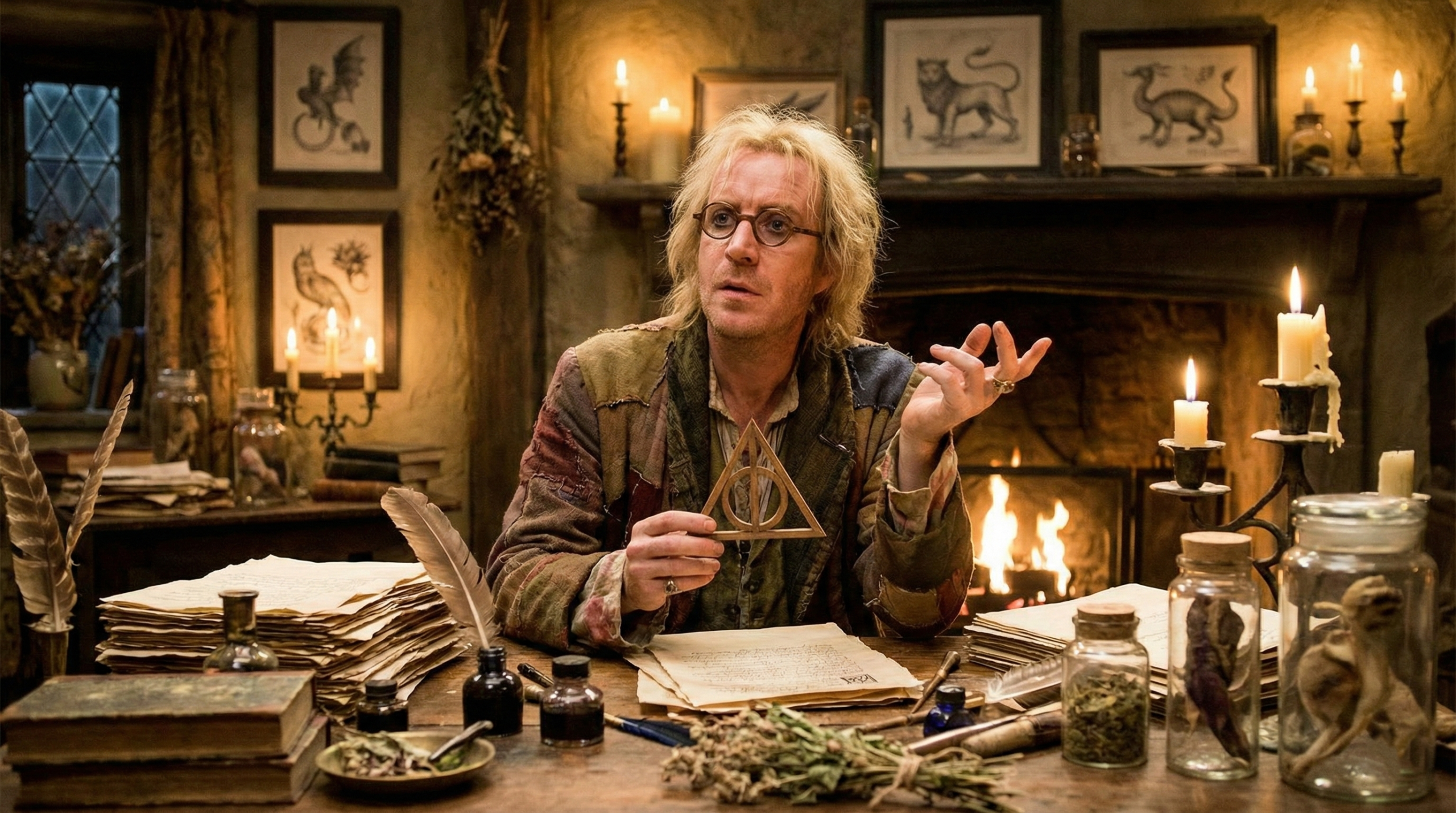
The heart of Xenophilius’ screen time is the storytelling scene. He draws the Hallows symbol—a triangle enclosing a circle and line—and recounts the fable of the three brothers who outwit Death. This moment not only advances the plot but also mirrors the series’ exploration of power, mortality, and humility. Ifans’ wide-eyed intensity and rhythmic narration make the legend feel mythic and urgent.
Rhys Ifans: The Actor Behind the Spectacles
Rhys Ifans, born in Wales in 1967, brings a chameleon-like versatility to every role. Before Harry Potter, he gained fame with breakout performances in Twin Town (1997), playing chaotic twins, and as the eccentric roommate Spike in Notting Hill (1999), where his disheveled charm stole scenes opposite Hugh Grant and Julia Roberts.
His career spans indie dramas like Enduring Love (2004) and ensemble comedies like The Boat That Rocked (2009). Ifans excels at portraying outsiders—characters who are odd, intense, or misunderstood—making him a natural fit for Xenophilius.
 How Rhys Ifans Landed the Role
Casting for Deathly Hallows focused on actors who could bring authenticity to quirky supporting parts. Ifans revealed his involvement in March 2009 on the BBC’s Friday Night with Jonathan Ross, confirming he would play Luna’s father. David Yates and the producers sought someone who could balance whimsy with underlying depth, and Ifans’ track record with eccentric yet human characters made him ideal.
In a 2009 BBC Radio Wales interview (translated from Welsh), Ifans described the massive scale of the production as unlike anything he’d experienced, calling it “a machine” and an “honour” to work alongside legends like Maggie Smith and Michael Gambon. He admitted he wasn’t a huge Harry Potter fan but felt privileged to join what he saw as a piece of British film history.
Rhys Ifans’ Own Words – Insights from Interviews
Ifans approached the role with humility. In press rounds for Harry Potter and the Deathly Hallows – Part 1, he described Xenophilius as “a good wizard—a really great guy” and highlighted director David Yates’ careful, forensic style. In one interview clip, he noted how Yates infused humanity into every character, allowing audiences to connect even with the oddest figures.
He also mentioned the joy of the set: “When he’s pleased, he says ‘fabby.’ When he’s happy, he jumps up and down.” These small quirks, drawn from the script and his improvisation, added charm. Ifans viewed the franchise as an “institution” with real gravitas, despite not being a die-hard fan himself.
Bringing Xenophilius to Life: Performance Analysis
What truly elevates Rhys Ifans’ portrayal of Xenophilius Lovegood from memorable to iconic is the meticulous way he transforms a relatively brief screen time into something indelible. In just one major sequence, Ifans manages to convey eccentricity, warmth, desperation, and quiet tragedy—qualities that many supporting characters in the Harry Potter series never fully achieve.
Physical Transformation and Quirky Mannerisms
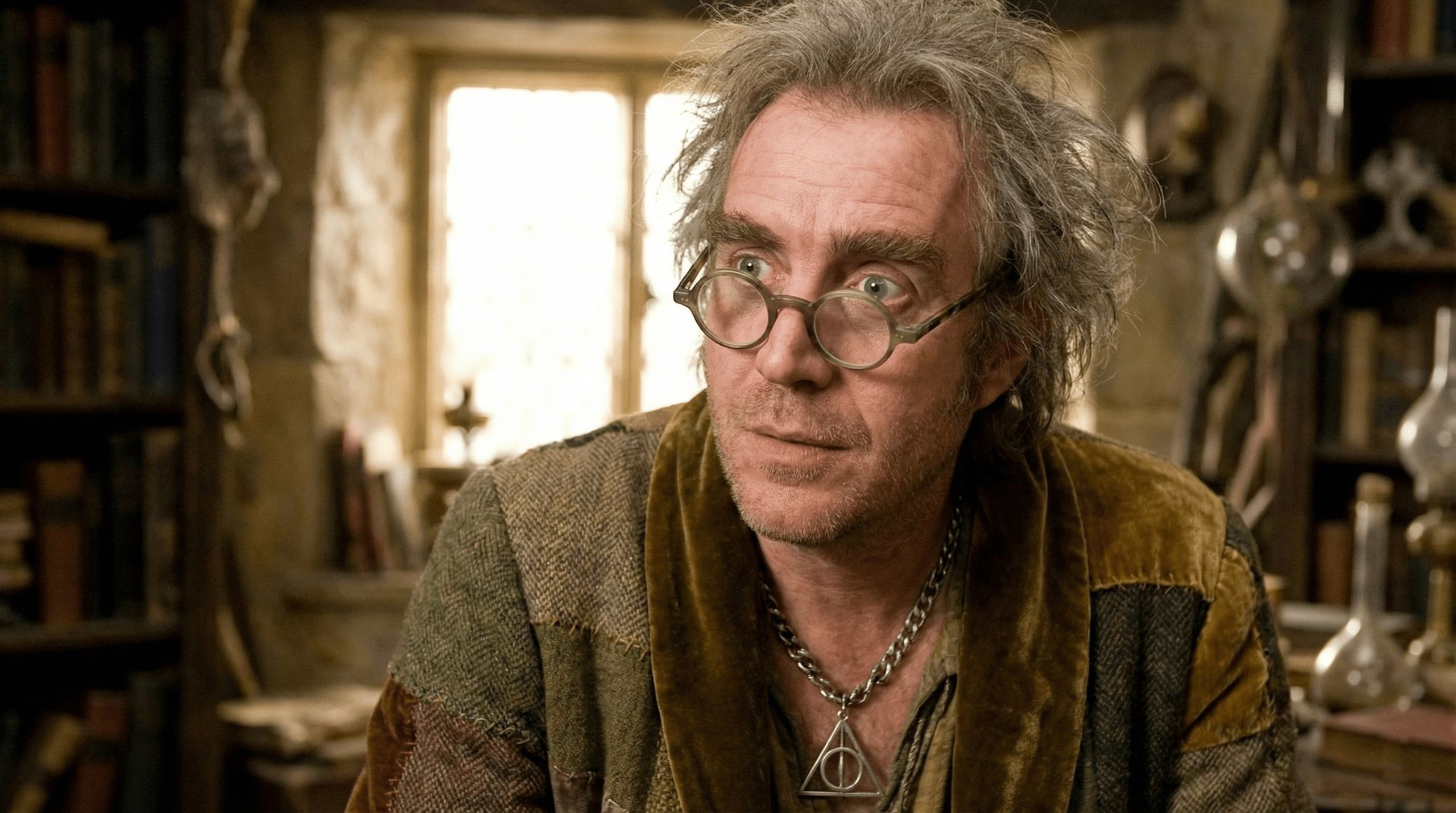
Ifans underwent a striking physical change for the role. His naturally thick, dark hair was teased into a wild, unkempt mane that seemed to defy gravity. He wore thick, crooked spectacles that sat at an odd angle on his nose, amplifying the sense that Xenophilius sees the world differently—literally and figuratively. His costume, a mismatched ensemble of robes, odd jewelry, and a necklace made of what appeared to be radishes and Dirigible plums, completed the look.
But it was the mannerisms that sealed the performance. Ifans gave Xenophilius a soft, lilting voice with elongated vowels and a dreamy cadence. He moved with gentle, almost floating gestures—tilting his head curiously, widening his eyes in childlike wonder, or bouncing slightly on his toes when excited. These small choices made the character feel lived-in rather than caricatured. When Xenophilius says “fabby” (his signature expression of delight), Ifans delivers it with genuine glee, turning what could have been a gimmick into an endearing personality trait.
Memorable Scenes and Dialogue Breakdown
The Lovegood home sequence is packed with standout moments:
- Arrival and Gnome Introduction Xenophilius greets the trio at the door with an enthusiastic “Hello!” before immediately launching into an explanation of gnome saliva’s supposed health benefits. Ifans plays this straight—no winking at the camera—making the absurdity feel completely sincere. The gnome he flings out the window (a classic book moment faithfully adapted) lands with a satisfying thud, and Ifans barely registers it, already moving on to the next oddity.
- The Deathly Hallows Legend This is the emotional and narrative centerpiece. Ifans sits the trio down and begins the tale with quiet reverence. He uses hand-drawn illustrations and a small wooden model to demonstrate the symbol and the three objects. His voice drops to an almost hypnotic rhythm as he describes the brothers’ encounters with Death. The performance is understated yet captivating—Ifans lets the wonder of the story shine through without overacting.
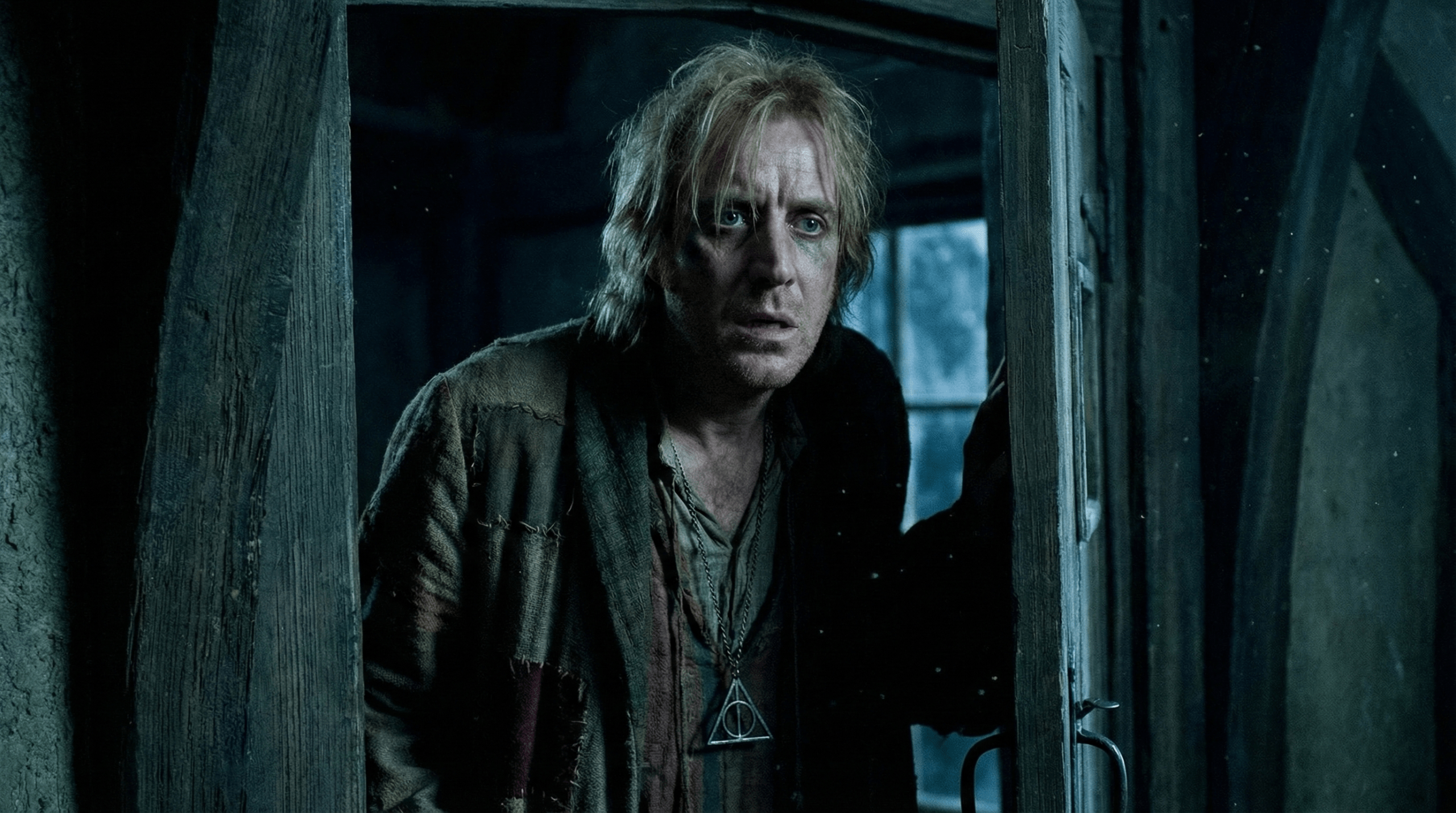
- The Betrayal Reveal When the Death Eaters arrive and Xenophilius’ true predicament is exposed, Ifans shifts gears masterfully. His wide-eyed enthusiasm collapses into panic and shame. The trembling hands, the averted gaze, the broken “I had to…”—these beats show a man torn between love for his daughter and loyalty to Harry. It’s a heartbreaking turn that humanizes what could have been a simple villainous twist.
 Chemistry with Co-Stars
Ifans shares particularly strong chemistry with Evanna Lynch. Their brief interactions feel genuinely familial—gentle smiles, shared quirks, unspoken understanding. With the Golden Trio, he strikes the right balance: welcoming yet slightly unsettling, enthusiastic yet detached from reality. Daniel Radcliffe later praised Ifans in interviews for bringing “complete commitment” to every line, no matter how bizarre.
Fans frequently note on forums and rewatch threads that Ifans makes Xenophilius feel like someone Luna would plausibly call “Dad.” That authenticity is rare in large ensemble casts.
What Fans and Critics Said – Reception Over Time
Upon release in 2010, reviews of Deathly Hallows – Part 1 were mixed on pacing, but Ifans’ cameo was almost universally praised as a highlight. Critics described him as “delightfully dotty” (The Guardian) and “perfectly peculiar” (Empire). Over the years, appreciation has grown. On Reddit’s r/harrypotter and TikTok rewatches, fans often post variations of “I always forget it’s Rhys Ifans until I see his name in the credits—then it clicks.”
His performance has become a textbook example of how strong acting can elevate limited screen time, frequently cited alongside other standout supporting turns like Bill Nighy’s Rufus Scrimgeour or Miranda Richardson’s Rita Skeeter.
Behind the Scenes: Filming Xenophilius’ World
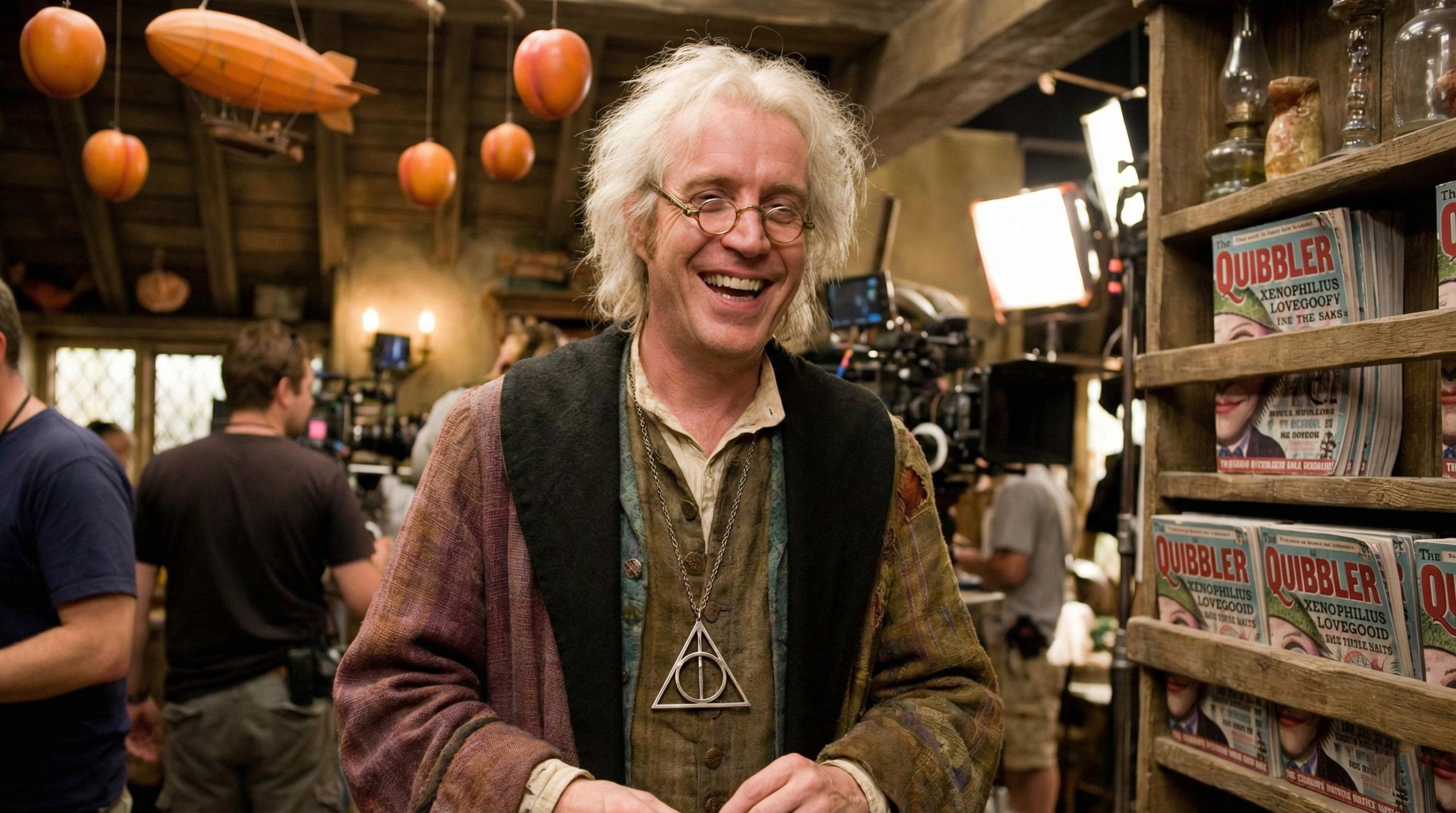
The Lovegood home set was one of the most creatively ambitious in the entire franchise. Built at Leavesden Studios, the crooked tower house featured slanted floors, hanging Dirigible plums, stacks of The Quibbler, taxidermy oddities, and walls covered in Luna’s drawings. Production designer Stuart Craig intentionally made the space feel both cozy and disorienting—mirroring Xenophilius’ worldview.
Costume designer Jany Temime added layers of eccentricity: mismatched patterns, hand-stitched patches, and accessories that looked like they were collected over decades. Ifans reportedly contributed ideas for small details, such as the way Xenophilius fiddled with his spectacles when nervous.
David Yates encouraged a collaborative rehearsal process. Ifans has spoken about how the director gave actors freedom to explore quirks while keeping the tone grounded in emotional truth. Filming the gnome scene required multiple takes due to the practical effects—realistic animatronic gnomes were used, and one reportedly malfunctioned hilariously during a take.
The Welsh accent subtly influenced Ifans’ delivery. While not overtly strong, certain inflections and rhythms gave Xenophilius a distinctive musicality that felt authentic rather than forced.
 Rhys Ifans’ Legacy in the Harry Potter Universe
Rhys Ifans’ brief but brilliant appearance as Xenophilius Lovegood has aged remarkably well within the Harry Potter canon. In a franchise filled with larger-than-life heroes, villains, and mentors, supporting characters who only appear in one film often fade into the background. Yet Xenophilius remains vividly remembered—and frequently re-discovered—by fans during rewatches.
Why His Performance Stands Out Among Supporting Roles
Compare Ifans’ turn to other single-film additions: Bill Nighy’s Rufus Scrimgeour brought gravitas and quiet authority in just a few scenes; Miranda Richardson’s Rita Skeeter delivered delicious malice in minutes of screen time. What sets Ifans apart is the sheer range he packs into limited moments—joyful eccentricity, gentle paternal love, panicked desperation, and ashamed remorse. Few actors could pivot so convincingly from “fabby” exuberance to heartbreaking betrayal without losing the thread of likability.
His work exemplifies David Yates’ directorial philosophy for the later films: even the strangest characters deserve emotional truth. Xenophilius isn’t played for laughs alone; he’s played as a real person whose beliefs and choices have consequences. That commitment elevates the role from quirky cameo to quietly powerful contribution.
Impact on Fans and the Franchise’s Enduring Appeal
Xenophilius reinforces one of the series’ core messages: belief matters. Whether it’s Luna’s unwavering faith in her father’s odd theories or Harry’s growing acceptance of the Deathly Hallows legend, the Lovegoods show that unconventional perspectives can hold truth—or at least offer comfort in dark times.
For many fans, the Lovegood home sequence provides a much-needed moment of warmth and wonder amid the escalating tension of Deathly Hallows – Part 1. It’s a brief oasis before the horrors of Malfoy Manor and the final battle. Ifans’ performance helps make that respite feel earned and memorable.
Online communities continue to celebrate the character. Threads titled “Underrated Harry Potter performances” or “Best one-scene wonders” almost always mention Rhys Ifans. Fan edits on TikTok and YouTube frequently pair his Hallows storytelling monologue with ethereal music, turning it into a mini-favorite among younger viewers discovering the series.
Connections to His Later Roles – Versatility Spotlight
Ifans’ range becomes even more apparent when viewed against his post-Potter career. In 2012 he played the chilling Dr. Curt Connors / The Lizard in The Amazing Spider-Man, a role that required physical transformation, quiet menace, and tragic undertones—qualities that echo Xenophilius’ own duality of warmth and desperation.
More recently, he portrayed the commanding, tradition-bound Otto Hightower in House of the Dragon (2022–), a stark contrast to the whimsical wizard. Critics praised his ability to convey authority and moral complexity with restraint, proving that the same actor who bounced around in radish earrings could dominate a throne room with gravitas.
This versatility underscores why casting directors trust him with eccentric yet human characters. Xenophilius wasn’t a fluke—it was a showcase of an actor who can make the strange feel deeply relatable.
Visual Gallery: Rhys Ifans as Xenophilius Lovegood
(Description for blog placement – embed the following high-quality, ethically sourced stills where possible:)
- Promotional portrait of Rhys Ifans in full Xenophilius costume, spectacles askew, wild hair, and gentle smile.
- Wide shot of the Lovegood home interior: crooked staircase, hanging Dirigible plums, stacks of The Quibbler.
- Close-up during the Deathly Hallows storytelling scene—Ifans holding the wooden symbol model, eyes wide with wonder.
- Behind-the-scenes shot of Ifans laughing on set with Evanna Lynch.
- The tense reveal moment: Xenophilius looking panicked as Death Eaters approach.
- Side-by-side comparison of book illustration of Xenophilius vs. film still.
These images help readers instantly reconnect with the character and appreciate the visual creativity behind the performance.
FAQs About Rhys Ifans in Harry Potter
Did Rhys Ifans appear in any other Harry Potter films? No, his only appearance is in Harry Potter and the Deathly Hallows – Part 1 (2010). He does not return in Part 2.
How does his portrayal differ from the books? The film condenses Xenophilius’ backstory and moral complexity. The novel spends more time exploring his grief over his wife’s death, his conspiracy-laden worldview, and the full extent of his desperation. The movie relies on Ifans’ performance and subtle visual cues to convey those layers in far less time.
What other notable roles has Rhys Ifans played? Beyond Xenophilius, he is known for Spike in Notting Hill (1999), The Lizard in The Amazing Spider-Man (2012), Edward de Vere in Anonymous (2011), and Otto Hightower in House of the Dragon (2022–). His filmography spans indie dramas, blockbusters, and television.
Why is Xenophilius Lovegood important to the plot? He introduces the legend of the Deathly Hallows to Harry, Ron, and Hermione, giving them crucial information about the Elder Wand, Resurrection Stone, and Invisibility Cloak. Without his explanation, Harry would have taken far longer to understand Voldemort’s pursuit of the wand.
Fun fact: Any real-life connections between Ifans and the cast? Ifans and David Thewlis (Remus Lupin) both hail from Welsh acting circles and had previously crossed paths in the British film industry. Ifans has spoken warmly about the professionalism and camaraderie on the Harry Potter set.
Rhys Ifans in Harry Potter gave us Xenophilius Lovegood—a character who, in just one extended sequence, managed to be hilarious, heartwarming, heartbreaking, and haunting all at once. His eccentric charm isn’t just a quirky footnote; it’s a testament to how even the smallest roles can leave a lasting imprint when entrusted to a gifted actor.
Next time you rewatch Harry Potter and the Deathly Hallows – Part 1, pay special attention to the crooked tower house on the hill. Listen to the dreamy cadence, watch the wide-eyed wonder, and notice the flicker of fear behind the spectacles. You’ll likely find yourself smiling—and perhaps tearing up—just as millions of fans have done over the years.
Thank you for joining this deep dive into one of the wizarding world’s most delightfully peculiar figures. If you enjoyed this exploration of Rhys Ifans in Harry Potter, check out our other character spotlights—Evanna Lynch as Luna Lovegood, the symbolism of the Deathly Hallows, or the unsung heroes of the later films. Drop your favorite Xenophilius moment in the comments below, and subscribe for more magical deep dives.