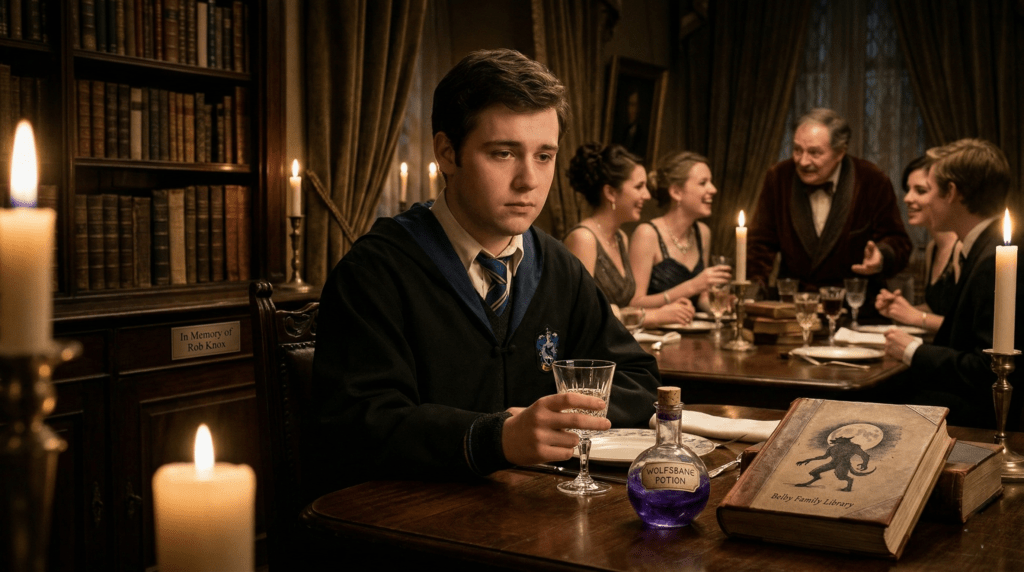
Imagine stepping into one of Professor Horace Slughorn’s opulent Slug Club gatherings aboard the Hogwarts Express or in the candlelit warmth of the dungeons—crystal goblets clinking, exotic foods piled high, and the air buzzing with the promise of influential connections. Amid the promising young witches and wizards sits a thin, nervous-looking Ravenclaw student, eagerly trying to contribute to the conversation, only to be overshadowed, ignored, and eventually sidelined. That student is Marcus Belby, a minor character in Harry Potter and the Half-Blood Prince whose brief appearance reveals much more about the wizarding world‘s social dynamics than first meets the eye.
In a franchise overflowing with legendary heroes like Harry Potter, brilliant minds like Hermione Granger, and complex anti-heroes like Severus Snape, why does this seemingly forgettable Ravenclaw student stick in the minds of so many fans? Often, it’s less about his limited page time or screen minutes and more about the poignant real-life tragedy tied to the actor who portrayed him. This comprehensive guide dives deep into Marcus Belby’s background, his role in the story, key differences between the book and film adaptations, his connections to broader Harry Potter lore like werewolf rights and potion innovation, and the heartbreaking legacy left by Rob Knox. Whether you’re revisiting Half-Blood Prince, exploring overlooked Hogwarts students, or curious about the Slug Club’s inner workings, this article uncovers the layers that make Marcus Belby worth remembering.
Who Is Marcus Belby? Basic Profile and Background
Marcus Belby (born circa 1978–1979) was a wizard and a student at Hogwarts School of Witchcraft and Wizardry from 1990 to 1997. As a member of Ravenclaw house—one year above Harry Potter—he belonged to the cohort that included students like Cho Chang (in his own year) and those who would graduate just before the height of the Second Wizarding War.
Ravenclaw’s emphasis on wit, learning, and wisdom fits Marcus in subtle ways: he’s portrayed as intelligent enough to be noticed for his family connections, yet lacking the standout academic flair or confidence that might have made him memorable. His physical description in the books reinforces this—thin and nervous-looking, suggesting a student more comfortable in the background than the spotlight.
Family Ties – The Belby Legacy
What truly sets Marcus apart is his uncle, Damocles Belby, a renowned potioneer who invented the Wolfsbane Potion in the late 20th century. This groundbreaking achievement earned Damocles an Order of Merlin, second class, recognizing the potion’s revolutionary impact. Wolfsbane Potion allows werewolves to retain their human minds during full-moon transformations, preventing the mindless violence that once defined lycanthropy. It represents a significant step toward werewolf rights and integration in wizarding society—a theme echoed in Remus Lupin’s struggles and advocacy efforts.
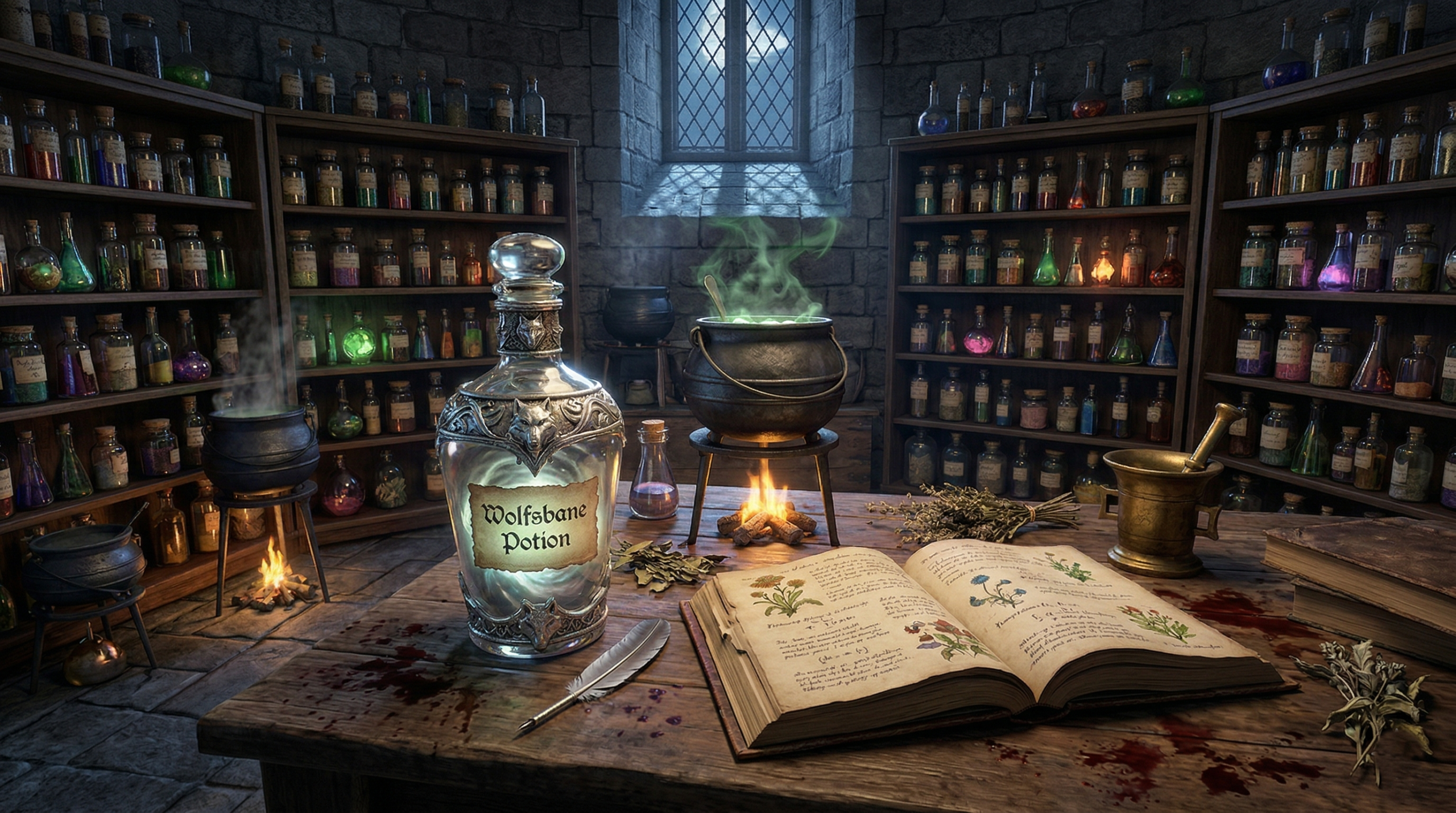 However, family dynamics complicate this legacy. Marcus’s father (Damocles’s brother) was not on good terms with the celebrated inventor, leading to estrangement. Marcus had little to no direct contact with his uncle, meaning he inherited none of the personal anecdotes, influence, or networking benefits that Slughorn craved. This detail underscores a recurring motif in J.K. Rowling’s world: family ties can be sources of privilege or pain, and superficial connections often fall short.
Physical Description and Personality Clues
In J.K. Rowling’s prose, Marcus appears eager yet awkward—choking on his food while attempting to answer a question about potions, highlighting his nervousness under pressure. These traits paint him as an ordinary student thrust into an elite circle, lacking the polish or charisma to thrive there. His personality feels understated, almost relatable for readers who remember feeling out of place in social settings.
 Marcus Belby’s Role in Harry Potter and the Half-Blood Prince
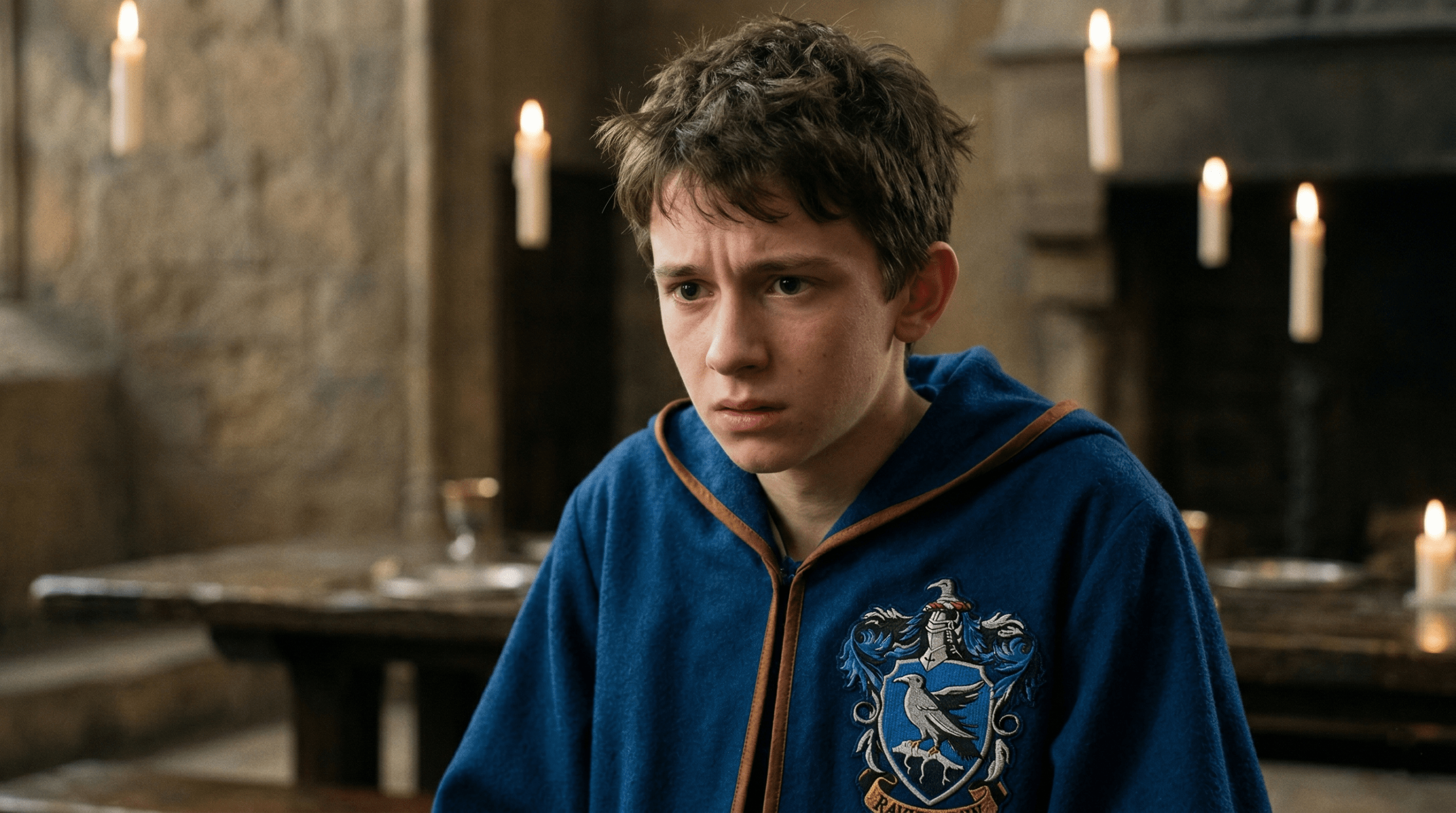
Marcus Belby’s entire canonical presence unfolds in Harry Potter and the Half-Blood Prince (2005), primarily during scenes introducing the Slug Club.
The Slug Club Invitation – Slughorn’s Networking in Action
Horace Slughorn, the new Potions Master and former head of Slytherin, revives his famous “Slug Club”—a selective group of students he believes will achieve fame, power, or useful connections. Slughorn “collects” people like rare potion ingredients, prioritizing potential over current merit.
Marcus receives an invitation solely because of his uncle’s fame. Slughorn hopes to leverage the relationship for access to Damocles Belby. This invitation exemplifies Slughorn’s opportunistic nature: he values proximity to influence more than individual talent. When Marcus proves unable to provide that bridge—due to the family rift—Slughorn quickly loses interest.
Key Moments and Interactions
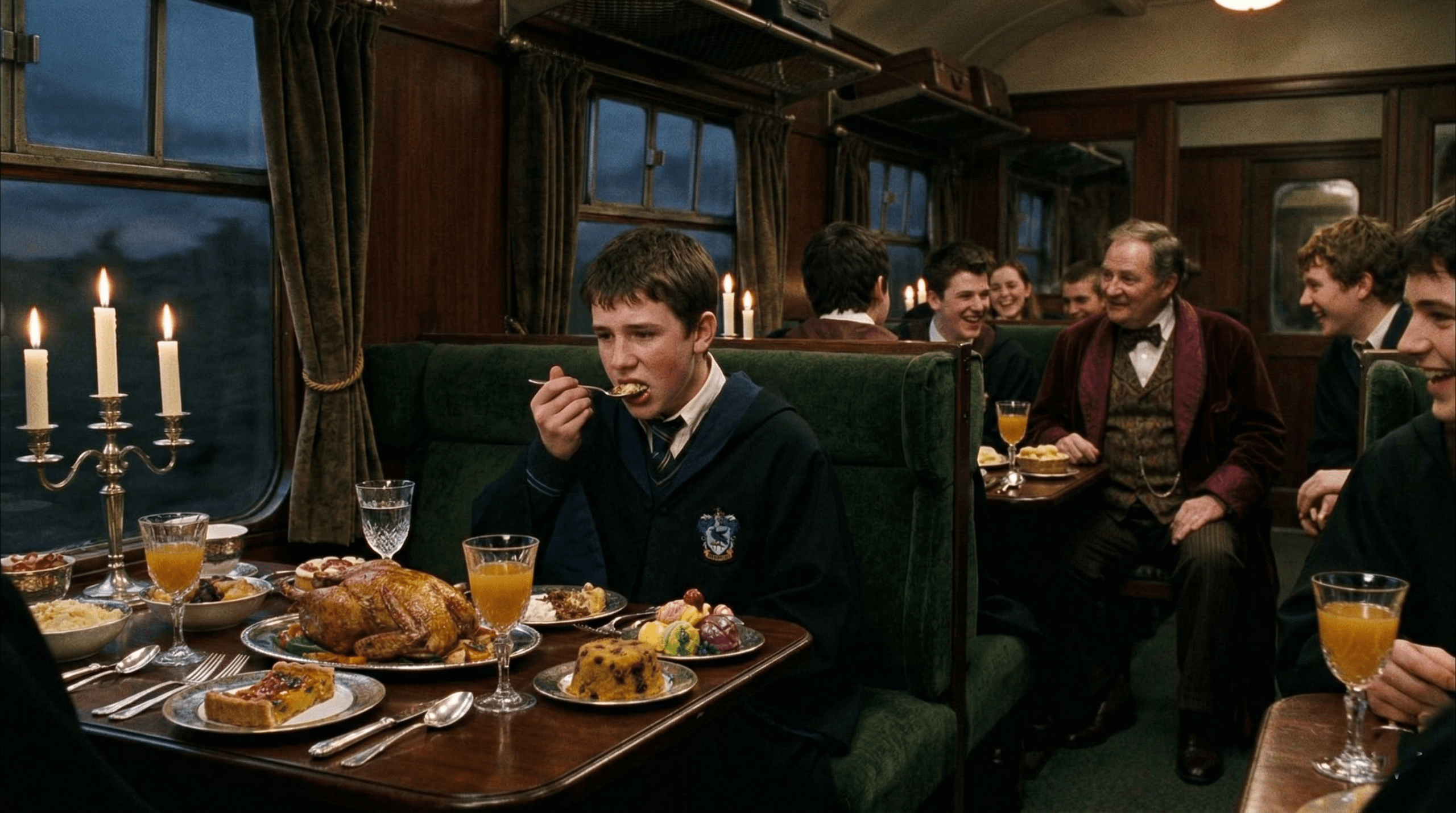
The most prominent scene occurs during the Slug Club supper on the Hogwarts Express. Slughorn quizzes members about their connections, and Marcus attempts to respond about his uncle’s potion work but chokes dramatically on pheasant. Slughorn casually casts Anapneo to clear his airway, a small but telling moment of indifference.
Later, at Slughorn’s Christmas party, Marcus appears in a minor capacity, handing out towels in the bathroom—an unglamorous task that emphasizes his diminished status. These interactions serve as comic relief amid the book’s darkening tone, but they also highlight themes of social climbing and exclusion.
 Why Slughorn Lost Interest – A Lesson in Social Capital
Slughorn’s swift dismissal of Marcus illustrates the superficiality of wizarding high society. Without a direct line to Damocles, Marcus offers no tangible benefit. This mirrors real-world networking dynamics and critiques how privilege is often unearned or fleeting. In a book exploring ambition, loyalty, and moral choices, Marcus Belby quietly embodies the overlooked consequences of family fractures and social hierarchies.
Book vs. Film: How Marcus Belby Was Adapted
The transition from page to screen often requires adjustments for pacing, tone, and visual storytelling. Marcus Belby’s portrayal in Harry Potter and the Half-Blood Prince (film, 2009) offers a clear example of how filmmakers amplified certain traits for comedic effect while preserving the essence of his minor role.
Character Portrayal Differences
In J.K. Rowling’s novel, Marcus is described as thin and nervous, with his most memorable moment being the awkward choking incident during the Slug Club supper. His attempts to impress Slughorn are earnest but clumsy, and he quickly fades into the background once it becomes clear he cannot provide a meaningful connection to his famous uncle.
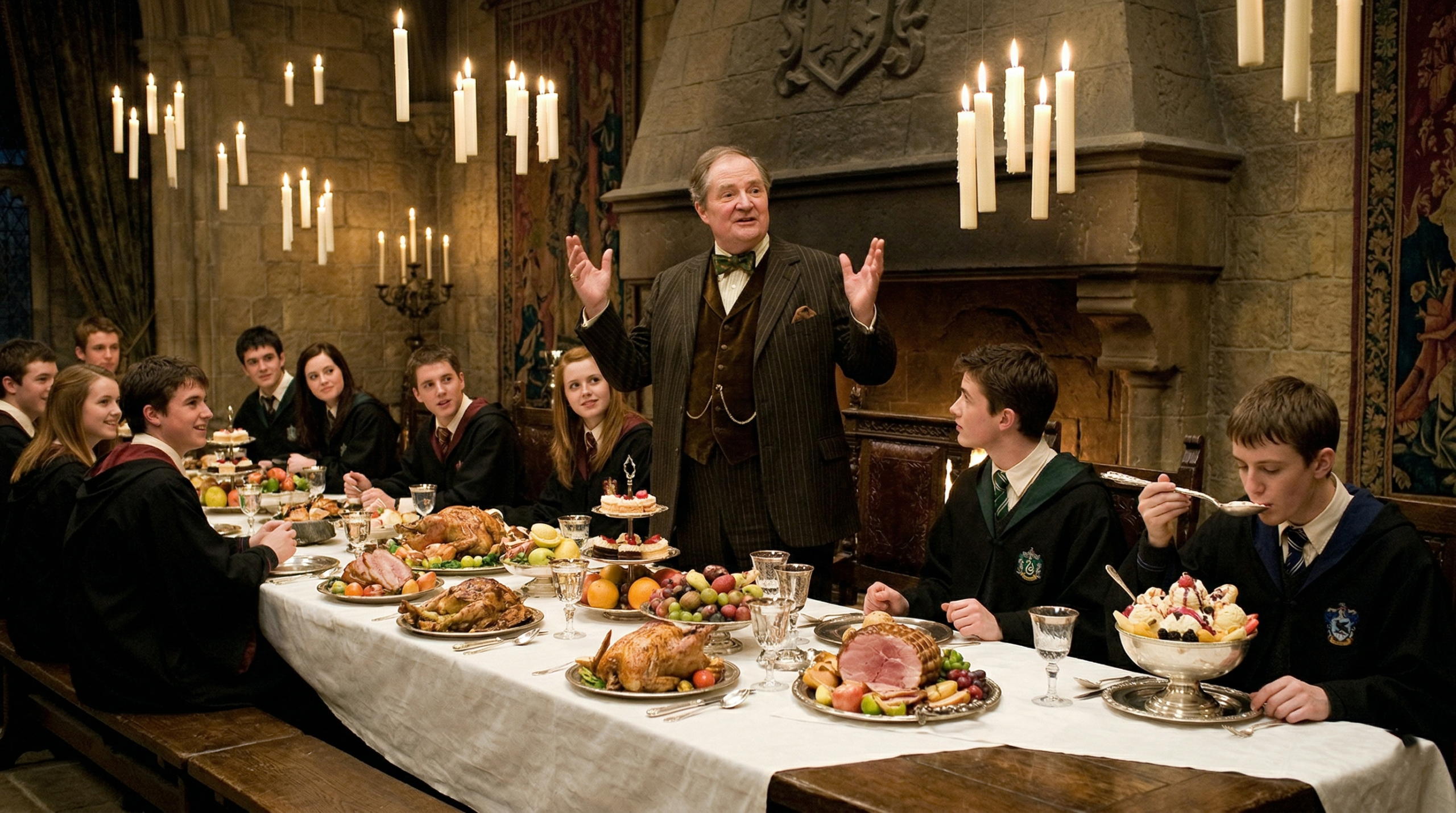
The film adaptation, directed by David Yates, leans into physical comedy to make the character more immediately memorable in a crowded ensemble cast. Actor Rob Knox plays Marcus with exaggerated enthusiasm for food—particularly devouring ice cream with his mouth full during the Slug Club dinner scene. This choice turns a subtle moment of social awkwardness into a broader humorous beat. Slughorn’s dry remark, “if Belby’s left you any!” lands as a gentle jab, emphasizing Marcus’s gluttonous behavior over his nervousness.
While some fans criticize the change as making Marcus more of a caricature, it serves the film’s need for quicker character establishment. The book allows for slower character beats; the movie must convey personality in seconds.
 Actor Rob Knox’s Performance
Rob Knox brought a natural, affable energy to the role. Born in 1989 in Lewisham, London, Knox had limited prior acting experience—mostly background roles and theater—but his chemistry with Jim Broadbent (Horace Slughorn) made the brief scenes work. Broadbent later recalled in interviews how Knox committed fully to the comedic eating sequences, consuming large amounts of prop food take after take to achieve the desired messy, enthusiastic effect.
Knox’s performance adds warmth to an otherwise forgettable character. Even in his limited screen time, he conveys a likable, slightly hapless teenager trying (and failing) to fit into an elite circle. This makes his real-life fate all the more tragic.
What Was Cut or Changed
Several details from the book did not make the final cut:
- The bathroom towel-handing scene at Slughorn’s Christmas party, which further humiliated Marcus and underscored his reduced status.
- Any extended dialogue about his uncle or family estrangement.
- Marcus receives no mention in later films, even though the Slug Club concept is briefly revisited.
These omissions keep the film streamlined but reduce the layered social commentary present in the novel.
The Tragic Real-Life Story of Rob Knox
No discussion of Marcus Belby in popular culture is complete without addressing the heartbreaking events surrounding the young actor who brought him to life.
Who Was Rob Knox?
Rob Knox was a promising British talent whose career was just beginning to take off. After small parts (including an uncredited extra role in King Arthur in 2004), landing the part of Marcus Belby in Harry Potter and the Half-Blood Prince marked his most significant credit. He was excited about the opportunity and reportedly signed on for potential appearances in Harry Potter and the Deathly Hallows (though his character had no canonical role in the final books).
Friends and colleagues described him as kind, funny, and deeply loyal—qualities that shone through even in his brief on-screen moments.
The Events of May 2008
On the night of May 24, 2008, just weeks after principal photography on Half-Blood Prince wrapped, 18-year-old Rob Knox was fatally stabbed outside the Lamb pub in Sidcup, southeast London. He had intervened to protect his younger brother, Jamie, from an altercation involving known troublemaker Karl Bishop.
Bishop, who had previously been barred from the pub, attacked multiple people with a knife. Rob was stabbed five times while trying to defend his brother and others. He was pronounced dead at the scene despite emergency efforts.
Karl Bishop was later convicted of murder and sentenced to life imprisonment with a minimum term of 20 years.
Legacy and Impact
The Half-Blood Prince film was released posthumously on July 15, 2009, and includes a touching dedication in the end credits: “In memory of Rob Knox.”
The Harry Potter cast and crew paid tribute in various ways. Daniel Radcliffe called Knox “a lovely guy,” while producer David Heyman emphasized the senseless loss of a young life full of potential. Knox’s death also contributed to broader public conversations in the UK about knife crime, youth violence, and community safety—issues that remain tragically relevant.
For many fans, revisiting the Slug Club scenes now carries an extra layer of poignancy. The nervous, pudding-loving Ravenclaw becomes a reminder of unrealized promise and the fragility of life.
 Why Marcus Belby Stands Out Among Minor Characters
Despite his limited role, Marcus Belby offers surprising depth when examined closely.
Connections to Larger Lore
His uncle’s invention of Wolfsbane Potion ties directly into one of the series’ most important social issues: the treatment and rights of werewolves. Remus Lupin’s arc—his secrecy, stigma, and eventual advocacy—gains context when we remember that a potion exists that could have eased his suffering far earlier. Damocles Belby’s Order of Merlin underscores how innovation can drive progress, even if personal family connections remain broken.
Marcus himself becomes a subtle critique of how wizarding society values proximity to achievement rather than individual merit.
Overlooked Themes
- Family estrangement — The rift between Marcus’s father and Damocles mirrors other fractured families (the Blacks, the Malfoys) and shows that blood ties do not guarantee closeness or benefit.
- Social capital and elitism — Slughorn’s quick dismissal illustrates how superficial networking can exclude even those with impressive lineage.
- Comic relief in darkness — In a book shadowed by Voldemort’s return, war preparations, and teenage heartbreak, Marcus’s awkward moments provide much-needed levity.
Fan Theories and Headcanons
Fans have speculated about Marcus’s post-Hogwarts life:
- Did he fight in the Battle of Hogwarts as part of Ravenclaw’s contingent?
- Might he have pursued potion-making, inspired (however distantly) by his uncle?
- Could the estrangement have healed during the war, or did it persist?
While canon offers no answers, these questions keep the character alive in fanfiction and discussion forums.
Marcus Belby Trivia and Fun Facts
Here are some lesser-known details and interesting tidbits that help round out the picture of this overlooked character:
- Estimated birth year: Based on his Hogwarts years (1990–1997) and being one year above Harry (born 1980), Marcus Belby was likely born between September 1978 and August 1979.
- Only named Ravenclaw boy in the Slug Club: While the club features several Ravenclaw girls (e.g., Melinda Bobbin, whose family owns a famous chain of apothecaries), Marcus is the sole named male Ravenclaw member shown.
- Wolfsbane connection in wider canon: Damocles Belby is mentioned in Fantastic Beasts and Where to Find Them (textbook edition) and appears on a Chocolate Frog Card in some supplemental materials, cementing the family’s place in potion history—even if Marcus himself remains peripheral.
- Film improvisation elements? While not officially confirmed, Jim Broadbent has hinted in interviews that some of the exaggerated eating behavior in the dinner scene came from Rob Knox playing up the awkwardness for laughs, with director David Yates encouraging the physical comedy.
- No post-HBP canonical mentions: Unlike other Slug Club members (e.g., Blaise Zabini, Ginny Weasley, Cormac McLaggen), Marcus never appears or is referenced again in the books or later films.
- Potential for future adaptations: In stage productions of Harry Potter and the Cursed Child or any future television series, a small cameo or expanded backstory for Marcus could easily be added without contradicting canon.
- Name etymology: “Belby” is an uncommon English surname possibly derived from Old Norse or Anglo-Saxon roots meaning “farmstead on the bell-shaped hill.” “Marcus” is a classic Roman name meaning “warlike” or “dedicated to Mars”—an ironic contrast to the timid, non-combative character we see.
These small facts keep Marcus Belby alive in fan communities long after his single-book appearance.
FAQs About Marcus Belby
Is Marcus Belby in the books? Yes, he appears briefly in Harry Potter and the Half-Blood Prince, mainly during Slug Club scenes.
What house was Marcus Belby in? Ravenclaw. He is sorted into the house known for intelligence, wit, and creativity.
Why was Marcus invited to the Slug Club? Professor Slughorn invited him solely because of his uncle Damocles Belby’s invention of the Wolfsbane Potion and the resulting Order of Merlin. Slughorn hoped to gain access to the famous potioneer through Marcus, but the family estrangement meant Marcus had no useful connection.
What happened to the actor who played Marcus Belby? Rob Knox, who portrayed Marcus in the film adaptation, was tragically murdered in May 2008 at age 18 while defending his younger brother during an altercation in southeast London. The film was released posthumously the following year and includes a dedication to him in the credits.
Does Marcus appear in later Harry Potter books or films? No. He is not mentioned or shown in Harry Potter and the Deathly Hallows (book or films), nor in any other canonical Harry Potter media released to date.
Is there any chance Marcus fought in the Battle of Hogwarts? Canon does not specify. As a seventh-year Ravenclaw in the 1997–1998 school year, he would have been of age and could theoretically have returned to defend the school (like many older students did). However, J.K. Rowling never confirmed his participation.
Why do so many fans remember Marcus Belby despite his small role? His brief but memorable awkward moments provide comic relief, his family tie to an important magical invention adds lore depth, and—most significantly—the real-life loss of actor Rob Knox gives his appearance an emotional weight that resonates with readers and viewers.
Marcus Belby may never rank among the most iconic or powerful characters in the Harry Potter universe. He lacks Harry’s courage, Hermione’s brilliance, Draco’s complexity, or even Neville’s quiet growth into heroism. Yet that very ordinariness is what makes him quietly compelling.
In a story that celebrates chosen families, hard-won loyalty, and the fight against prejudice, Marcus quietly illustrates the other side: the people who fall through the cracks of social ambition, who carry impressive names without reaping the benefits, who try to belong in elite circles and are politely (or not-so-politely) set aside.
His uncle’s Wolfsbane Potion helped change the lives of werewolves like Remus Lupin, yet Marcus himself received none of that reflected glory. Slughorn’s fleeting interest—and rapid disinterest—mirrors how superficially the wizarding world often measures worth.
And then there is Rob Knox. A young man whose brief time on screen brought warmth and humor to a small part, only to have his life cut short in a senseless act of violence. Every time fans revisit the Slug Club scenes in Harry Potter and the Half-Blood Prince, they see not just a nervous Ravenclaw stuffing his face with pudding, but a real person whose potential was stolen far too soon.
So the next time you re-read or re-watch the sixth book/film, pause on those brief moments. Look a little closer at the thin boy in blue and bronze who barely gets a word in. Marcus Belby may be the Slug Club member you barely remember—but once you do remember him, he’s surprisingly hard to forget.
Have a favorite overlooked minor character in the Harry Potter series? Drop their name in the comments below—I’d love to hear which forgotten students, shopkeepers, or background figures deserve their own deep dive next.