The corridors of Hogwarts have always hidden shadows. But beyond the moving staircases and enchanted ceilings lies a far darker truth about the Wizarding World — one that J.K. Rowling wove with extraordinary care and psychological depth. The evil wizards in Harry Potter are not simply monsters in robes. They are ideologues, fanatics, bureaucrats, and broken souls, each embodying a distinct and chilling brand of darkness that has captivated readers and viewers for over two decades.
From the moment Harry Potter first heard the name Voldemort spoken in hushed, terrified tones, fans understood that this world’s villains were something special. They were not cartoonish. They were not easily defeated. And more unsettlingly, many of them were deeply, uncomfortably human.
This article is the definitive guide to the dark wizards of the Harry Potter universe — ranked by three precise criteria: Power (raw magical ability and combat dominance), Cruelty (willingness to harm, torture, and destroy), and Legacy (long-term impact on the Wizarding World). Whether you are a longtime fan revisiting the series or a newcomer trying to understand who truly stands at the apex of magical evil, this ranking cuts through the noise and delivers a comprehensive, canon-accurate verdict.
Let the darkness begin.
What Makes a Wizard “Evil” in the Wizarding World?
Before the ranking begins, it is worth establishing what separates a morally complex character from a genuinely evil one in Rowling’s universe — because the line is not always as clear as it seems.
The Dark Arts as a Defining Line
The Wizarding World draws its clearest moral boundary through the Unforgivable Curses — the Killing Curse (Avada Kedavra), the Cruciatus Curse (Crucio), and the Imperius Curse (Imperio). These three spells are not simply powerful; they require a specific psychological commitment. To cast the Cruciatus Curse with full effect, for example, a witch or wizard must want to cause pain. The magic itself demands cruelty as a prerequisite. This is Rowling’s most elegant piece of world-building: the Dark Arts do not corrupt the innocent — they reveal those already capable of darkness.
Ambition alone does not make a dark wizard. Severus Snape was ambitious, morally compromised, and capable of great cruelty — yet the series ultimately frames him as something far more nuanced. The wizards on this list crossed a definitive threshold: they chose harm, deliberately and repeatedly, for purposes of power, ideology, or pure pleasure.
 The Three Ranking Criteria Explained
Each dark wizard in this ranking is evaluated across three pillars:
Power refers to raw magical capability — duelling skill, mastery of advanced and dark magic, and the ability to project fear and dominance across the Wizarding World. A wizard who could bring the Ministry of Magic to its knees scores differently here than one who was merely dangerous in a corridor.
Cruelty examines intent and action. How far was this wizard willing to go? Did they take pleasure in suffering? Did they target the innocent and the vulnerable? Cruelty is not measured in kill counts alone — institutional cruelty, psychological torture, and the deliberate destruction of hope all factor in here.
Legacy considers the long shadow each dark wizard casts beyond their own lifetime or defeat. Some villains changed the Wizarding World permanently. Others planted seeds of ideology that outlasted them by generations. A villain’s legacy is often the truest measure of their danger.
It is worth noting that Rowling herself has spoken about constructing evil as a spectrum. In her view, the most dangerous villains are not always the most powerful — they are the most convincing. That insight shapes this ranking at every level.
The Complete Ranking — Evil Wizards in Harry Potter
#10 — Quirinus Quirrell: The Trojan Horse of Hogwarts
At first glance, Professor Quirrell appears to be the least threatening figure at Hogwarts — a nervous, stuttering Defence Against the Dark Arts teacher who seems barely capable of managing a classroom. That, of course, is precisely the point.
Power: Independently, Quirrell’s magical abilities were modest at best. However, his willingness to serve as a living vessel for the fragmented soul of Lord Voldemort elevated him into something far more dangerous than his appearance suggested. He was capable enough in dark magic to navigate the series of enchanted obstacles protecting the Philosopher’s Stone — a gauntlet designed to challenge the finest witches and wizards in Britain.
Cruelty: Quirrell had already crossed the point of no return before the events of the first book. He had travelled to Albania, sought out the remnant of Voldemort’s soul, and agreed to share his body with it. He murdered the unicorns in the Forbidden Forest and was fully prepared to kill an eleven-year-old boy on command. His apparent timidity was a performance — beneath it lived a man who had freely chosen to serve evil.
Legacy: Quirrell functions as the series’ opening statement on deception and complicity. He teaches readers — and Harry — that danger does not announce itself. His role as the first true threat sets the moral and narrative tone for everything that follows. In a universe full of monsters, he was the first reminder that the most dangerous ones often look perfectly ordinary.
#9 — Fenrir Greyback: The Beast They Unleashed on Purpose
Among the Death Eaters, most pursued power through magical skill, political manipulation, or ideological conviction. Fenrir Greyback pursued it through terror, infection, and appetite — and Voldemort weaponised him deliberately.
Power: Greyback was not among the most magically gifted dark wizards in the series. His threat was physical, predatory, and psychological. As a werewolf who chose to be near humans during his transformations — even positioning himself near victims before the full moon to ensure maximum damage — he represented a biological weapon in Voldemort’s arsenal. He did not need sophisticated spellwork to inspire dread.
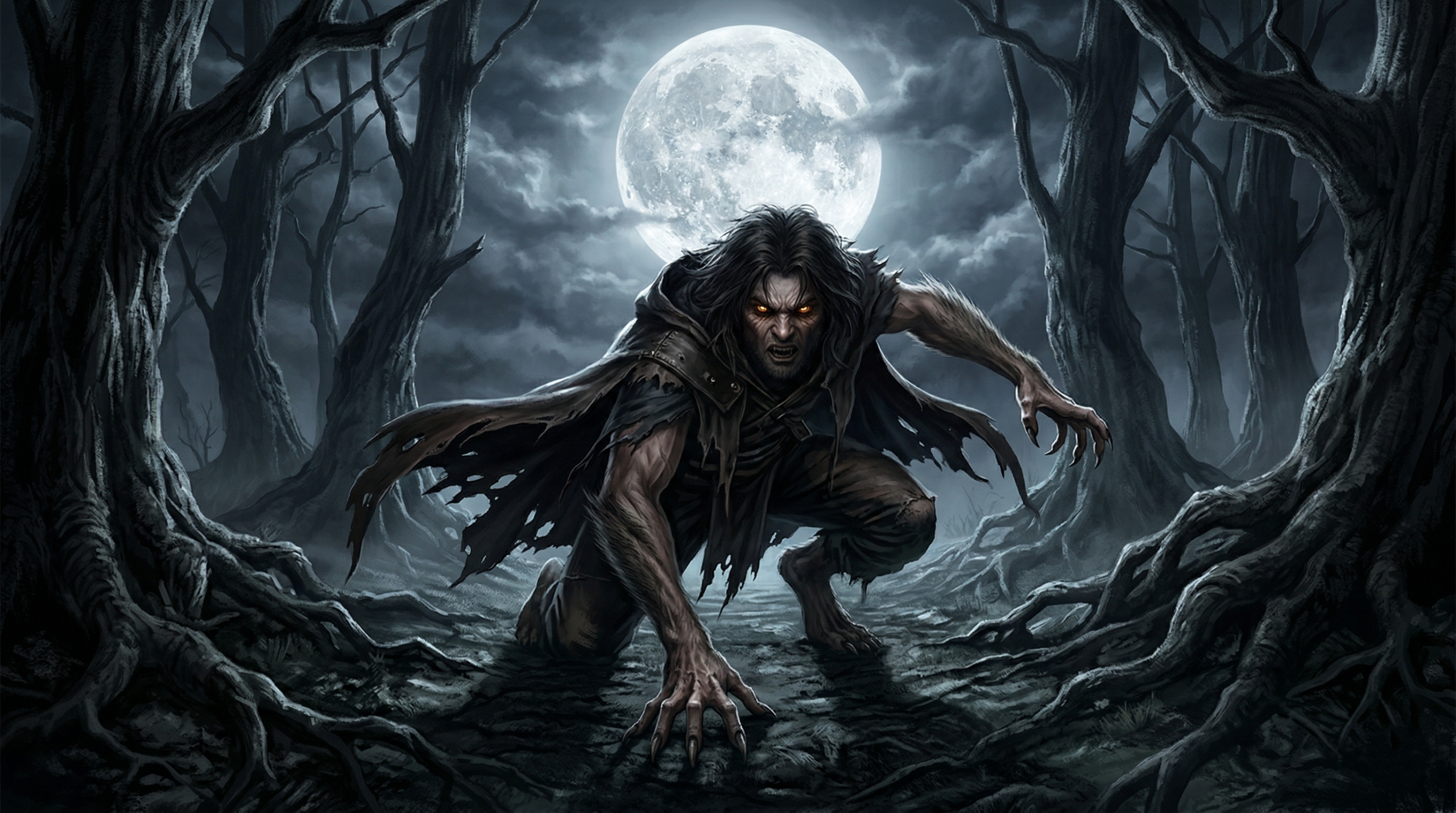 Cruelty: This is where Greyback earns his place on the list. He deliberately targeted children, biting them young to ensure they grew up as werewolves, swelling the ranks of creatures who faced discrimination and poverty in wizarding society. He took pleasure in this. He bragged about it. The attack on Bill Weasley — conducted even without a full moon — demonstrated that his savagery was not a condition but a choice. He is the only figure in the series for whom violence appears to be genuinely recreational.
Legacy: Greyback represents the brutalisation of marginalised communities as a weapon of war — a darker subtext that Rowling uses to illuminate how oppressive regimes weaponise the already-persecuted. His presence in Voldemort’s forces was not incidental. He was there because fear of him was useful, and because his victims became outcasts in the very society that claimed to oppose Voldemort’s cruelty.
#8 — Dolores Umbridge: The Smiling Face of Systemic Evil
No character in the Harry Potter series inspires a more visceral, immediate hatred among readers than Dolores Umbridge — and it is not even particularly close. She is the villain readers recognise because she is the villain they have met.
Power: Umbridge’s power is not magical in the conventional sense, though she is a capable witch. Her true power is institutional. Armed with Ministry authority and an unctuous, self-righteous certainty in her own righteousness, she dismantled Hogwarts from the inside — stripping Dumbledore of authority, terrorising students, controlling information, and eventually running the Muggle-Born Registration Commission with bureaucratic enthusiasm for persecution. She wielded policy as a weapon more effectively than most Death Eaters wielded wands.
Cruelty: What distinguishes Umbridge from almost every other villain on this list is that she enjoyed it. She forced Harry to carve words into the back of his own hand with a Blood Quill — a torture instrument — and watched with visible satisfaction. She had no grand ideological motive. She had no Voldemort to serve as an excuse. She was cruel because cruelty, dressed in authority and procedure, felt entirely justified to her. That psychological portrait is Rowling’s most disturbing achievement.
Legacy: Umbridge has transcended the Harry Potter fandom to become a cultural shorthand for a specific, recognisable type of evil — the petty bureaucrat who enforces suffering not from malice in the dramatic sense, but from a smug, procedural conviction that the rules justify everything. Adult readers often rank her above Voldemort as the series’ most hated character because, unlike Voldemort, she is plausible. She sits in offices. She wears cardigans. She exists.
“I will have order.” — Dolores Umbridge, Order of the Phoenix. Three words that, in context, are among the most chilling in the series.
#7 — Antonin Dolohov: The Soldier Who Never Stopped Fighting
Dolohov lacks the fame of Bellatrix or the narrative centrality of Voldemort, but among the inner circle of Death Eaters, he stands as one of the most genuinely lethal and committed dark wizards in the entire canon.
Power: Dolohov is distinguished by a remarkable detail — he created his own dark curse, a slashing purple flame that causes severe internal damage and, at full strength, is capable of killing. Creating original dark magic places him in rare company. He was skilled enough to duel Hermione Granger — at the time fighting beyond her years — and incapacitate her with minimal effort. He also bested Remus Lupin in combat, which is no minor achievement.
Cruelty: Dolohov was among the Death Eaters who murdered Gideon and Fabian Prewett — members of the original Order of the Phoenix — and the McKinnon family during the First Wizarding War. He carried out massacres as a professional function, not a crisis of passion. His cruelty is cold, practised, and systematic.
Legacy: Dolohov represents the Death Eater as true believer and career soldier. He did not follow Voldemort for personal gain or out of fear. He was a loyal, capable, and deeply dangerous instrument of dark ideology who fought across both Wizarding Wars without apparent hesitation or remorse. His legacy is the quiet horror of institutional commitment to evil — the person who does terrible things not in a moment of weakness, but because it is simply what they do.
#6 — Bartemius Crouch Jr.: The True Believer Who Changed Everything
If a single character can be credited — or blamed — for the most pivotal turning point in the entire Harry Potter series, it is Bartemius Crouch Jr. Without him, Voldemort does not return. The entire trajectory of the Wizarding War changes. His impact on the plot is matched by few characters and exceeded by almost none.
Power: Crouch Jr. was extraordinarily talented — talented enough to spend an entire academic year impersonating one of the Wizarding World’s most accomplished Aurors, fooling Dumbledore himself. He successfully cast the Dark Mark over the Quidditch World Cup, managed the logistics of the Triwizard Tournament’s corruption from the inside, and bound Harry in the graveyard. His competence was terrifying precisely because it was so complete.
Cruelty: Along with three other Death Eaters, Crouch Jr. tortured Frank and Alice Longbottom — two outstanding Aurors and members of the Order of the Phoenix — into permanent insanity using the Cruciatus Curse. He did not do this reluctantly. He did it because he wanted to find Voldemort’s location and because he believed it was his right. He showed no remorse at his trial, addressing Voldemort’s empty chair in the courtroom as though his master were already there.
Legacy: Bartemius Crouch Jr. is the hinge upon which the entire series turns. Without his year-long deception at Hogwarts, Harry never enters the maze. He never touches the Portkey. He never reaches the graveyard. Voldemort never returns. The man who cast the killing curse that ended the First Wizarding War’s stalemate and reignited the Second is a figure whose impact on the Wizarding World is impossible to overstate.
#5 — Lucius Malfoy: Evil in a Tailored Robe
Lucius Malfoy is the Harry Potter series‘ most precise portrait of how evil operates through privilege — quietly, elegantly, and with plausible deniability always at hand.
Power: Lucius wielded influence at the highest levels of wizarding society. His financial contributions to the Ministry of Magic bought him access and immunity. He sat on the Hogwarts Board of Governors and engineered Dumbledore’s removal from the school — a feat that neither dark magic nor open warfare had achieved. When Voldemort returned, Lucius was among the first summoned, confirming his place in the inner circle.
Cruelty: His single most chilling act of cruelty is also his most calculated: slipping Tom Riddle’s diary — a Horcrux and dark artifact capable of possessing and ultimately killing its victim — into the bag of an eleven-year-old girl named Ginny Weasley. He did this calmly, in a bookshop, as an act of personal revenge against Arthur Weasley. He was willing to sacrifice a child for a petty grudge while maintaining complete social composure.
Legacy: Lucius Malfoy is the series’ definitive portrait of complicity dressed as respectability. He represents every institution, every individual, and every society that enables atrocity through silence, donation, and convenient distance from the actual violence. His arc — ending in disgrace, stripped of his wand and his pride — is also one of the series’ most deliberate moral statements: that the comfortable collaborators ultimately have nowhere to hide.
#4 — Bellatrix Lestrange: Devotion Turned Into a Weapon
If Lucius Malfoy represents evil through privilege and Umbridge represents evil through bureaucracy, Bellatrix Lestrange represents evil in its most undiluted, passionate, and terrifying form. She is the Death Eater who needed no coercion, no ideology, and no incentive beyond her absolute, consuming devotion to Lord Voldemort.
Power: Bellatrix was, without question, the most dangerous Death Eater in open combat. She escaped from Azkaban after fourteen years of imprisonment with her powers not only intact but seemingly sharpened by confinement and fanaticism. She duelled Albus Dumbledore — briefly, but without being immediately destroyed, which places her in extraordinarily rare company. She killed Sirius Black, Nymphadora Tonks, and an untold number of witches and wizards across both Wizarding Wars. She was the only Death Eater to successfully deflect spells from Dumbledore during the Battle of the Department of Mysteries and survive the encounter. Her mastery of the Dark Arts was comprehensive, instinctive, and deeply personal.
Cruelty: Bellatrix did not commit acts of cruelty reluctantly or as a means to an end. She committed them with joy. The torture of Frank and Alice Longbottom — which she carried out alongside Crouch Jr. and two others — was conducted with the Cruciatus Curse at a sustained level that destroyed two of the finest Aurors the Ministry had ever produced. She left them alive but permanently, irreparably broken, which many fans and scholars of the series have argued is a deliberate choice on her part — leaving the evidence of what she was capable of behind as a living warning to the Wizarding World.
Her mockery of Neville Longbottom — taunting him about his parents to his face — revealed that for Bellatrix, cruelty extended beyond the physical. She understood psychological wounds and deployed them without mercy. She murdered her own cousin, Sirius Black, during the Battle of the Department of Mysteries and celebrated in the immediate aftermath. She attempted to kill Ginny Weasley during the Battle of Hogwarts — a sixteen-year-old girl — and was stopped only by Molly Weasley’s intervention.
Legacy: Bellatrix Lestrange has become one of cinema’s and literature’s defining female villains — a benchmark against which dark witches in popular culture are frequently measured. Her legacy within the Wizarding World is one of terror and fanaticism: she is the Death Eater who proved that devotion to Voldemort could produce something arguably more dangerous than Voldemort himself in certain contexts. Where Voldemort was coldly strategic, Bellatrix was explosively unpredictable. Where he calculated, she simply destroyed.
Her cultural legacy is equally significant. Helena Bonham Carter’s portrayal cemented her as an icon. The revelation in Harry Potter and the Cursed Child that she bore Voldemort’s child — Delphini — extends her legacy into the next generation and confirms that her connection to the Dark Lord was absolute in every sense.
Verdict Badge: “Devotion Turned Into a Weapon” — Bellatrix did not serve Voldemort. She worshipped him. And that distinction made her the most purely dangerous Death Eater who ever drew breath.
#3 — Gellert Grindelwald: The Architect of Pure-Blood Terror
To understand Voldemort fully, one must first understand Gellert Grindelwald — because Grindelwald did not merely precede the Dark Lord chronologically. He built the template that Voldemort inherited, refined, and ultimately used to nearly destroy the Wizarding World a second time.
Power: Grindelwald was, by any canonical measure, one of the two or three most powerful wizards in recorded Wizarding history. He sought and obtained the Elder Wand — the most powerful wand in existence — and wielded it with the skill and ambition it demands. For decades, he dominated European wizarding society through a combination of raw magical power, strategic brilliance, and an ideology compelling enough to attract genuine followers rather than merely frightened subordinates.
His duel with Albus Dumbledore in 1945 is described across the series as the greatest wizarding duel ever fought — a confrontation so legendary that it passed into Wizarding World history as a defining moment. The fact that Dumbledore himself postponed that duel for years, despite knowing what Grindelwald was doing across Europe, speaks volumes about how formidable an opponent Grindelwald truly was. Even Dumbledore — widely considered the greatest wizard of the modern age — hesitated before facing him.
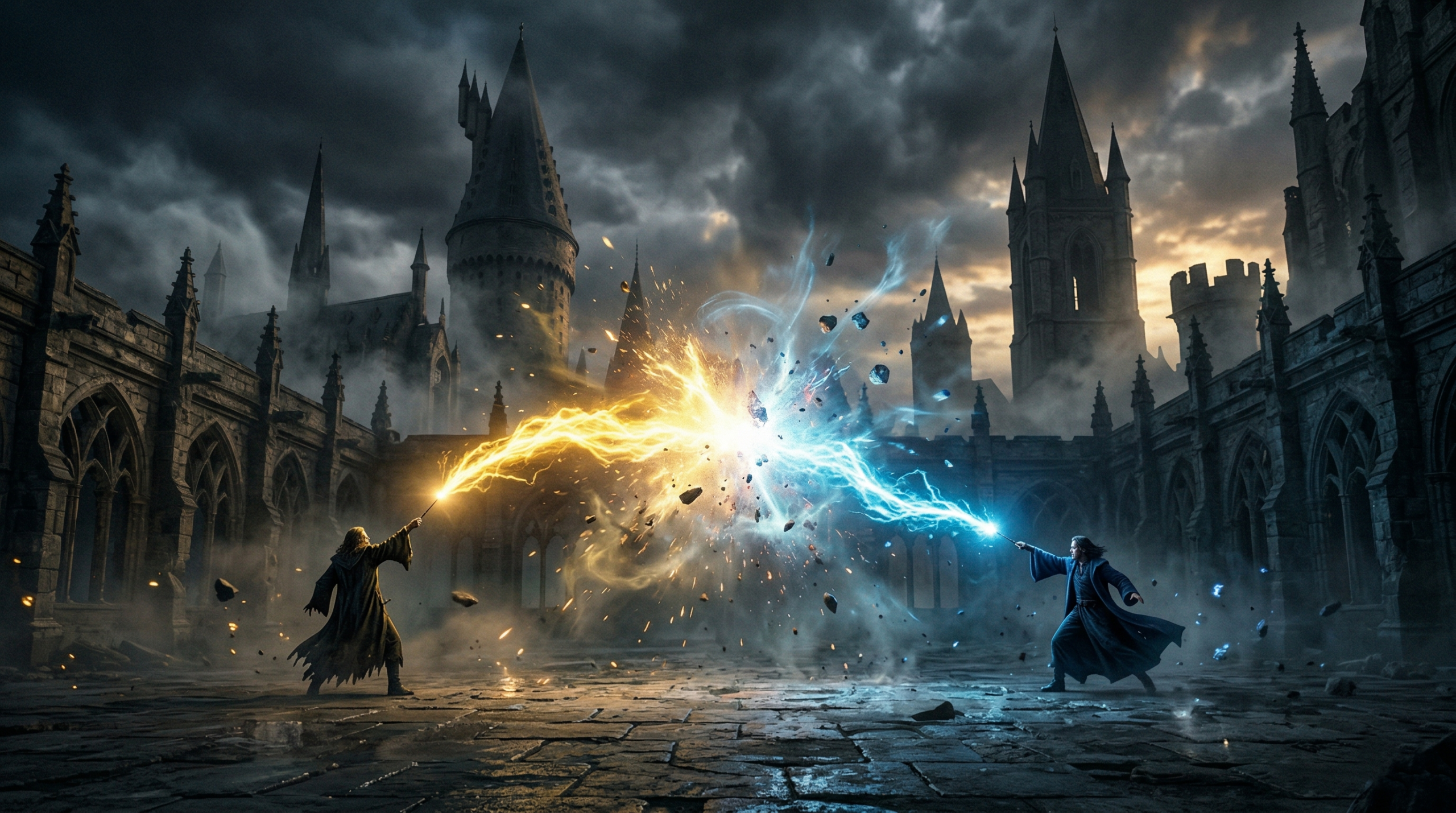 Cruelty: Grindelwald’s cruelty operated at a different scale than most dark wizards on this list. Where others tortured individuals, Grindelwald waged war across entire nations. Under the banner of “For the Greater Good” — a phrase he co-coined with the young Dumbledore during their brief, ill-fated intellectual partnership — he constructed a philosophy that framed the subjugation and suffering of non-magical people as not only justified but necessary. This ideological cruelty is, in many ways, the most dangerous kind: it does not require personal hatred. It simply requires conviction.
His construction of Nurmengard prison — where he later imprisoned and ultimately died — was built first to hold his enemies. The fortress is a monument to his belief that those who opposed magical supremacy deserved to be erased from the world’s consideration entirely.
Legacy: Grindelwald’s legacy is arguably the most consequential of any dark wizard in Harry Potter history — even more so than Voldemort’s in certain respects. He proved that Wizarding society was ideologically vulnerable: that a sufficiently charismatic, intelligent, and powerful dark wizard could not only attract followers but build an international movement. Voldemort studied this blueprint and built upon it.
His brief, cryptic moment of possible redemption in Harry Potter and the Deathly Hallows — when he refuses to confirm to Voldemort that the Elder Wand is buried with Dumbledore’s tomb, perhaps to protect Dumbledore’s memory even in his final hours — introduces a note of moral ambiguity that has fascinated fans and scholars for years. Does it diminish his evil? Almost certainly not. Does it make him the most complex villain in the series? It is a compelling argument.
Verdict Badge: “The Architect of Pure-Blood Terror” — Grindelwald did not inherit a world built for dark wizards. He constructed one, and others moved into it after him.
#2 — Lord Voldemort: Fear of a Name Only Increases Fear of the Thing Itself
There is a reason that for the majority of the Harry Potter series, most witches and wizards in Britain could not bring themselves to speak his name. Lord Voldemort — born Tom Marvolo Riddle in a Muggle orphanage in London — represents the fullest possible realisation of what dark magic, obsessive ambition, and the complete absence of love can produce in a human being.
Power: Voldemort’s magical power was exceptional almost from birth. As a child at Wool’s Orphanage, before any formal training, he instinctively weaponised his magic against other children — a degree of innate ability that is virtually unparalleled in the canon. At Hogwarts, he was considered the most brilliant student the school had seen in generations, a reputation that stood even decades later when Dumbledore spoke of him.
As an adult, Voldemort’s power was vast across every dimension. He achieved what no other wizard in known history had accomplished: the creation of multiple Horcruxes, fracturing his soul seven times in his pursuit of immortality. He performed feats of magic that pushed the boundaries of what was considered possible — including body possession, serpent communication as a hereditary gift, wandless and wordless magic, and the development of a psychic connection with Harry Potter that functioned as both weapon and fatal vulnerability.
He was powerful enough that Dumbledore — who had already defeated Grindelwald — acknowledged him as the most dangerous dark wizard he had ever faced. That is not a casual distinction.
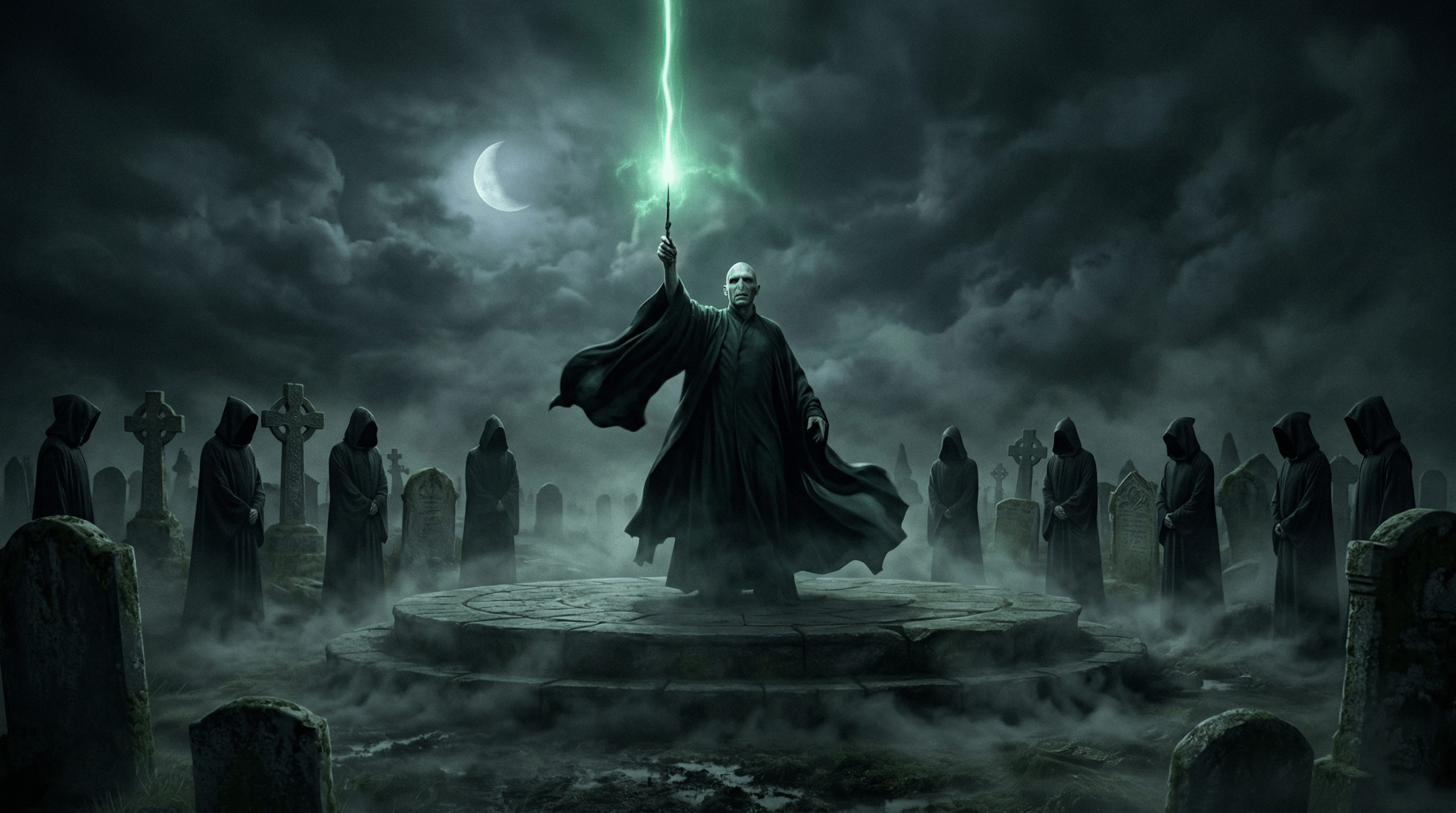 Cruelty: Voldemort’s cruelty is defined by its totality and its absence of personal feeling. Unlike Bellatrix, he did not torture for pleasure. Unlike Grindelwald, he did not operate from a coherent ideology. He killed, tortured, and destroyed as instruments of control and efficiency. People around him were means to ends. This makes him, paradoxically, more chilling than many of the dark wizards below him on this list — there is no passion to appeal to, no belief system to reason with, no emotional leverage to use against him.
He murdered his own father and grandparents without hesitation. He created his first Horcrux as a Hogwarts student, committing murder in the castle’s walls. He orchestrated two Wizarding Wars that claimed dozens of beloved characters and hundreds of unnamed victims. He attempted to murder an infant and spent years as a wraith, attached to the back of a lesser wizard’s head, rather than accept defeat.
Legacy: Voldemort’s legacy in the Wizarding World is profound and paradoxical. On one hand, his defeat — twice — by Harry Potter ultimately served to heal and reunite wizarding society. On the other hand, the world he left behind bore permanent scars: families destroyed, communities fractured, and a generation of witches and wizards who grew up under the shadow of his name. The very fact that saying his name aloud was considered dangerous for the better part of two decades is itself a measure of how completely he colonised the imagination of an entire society.
He is the central villain of one of the most beloved literary series in history — and he earns that position entirely on the merits of what Rowling built him to be.
Why #2 and not #1? Because the case for the top position is more complicated — and more interesting — than it first appears.
#1 — The Case for the Top Spot: Voldemort vs. Grindelwald
This is the ranking’s most deliberately contested position — and that is by design. Because the question of who deserves the title of the most dangerous, most impactful evil wizard in Harry Potter history is not settled by a simple body count. It requires weighing different kinds of power and different scales of consequence.
The Case for Voldemort at #1:
Voldemort’s direct impact on the protagonist of the series — and therefore on the reader’s emotional experience — is unmatched. He murdered Harry’s parents. He shaped Harry’s entire life, identity, and destiny. He drove the narrative of seven books and eight films. No other dark wizard comes close to that level of sustained, personal, catastrophic impact on the story’s central figures. Furthermore, his achievement of multiple Horcruxes represents the single most ambitious act of dark magic in the entire canon — an achievement that even Grindelwald, with the Elder Wand, never attempted or perhaps never dared.
The Case for Grindelwald at #1:
Grindelwald’s scope of damage was geographically and historically broader than Voldemort’s. While Voldemort’s terror was largely concentrated on Britain and the surrounding Wizarding community, Grindelwald’s war engulfed continental Europe. His ideological reach was wider, his movement more organised, and his philosophical influence more enduring — in the sense that the seeds of pure-blood supremacy that Voldemort later cultivated had already been planted by Grindelwald’s public ideology.
Furthermore, Grindelwald accomplished something Voldemort ultimately never did: he held the Elder Wand and used it effectively over a sustained period. He built Nurmengard. He created an international movement with genuine ideological coherence. He came extraordinarily close to achieving his vision of a world ruled by wizards — and was stopped not by a chosen one, but by the one wizard powerful enough to face him.
The Verdict:
Both wizards represent the pinnacle of dark magic in the Harry Potter universe, and the honest answer is that the top position is genuinely debatable. For narrative centrality and personal devastation, Voldemort stands supreme. For historical scope and ideological impact, Grindelwald presents a formidable counter-argument.
This ranking places Voldemort at #1 — but only barely, and with full acknowledgement that a credible case exists for his predecessor. The Dark Lord who shaped the entire arc of Harry Potter’s life, who split his soul seven times, and who brought the Wizarding World to its knees twice earns the top position. But Grindelwald is the dark wizard whose shadow made Voldemort’s rise possible — and that is a legacy that deserves permanent recognition.
💬 Who do YOU think deserves the #1 spot? The comments section exists precisely for this debate — and it is one worth having.
Honourable Mentions — Dark Wizards Who Nearly Made the List
The ten wizards ranked above represent the apex of dark magic in Harry Potter’s main canon. But the Wizarding World’s history of evil stretches far beyond the events of the seven books — and several figures deserve acknowledgement for their unique contributions to the darkness.
Salazar Slytherin
One of Hogwarts’ four founders, Slytherin was responsible for embedding the conditions of blood purity ideology into the school’s founding structure — a poisonous inheritance that shaped wizarding society for a thousand years. He built the Chamber of Secrets within the castle walls and left the Basilisk within it as a weapon for his heir to deploy against Muggle-born students. Slytherin did not simply commit evil acts. He institutionalised evil — designing it to activate automatically when the right conditions were met, centuries after his death. Few villains in any fictional universe have managed to make their prejudice so architecturally persistent.
Herpo the Foul
An Ancient Greek dark wizard whose influence on dark magic is so foundational that he deserves mention even in a list focused on the modern Wizarding era. Herpo the Foul was the first known wizard to successfully breed a Basilisk and — far more significantly — the first known creator of a Horcrux. He invented the most abominable act of dark magic in the canon’s history, making him the originator of the very technique Voldemort used to nearly destroy the Wizarding World. Every Horcrux ever created traces its intellectual lineage back to Herpo. His legacy is the darkest possible kind — foundational and almost impossible to fully erase.
The Carrow Siblings — Amycus and Alecto
Among the most underappreciated villains in the series, the Carrow siblings were installed as professors at Hogwarts during Voldemort’s occupation of wizarding Britain in Harry Potter and the Deathly Hallows. Amycus taught Dark Arts — not Defence Against the Dark Arts, but the Dark Arts themselves — and used students to practise the Cruciatus Curse on fellow students as punishment. Alecto taught Muggle Studies, restructured as a class dedicated to the dehumanisation of non-magical people. Together, they transformed Hogwarts into an institution of fear and indoctrination — turning the safest place most wizarding children had ever known into a place of daily dread. Their cruelty was banal, systematic, and specifically designed to break the next generation of witches and wizards.
What Evil Wizards in Harry Potter Teach Us About Real-World Darkness
The most enduring quality of Rowling’s dark wizards is not their magic. It is their recognisability.
Grindelwald’s movement — built on the ideology of magical supremacy, wrapped in the language of historical inevitability and the greater good — is a direct and deliberate echo of the fascist movements that swept Europe in the early twentieth century. Rowling, who has spoken openly about the influence of World War II on her writing, constructed Grindelwald’s rise to mirror the mechanisms of real ideological terror: the charismatic leader, the compelling narrative of grievance, the promise of power to those who felt overlooked, and the systematic dehumanisation of a targeted group.
Voldemort’s obsession with blood purity — the division of the Wizarding World into pure-bloods, half-bloods, and Muggle-borns, with each category assigned decreasing worth and rights — maps with uncomfortable clarity onto the racial hierarchies that have motivated some of history’s most destructive movements. The fact that Voldemort himself was a half-blood, concealing his heritage while promoting pure-blood supremacy, is Rowling’s sharpest satirical observation: that the ideologues of exclusion are frequently the least qualified to claim the identity they weaponise.
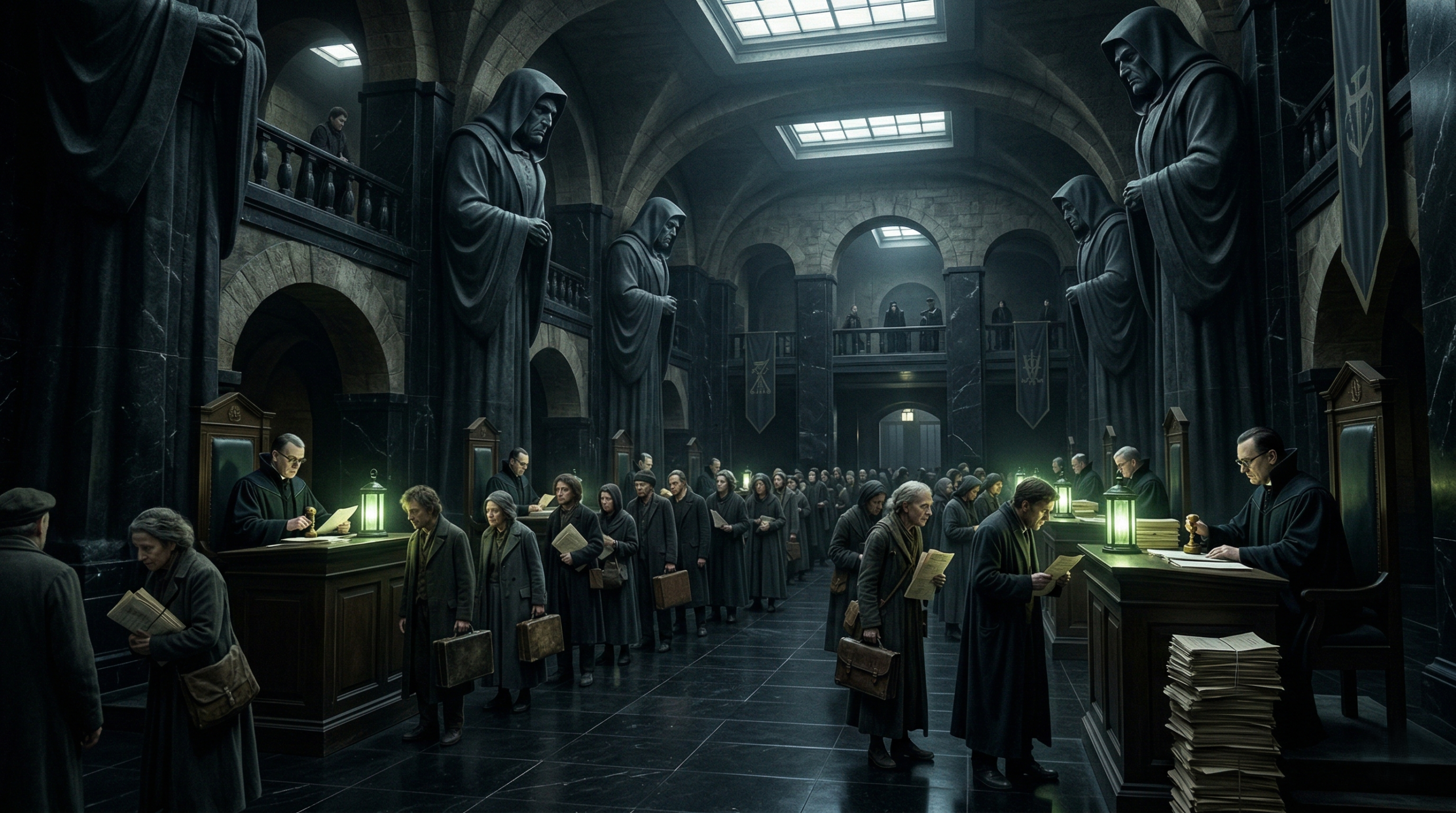 Umbridge, meanwhile, speaks to something more immediate and personal for most readers — the experience of encountering cruelty in a position of institutional authority, shielded from consequence by procedure, rank, and the passive complicity of those around her. She is not a fantasy villain. She is a workplace villain, a school villain, a government villain. Adult readers recognise her with a specificity that Voldemort — for all his narrative power — does not inspire.
This is what the evil wizards of Harry Potter ultimately offer: not an escape from real-world darkness, but a structured, illuminated, and emotionally manageable way to examine it. Rowling created these characters not simply to frighten her readers, but to help them understand the shapes that evil takes — and perhaps to recognise those shapes in the world outside the books.
Frequently Asked Questions
Q1: Who is the most evil wizard in Harry Potter?
By the criteria of power, cruelty, and legacy combined, Lord Voldemort holds the top position — though Gellert Grindelwald presents a compelling alternative argument based on historical scope and ideological impact. For raw personal cruelty, many fans and readers argue that Dolores Umbridge is the series’ most viscerally disturbing villain, despite her lower magical ranking.
Q2: Is Grindelwald more powerful than Voldemort?
This is one of the most hotly debated questions in the Harry Potter fandom, and the canon does not resolve it definitively. Grindelwald possessed the Elder Wand and wielded it effectively over decades. Voldemort created multiple Horcruxes and performed feats of magic that pushed the limits of the possible. Dumbledore himself described Voldemort as the most dangerous dark wizard he had ever faced — but he made that assessment after Grindelwald’s defeat, which complicates the comparison. The most accurate answer is that they were peers at the absolute apex of dark magical power, with different strengths and different scales of ambition.
Q3: Why do people hate Umbridge more than Voldemort?
The psychological explanation is rooted in relatability and proximity. Voldemort is a fantasy villain — his scale of evil is so vast and his nature so inhuman that readers can process him at an emotional distance. Umbridge, by contrast, operates in spaces everyone has inhabited: classrooms, offices, institutions. Her cruelty is dressed in authority and procedure, which makes it both familiar and infuriating. She represents not the evil of monsters, but the evil of systems — and that is a far more intimate and recognisable form of darkness for most readers.
Q4: Who were the original Death Eaters?
The original inner circle of Death Eaters — those who served Voldemort during the First Wizarding War — included Bellatrix, Rodolphus, and Rabastan Lestrange; Lucius Malfoy; Antonin Dolohov; Evan Rosier; Wilkes; the Mulciber brothers; Avery; Peter Pettigrew (Wormtail); and Bartemius Crouch Jr., among others. Severus Snape also joined the original Death Eaters before ultimately becoming a double agent for Dumbledore.
Q5: Are there any female evil wizards in Harry Potter?
Yes — and they are among the most significant villains in the series. Bellatrix Lestrange ranks fourth on this list and is widely considered the most dangerous Death Eater in open combat. Dolores Umbridge ranks eighth and is frequently cited as the series’ most hated villain. Alecto Carrow served as a professor at Hogwarts during Voldemort’s occupation and participated in the institutional cruelty of that period. Female dark witches in the Harry Potter universe are not peripheral — they are central to its darkest chapters.
Q6: What dark magic did Grindelwald use?
Grindelwald’s canonical dark magic includes masterful use of the Elder Wand across decades of conflict, construction of the prison fortress Nurmengard, leadership of an international dark wizarding movement, and various unspecified acts of dark magic across Europe during his war. In the Fantastic Beasts film series — which expands his story — he demonstrates extraordinarily advanced magic including the creation of blue firestorms and the ability to project compelling visions of the future to manipulate followers. His specific spellwork is less catalogued than Voldemort’s, but his general capability is established as extraordinary across all canonical sources.
The evil wizards of Harry Potter are, collectively, one of fiction’s greatest ensembles of villainy. From the institutional cruelty of Dolores Umbridge to the ideological architecture of Gellert Grindelwald, from the savage ferocity of Fenrir Greyback to the absolute, soul-fracturing ambition of Lord Voldemort, each dark sorcerer in this ranking represents a distinct and carefully constructed portrait of what it means to choose darkness.
What Rowling achieved across seven books is remarkable: she built a rogues’ gallery in which no two villains are truly alike, in which evil is never a monolith but always a specific, particular choice made by a specific, particular person. The dark wizards of Harry Potter are frightening not because they are impossible — but because they are, each in their own way, entirely believable.
The ranking stands. But the conversation it opens is more valuable than any final verdict. Because the best thing the evil wizards of Harry Potter ever did — perhaps the only good thing — is give millions of readers a framework for thinking clearly about the darkness that exists in every world, including their own.