

Imagine the terrifying sensation of being forced through a tight, suffocating rubber tube in pitch darkness, followed by an ear-splitting, whip-like CRACK. In the wizarding world, fast travel isn’t a gentle, glittering fade to black. If you have ever searched for the Harry Potter teleport spell, you are actually looking for an advanced, highly regulated, and incredibly dangerous magical skill known as Apparition.
For casual fans and devoted Potterheads alike, understanding how characters instantly zip across the United Kingdom is a fascinating dive into the lore. Unlike a simple Levitation Charm or a standard Stunning Spell, teleportation in this universe requires intense psychological focus and carries gruesome physical risks for those who fail.
In this comprehensive guide, we are breaking down everything you need to know about magical transportation. From the exact mechanics of the spell and the strict Ministry laws governing its use, to the horrifying, hidden dangers of a botched jump, here is the ultimate masterclass on how wizards truly travel.
What is the “Teleport Spell” in Harry Potter?
When fans refer to the “teleport spell,” they are actually talking about a complex branch of magic that doesn’t rely on a spoken incantation. It is a sheer act of magical will divided into two distinct terms depending on the wizard’s perspective: Apparition and Disapparition.
Apparition vs. Disapparition
The terminology is simple but essential for understanding wizarding travel:
-
Disapparate: The act of disappearing from your current location.
-
Apparate: The act of arriving at your new destination.
For example, when Albus Dumbledore leaves his office, he Disapparates from Hogwarts (ignoring the castle’s magical wards for a moment) and Apparates in the middle of London. Unlike most spells taught at Hogwarts, there is no pseudo-Latin phrase to shout. The magic is entirely internal, requiring absolute mental clarity.
 Side-Along Apparition: Teleporting with a Passenger
What happens when a wizard needs to transport someone who doesn’t know how to teleport, such as an underage child or an injured friend? The answer is Side-Along Apparition.
In this scenario, the skilled wizard acts as the anchor. The passenger must grip the anchor’s arm tightly and hold on for dear life as the caster initiates the magic. The lore provides several iconic examples of this:
-
Albus Dumbledore and Harry Potter: In Harry Potter and the Half-Blood Prince, Dumbledore uses Side-Along Apparition to take Harry to the village of Budleigh Babberton to recruit Horace Slughorn.
-
Hermione Granger’s Rescues: In Harry Potter and the Deathly Hallows, Hermione repeatedly uses Side-Along Apparition to save Harry and Ron Weasley from Death Eaters, showcasing her incredible magical proficiency at a young age.
Book vs. Movie Differences
Understanding the visual translation from page to screen is crucial for deep lore analysis. Just as we have previously explored the fascinating additions of movie-only characters like Bem, examining how the films altered Apparition reveals interesting creative choices by the directors.
-
In the Books: Apparition is instantaneous and invisible. The only sign that someone has teleported is a loud, distinct “POP” or a violent “CRACK,” like a car backfiring. The wizard simply vanishes and reappears.
-
In the Movies: To make the magic more cinematic, director David Yates introduced a visual flair. Order of the Phoenix members often Apparate in streaks of bright, white light or smoke, while Death Eaters fly across the sky in violent trails of black smoke. While visually stunning, this “flight” mechanic strays from the instantaneous, invisible teleportation J.K. Rowling originally penned.
The Mechanics: How Do Wizards Actually Apparate?
Teleporting in the Harry Potter universe is not a natural talent; it is a learned skill that requires formal education. In their sixth year, Hogwarts students who are of age (or turning 17 soon) are offered a Ministry-sanctioned course taught by a certified Apparition Instructor.
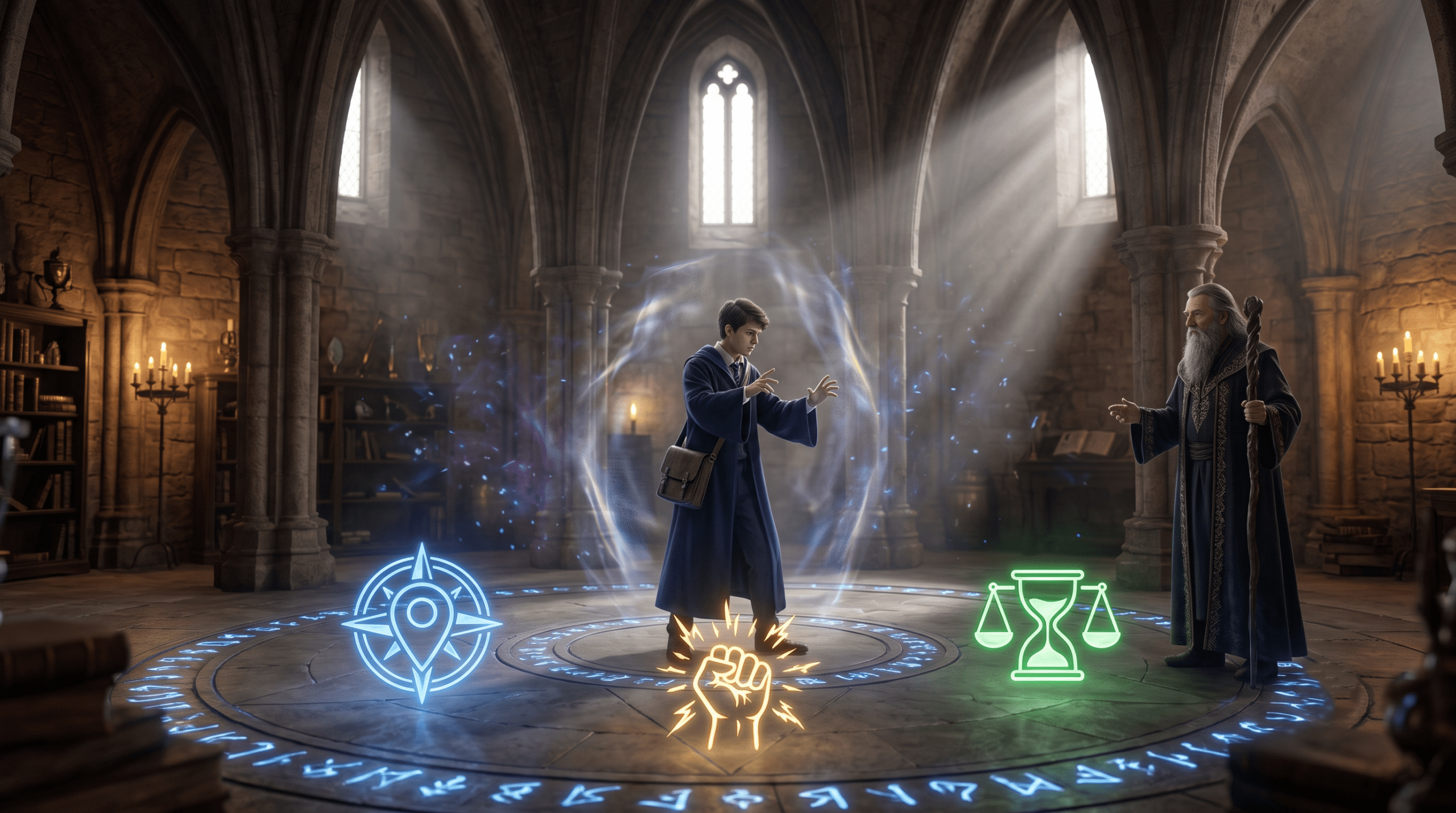
The “Three D’s” of Apparition
During Harry’s sixth year, the Ministry assigns Wilkie Twycross to teach the Hogwarts students. Twycross bases his entire curriculum on a strict psychological framework known as the Three D’s. To successfully execute the Harry Potter teleport spell, a wizard must master:
-
Destination: The caster must firmly fix the exact location they want to arrive at in their mind’s eye. A vague idea of the location is not enough; the visualization must be crystal clear.
-
Determination: The caster must focus their absolute will upon occupying that visualized space. Any hesitation or second-guessing will cause the spell to fail.
-
Deliberation: The caster must turn on the spot, moving with calm, conscious, and deliberate intent. Panic is the enemy of Apparition.
 Do You Need a Wand to Teleport?
This is a frequent point of debate within the fandom: Does Apparition require a wand?
The short answer is yes, for the vast majority of wizards. While Apparition is technically considered “wandless magic” because there is no incantation, the wand acts as a crucial conduit that channels and stabilizes the wizard’s magical core. Highly powerful wizards, like Dumbledore or Voldemort, can likely Apparate without one, but for the average witch or wizard, attempting to teleport without a wand in hand is a recipe for disaster. Losing a wand in a duel effectively traps a standard wizard in their current location.
The Hidden Danger: What is Splinching?
If teleporting is so convenient, why doesn’t everyone do it all the time? The answer lies in the horrifying physical risk associated with a lack of Determination.
The Gruesome Reality of a Botched Apparition
When a wizard fails to adequately focus on their destination, or panics mid-jump, their body literally splits in two. This gruesome magical accident is known as Splinching.
Splinching occurs when the mind is insufficiently determined; part of the body arrives at the destination, while the rest remains at the starting point. Depending on the severity of the mental lapse, Splinching can range from hilariously minor to fatally traumatic. A wizard might leave behind half an eyebrow or a few fingernails, or they might arrive missing an entire leg or an arm.
 Famous Cases of Splinching in the Series
The Harry Potter lore provides several harrowing examples of what happens when the Three D’s are not perfectly executed. The most prominent example occurs in Harry Potter and the Deathly Hallows. When Harry, Ron, and Hermione are escaping the Ministry of Magic, the Death Eater Yaxley grabs hold of Hermione. In her desperation to shake him off and change their destination mid-jump, the mental focus fractures. The result is a severe Splinch for Ron Weasley, who loses a massive chunk of flesh from his upper arm, leading to dangerous blood loss.
Another notable incident happens within the supposedly safe confines of the Great Hall during Wilkie Twycross’s Apparition lessons. Hufflepuff student Susan Bones fails to display enough Determination and successfully Apparates, but leaves her entire left leg standing five feet away from her body.
How to Heal a Splinch
While horrifying, Splinching is rarely fatal if treated promptly. Minor cases in public are usually handled by the Accidental Magic Reversal Squad, a division within the Ministry of Magic tasked with repairing magical mishaps and modifying Muggle memories if necessary. They can seamlessly reattach missing limbs and reverse the damage within minutes.
In emergency survival situations, such as Ron’s injury in the forest, witches and wizards rely on Essence of Dittany. This rare, potent magical herb is a powerful healing agent. When applied directly to a bleeding wound, Dittany produces a greenish smoke and instantly begins to regenerate skin, sealing the wound and preventing infection, though it leaves severe scarring.
The Strict Laws of Magical Teleportation
Because of the extreme dangers associated with the Harry Potter teleport spell, the wizarding government regulates it heavily. You cannot simply decide to start teleporting; it is a legal privilege governed by strict bureaucracy.
The Apparition License and Age Requirements
To legally Apparate in the wizarding world, a witch or wizard must obtain an Apparition License. The process is highly comparable to obtaining a Muggle driver’s license.
Candidates must be at least 17 years old—the legal age of adulthood in the wizarding world—to take the exam. The test is administered by the Department of Magical Transportation, and examiners evaluate the candidate’s ability to execute the Three D’s flawlessly under pressure. Apparating without a license is strictly illegal and carries heavy Ministry fines, not to mention the immense physical risk to the untrained caster.
Anti-Apparition Charms (Why You Can’t Teleport Inside Hogwarts)
If teleportation is so powerful, why don’t dark wizards simply Apparate into heavily guarded areas, or why doesn’t Harry just Apparate directly into his dormitory?
As Hermione Granger famously and repeatedly reminds her friends: “You can’t Apparate or Disapparate inside Hogwarts. Read Hogwarts, A History!”
High-security locations utilize powerful Anti-Apparition Charms and jinxes to prevent people from magically bypassing their defenses. Hogwarts School of Witchcraft and Wizardry, Gringotts Wizarding Bank, the Ministry of Magic, and the wizarding prison Azkaban are all heavily warded. The only person capable of lifting the Anti-Apparition enchantment over Hogwarts is the Headmaster, which Dumbledore occasionally does for a limited time in the Great Hall specifically for sixth-year Apparition lessons.
 The Exception to the Rule: House-Elf Magic
There is a massive, plot-altering loophole to wizarding teleportation laws and defensive wards: House-Elf Magic.
Why Dobby and Kreacher Can Teleport Anywhere
Wizarding wards, including Anti-Apparition Charms, are designed by wizards to block wizarding magic. However, J.K. Rowling establishes early on that House-Elves possess a completely different, independent branch of magic. Because wizards historically underestimate and subjugate non-human magical creatures, they possess a dangerous blind spot regarding elf capabilities.
House-Elves like Dobby and Kreacher can Apparate and Disapparate anywhere they please, completely ignoring wizarding wards. This is a critical plot point throughout the series. It explains how Kreacher was able to escape Voldemort’s inferi-infested cave when stealing the Slytherin Locket, and it is the only reason Dobby was able to bypass the heavy enchantments around Malfoy Manor to rescue Harry, Ron, Hermione, Luna Lovegood, and Ollivander in the final book.
Apparition vs. Other Magical Transportation
While Apparition is the fastest method of travel, it is not always the best. Depending on the distance, the cargo, and the wizard’s skill level, other methods are frequently utilized.
| Transportation Method | Speed | Skill Level Required | Best Used For | Primary Drawback |
| Apparition | Instantaneous | Extremely High | Solo travel, emergencies | High risk of Splinching |
| The Floo Network | Very Fast | Low | Safe domestic travel | Requires fireplaces & Floo Powder |
| Portkeys | Instantaneous | Low (for user) | International travel, groups | Cause severe nausea (“Portkey sickness”) |
| Broomsticks | Moderate | Moderate | Short distances, stealth | Exposed to weather and Muggle sightings |
 When to use the Floo Network
For the average wizard who hasn’t mastered the Three D’s, or for families traveling with children, the Floo Network is the gold standard. By throwing a handful of Floo Powder into a lit fireplace and clearly stating the destination, wizards can travel safely between connected grates. It requires very little skill, completely eliminating the risk of Splinching.
When to use Portkeys
Apparition has distance limits. Attempting to Apparate across continents or oceans drastically increases the chance of fatal Splinching. For international travel, or for moving large groups of people simultaneously (like attending the Quidditch World Cup), the Ministry sets up Portkeys. These are ordinary, inconspicuous objects enchanted with the Portus charm that transport anyone touching them at a pre-arranged time.
When to use Broomsticks
Sometimes, the journey is just as important as the destination. Broomsticks are utilized when wizards are traveling relatively short distances, need aerial maneuverability, or are transporting items that might not survive a violent Apparition jump. While it exposes the rider to the elements and requires Disillusionment Charms to hide from Muggles, it remains a highly reliable, traditional mode of transit.
Frequently Asked Questions (FAQs)
What is the Harry Potter teleport spell called?
The magical ability to teleport in the Harry Potter universe is called Apparition (when arriving at a destination) and Disapparition (when leaving a location). It does not require a spoken incantation.
Can Muggles Apparate?
No. Apparition requires an inherent magical core to channel the energy necessary to bend space. A Muggle attempting to execute the Three D’s would experience nothing. However, a Muggle can be transported via Side-Along Apparition if held tightly by a wizard, though they often find the sensation horrifying.
Does Apparating hurt?
When executed correctly, it does not cause physical pain, but it is incredibly uncomfortable. Characters describe the sensation as being forced through a painfully tight rubber tube, resulting in a crushing feeling on the chest and a temporary inability to breathe.
Can you Apparate anywhere in the world?
No. Apparition becomes exponentially more difficult and dangerous the further the distance. Intercontinental Apparition is almost universally avoided even by master wizards due to the extreme risk of severe Splinching. Wizards rely on Portkeys for cross-country or overseas travel.
The Harry Potter teleport spell is much more than a simple plot device to move characters from point A to point B. Apparition is a beautifully complex, highly regulated, and perilous magical art that perfectly reflects the dangers of the wizarding world. While the sheer convenience of bypassing London traffic with a simple “CRACK” is undeniable, the gruesome threat of Splinching ensures that only the most focused and determined wizards dare to travel without a broomstick or a pinch of Floo Powder.
If you lived in the wizarding world and were of age, would you brave the Department of Magical Transportation’s test to earn your Apparition License, or would you play it safe with the Floo Network? Let us know your travel preferences in the comments below!
For more deep dives into wizarding lore, check out our comprehensive guide on [Placeholder: The Complete History of the Floo Network] and our analysis of [Placeholder: The 3 Unforgivable Curses Explained].