Buckbeak was far more than just a majestic creature housed on the grounds of Hogwarts School of Witchcraft and Wizardry; he was a pivotal catalyst who fundamentally altered the timeline of the Second Wizarding War. Without the intervention of Buckbeak in Harry Potter, the fate of Sirius Black—and by extension, the trajectory of Harry’s entire journey—would have ended in profound tragedy. Despite his critical role, the timeline of this proud Hippogriff is often misunderstood by casual fans, tangled in a web of time travel, secret aliases, and complex ownership transfers.
For readers looking to dive deep into the Wizarding World, this comprehensive guide explores everything you need to know about this unsung hero. From his rocky introduction in Rubeus Hagrid’s Care of Magical Creatures class to his valiant charge in the Battle of Hogwarts, we are unpacking the complete, chronological timeline, the complex legal ownership, and the hidden lore that the movie adaptations left behind.
Who (and What) is Buckbeak in Harry Potter?
To understand Buckbeak’s actions, one must first understand the magical species he belongs to. Buckbeak is a Hippogriff, a magical beast deeply rooted in mythology and masterfully adapted into J.K. Rowling’s magical universe.
The Anatomy and Temperament of a Hippogriff
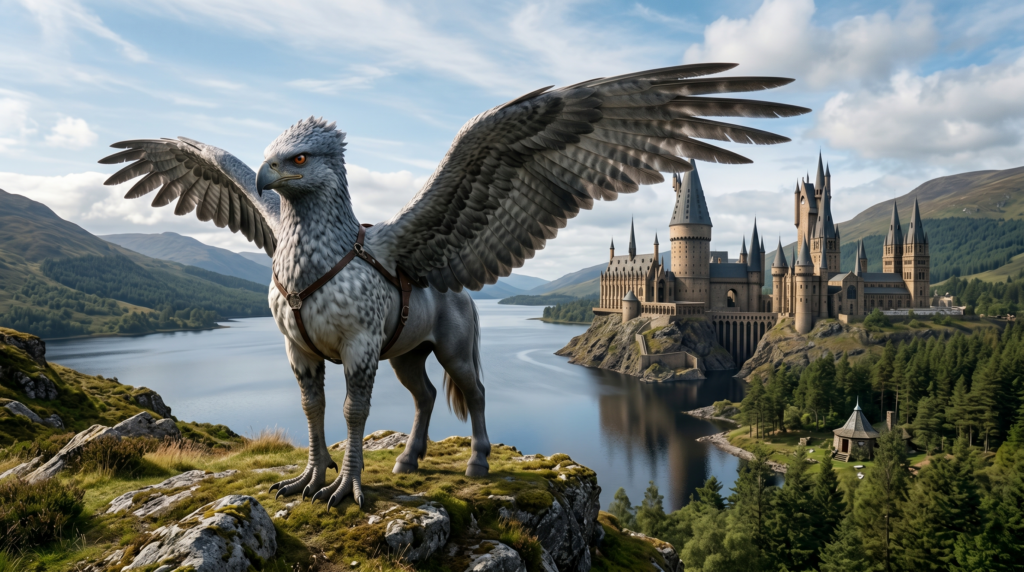
According to Newt Scamander’s Fantastic Beasts and Where to Find Them, a Hippogriff is a creature native to Europe, featuring the head, forelegs, and wings of a giant eagle, and the body, hind legs, and tail of a horse. Buckbeak specifically was a striking specimen. He possessed steel-grey feathers that blended seamlessly into a sleek, muscular horse-like body, accompanied by fierce, piercing orange eyes and razor-sharp talons up to half a foot long.
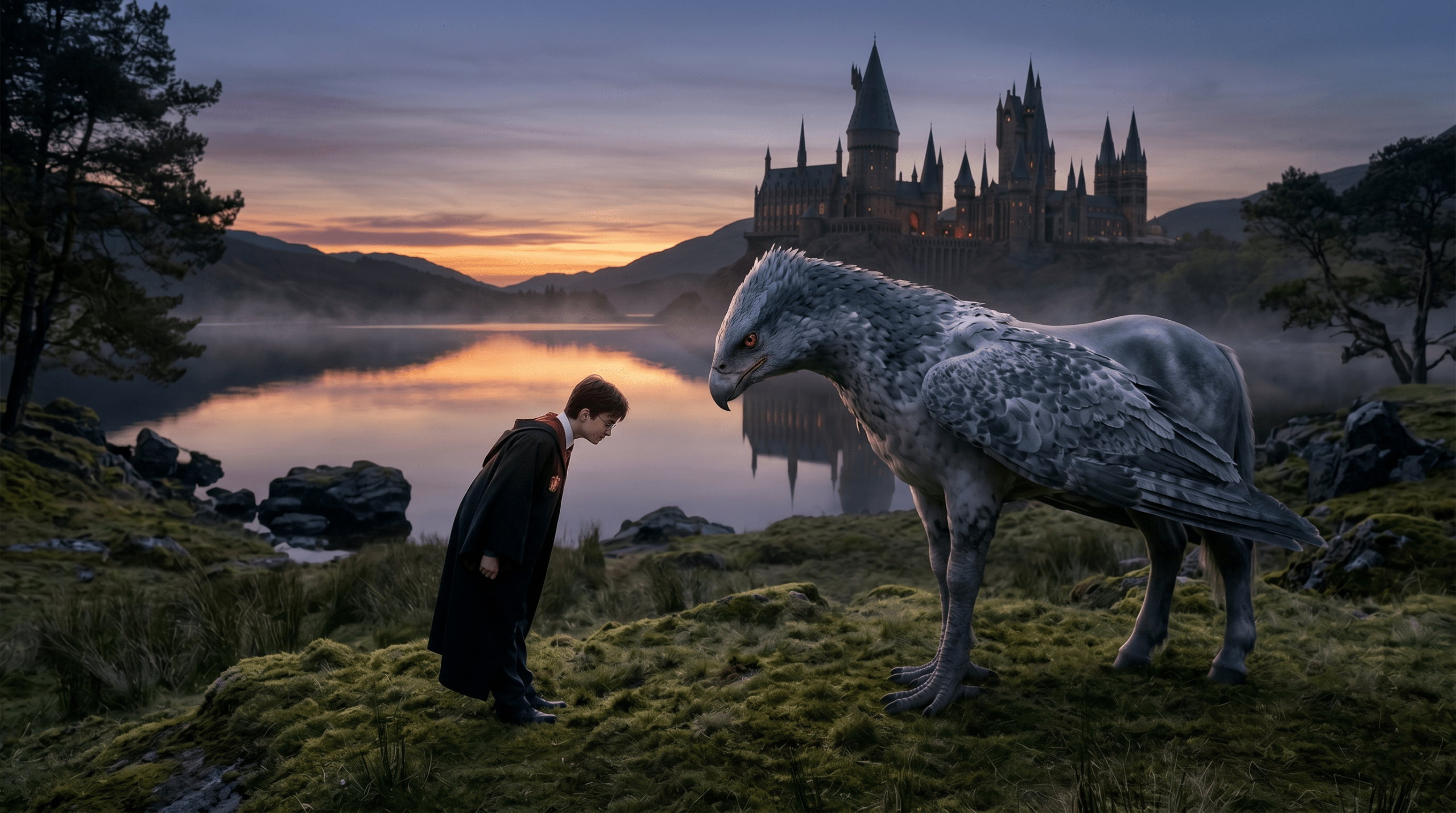
Hippogriffs are defined by one overriding character trait: immense pride. They are fiercely intelligent but easily offended. Wizarding etiquette mandates a strict protocol when approaching one. A witch or wizard must maintain unbroken eye contact, step forward, and bow deeply. Only if the Hippogriff bows in return is it safe to approach. Any sudden movements, breaks in eye contact, or insults can result in a swift, and often lethal, attack.
 First Appearance: Hagrid’s Care of Magical Creatures Class
Buckbeak made his dramatic debut in the fall of 1993, during Harry Potter’s third year at Hogwarts (Harry Potter and the Prisoner of Azkaban). This coincided with Rubeus Hagrid’s very first lesson as the new Care of Magical Creatures professor.
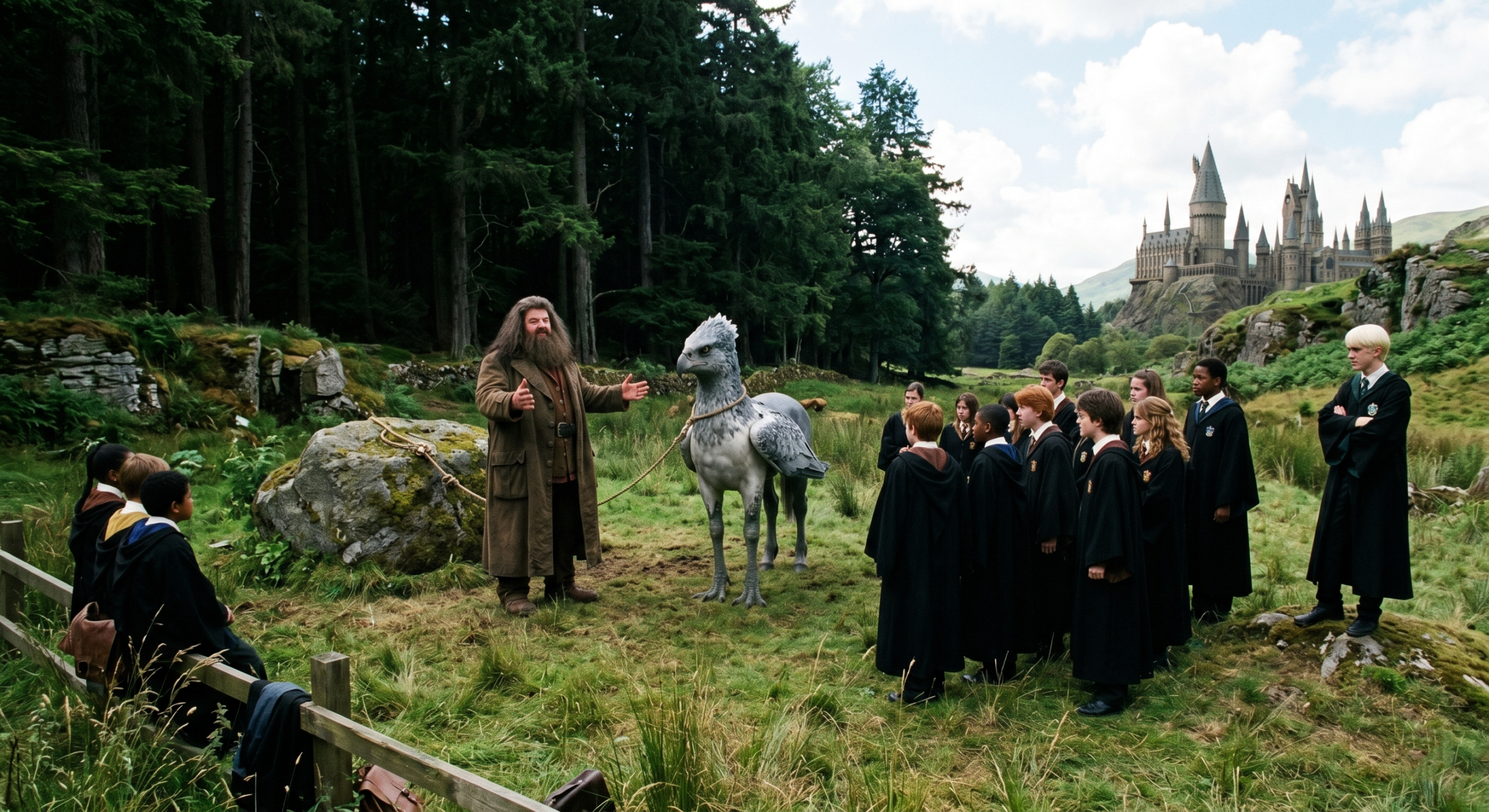
Hagrid, always eager to showcase misunderstood beasts, introduced a herd of Hippogriffs to his third-year Slytherin and Gryffindor students. Harry Potter was the first to successfully approach Buckbeak, following Hagrid’s instructions flawlessly. In return for Harry’s respect, Buckbeak allowed Harry to pat his beak and subsequently took him on a breathtaking flight over the Hogwarts castle and the Great Lake—a moment of pure cinematic magic that cemented a lifelong bond between the boy and the beast.
However, the lesson ended in disaster. Draco Malfoy, arrogant and dismissive of Hagrid’s warnings, swaggered up to Buckbeak without bowing and insulted him, calling him an “ugly great brute.” True to his proud nature, Buckbeak reacted instantly, slashing Draco’s arm with his talons. While the injury was superficial and easily healed by Madam Pomfrey, the political fallout from this single slash would shape the rest of Buckbeak’s life.
 The Complete Timeline of Buckbeak’s Life
Tracking Buckbeak’s whereabouts can be challenging, as his life was defined by moments of intense danger followed by years of isolated hiding. Here is the definitive chronological timeline of his heroic journey.
1993 – 1994: The Malfoy Incident & Sentencing
Following the incident in the paddock, Lucius Malfoy—Draco’s wealthy and politically powerful father—waged a campaign of intimidation against the Ministry of Magic. He pressured the Committee for the Disposal of Dangerous Creatures to hold a biased hearing. Despite Hagrid’s passionate defense, Hermione Granger’s extensive legal research, and the undeniable fact that Draco had provoked the creature, the Ministry succumbed to Malfoy’s influence.
Buckbeak was classified as a dangerous beast and unjustly sentenced to death. The execution was to be carried out on the Hogwarts grounds by Walden Macnair, a ruthless Ministry executioner who was secretly a loyal Death Eater.
June 6, 1994: The Time-Turner Rescue
The execution date marked one of the most critical turning points in the entire Harry Potter series. As Hagrid, Harry, Ron, and Hermione wept in Hagrid’s hut, they believed they heard the executioner’s axe fall, ending the Hippogriff’s life.
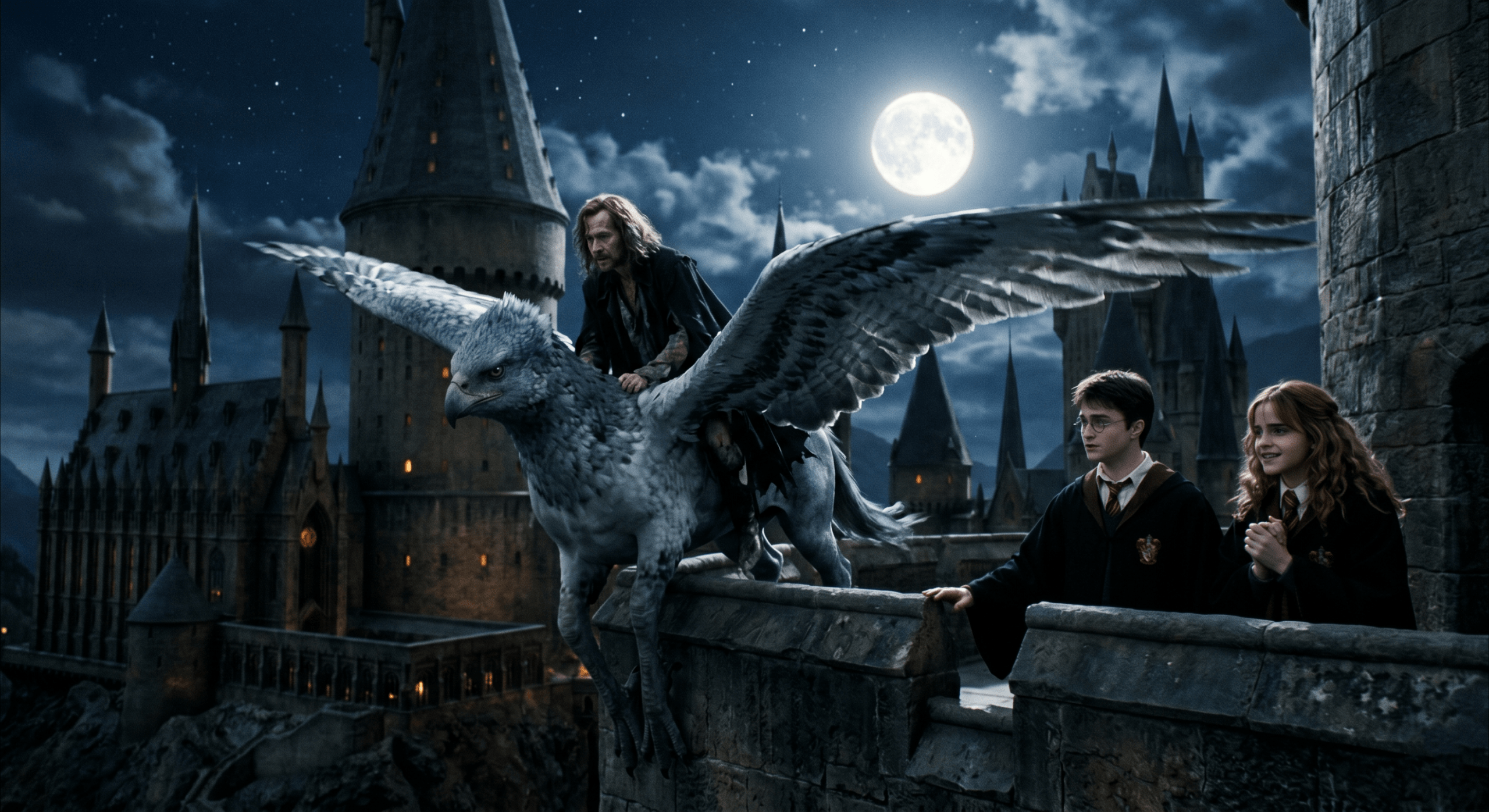
However, thanks to the brilliant intervention of Albus Dumbledore and Hermione Granger’s Time-Turner, the timeline was rewritten. Harry and Hermione traveled back in time to that same afternoon. Sneaking through the pumpkin patch while their past selves were inside the hut, they lured Buckbeak into the Forbidden Forest using dead ferrets. The “thud” their past selves heard was simply Macnair burying his axe into a pumpkin in a fit of rage after finding the creature missing.
Later that same night, Harry and Hermione rode the rescued Hippogriff to the Dark Tower, where Sirius Black was being held captive awaiting the Dementor’s Kiss. Sirius mounted Buckbeak, and the two fugitives flew off into the night sky, saving both of their lives in a single, masterful stroke of time magic.
 1994 – 1995: Life on the Run
For the next year, Buckbeak became Sirius Black’s sole companion as they lived as fugitives. They initially traveled to tropical climates, hiding out of the jurisdiction of the British Ministry of Magic. However, when Harry’s name was mysteriously drawn from the Goblet of Fire, Sirius refused to stay away.
Sirius and Buckbeak returned to Britain, taking up residence in a harsh, remote mountain cave just outside the wizarding village of Hogsmeade. Buckbeak survived during this period by hunting for small prey in the mountains and relying on food brought by Harry, Ron, and Hermione.
1995 – 1996: Confinement at Grimmauld Place
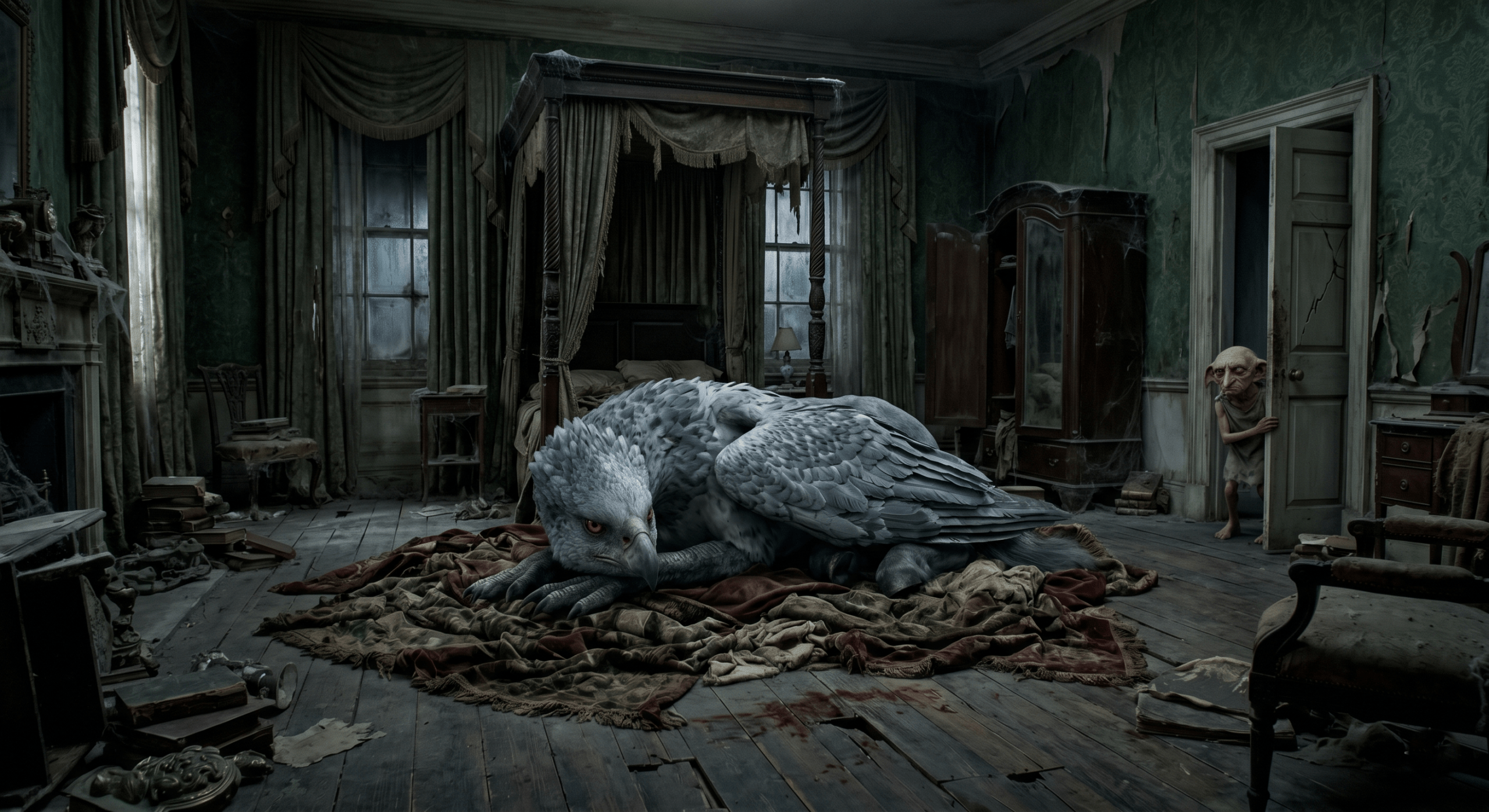
When Voldemort’s return became undeniable, Dumbledore reconstituted the Order of the Phoenix. Sirius offered his ancestral home, 12 Grimmauld Place in London, as their secret headquarters. Because both Sirius and Buckbeak were still highly wanted by the Ministry, they were trapped indoors.
Buckbeak was housed in the upstairs bedroom that formerly belonged to Sirius’s mother, Walburga Black. This period of confinement was miserable for the majestic outdoor creature, who spent his days eating dead rats and making the floorboards sticky with blood.
Crucial Lore Detail: During this time, the treacherous house-elf Kreacher intentionally injured Buckbeak. Kreacher knew Sirius would prioritize caring for the wounded Hippogriff, keeping Sirius away from the fireplace when Harry Potter used the Floo Network to check if his godfather was safe. This deliberate distraction led directly to Harry believing Sirius had been captured, triggering the tragic battle at the Department of Mysteries where Sirius ultimately lost his life.
 1997 – 1998: The Battles at Hogwarts
After Sirius’s death, Buckbeak returned to Hogwarts under a new alias (detailed below) and quietly lived in the Forbidden Forest. However, when war arrived at the school, the Hippogriff did not hesitate to fight for those who had protected him.
During the Battle of the Astronomy Tower in 1997, as Severus Snape fled the castle after killing Dumbledore, Buckbeak attacked Snape to protect Harry, slashing at the fleeing Potions Master and allowing Harry to survive the encounter.
A year later, during the climactic Battle of Hogwarts, Buckbeak proved his loyalty once more. Alongside a flock of Thestrals, Buckbeak led an aerial assault against Voldemort’s giants. They slashed at the giants’ eyes, neutralizing one of the Death Eaters’ most devastating weapons and helping to secure the ultimate victory for the forces of good.
The Complex Ownership of Buckbeak in Harry Potter
One of the most frequently asked questions by fans is: Who actually owned Buckbeak? The legal ownership of the creature is a fascinating exploration of Wizarding law and inheritance.
From Hogwarts Property to Sirius Black
Originally, Buckbeak was the property of Hogwarts School of Witchcraft and Wizardry, under the stewardship of Rubeus Hagrid. When the Ministry sentenced him to death, his legal status transitioned from school property to a condemned beast.
When Dumbledore orchestrated the rescue, a “gentleman’s agreement” of sorts took place. Dumbledore, representing Hogwarts, implicitly relinquished any claim to the creature, allowing Sirius Black to take him. From 1994 until 1996, Sirius Black was Buckbeak’s de facto and widely recognized owner, binding the two fugitives together.
Harry Potter’s Inheritance and the “Witherwings” Alias
Following the tragic events at the Department of Mysteries, Sirius Black’s last will and testament was executed. Sirius left all of his worldly possessions—including 12 Grimmauld Place, Kreacher the house-elf, and Buckbeak—directly to his godson, Harry Potter.
Legally, at sixteen years old, Harry Potter became the owner of a fully-grown Hippogriff.
Recognizing that he could not care for a magical beast while hunting Horcruxes, Harry and Dumbledore made a tactical decision. They returned the Hippogriff to Hagrid’s care. However, there was a major problem: Buckbeak was still a wanted fugitive in the eyes of the Ministry of Magic.
To bypass this legal hurdle, Buckbeak was officially renamed “Witherwings.” Hagrid presented “Witherwings” to the world as a completely different Hippogriff. Because Ministry officials were too terrified of Hippogriffs to inspect them closely, the ruse worked perfectly. This crucial plot point, which explains how he was able to safely return to Hogwarts grounds, was entirely omitted from the movie adaptations.
Hidden Lore and Behind-the-Scenes Facts
The transition of Buckbeak from the page to the silver screen brought its own kind of magic, alongside some significant changes to the canon lore.
Buckbeak in the Books vs. The Movies
In J.K. Rowling’s original Prisoner of Azkaban novel, Buckbeak was not the only Hippogriff featured during that fateful Care of Magical Creatures class. Hagrid actually brought a small herd of them to the paddock. The filmmakers, directed by Alfonso Cuarón, made the creative decision to isolate Buckbeak. By making him the only Hippogriff present, it amplified his uniqueness, raised the dramatic stakes of his impending execution, and streamlined the visual storytelling.
The Visual Magic: Bringing Him to Life on Screen
Creating a believable half-eagle, half-horse for a major motion picture in 2004 was a monumental task. The creature effects team utilized a brilliant hybrid approach, blending cutting-edge Computer Generated Imagery (CGI) with a massive, life-sized animatronic puppet.
The practical animatronic was a masterpiece of engineering. It was capable of blinking, moving its head, and bowing. Every single feather on the animatronic was hand-dyed and individually glued onto the rig to ensure it looked perfectly realistic when actors like Daniel Radcliffe or Gary Oldman had to physically interact with it on set.
What Happened to Buckbeak After the War?
For fans wondering about his ultimate fate, the answer is a happy one. Following the fall of Lord Voldemort at the Battle of Hogwarts, the Ministry of Magic was completely reformed under the leadership of Minister Kingsley Shacklebolt. The corruption that had originally sentenced Buckbeak to death was purged.
While J.K. Rowling has not detailed his every move post-war, it is canon that he survived the final battle. No longer needing the alias “Witherwings,” Buckbeak lived out the rest of his natural days in peace, roaming the Forbidden Forest and the Hogwarts grounds under the loving, watchful eye of Rubeus Hagrid.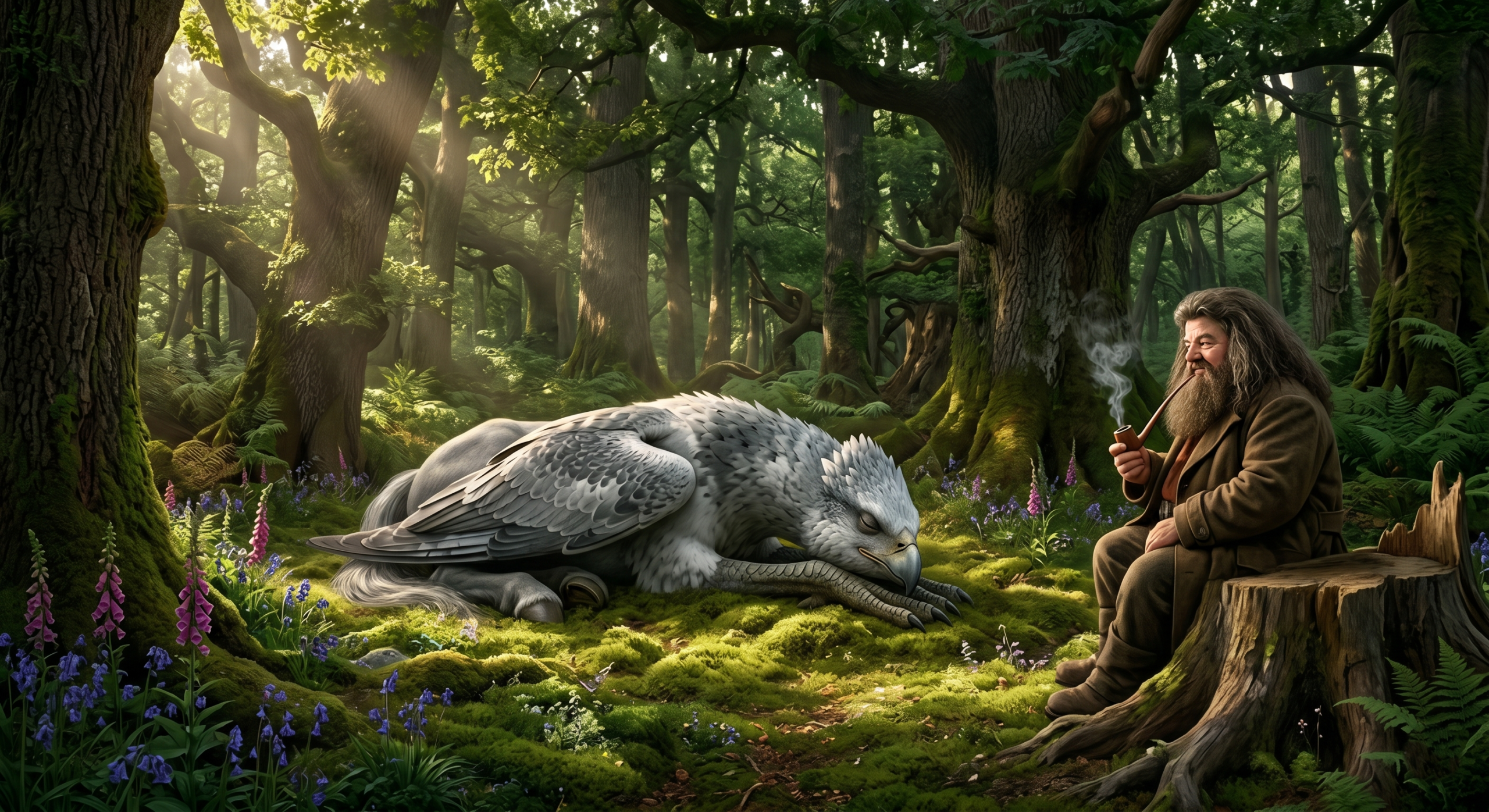
Frequently Asked Questions (FAQs)
Did Buckbeak actually die in Harry Potter?
No. While it appeared that he was executed in Prisoner of Azkaban, Harry and Hermione used a Time-Turner to rescue him just moments before the executioner swung his blade. The sound the characters heard was the axe hitting a pumpkin, not the Hippogriff.
Why did they change Buckbeak’s name to Witherwings?
After Sirius Black died, ownership of Buckbeak transferred to Harry Potter. To hide the creature from the Ministry of Magic—who still viewed him as a condemned, dangerous fugitive—he was renamed “Witherwings” and returned to Hagrid’s care in secret.
What does Buckbeak eat?
Hippogriffs are strictly carnivorous. Throughout the series, Buckbeak’s diet primarily consists of dead ferrets, dead rats, and whatever raw meat Hagrid or Sirius provided. In the wild, they are known to dig through the dirt to eat insects and worms when larger prey is scarce.
Is Buckbeak a Griffin?
No, he is a Hippogriff. A Griffin has the head and front legs of an eagle, but the body and hind legs of a lion. A Hippogriff, as seen in the Harry Potter series, has the body and hind legs of a horse.