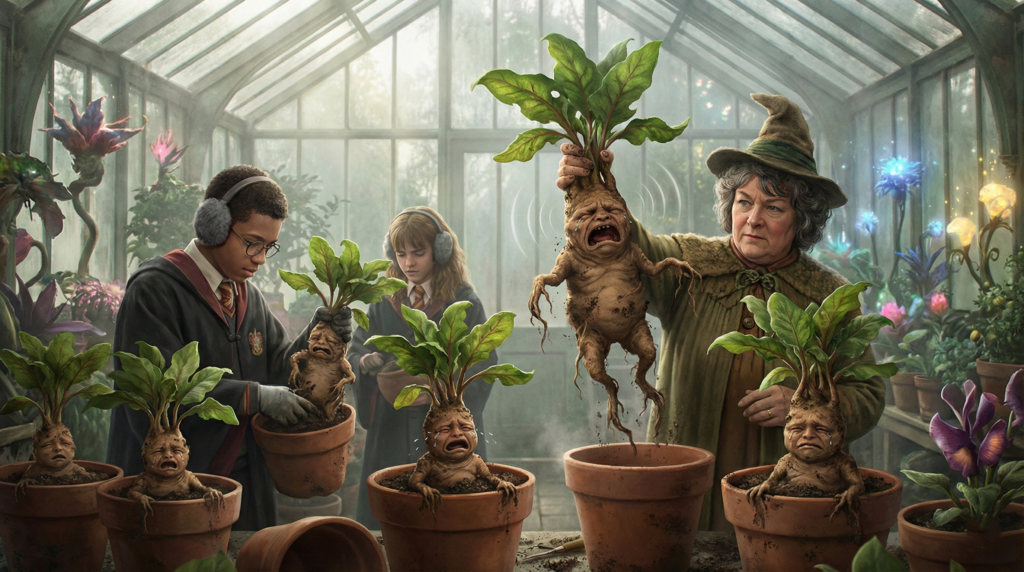
Imagine stepping into the humid, earthy greenhouses of Hogwarts School of Witchcraft and Wizardry. Second-year students stand in a nervous cluster, thick woolen earmuffs clamped over their ears. Professor Sprout, sleeves rolled up, demonstrates the task: grasp the plant firmly, pull sharply, and repot it before the inevitable happens. Then comes the sound—a high-pitched, wailing cry that pierces the air like a distressed infant in full meltdown. The students wince, one faints dramatically, and the lesson continues.
This unforgettable scene from Harry Potter and the Chamber of Secrets has left millions of fans wondering about the so-called “crying plants in Harry Potter.” Search for the term online, and you’ll find curiosity about these strange, screaming roots: What are they? Why do they cry (or scream)? Are they real? And how do they fit into the larger magic of J.K. Rowling’s world?
The answer lies with Mandrakes (also known as Mandragora), the magical plants whose cries have become one of the series’ most iconic and chilling details. Far from gentle, tear-shedding flora, these plants are powerful, dangerous, and deeply rooted in both wizarding lore and ancient mythology. In this comprehensive guide, we’ll uncover everything you need to know about crying plants in Harry Potter—from their deadly screams and life-saving properties to real-world inspirations, film secrets, and fan debates. Whether you’re revisiting Chamber of Secrets, exploring Herbology trivia, or simply fascinated by the Wizarding World’s flora, this deep dive will answer your questions and reveal why Mandrakes remain one of the most memorable elements of the series.
What Are the “Crying Plants” in Harry Potter? Meet the Mandrakes
At the heart of the “crying plants” confusion is a simple but evocative description from official sources. According to the Wizarding World (formerly Pottermore), Mandrakes, or Mandragora, are described as “magical plants (resembling crying babies, initially) which have incredible, restorative powers.”
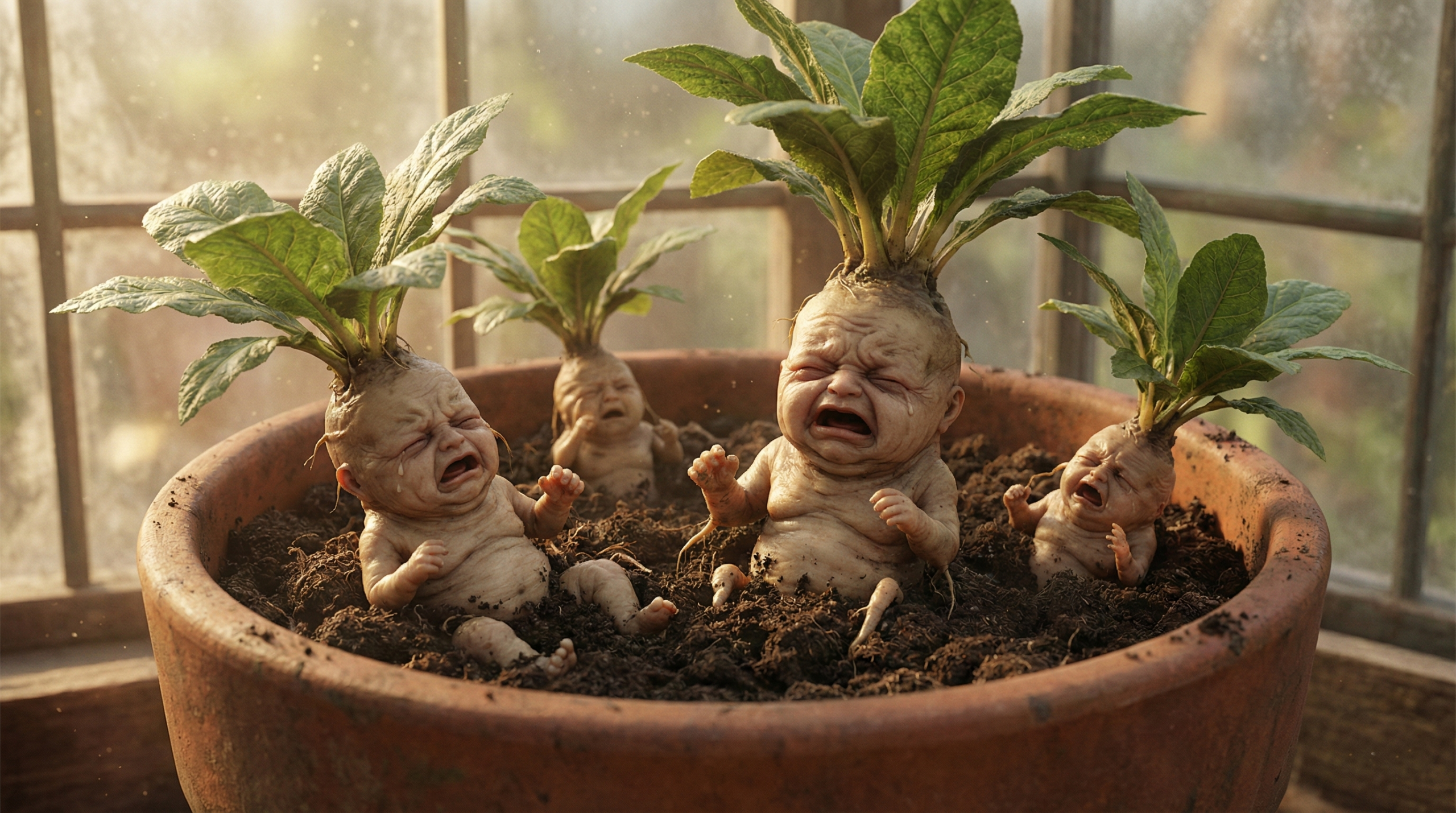
The young Mandrake’s root looks strikingly like a human infant—wrinkled, fleshy, with tiny arms, legs, and a contorted face frozen in what appears to be a wail. When pulled from the soil, it lets out a piercing cry that sounds exactly like a baby’s scream. This auditory “cry” is why fans shorthand them as crying plants in Harry Potter discussions, even though the books and films more precisely describe it as a scream.
 The Official Name and Description
Mandrakes belong to the Solanaceae family (the same as deadly nightshade and other poisonous plants). Young specimens are purplish-green and tufty above ground, unremarkable until uprooted. As they mature, the roots grow more humanoid, eventually resembling adults. In their “teenage” phase, they become moody, secretive, and even throw raucous parties in their pots—details that add a touch of whimsy to their otherwise menacing nature.
Why Fans Call Them “Crying Plants”
The books use “cry” and “scream” somewhat interchangeably. Hermione Granger famously explains: “The cry of the Mandrake is fatal to anyone who hears it.” Professor Sprout echoes this in class. The infant-like appearance combined with the wailing sound creates the perfect storm for the “crying” nickname. No, they don’t shed literal tears—the “crying” is purely sonic, a distress call amplified by magic.
Key Characteristics from Canon
These plants are semi-sentient. Mature Mandrakes can move between pots and exhibit behaviors like acne and mood swings. They attract pests such as Dugbogs (who love to eat their roots) and Flesh-Eating Slugs. Their leaves appear in advanced potions, including Animagus transformation aids, but the root is the star.
Understanding Mandrakes clarifies one of the series’ most puzzling plant-based moments and highlights Rowling’s genius in blending danger with everyday magic.
The Deadly Cry of the Mandrake: How It Works and Why It’s Dangerous
The scream is no mere annoyance—it’s a lethal defense mechanism.
The Science (Magic) of the Scream
When unearthed, every Mandrake screams. For seedlings and young plants, the cry knocks out anyone who hears it unprotected, leaving them unconscious for several hours. Mature Mandrakes take it further: their scream is fatal, powerful enough to shatter glass and kill instantly. Hermione states it plainly in class: “The cry of the Mandrake is fatal to anyone who hears it.” Professor Sprout confirms: “Precisely.”
The scream stops the moment the plant is replanted in soil, suggesting it’s triggered by exposure to air or uprooting.
Protection Methods in the Wizarding World
Hogwarts Herbology classes mandate protective earmuffs—brightly colored, fluffy ones that muffle the sound completely. In earlier centuries, students used cotton wool stuffed in their ears. The key rule: pull quickly, repot immediately, and never let the cry linger.
Memorable Scenes Featuring the Cry
The standout moment is the second-year Herbology lesson in Chamber of Secrets. Students repot young Mandrakes under earmuffs. Neville Longbottom faints dramatically after pulling his (in the book, from the shock; in the film, exaggerated for comedy). Draco Malfoy gets bitten when he mocks the process. The scene perfectly balances humor, tension, and world-building.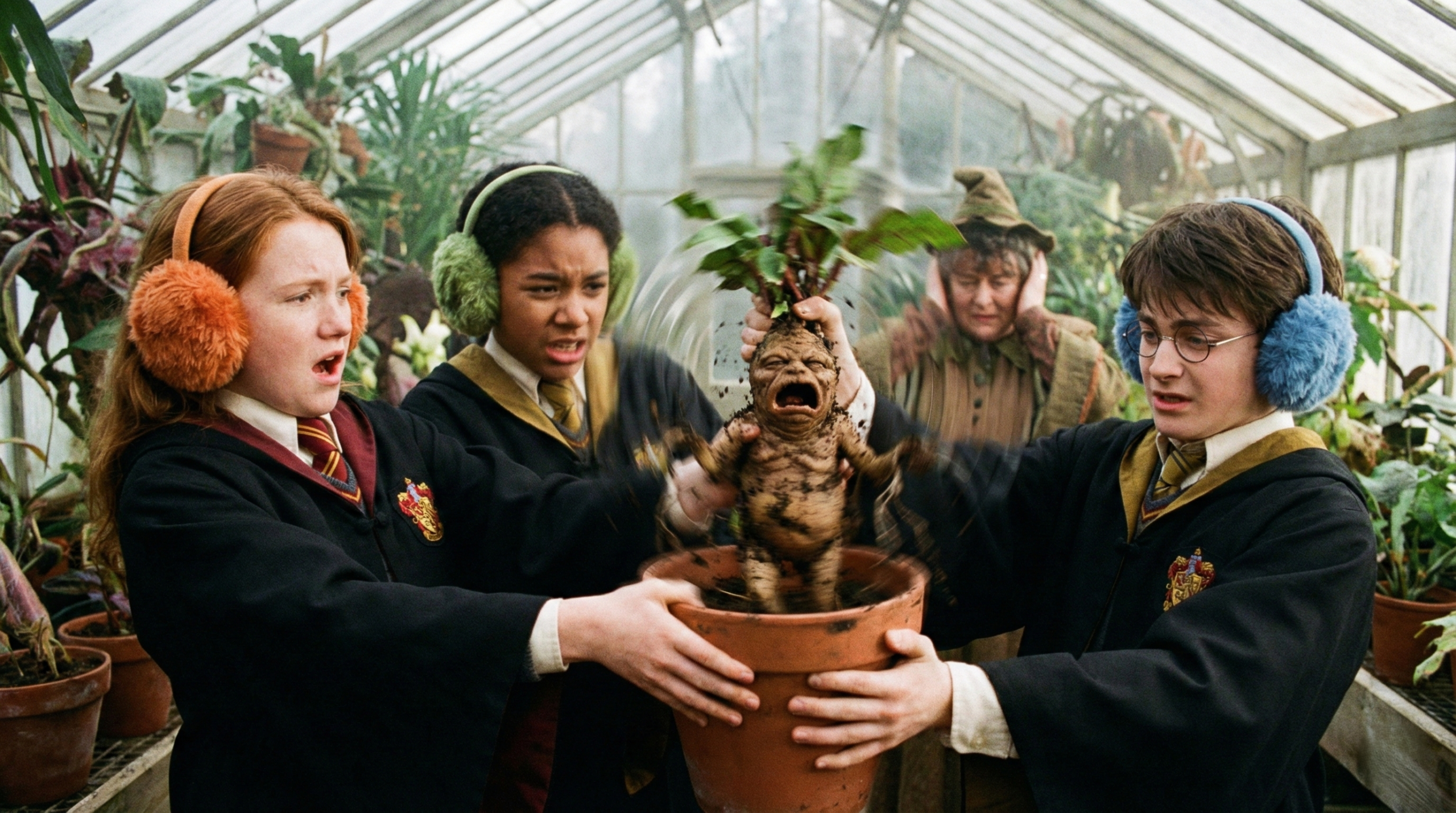
These details make the Mandrake’s cry one of the most visceral magical dangers in the early books—harmless in controlled settings, deadly otherwise.
Mandrakes’ Star Role in Harry Potter and the Chamber of Secrets
While the Mandrake scream provides one of the series’ most memorable comedic and creepy moments, their true narrative importance emerges as the plot of Harry Potter and the Chamber of Secrets unfolds.
The Petrification Crisis and Mandrake Draught
Throughout the book, students and a cat are attacked by the Basilisk, leaving them petrified—frozen in a rigid, statue-like state, fully conscious but unable to move or speak. Madam Pomfrey diagnoses the condition immediately: “They’ve been Petrified.” The only known cure is a complex potion called the Mandrake Restorative Draught.
Professor Sprout explains the timeline: “It takes Mandrakes several months to reach full maturity. Once mature, we can cut them up and stew them, and the resulting draught will revive those who have been Petrified.”
This creates genuine tension. The school is in lockdown, parents are threatening to withdraw students, and Harry, Ron, and Hermione are racing against time to find the Heir of Slytherin. The Mandrakes become a ticking clock—the longer they take to mature, the longer the victims remain trapped.
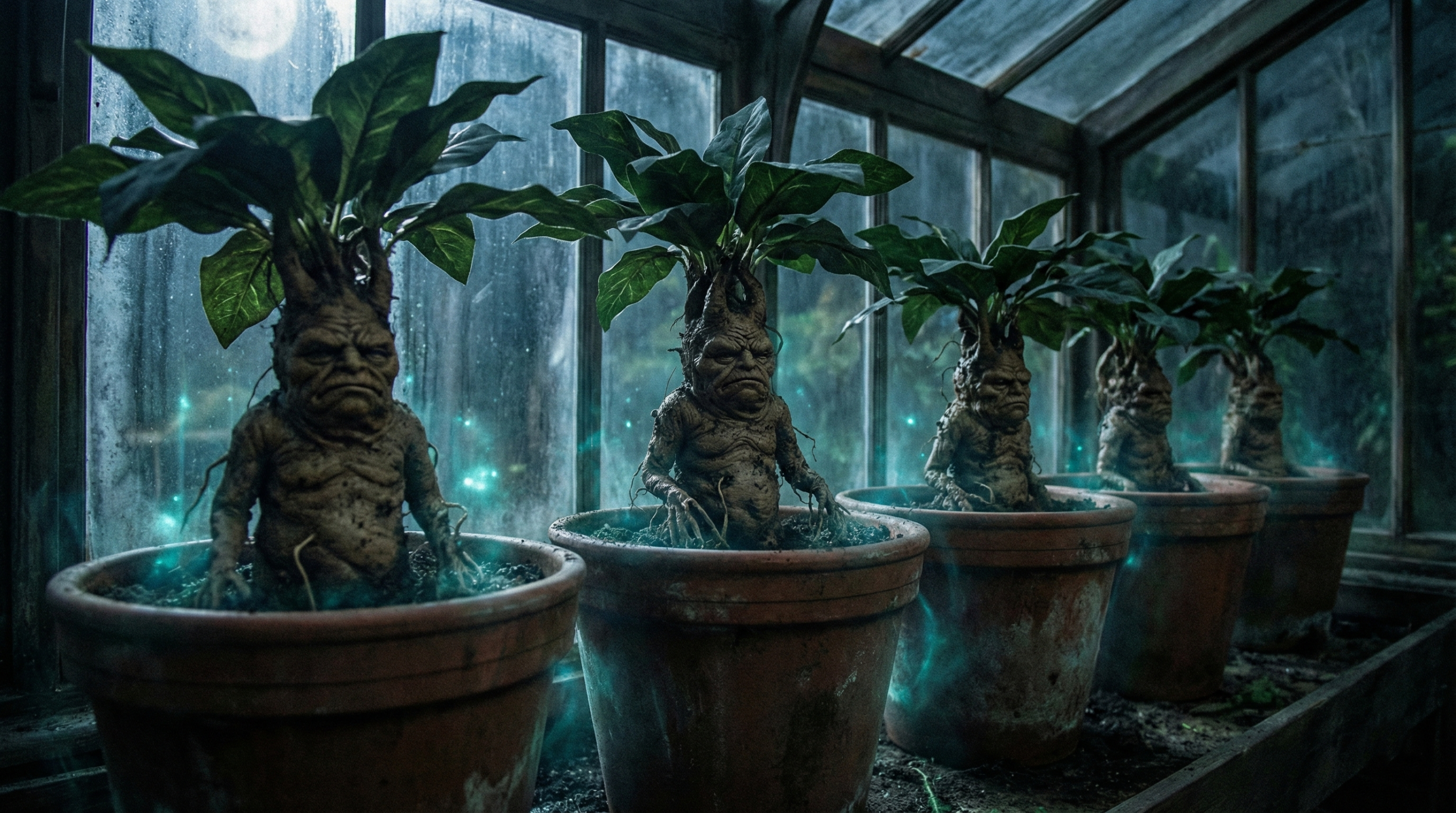 Snape brews the draught (despite his usual disdain for Herbology-related tasks), and by the end of the school year, the mature Mandrakes are ready. The victims—including Hermione, Justin Finch-Fletchley, Colin Creevey, Nearly Headless Nick, and Mrs. Norris—are revived in a touching hospital wing scene. The Mandrakes literally save the day.
Key Moments and Character Interactions
The greenhouse scenes serve multiple purposes. They introduce Herbology as more than just “plant-growing”—it’s dangerous, precise, and essential. Neville shines in these lessons; despite his early fainting spell, his natural talent with plants is evident when he handles his Mandrake confidently later.
Harry’s first encounter with a Mandrake scream also foreshadows his Parseltongue ability (both involve snake-like or creature communication), though the connection isn’t made explicit until later books.
Ethical Questions Fans Debate
One lingering question among Potterheads: Is it morally acceptable to chop up mature Mandrakes for potion ingredients?
The plants are clearly semi-sentient. Teenage Mandrakes throw tantrums, hide from each other, and display acne-like spots. Mature ones presumably have even more developed personalities. Yet the wizarding world treats them as harvestable crops—no outrage is expressed when they are “cut up and stewed.”
Some fans theorize that Mandrake sentience is limited or that their screams are instinctual rather than emotional. Others point out the hypocrisy: wizards have no qualms using parts of intelligent creatures (e.g., unicorn hair, dragon heartstrings) in wands and potions. The books never resolve this, leaving room for philosophical discussion in fan communities.
This moral gray area adds depth to the seemingly whimsical Herbology lessons.
Real-World Origins: The Mythology Behind Harry Potter’s Mandrakes
J.K. Rowling didn’t invent the screaming plant—she brilliantly adapted and expanded one of the oldest pieces of plant folklore in Western tradition.
Ancient Folklore and Legends
The real mandrake (Mandragora officinarum) is a Mediterranean plant in the nightshade family. Its thick, forked root often resembles a human figure—complete with what could be interpreted as arms, legs, and a head. For centuries, it was believed that when pulled from the ground, the mandrake would emit a deadly scream that could drive people mad, cause miscarriage, or kill outright.
Medieval texts warned harvesters to tie a dog to the plant and have the animal pull it up, sacrificing the dog to absorb the scream. The plant was then used in witchcraft, love potions, fertility rites, and as an anesthetic (its roots contain hallucinogenic and narcotic alkaloids like hyoscyamine and scopolamine).
Shakespeare referenced mandrakes in several plays, including Romeo and Juliet (“shrieks like mandrakes torn out of the earth”) and King Lear. The legend appears in ancient Greek, Roman, and Jewish texts, often linked to the gallows—mandrakes supposedly grew beneath hanged men, nourished by their bodily fluids.
 How J.K. Rowling Adapted the Myth
Rowling kept the core elements: human-shaped root, fatal scream when uprooted. She then layered on wizarding innovations:
- The scream is age-dependent (non-lethal when young, fatal when mature).
- The plant is fully magical, used in restorative potions rather than just poisons or hallucinogens.
- The baby-like appearance is literal, not just a root resemblance.
- Sentience and personality are added for humor and world-building.
The restorative power is a complete invention, turning a traditionally feared and sinister plant into a heroic one.
Modern Cultural Impact
Harry Potter single-handedly revived global interest in mandrake lore. Botanical gardens now field questions about “real Mandrakes,” and the plant appears more frequently in fantasy media, herbalism discussions, and even Halloween decorations. Rowling’s version has arguably become the dominant modern image of the mandrake.
Mandrakes in the Films: Behind-the-Scenes Magic
The 2002 film adaptation of Chamber of Secrets brought the crying plants to vivid life.
Sound Design Secrets
The Mandrake screams are a masterful blend. Young Mandrakes use recordings of actual babies crying, layered with higher-pitched distortions. Mature Mandrakes incorporate adult female screams for a more piercing, terrifying effect. Sound designer David Evans noted that the goal was to make the cry instantly recognizable as “baby in distress” while remaining otherworldly.
Visual Effects and Props
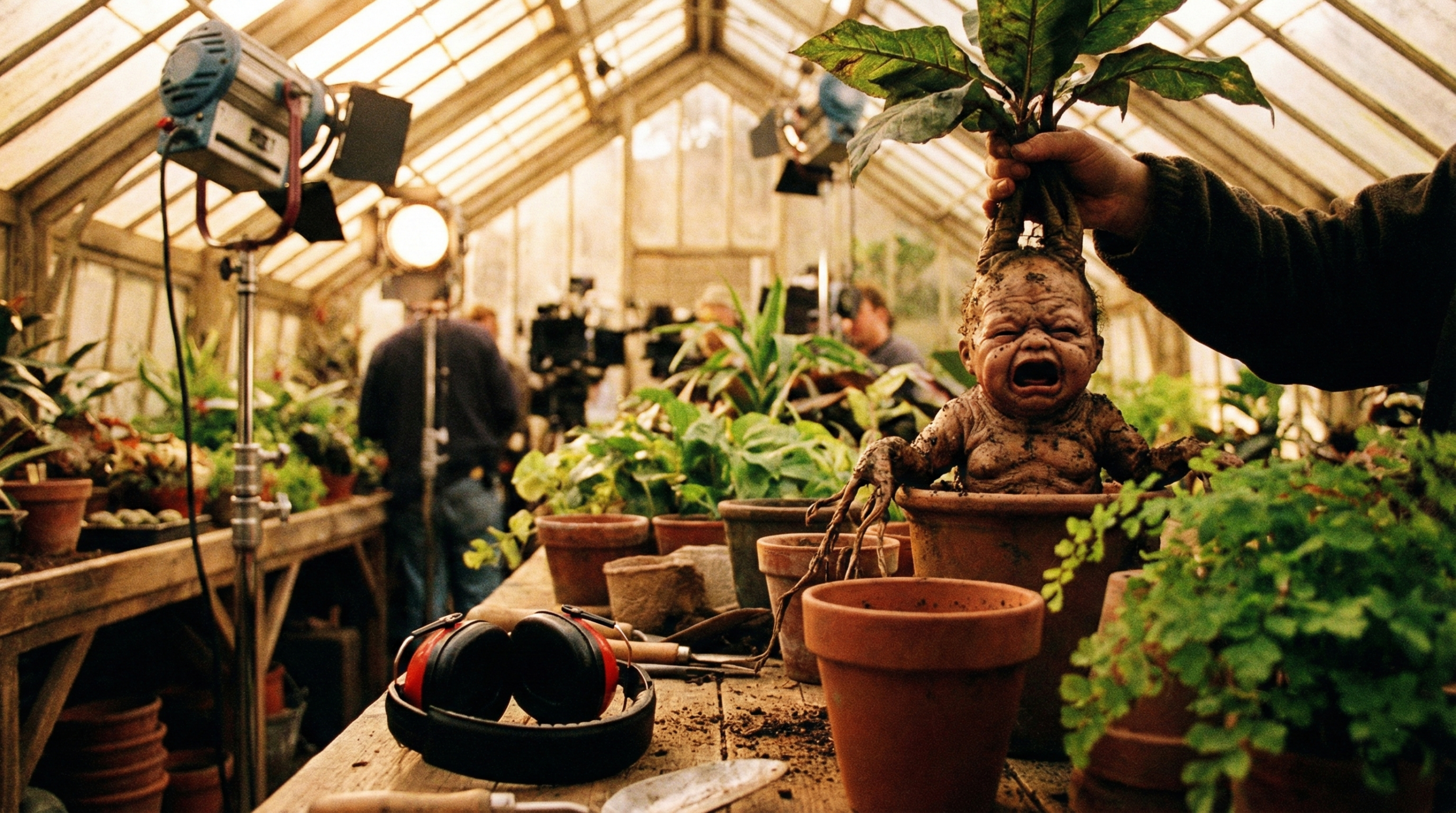
The young Mandrakes were a combination of practical puppets (with animatronic faces for wriggling and screaming) and early CGI for close-ups. The roots were designed to look wrinkled, fleshy, and disturbingly lifelike. The greenhouse sequence required dozens of synchronized puppeteers and sound cues timed to the actors’ reactions.
The result is one of the most memorable visual gags in the early films—equal parts funny and unsettling.
 Fun Facts, Similar Plants, and Mandrake-Inspired Ideas
Here are some additional tidbits and connections that deepen appreciation for these iconic crying plants in Harry Potter:
- Mandrakes are mentioned or appear briefly in later books and media. In Harry Potter and the Goblet of Fire, teenage Mandrakes are described as having “acne” and being “moody,” with some throwing “tantrums” by jumping between pots at night.
- The only known post-Chamber of Secrets appearance of mature Mandrakes in the main series is indirect: their restorative draught is referenced again in Order of the Phoenix hospital wing scenes.
- In the video game Hogwarts Legacy (set in the 1890s), players can grow, harvest, and use Mandrakes in combat—throwing them to stun enemies with their screams.
- J.K. Rowling has confirmed that Mandrakes are among the few plants she based directly on real folklore rather than inventing from scratch.
- The scream’s volume is so extreme that, in-universe, it’s said to be capable of breaking glass when a fully mature Mandrake is pulled.
Other “Emotional” or Sentient Plants in the Wizarding World
Harry Potter is full of plants that behave in surprisingly human (or animal) ways:
- Bubotubers — Produce yellowish pus used for acne treatment, but the plant itself squeals when prodded.
- Venomous Tentacula — Snaps and bites at anything that comes near; Professor Sprout keeps one chained up.
- Devil’s Snare — Reacts to heat and light, but relaxes when calm (almost like it’s sulking).
- Gillyweed — Not sentient, but dramatically changes the user’s body.
These examples show Rowling’s consistent theme: magic-infused nature is rarely passive.
Mandrake-Inspired Ideas for Fans
While you can’t grow a real screaming Mandrake (and shouldn’t try growing actual mandrake plants without expertise—they’re toxic), here are safe, fun ways to celebrate them:
- Craft earmuff replicas using bright yarn and headbands for cosplay or themed parties.
- Create Mandrake “pot babies” with clay, paint, and baby-doll faces peeking out of terracotta pots.
- Brew non-magical “Mandrake Restorative Draught” mocktails—green-colored lime soda with gummy worms for roots.
- Listen to sound-effect compilations of baby cries mixed with horror screams (available on YouTube and sound libraries) to recreate the greenhouse atmosphere.
- Read medieval herbals or Shakespeare passages about mandrakes to compare folklore with Rowling’s version.
These activities keep the magic alive long after finishing the books.
Frequently Asked Questions (FAQs)
Are there any actual crying plants in Harry Potter besides Mandrakes? No. Mandrakes are the only plants whose cries are described in detail and nicknamed “crying plants” by fans. Other plants may squeal or snap, but none produce the distinctive baby-like wail.
Do Mandrakes really cry tears, or is it just the sound? It’s purely the sound. The books and films never mention tears or liquid crying—only the piercing, scream-like cry.
What exactly happens if someone hears a mature Mandrake’s cry without protection? According to canon, it is instantly fatal. Hermione states: “The cry of the Mandrake is fatal to anyone who hears it properly.” No counter-curse or antidote is ever mentioned.
Are Mandrakes based on a real plant? Yes—Mandragora officinarum, a real nightshade species native to the Mediterranean. Its root was long believed to scream when uprooted, though the effect is folklore, not biology.
Why do young Mandrakes look like human babies? Rowling amplified real mandrake folklore (the root’s humanoid shape) into literal baby resemblance for dramatic and humorous effect. It ties directly into the “crying” nickname.
Can Mandrakes be used for anything besides the restorative draught? Yes. Mature Mandrake root appears in advanced potions (including some Animagus preparations), and the leaves are used in other brews. Their scream is occasionally weaponized in games and fan theories.
How long does it take for Mandrakes to mature in the books? Several months. They start as seedlings in early term and reach maturity by the end of the school year—conveniently timed for the cure.
Do the films change anything significant about Mandrakes? The scream is more exaggerated for comedic effect, Neville’s faint is played up, and the visual design is creepier than some readers imagined. The core lore remains identical.
Are Mandrakes considered dark magic or evil plants? No. They’re standard Herbology curriculum plants. Their danger comes from improper handling, not inherent evil.
These answers cover the most common long-tail searches and lingering curiosities about crying plants in Harry Potter.
The “crying plants in Harry Potter” are far more than a quirky Herbology detail—they’re a perfect microcosm of J.K. Rowling’s world-building genius. Mandrakes blend ancient folklore with original magic, deliver genuine danger, provide comic relief, drive plot tension, and ultimately become instruments of salvation.
Next time you reread Chamber of Secrets or rewatch the greenhouse scene, listen closely to that wail. It’s not just a scream—it’s the sound of centuries-old legend given new life, of second-years facing real peril, and of nature’s strangest gifts being turned toward healing.
If you’re a Potterhead who still gets chills (or giggles) at the thought of earmuff-wearing students wrestling screaming roots, you’re in good company. The magic of Mandrakes endures because it reminds us that even in a world of wands and spells, some of the most powerful forces grow quietly beneath the soil—waiting for the right moment to cry out.
Have a favorite Mandrake moment? Drop it in the comments below—I’d love to hear which scene still makes you laugh or shudder.