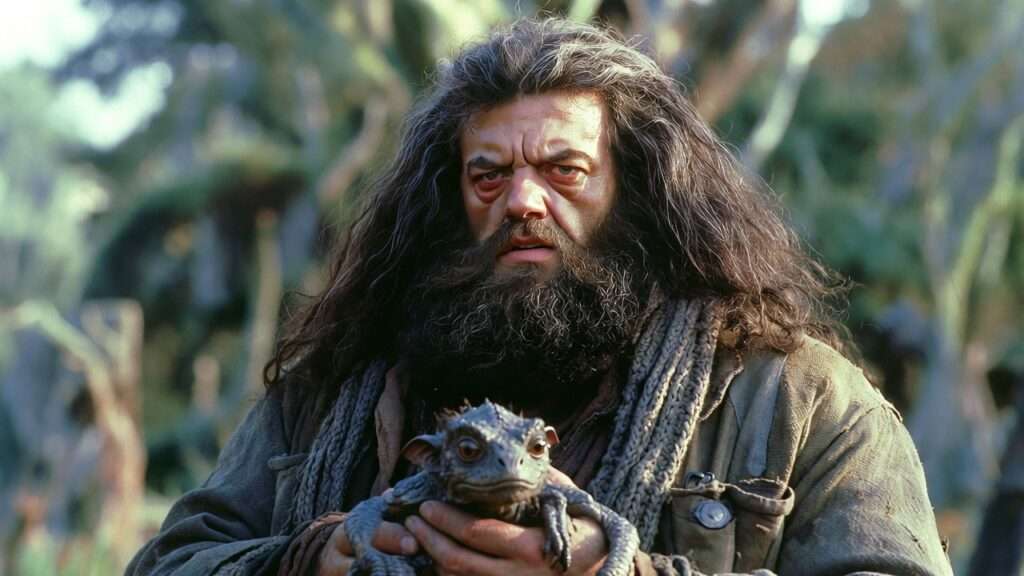
Imagine this scene: a stormy November night in 1981. A giant of a man roars down from the sky on a flying motorbike, his wild black hair and tangled beard whipping in the wind, his beetle-black eyes shining with a mixture of grief and fierce determination. He looks utterly exhausted, battle-worn, and — yes — profoundly haggard. This is how readers first meet Rubeus Hagrid in Harry Potter and the Philosopher’s Stone, and from that very first page, J.K. Rowling plants a linguistic Easter egg so clever that many fans only notice it years later.
The phrase haggard Harry Potter frequently appears in searches because people instinctively connect the word “haggard” (meaning worn-out, weary, or plagued by bad nights) with the half-giant groundskeeper. And they’re right to make the association — it’s no coincidence. J.K. Rowling deliberately crafted Hagrid’s name as a brilliant play on the old dialect term “hag-rid,” meaning someone who has endured a terrible, restless night — often after too much drink. In this in-depth exploration, we’ll uncover the etymology, examine how perfectly the name mirrors Hagrid’s physical appearance and emotional journey, explore the deeper themes it unlocks, and reveal why this remains one of Rowling’s most masterful pieces of wordplay.
Whether you’ve always wondered why Hagrid seems perpetually rumpled and weary, or you’ve just stumbled across the “haggard” similarity in fan discussions, this article will give you the complete picture — backed by Rowling’s own words, direct book quotations, historical linguistics, and years of Potter scholarship.
Unpacking the Etymology – What “Hagrid” Really Means
The True Origins of “Haggard” and “Hag-ridden”
The modern English word haggard carries two primary meanings today:
- Looking exhausted and unwell, especially from fatigue, worry, illness, or grief
- (In falconry) A hawk caught for training when already adult and therefore wild and difficult to tame
Both senses trace back to the same root. The term entered English in the 16th century from French hagard, originally meaning “wild” or “untamed” (especially of hawks). Over time, it evolved in English to describe a human appearance marked by weariness and dishevelment.
Even more revealing is the older dialect phrase “hag-ridden” (sometimes spelled “hag-rid”), which dates back to Middle English and early modern folklore. It described someone tormented at night by a “hag” — a witch or evil spirit believed to sit on a sleeper’s chest, causing nightmares, sleep paralysis, or a feeling of suffocation. By the 18th and 19th centuries, especially in rural English dialects, “hag-ridden” had taken on a secondary, humorous meaning: suffering the after-effects of heavy drinking — in other words, hungover and miserable.
This dual sense — supernatural torment + self-inflicted hangover misery — is exactly the flavor J.K. Rowling wanted to capture.
J.K. Rowling’s Direct Explanation
In a widely quoted 1999 interview with WBUR Boston (archived on Accio Quote!), Rowling explained:
“Hagrid is also another old English word meaning if you were ‘hag-rid,’ it’s a dialect word meaning you’d had a bad night. Hagrid is a big drinker and has many bad nights.”
She elaborated in other conversations that she loved collecting unusual dialect words, especially from the West Country and northern England, and deliberately chose names that carried both literal and symbolic weight.
Elsewhere she noted that “Rubeus” (Hagrid’s first name) comes from the Latin rubeus meaning “red” — hinting at his flushed cheeks, ruddy complexion, and tendency to become emotional (or flushed from firewhisky).
Together, Rubeus Hagrid becomes a name layered with meaning: a red-faced, wild, frequently hungover, perpetually exhausted but enormously warm-hearted man.
Phonetic Magic – Why “Hagrid” Sounds So Much Like “Haggard”
Say the names out loud: HAG-rid HAG-gard
The phonetic overlap is striking, especially in certain British accents where the final “-gard” and “-rid” blur together. Add the fact that Grawp, Hagrid’s giant half-brother, repeatedly calls him “Hagger” in Order of the Phoenix, and the connection becomes impossible to ignore.
This is classic Rowling wordplay — subtle enough to slip past younger readers on first reading, yet delightfully satisfying when discovered years later.
Hagrid’s “Haggard” Appearance – Book Descriptions vs. Reality
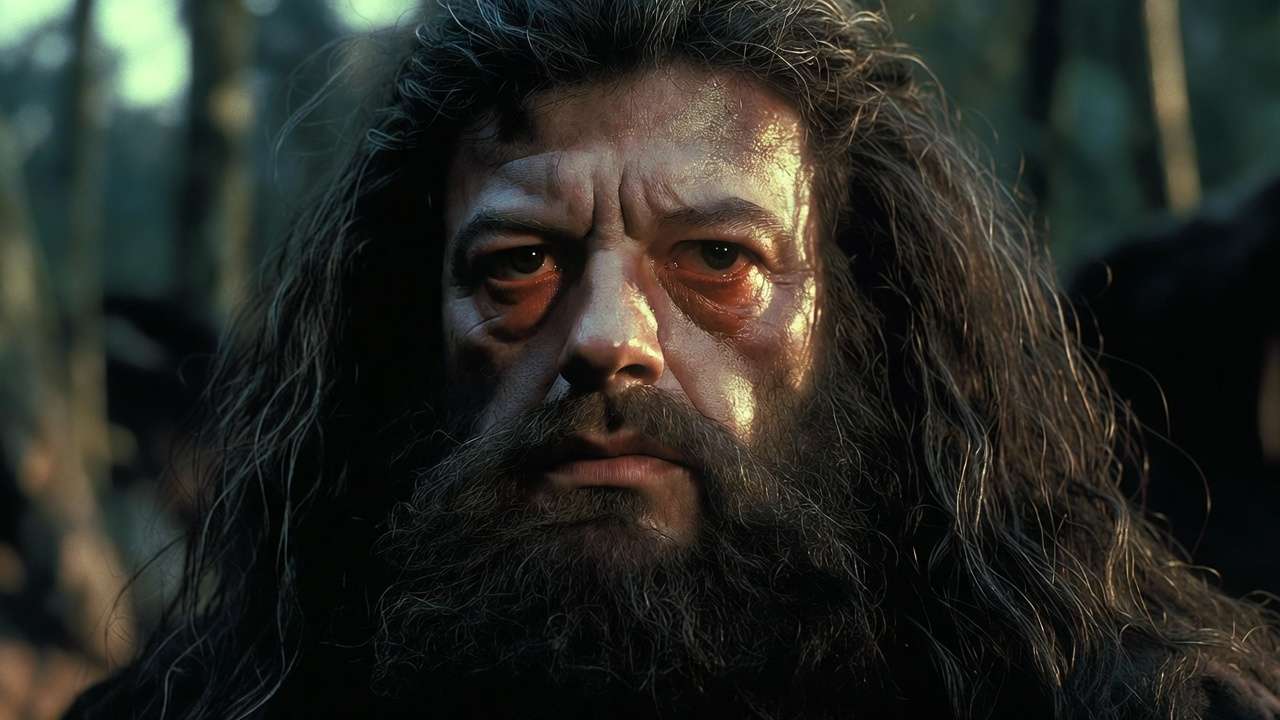
Iconic Physical Traits from the Books
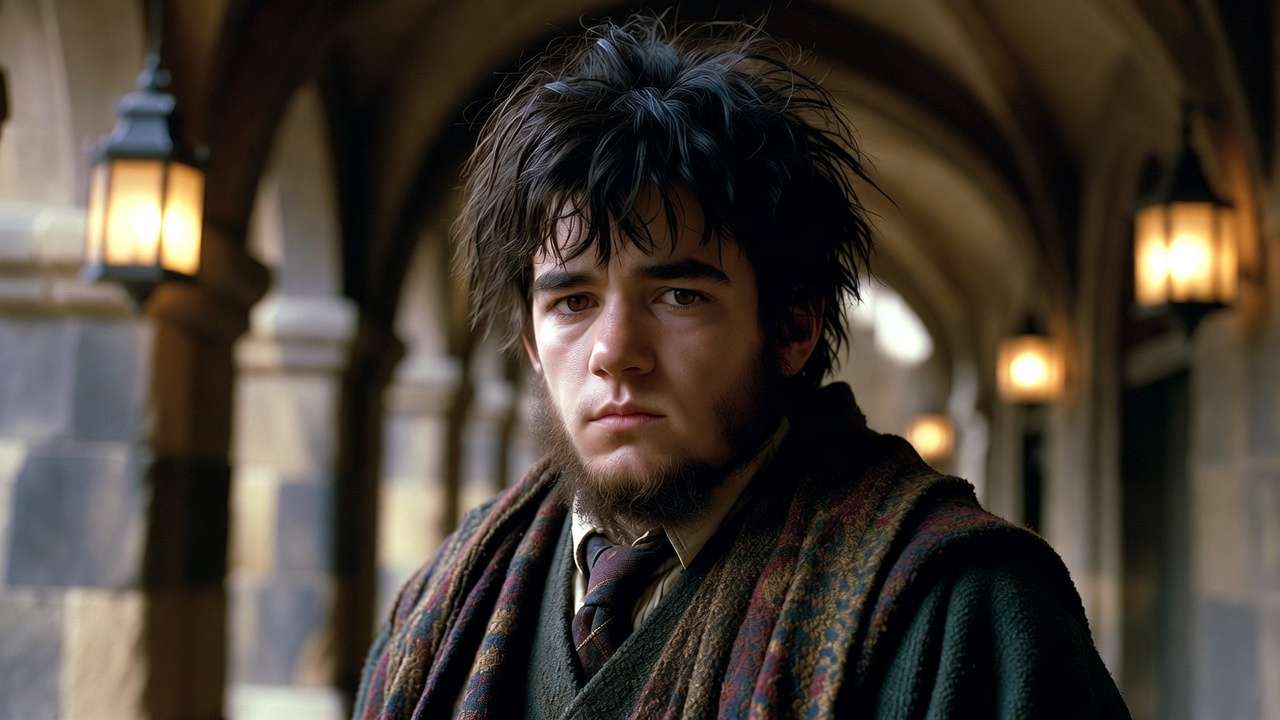
J.K. Rowling paints Rubeus Hagrid as larger-than-life in every sense. In Harry Potter and the Philosopher’s Stone, when Harry first meets him, he’s described as “almost twice as tall as a normal man and at least five times as wide,” with a “wild, tangled beard” that hides much of his face, and “shining beetle-black eyes” that often glint with emotion or tears. His hands are “the size of dustbin lids,” and his hair is long, shaggy, and black, giving him an untamed, rugged appearance that perfectly aligns with the modern meaning of haggard — exhausted, disheveled, and worn by life.
This description isn’t just for show; it reinforces Hagrid’s half-giant heritage. Giants in the wizarding world are portrayed as massive, rough, and often unkempt, and Hagrid’s mixed blood only amplifies that wild look. Yet Rowling balances it with warmth: his eyes “crinkle” when he smiles, and his face flushes ruddy (echoing his first name “Rubeus,” from Latin rubeus meaning “red” or “ruddy,” often associated with a flushed, hearty complexion from emotion, warmth, or — yes — drink).
Readers often note how Hagrid’s appearance evolves subtly across the series. In moments of joy (like hatching Norbert the dragon), he looks beaming despite the messiness. In grief (mourning Aragog or Buckbeak), he appears truly haggard — eyes red-rimmed, beard matted with tears, shoulders slumped under invisible weight.
Moments Hagrid Looks Truly Haggard
The books are filled with scenes where Hagrid’s exhaustion is palpable:
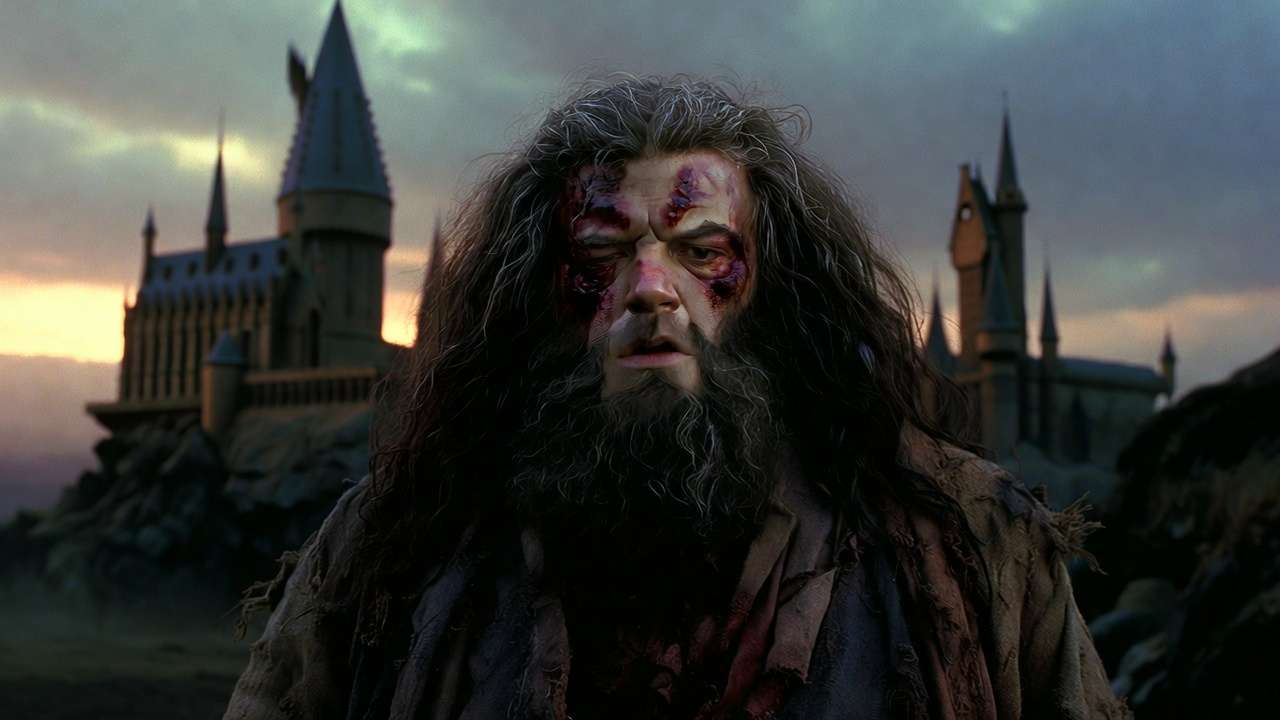
- After his secret mission to the giants in Order of the Phoenix, he returns bruised, bloodied, and weary, his clothes torn and his face etched with new lines of strain.
- When Buckbeak is sentenced to death, Hagrid breaks down sobbing in his hut, looking “more haggard than ever” as he drowns his sorrows in strong tea (and likely something stronger later).
- The most heartbreaking: In Deathly Hallows, Hagrid carries what he believes to be dead Harry through the Forbidden Forest. His face is “wet with tears,” his voice broken, every inch the tormented, hag-ridden protector.
These moments tie directly back to Rowling’s “bad nights” explanation — nights of worry, loss, and yes, heavy drinking to cope.
The “Bad Nights” Connection – Drink, Trauma, and Resilience
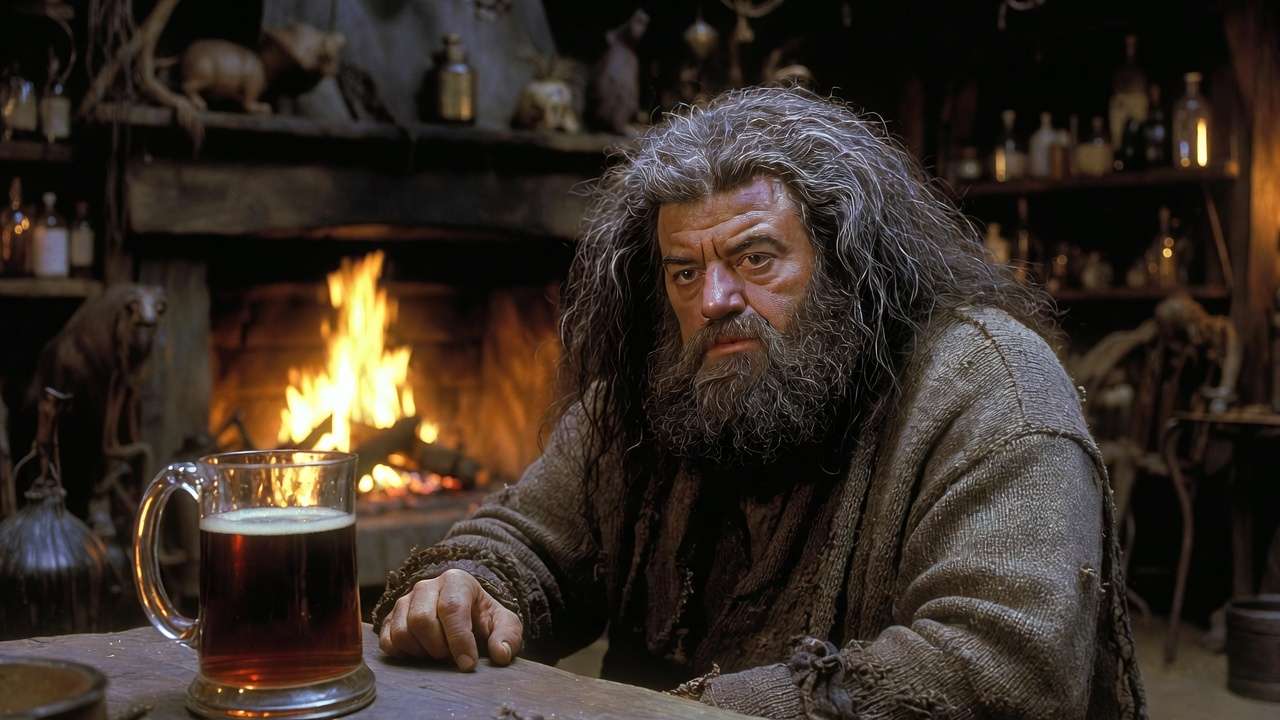
Rowling explicitly linked the name to dialect for someone who’d “had a bad night,” often implying a hangover. Hagrid is repeatedly shown enjoying firewhisky, rock cakes, and strong brews in his hut. After emotional blows, he turns to drink — not as a flaw, but as a very human (or half-giant) way to dull pain.
His “bad nights” aren’t just from alcohol, though. Hagrid carries deep trauma: expelled from Hogwarts at 13 for a crime he didn’t commit, accused of opening the Chamber of Secrets; prejudice against half-giants (he’s forced to hide his heritage); loss of his father young; rejection by the giant community; and constant fear for Harry’s safety. These weigh on him like the mythical hag pressing on a sleeper’s chest — the original folklore root of “hag-ridden.”
Yet Hagrid’s resilience shines. Despite looking haggard, he remains kind, loyal, and fiercely protective. His “bad nights” never break him; they make him more determined.
Deeper Themes – How “Haggard” Captures Hagrid’s Life Journey
The Outsider’s “Hag-ridden” Burden
At its core, the hag-ridden folklore origin speaks of an invisible, oppressive force that keeps someone from rest — a perfect metaphor for the constant prejudice Hagrid faces as a half-giant.
In the wizarding world, giants are feared and reviled, often stereotyped as violent and uncivilized. Hagrid’s mother Fridwulfa abandoned him and his father when he was young, and his giant heritage is a source of lifelong shame and danger. He must hide his true nature, even from close friends for many years. This secret weighs on him like the mythical hag sitting on his chest — preventing true peace.
The discrimination he endures mirrors real-world experiences of marginalization, and Rowling uses the name to underscore this quiet, ongoing torment. Hagrid’s “bad nights” aren’t just hangovers; they are nights spent worrying about being discovered, about Harry’s safety, about the world’s judgment.
Yet he never lets bitterness take root. Instead, he channels that burden into fierce loyalty and kindness — the very qualities that make him so beloved.
Wild Yet Noble – The Falconry Angle
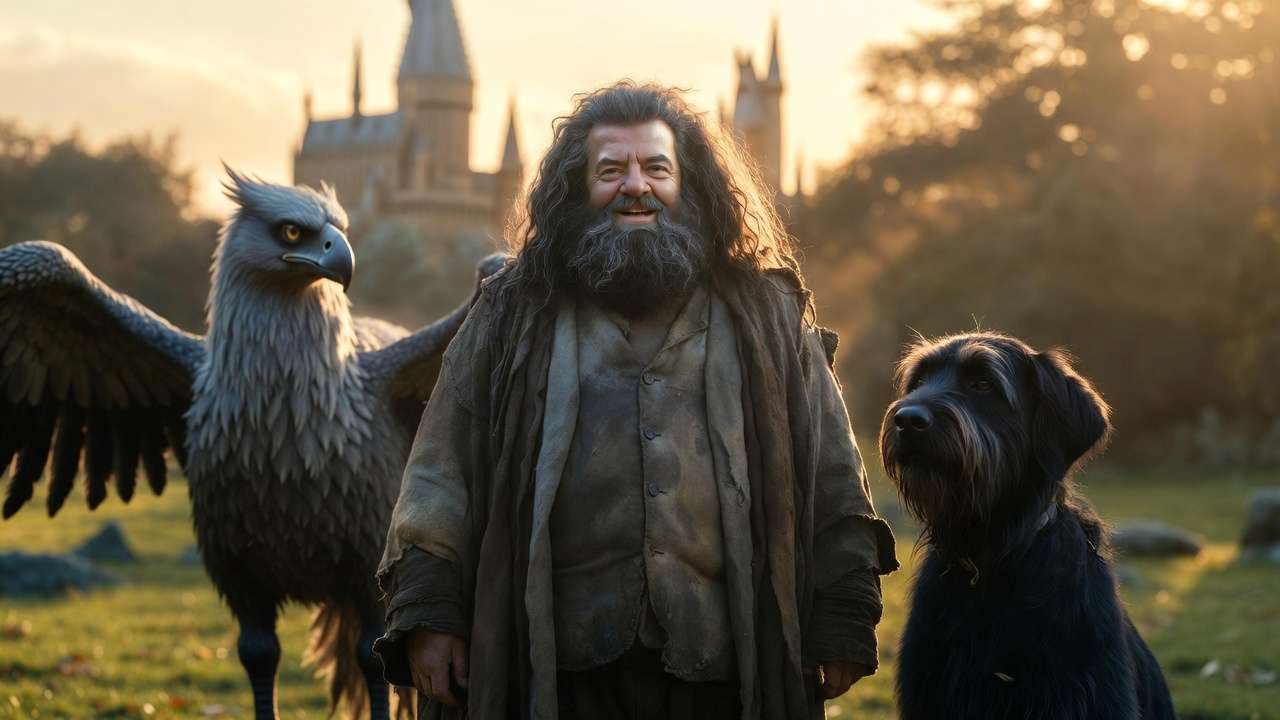
The secondary meaning of haggard — a wild-caught hawk, untamed and difficult to train — adds another beautiful layer.
Hagrid is undeniably “wild”: he keeps dangerous magical creatures (dragons, blast-ended skrewts, thestrals, Aragog), lives in a hut full of chaos, and speaks with a thick West Country accent that marks him as an outsider to the refined wizarding elite.
But like a haggard hawk, he is noble and majestic in his own way. Once these birds are caught and trained, they become powerful allies. Hagrid, too, proves himself time and again: saving Harry as a baby, protecting the school, standing up to Death Eaters, and ultimately earning the respect he deserves when his name is cleared and he becomes a fully recognized professor.
This dual meaning — exhausted and wild, yet trustworthy and strong — encapsulates Hagrid better than any other word could.
From Expelled Student to Heroic Protector
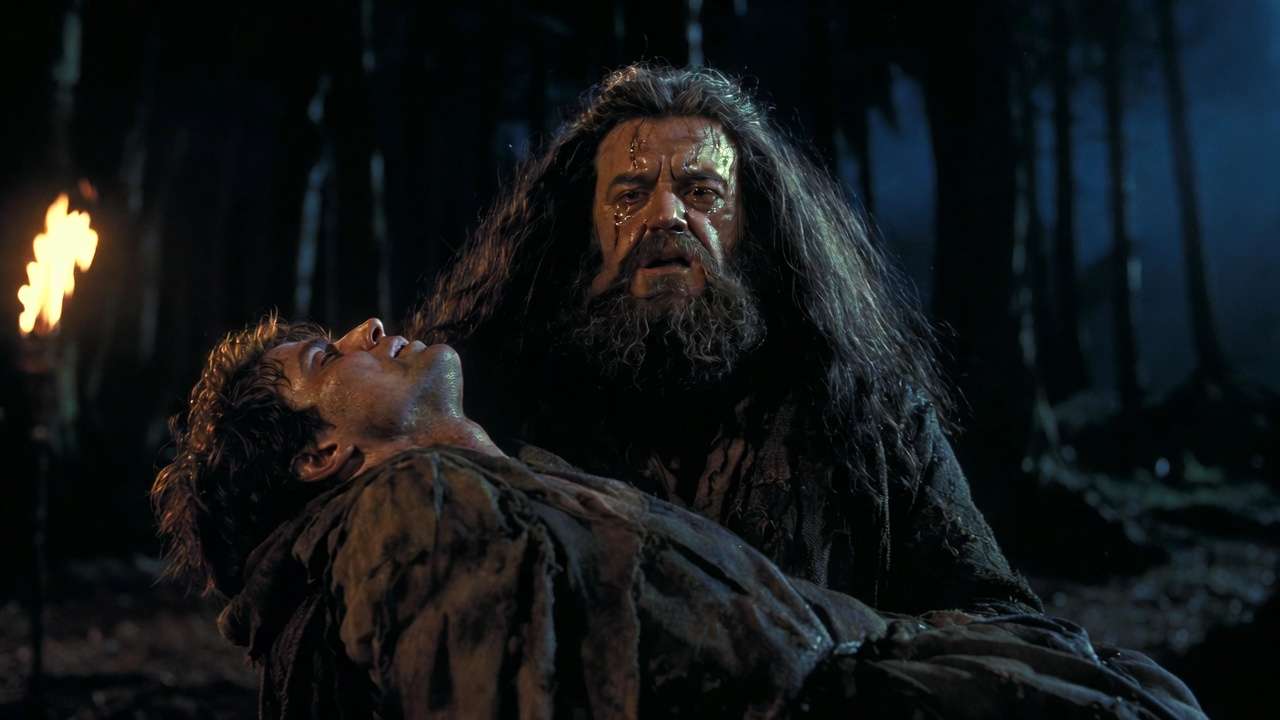
Hagrid’s arc is one of the series’ most satisfying redemptions.
- Expelled at age thirteen, wand snapped in half, dreams of becoming an Auror shattered
- Spends decades as gamekeeper, quietly serving Hogwarts
- In Chamber of Secrets, his name is cleared after fifty years of suspicion
- In Prisoner of Azkaban, he finally teaches Care of Magical Creatures
- By Deathly Hallows, he is carrying Harry’s “body” through the forest, weeping openly — a haggard figure who has given everything for love
The name “Hagrid” foreshadows this entire journey: a man who has known many bad nights, who has been worn down by life, yet who rises every time with unbreakable heart.
Fan Discoveries, Theories, and Cultural Impact
Reddit and Community Reactions to the “Haggard” Pun
The “haggard Harry Potter” connection has become a beloved piece of fan lore, especially on platforms like Reddit, Tumblr, and TikTok.
One of the most popular threads on r/harrypotter (dating back to the mid-2010s and still referenced today) asks: “Did anyone else just realize Hagrid is literally named after being ‘hag-ridden’?” Hundreds of comments poured in with variations of “mind blown” and “Rowling is a genius.” Many users shared screenshots of dictionary definitions next to book quotes, while others joked about Hagrid’s firewhisky consumption being “canonically explained by his own name.”
On TikTok, short videos reading Rowling’s 1999 quote alongside clips of Robbie Coltrane looking especially weary have garnered millions of views, often captioned with phrases like “Hagrid has been telling us he’s hungover this whole time” or “The most accurate character name in literary history.”
Even younger fans who encounter the books for the first time in the 2020s report the same delighted reaction: the name isn’t just funny — it’s deeply intentional.
Comparisons to Other Brilliant Rowling Names
Hagrid’s name is far from the only example of Rowling’s linguistic mastery. She consistently uses etymology, anagrams, Latin roots, and dialect to deepen character:
- Remus Lupin — “Lupine” means wolf-like; Remus was raised by a she-wolf in Roman myth.
- Sirius Black — The brightest star in Canis Major (the Dog Star); he can transform into a black dog.
- Albus Dumbledore — “Albus” = white (his long silver beard); “Dumbledore” is an old English word for bumblebee, reflecting his gentle, wandering nature.
- Severus Snape — “Severus” = stern/severe; “Snape” evokes a sharp, cutting edge.
What sets Hagrid apart is how emotional and human the name feels. While many others are clever or symbolic, “Hagrid” carries warmth, humor, and pathos all at once — a name that makes you smile and ache at the same time.
Why This Name Endures as Genius
The true brilliance lies in how slowly the layers reveal themselves.
A child reading Philosopher’s Stone for the first time simply sees a big, friendly giant. A teenager notices the drinking jokes and wild appearance. An adult rereading the series catches the dialect reference, the folklore roots, the falconry metaphor, and the quiet tragedy beneath the laughter.
That gradual discovery is exactly what makes Rowling’s world so re-readable. Twenty-five years after publication, fans are still finding new meaning in Hagrid’s name — proof of the depth she built into even the most seemingly straightforward characters.
Expert Insights – Lesser-Known Facts and Behind-the-Scenes
Robbie Coltrane’s Portrayal and Rowling’s Vision
J.K. Rowling has repeatedly stated that Robbie Coltrane was her first and only choice to play Hagrid. In a 2001 interview, she described him as bringing exactly the right blend of “gentleness and menace” to the role — a perfect embodiment of the haggard yet warm-hearted giant she had written.
Coltrane himself drew inspiration from a very specific archetype. In interviews (including one with the BBC during Philosopher’s Stone promotion), he revealed that he modeled Hagrid partly on a Hell’s Angels biker he once met: huge, intimidating on the outside, but surprisingly soft-spoken and kind once you got past the leather and tattoos. That real-world contrast mirrors the name’s dual nature — wild/haggard on the surface, deeply loyal underneath.
Coltrane’s performance also amplified the “bad nights” aspect: his eyes often looked bloodshot and weary, his voice gravelly and emotional, especially in scenes of grief or drunkenness. Many fans argue that the films made Hagrid appear even more haggard than the books, thanks to heavy makeup, prosthetics, and Coltrane’s natural ability to convey exhaustion without losing warmth.
A Timeline of Hagrid’s “Bad Nights” – Key Life Events
To truly appreciate how the name fits, here’s a chronological look at some of the most significant hardships that left Hagrid looking and feeling haggard:
- c. 1940s — Born to a wizard father and giantess mother; mother abandons family early, leaving deep emotional scars.
- 1943 — At age 13, expelled from Hogwarts and blamed for opening the Chamber of Secrets (later proven false in Chamber of Secrets).
- 1950s–1981 — Lives in isolation as gamekeeper, ostracized by much of wizarding society due to his giant blood.
- 1981 — On the night Voldemort falls, Hagrid flies through a storm to deliver baby Harry to the Dursleys — already looking haggard from grief over James and Lily’s deaths.
- 1992–1993 — Arrested again, sent to Azkaban briefly, and Buckbeak sentenced to death — multiple nights of sobbing and drinking in his hut.
- 1995–1996 — Secret mission to recruit giants for Dumbledore; returns battered, bruised, and emotionally shattered.
- 1997–1998 — Forced to serve Death Eaters at Hogwarts while secretly aiding the resistance; witnesses horrors and carries what he believes is Harry’s corpse in the final battle.
Each of these events adds another layer of weariness — literal and figurative — that the name “Hagrid” quietly foreshadows.
Rowling’s Early Planning: Hagrid Bookends Harry’s Story
In her earliest notes (some of which have been shared via the Harry Potter exhibition and Wizarding World website), Rowling planned for Hagrid to carry Harry twice: once as a sleeping baby on the motorbike in 1981, and once as what he believes to be a dead body in 1998. This symmetry is heartbreaking — the same haggard, loyal giant protecting Harry at the beginning and end of his journey.
She has called Hagrid “one of the first characters I ever thought of,” and his name was locked in from the very beginning, a testament to how carefully she built the emotional foundation of the series.
FAQs – Your Most Common Questions About Hagrid’s Name Answered
Is Hagrid’s name really based on “haggard”? Yes — directly confirmed by J.K. Rowling in multiple interviews. She described it as coming from the dialect term “hag-rid,” meaning someone who has had a “bad night” (often implying a hangover or restless sleep).
Why does Hagrid drink so much? Rowling intentionally tied his heavy drinking to the “hag-ridden” origin. It’s both comic relief and a realistic portrayal of someone using alcohol to cope with deep trauma, prejudice, and loss.
What does “Rubeus” mean in Hagrid’s name? From Latin, meaning “red” or “ruddy.” It reflects his flushed cheeks (from emotion, warmth by the fire, or drink), tying beautifully into the overall theme of a hearty, warm-hearted man.
Does Grawp calling him “Hagger” count as a clue? Many fans think so! It’s a delightful in-universe nod that makes the phonetic similarity even more obvious.
Is “haggard” also a falconry term? How does that fit? Yes — a haggard hawk is one caught wild as an adult, untamed and hard to train. Hagrid’s love for dangerous, “wild” creatures and his own half-giant wildness make this secondary meaning a perfect bonus layer.
Why is Hagrid so loved despite looking haggard? Because his appearance and struggles make him relatable. He’s not a perfect hero; he’s a flawed, exhausted, big-hearted man who chooses kindness every day. That’s what resonates.
Has Rowling ever talked about other name origins like this? Yes — she’s shared dozens, from Remus Lupin (wolf) to Sirius Black (Dog Star) to Dumbledore (bumblebee). Hagrid’s is one of the most emotionally layered.
Did the films make Hagrid look more haggard than the books? Many readers think so. Robbie Coltrane’s performance, combined with makeup and weary expressions, amplified the exhausted, rumpled look beautifully.
Rubeus Hagrid is so much more than a comic-relief giant with a fondness for dangerous creatures and strong drink. His name — that perfect, phonetic echo of haggard — is one of J.K. Rowling’s quietest yet most profound strokes of genius.
It captures everything we love and ache for in the character: the wild, untamed exterior; the nights of worry, grief, and firewhisky; the constant weight of prejudice and loss; and, most importantly, the unbreakable warmth and loyalty that shine through every layer of exhaustion.
The word haggard tells us that Hagrid has been through hell — literal bad nights, metaphorical hags pressing on his chest — and yet he keeps showing up. For Harry. For Hogwarts. For the creatures no one else will love. For hope itself.
That’s why, decades after the books were first published, the name still lands like a gentle punch to the heart. It reminds us that being worn down doesn’t make you weak. Sometimes it makes you the strongest, kindest person in the room.
So the next time you reread the series, pay attention when Hagrid appears — disheveled, red-eyed, voice cracking with emotion. Smile at the cleverness of the name, but also feel the depth behind it. Because haggard Harry Potter isn’t just a fun search phrase or a linguistic Easter egg.
It’s a tribute to one of the most beautifully human characters in modern literature.
Thank you for joining this deep dive into Hagrid’s name. Whether you’re a lifelong Potterhead or someone who just noticed the similarity for the first time, I hope you now see the half-giant in an even warmer, richer light.
What’s your favorite Hagrid moment — the one that makes you laugh, cry, or both? Drop it in the comments below. I’d love to hear.