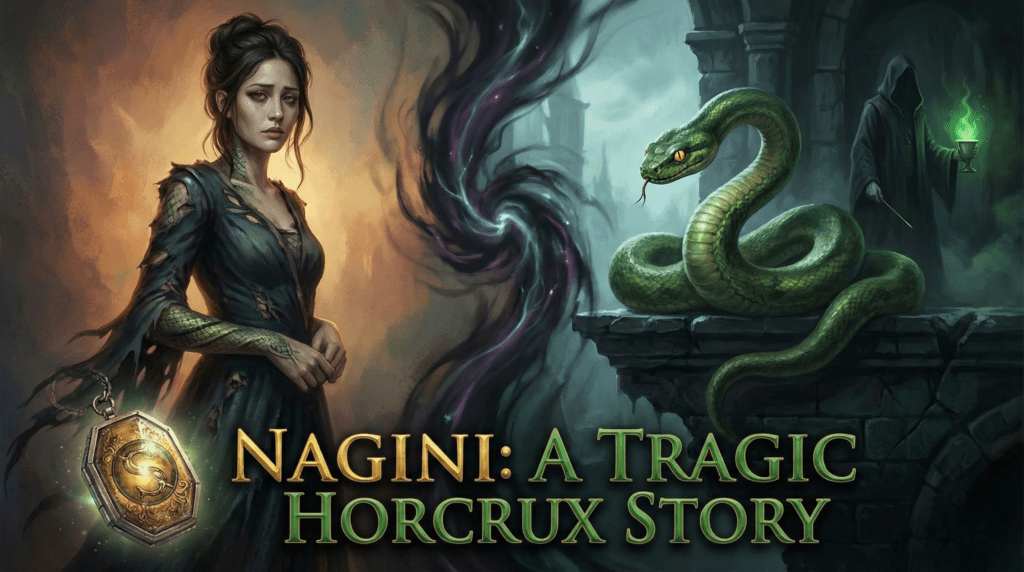
In the shadowy depths of the Riddle House, a massive green snake slithers across the dusty floorboards. Her scales catch the faint moonlight as she rises, coils tightening, and hisses a single, chilling promise to the Dark Lord: “I will bring you the boy.” That snake was no ordinary serpent. She was Nagini — the Harry Potter snake Nagini — Voldemort’s most loyal companion, his living Horcrux, and, in a heartbreaking twist revealed years later, a cursed woman who once walked as a human being.
For millions of fans, Nagini began as simply “the big snake that hangs around Voldemort.” Yet her story is one of the most tragic and complex in the entire Wizarding World. From her origins as a Maledictus in the 1920s to her final, violent death at the Battle of Hogwarts, Nagini’s journey encapsulates themes of prejudice, irreversible loss, exploitation, and the terrible cost of dark magic.
In this in-depth guide, we’ll uncover everything you need to know about the Harry Potter snake Nagini: her human past, the blood curse that stole her humanity, how she became Voldemort’s deadliest weapon, her key moments across the series, and why her fate still sparks passionate debate among fans more than two decades after the final book’s release. Whether you’re revisiting the books, rewatching the films, or diving into Fantastic Beasts for the first time, this comprehensive exploration will finally give you the complete picture of one of J.K. Rowling’s most misunderstood and heartbreaking characters.
Who Is Nagini? The Basics of Voldemort’s Loyal Serpent
Nagini in the Original Harry Potter Series
Nagini makes her first chilling appearance in Harry Potter and the Goblet of Fire (1994). She is described as an enormous, emerald-green snake measuring roughly twelve feet in length, with a thick, muscular body and eyes that gleam with unnatural intelligence. Unlike ordinary snakes, Nagini displays clear signs of sentience: she understands complex commands, communicates telepathically with Voldemort, and even seems to relish her role as both protector and executioner.
Throughout the series, readers and viewers witness several unforgettable traits:
- Parseltongue mastery — As a snake, she naturally speaks the language of serpents, but her bond with Voldemort goes far beyond ordinary Parseltongue communication.
- Unusual loyalty — While most of Voldemort’s followers serve out of fear, Nagini appears genuinely devoted, almost affectionate.
- Physical prowess — She is venomous (likely a king cobra or similar species), incredibly strong, and capable of constricting and killing adult wizards with terrifying efficiency.
These qualities set her apart from every other snake in the Wizarding World, making early fans wonder: Why is this particular serpent so special to the Dark Lord?
Nagini’s Role as a Horcrux
The answer came in Harry Potter and the Deathly Hallows. Nagini was not merely a pet — she was Voldemort’s final Horcrux.
Voldemort created the snake Horcrux sometime after his return to a rudimentary body in 1994, using the murder of Bertha Jorkins as the catalyst. Unlike his other Horcruxes (the diary, ring, locket, cup, diadem, and Harry himself), Nagini was a living creature. This choice carried enormous risk: a living Horcrux could be killed more easily than an inanimate object, and its destruction would immediately alert Voldemort.
Albus Dumbledore explains the reasoning in Harry Potter and the Half-Blood Prince:
“He did not want to entrust his Horcrux to anything that could be stolen or destroyed by accident… He preferred to keep his most valuable possession close.”
After his failed Killing Curse in 1981, Voldemort’s disembodied spirit relied on Nagini’s venom to sustain a fragile, snake-like body (the potion described in Goblet of Fire included “snake venom” and “unicorn blood”). In this way, Nagini literally kept Voldemort alive during his weakest years — making her destruction the final, decisive blow in his downfall.
Nagini’s Tragic Origins – From Human Woman to Eternal Snake
What Is a Maledictus? Explaining the Blood Curse
The single most shocking revelation about Nagini came not from the original seven books, but from Fantastic Beasts: The Crimes of Grindelwald (2018).
In a quiet scene set in 1927 Paris, we meet a young woman named Nagini (played by Claudia Kim) working as a performer at the Circus Arcanus. She confides in Credence Barebone that she is a Maledictus — a woman afflicted with a rare, inherited blood curse that causes permanent, irreversible transformation into a beast.
Key characteristics of the Maledictus curse include:
- It affects only women (passed from mother to daughter).
- The transformation is gradual, beginning with short periods as the animal form and eventually becoming permanent.
- Unlike an Animagus transformation, the change is involuntary and strips away human sentience over time.
- Once the final transformation occurs, the person is trapped forever in animal form, losing all memory of their human life.
J.K. Rowling later confirmed on social media that the Maledictus condition is always fatal in terms of humanity: “She will never be human again.”
Nagini’s Early Life in Fantastic Beasts
The 1927 Nagini is a far cry from the cold, menacing serpent we meet in the 1990s. She is intelligent, kind-hearted, and deeply lonely. Trapped and exploited by the cruel ringmaster Skender at the Circus Arcanus, she befriends Credence Barebone (Aurelius Dumbledore) and forms a close, possibly romantic bond with him.
Together they escape the circus with help from Newt Scamander, Tina Goldstein, and Yusuf Kama. For a brief moment, it appears Nagini might find safety and perhaps even delay her curse.
But the timeline tells a different story.
 Between 1927 and the early 1990s — roughly 65–70 years — the curse completes its work. By the time Voldemort encounters her in the forests of Albania, Nagini is no longer capable of human speech, memory, or independent thought. She has become, in every meaningful sense, a snake.
How Nagini Became Voldemort’s Companion
The exact moment Voldemort first encountered the Harry Potter snake Nagini remains one of the great unsolved mysteries of the series, but canon and logical timeline clues point strongly to the forests of Albania sometime after 1992.
After his defeat in 1981, Voldemort’s disembodied spirit fled to Albania, where he had previously hidden (as described in Chamber of Secrets when he possessed animals and possessed Quirrell). By the early 1990s, Nagini — having fully succumbed to her Maledictus curse sometime in the decades following 1927 — was likely roaming as a wild, highly intelligent serpent. Snakes in Albania’s forests would have been natural hosts for Voldemort’s weakened form, as he had possessed them before.
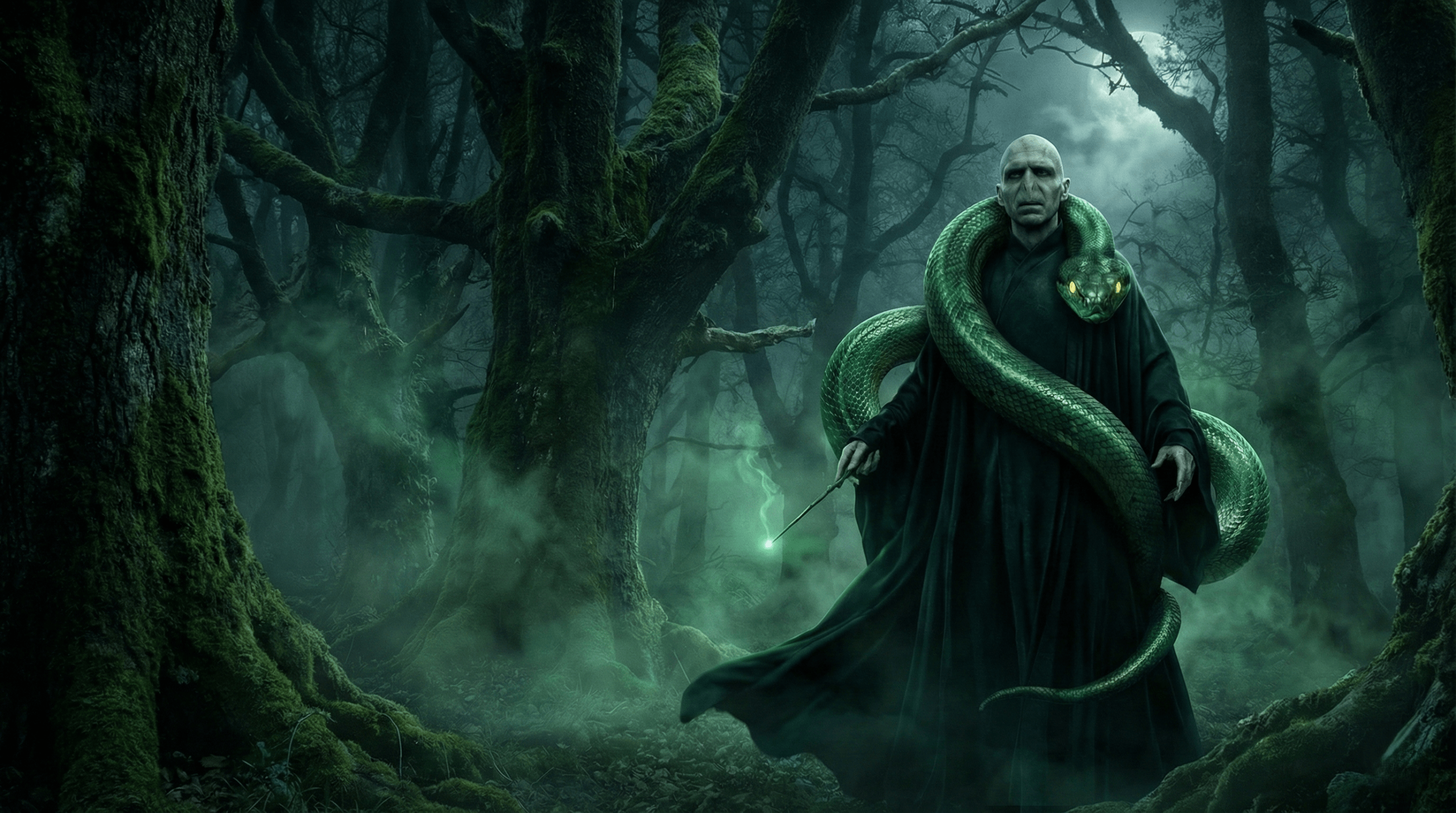 Theories suggest he sensed her unusual sentience (a remnant of her witch heritage) and forged a bond. This connection grew into deep loyalty, amplified when he made her a Horcrux in 1994 after murdering Bertha Jorkins. The act not only split his soul but bound her irrevocably to him — perhaps the closest thing Voldemort ever had to genuine companionship.
Dumbledore notes in Half-Blood Prince that Voldemort showed an unusual “fondness” for Nagini, almost treating her like a familiar. Whether this was exploitation of her curse, shared darkness, or something more twisted, their bond was unbreakable until the end.
The Dark Bond – Loyalty, Possession, and Affection?
Nagini’s devotion stands out among Voldemort’s followers. Death Eaters served through fear, ambition, or ideology; Nagini served through instinctual, almost primal loyalty. Her telepathic link allowed Voldemort to communicate directly in Parseltongue, issuing commands no one else could overhear.
This bond intensified after she became a Horcrux. The fragment of soul inside her may have further eroded any lingering humanity, turning her into the perfect, unquestioning weapon. Yet fans often debate: Was there real affection? Voldemort’s rare displays of emotion — rage at her near-death, reliance on her venom — suggest Nagini filled a void no human follower could.
In the end, she was both victim and enabler: a cursed woman exploited by the ultimate dark wizard, her tragedy magnified by the very soul piece meant to ensure his immortality.
Nagini’s Key Moments and Deadly Actions in the Harry Potter Series
Iconic Scenes from the Books and Films
Nagini’s presence haunts the later books and films with several terrifying set pieces:
- The Riddle House (1994) — Goblet of Fire opens with Nagini slithering through the abandoned house, detecting Muggle caretaker Frank Bryce. She alerts Voldemort, leading to Bryce’s murder — the first on-screen kill in the series (film). This scene establishes her as an intelligent guardian.
- Attack on Arthur Weasley (1995) — In Order of the Phoenix, Nagini possesses Arthur Weasley at the Ministry of Magic. Harry experiences the attack through Voldemort’s eyes in a prophetic vision, nearly killing Arthur. This moment highlights her danger as Voldemort’s remote weapon.
- Godric’s Hollow Ambush (1997) — Posing as the elderly Bathilda Bagshot (whose corpse she controls), Nagini waits for Harry and Hermione. The sudden transformation into snake form in the mirror is one of the films’ most jump-scare moments — Harry barely escapes as she lunges.
- Killing Severus Snape (1998) — In the Boathouse (film) or Shrieking Shack (book), Voldemort orders Nagini to strike Snape, believing the Elder Wand’s allegiance transfers through death. Snape dies in Harry’s arms, whispering his final memories — a brutal, personal execution carried out by the snake.
These scenes showcase Nagini’s evolution from silent companion to active assassin.
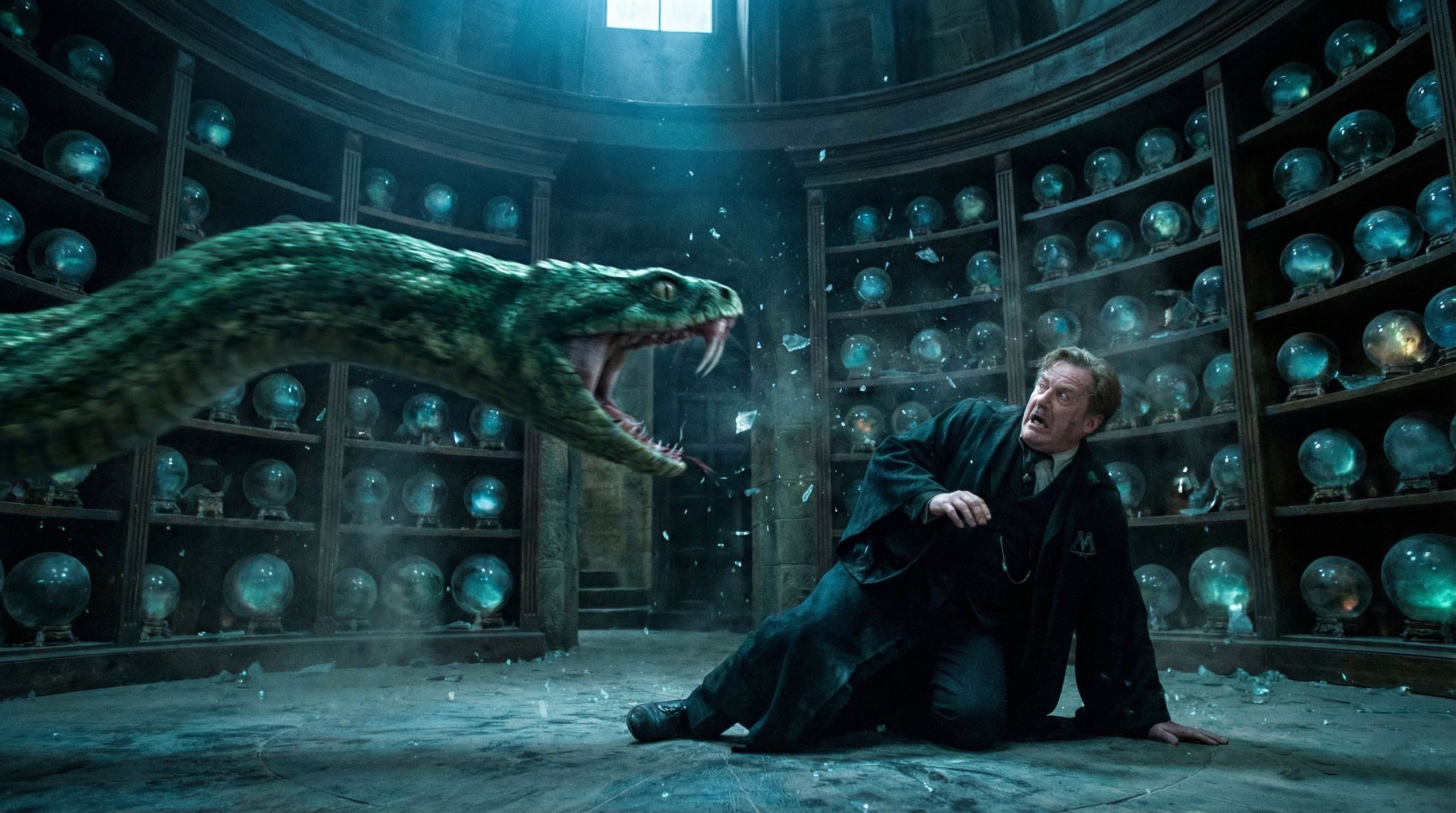 Her Role in the Second Wizarding War
Throughout the war, Nagini served multiple functions: enforcer, protector, and living Horcrux. She disposed of bodies (e.g., Charity Burbage in Deathly Hallows), guarded Voldemort, and struck fear into his enemies. Her presence amplified Voldemort’s aura of invincibility — until the final battle revealed her vulnerability.
Nagini’s Death and Its Impact – The End of the Final Horcrux
The Battle of Hogwarts Climax
The destruction of Nagini marks the turning point in the Battle of Hogwarts (May 2, 1998). After Voldemort seemingly kills Harry in the Forbidden Forest, he believes no threats remain. He releases Nagini from her magical protective cage and drapes her around his shoulders during the victory march.
As chaos erupts — with defenders rallying — Neville Longbottom seizes his moment. The Sorting Hat, forced onto Neville’s head and set aflame by Voldemort as punishment, yields the Sword of Gryffindor. With one powerful stroke, Neville decapitates Nagini, destroying the last Horcrux. Voldemort’s scream of fury echoes as the snake’s body falls.
In the films, this happens amid the courtyard battle; in the books, it occurs during the standoff outside the Entrance Hall. Either way, it’s Neville’s defining heroic act — the once-timid boy fulfilling Harry’s final order.
 Symbolic Meaning
Nagini’s death symbolizes the complete collapse of Voldemort’s immortality and the triumph of humanity over curse and darkness. Her arc — from a kind, cursed woman seeking escape to a soulless instrument of evil — underscores the series’ themes: prejudice against “beasts,” the irreversible cost of dark magic, and how exploitation destroys both victim and perpetrator.
Controversies, Fan Theories, and Expert Insights
The Backlash to Nagini’s Reveal
When Fantastic Beasts: The Crimes of Grindelwald revealed that Nagini was once a human woman — and specifically portrayed her as an Asian woman (Indonesian roots implied through her name and circus background) — the internet exploded with discussion.
Some fans praised the added depth and tragedy, appreciating how it humanized one of Voldemort’s most monstrous allies. Others criticized the decision, with two main lines of argument:
- Representation concerns — Critics felt that turning an Asian woman into a literal snake perpetuated harmful stereotypes (the “snake woman” trope in certain mythologies and media). J.K. Rowling responded by pointing out that Nagini’s name derives from the Naga — serpent deities in Hindu and Buddhist mythology common across South and Southeast Asia — and that the Maledictus curse is not race-specific.
- Canon integration — A smaller group argued the reveal felt like retroactive fan-service or forced expansion, pointing out that nothing in the original seven books hinted at Nagini having a human past.
Over time, the controversy has largely softened. Many fans now view the Maledictus origin as one of the most emotionally resonant additions to the lore.
Popular Fan Theories
Several compelling theories continue to circulate in the fandom:
- Horcrux corruption theory — Did the fragment of Voldemort’s soul inside Nagini accelerate or permanently darken whatever remained of her mind? Some argue that without the Horcrux, she might have retained faint traces of humanity longer.
- Credence connection — A few speculate that Nagini’s deep bond with Credence Barebone (Aurelius Dumbledore) explains why she gravitated toward dark magic later — perhaps seeking power to reverse her curse, only to be ensnared by Voldemort instead.
- Early canon hints — Dedicated readers point to subtle clues: Nagini’s unusual intelligence, her name (which always sounded more like a person’s than a pet’s), and Voldemort’s rare “fondness” as possible foreshadowing Rowling planted years in advance.
While none are confirmed, these theories enrich rereads and discussions.
Expert Analysis: How Nagini Deepens the Wizarding World
From a storytelling perspective, Nagini is one of Rowling’s most successful tragic figures. She mirrors other cursed or marginalized characters (Remus Lupin, Ariana Dumbledore, even house-elves) while taking the theme to its darkest extreme: total, irreversible loss of self.
Her relationship with Voldemort also offers rare insight into the Dark Lord’s psychology. He trusts almost no one — yet he trusts Nagini with his life (literally). This dependency humanizes him just enough to make his downfall more satisfying.
In short, Nagini transforms a simple “evil snake” into a symbol of exploitation, lost agency, and the long shadow cast by prejudice and dark magic.
10 Shocking Facts About the Harry Potter Snake Nagini
- She lived over 70 years — From her human birth sometime before 1927 to her death in 1998, Nagini is one of the longest-lived characters in the series.
- Unique Horcrux — Nagini is the only living Horcrux Voldemort ever created (Harry was unintentional).
- Maledictus rarity — The curse affects only women and is considered extremely rare — Nagini may be the only named Maledictus in canon.
- Name origin — “Nagini” comes from “Naga,” mythical serpent beings in South and Southeast Asian folklore, tying directly to her human backstory.
- Venom sustainability — Between 1981 and 1994, Nagini’s venom literally kept Voldemort’s rudimentary body alive — she was his lifeline.
- Final Horcrux destroyed — Nagini was the very last Horcrux Voldemort lost, making Neville’s beheading the decisive moment of victory.
- No human speech after transformation — Once fully transformed, Nagini could no longer speak or think as a human — a heartbreaking detail.
- Possible romantic subplot — Her relationship with Credence Barebone in 1927 is heavily implied to be romantic by both the script and cast interviews.
- Most screen time of any snake — Nagini appears in more scenes across the Harry Potter and Fantastic Beasts films than any other animal character.
- Symbolic end — Her death by the Sword of Gryffindor (a weapon of pure intent) contrasts perfectly with her life of dark servitude.
Frequently Asked Questions (FAQs)
Is Nagini an Animagus? No. Animagi choose and control their transformations. Nagini was a Maledictus — her change was involuntary, permanent, and stripped away her humanity.
How old was Nagini when she died? Likely in her 70s or early 80s, depending on her exact birth year (sometime before 1927).
Why did Voldemort choose Nagini as a Horcrux? Convenience, control, and attachment. A living creature could be kept close, protected, and used practically (venom, intimidation). It also reflected his rare emotional bond.
Could Nagini have been saved? Unfortunately, no. Maledictus transformations are canonically irreversible once complete.
Did Nagini know she was a Horcrux? Probably not. After full transformation, she lacked human-level cognition.
Is Nagini in Fantastic Beasts the same snake as in Harry Potter? Yes — confirmed by J.K. Rowling and the timeline.
The Harry Potter snake Nagini began as a terrifying shadow at Voldemort’s side — a massive, venomous serpent who struck fear into the hearts of wizards and Muggles alike. Yet beneath the scales lay one of the series’ most heartbreaking stories: a woman named Nagini, cursed from birth, who lost everything — her humanity, her freedom, her very self — before being exploited by the darkest wizard of all time.
Her journey from hopeful circus performer to living Horcrux to final casualty of war adds profound layers of tragedy to the Wizarding World. It reminds us that evil is not born in a vacuum — it is often forged through suffering, isolation, and the cruel indifference of those in power.
Next time you revisit Goblet of Fire, Deathly Hallows, or The Crimes of Grindelwald, look at Nagini with fresh eyes. She isn’t just Voldemort’s snake. She is a victim, a survivor, and — in the end — a quiet warning about what happens when curses, both literal and metaphorical, are allowed to run their course unchecked.
What are your thoughts on Nagini’s story? Did the Maledictus reveal change how you see her forever? Drop your favorite (or most chilling) Nagini moment in the comments below — we’d love to hear from fellow Potterheads!