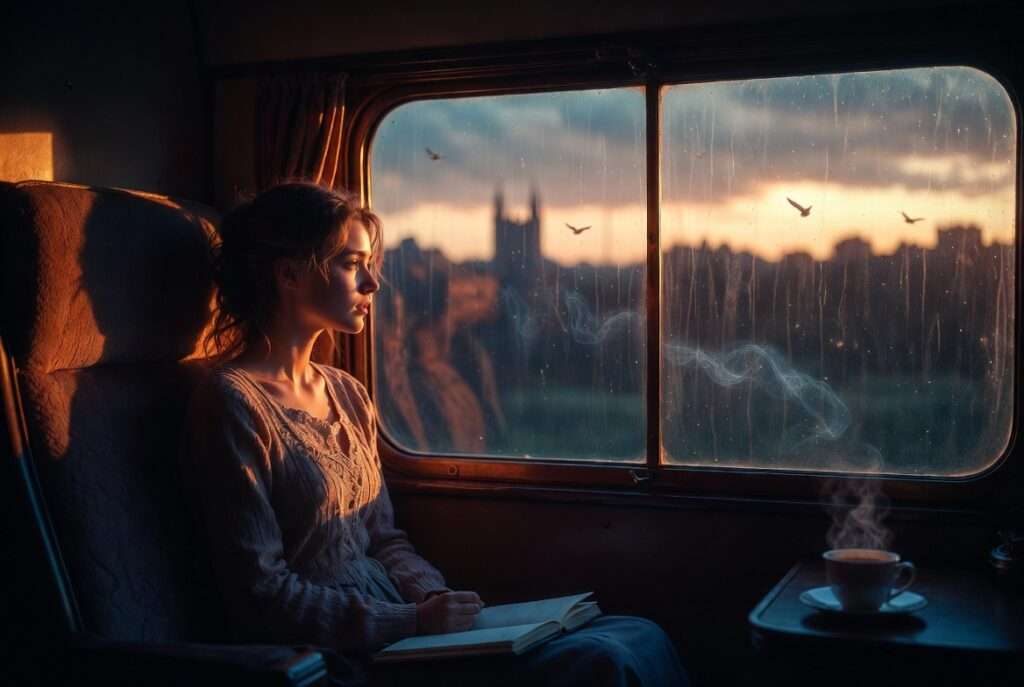
Picture this: a young woman sits on a delayed train somewhere between Manchester and London. She has no pen. She has no notebook. But in her mind, a world is exploding into existence — a boy with a lightning-bolt scar, a castle hidden from the non-magical world, a platform you can only reach by walking through a brick wall. She is 25 years old, and she has just conceived one of the most beloved stories in human history.
So, how old was J.K. Rowling when she wrote Harry Potter? The short answer is that she was 25 when the idea first arrived in 1990 — and 31 when the finished book finally reached bookstore shelves in 1997. But those numbers alone tell only a fraction of the story. Between that train journey and publication day lay six years of grief, poverty, single motherhood, depression, and relentless rejection. Understanding her age isn’t just a matter of trivia. It is the key to understanding why Harry Potter feels the way it does — why it aches with loss, radiates with hope, and speaks so honestly to anyone who has ever felt overlooked, powerless, or alone.
This article takes you through the full timeline of Rowling’s writing journey, the extraordinary life circumstances that shaped every page of the manuscript, and why her particular age and life stage produced a story that no other version of Joanne Rowling — younger or older — could have written.
How Old Was J.K. Rowling When She Wrote Harry Potter? The Direct Answer
The Moment the Idea Was Born (1990)
On a day in the summer of 1990, J.K. Rowling was a 25-year-old woman traveling by train from Manchester to London’s King’s Cross station. The train was delayed. She was sitting quietly, not reading, when the idea came — not gradually, not in fragments, but all at once, like a film playing fully formed behind her eyes.
Harry Potter arrived in her imagination complete: a young boy who didn’t know he was a wizard, raised by people who did their best to suppress that truth, destined to attend a school for witches and wizards. Hagrid appeared. The shape of Hogwarts took form. The broader structure of the wizarding world began filling in with a richness and detail that astonished even Rowling herself.
“I had been writing almost continuously since the age of six,” she later recalled, “but I had never been so excited about an idea before.” The cruelty of the moment was that she had no pen. She spent the remainder of the delayed journey committing every detail to memory, and the moment she arrived home, she began writing.
That day, Joanne Rowling was 25 years old. The birth of Harry Potter was not the product of years of planning or careful literary strategy. It was a thunderbolt.
When She Actually Began Writing
Within days of the train journey, Rowling began putting the story to paper in earnest. The early writing happened in bursts and fragments, often at night, often by hand in whatever notebook she had nearby. She was working and managing the early stages of a turbulent personal life, so writing happened when and where it could.
It is important to distinguish between two ages here: the age at which the idea was born (25) and the age at which serious, sustained writing began. Both were in her mid-twenties. She did not sit down in comfortable circumstances with years of free time ahead of her. She wrote around the edges of a life that was, in many ways, beginning to fall apart.
The Full Timeline — From First Idea to Published Book
1990 — The Train Journey That Changed Literature
Rowling’s age: 25
The year 1990 was already a year of emotional weight for Rowling. Her mother, Anne, had been diagnosed with multiple sclerosis in 1989, and the illness was progressing. It was against this backdrop of worry and grief-in-advance that the Harry Potter idea arrived.
After the train journey, Rowling threw herself into the early stages of the story with an almost compulsive energy. She began mapping out the wizarding world in extraordinary detail — not just Book One, but the architecture of all seven novels. She sketched out the fates of major characters, the rules of magic, the history of Hogwarts. Much of what would not appear in print until a decade later was already alive in her notebooks by the end of 1990.
Then, in December 1990, her mother died.
Anne Rowling passed away at the age of 45. Joanne was 25. The loss was shattering — sudden in its finality, even if not in its arrival. And it would leave fingerprints on every single Harry Potter book that followed.
 1990–1993 — Writing Through Personal Tragedy
Rowling’s age: 25–28
In the immediate aftermath of her mother’s death, Rowling made a decision that would shape the next phase of both her life and her writing: she moved to Porto, Portugal, to teach English as a foreign language.
In Portugal, she continued writing. She carried the manuscript with her across borders the way one carries something irreplaceable. The early chapters of Philosopher’s Stone were taking clearer shape. The world was becoming more solid. But her personal life was in turbulence. She met and married Portuguese journalist Jorge Arantes in October 1992. Their daughter, Jessica, was born in July 1993.
The marriage was troubled almost from the start. By November 1993, it had broken down entirely. Rowling left Portugal and returned to the United Kingdom — to Edinburgh, Scotland, where her sister Di was living — with an infant daughter, a suitcase, and the unfinished manuscript of Harry Potter tucked carefully inside.
She was 28 years old. She had no job, no permanent home, and no income beyond state benefits. But she had the story.
1993–1995 — The Edinburgh Years and the Café Mythology
Rowling’s age: 28–30
The Edinburgh years are the most mythologized chapter of Rowling’s story, and also the most human. She was living in a small flat, surviving on £70 per week in welfare benefits, and raising Jessica alone. Clinical depression descended on her during this period — not a metaphor, not a passing sadness, but a genuine, destabilizing illness that she has spoken about with remarkable candor in the years since.
“I was the biggest failure I knew,” she told Harvard graduates in her famous 2008 commencement address. Rock bottom, she said, became the foundation on which she rebuilt her life.
 It was during this period that the famous café writing sessions took place. The image of Rowling writing in Nicolson’s Café in Edinburgh while baby Jessica slept in a pram beside her has become one of the most romanticized stories in modern literary history. The reality, as Rowling has clarified, was somewhat more mundane — she also wrote at home, at a desk, like most writers — but the café sessions were real. She wrote wherever she could. She wrote because she had to.
By 1995, she had completed the manuscript of Harry Potter and the Philosopher’s Stone. She was approximately 30 years old. She typed the final manuscript on a secondhand typewriter, making two copies by hand because she could not afford photocopying.
1995–1997 — Rejections, Perseverance, and Publication
Rowling’s age: 30–32
With the manuscript complete, Rowling began submitting it to literary agents. The first agent she approached, Christopher Little, agreed to represent her — a decision that would prove historic. Little then began submitting the manuscript to publishers.
What followed was a string of rejections that has since become as legendary as the book itself. Twelve major publishing houses passed on Harry Potter and the Philosopher’s Stone. The reasons were familiar and discouraging: the book was too long for a children’s novel, fantasy was a difficult market, the commercial prospects were unclear.
Then Bloomsbury said yes.
The decision was influenced in no small part by Barry Cunningham, then an editor at Bloomsbury, and by a practical piece of editorial wisdom: Cunningham gave the first chapter to his eight-year-old daughter, Alice Newton, to read. She returned an hour later demanding the rest of the book.
Bloomsbury offered Rowling an advance of £1,500. Cunningham famously advised her not to quit her day job, telling her there was no money in children’s books. She signed the contract. She was 31 years old.
On June 26, 1997, Harry Potter and the Philosopher’s Stone was published. The first print run was 500 copies — 300 of which went directly to libraries. Joanne Rowling was 31 years old, holding a book that had taken seven years to travel from a delayed train to a bookshelf.
The quiet beginning of a global phenomenon had arrived.
What Was Happening in J.K. Rowling’s Life While She Wrote?
Grief, Loss, and the Shadow of Death in Harry Potter
It is impossible to read Harry Potter with full understanding without acknowledging the grief at its center. Harry Potter is, at its core, a story about loss — about a boy shaped entirely by the death of his parents, about the human longing to reverse death, about the courage required to accept it.
That grief was not invented. It was lived.
Rowling’s mother died just months after Harry arrived in her imagination. The timing is not incidental. The Mirror of Erised — in which Harry sees his parents alive and whole, standing beside him — is one of the most emotionally devastating images in the entire series. Rowling has confirmed what readers long suspected: she was thinking of her mother when she wrote it.
The climax of the entire seven-book series turns on a single principle: that love is the one force more powerful than death. This was not a philosophical position Rowling arrived at intellectually. It was something she needed to believe.
“The books are about death,” she told a reporter plainly in 2006. “I’m not afraid to say that. The fear of death, and the fact that there are worse things you can do to people than kill them — that became my theme.”
 Single Motherhood and Financial Hardship
The practical circumstances of Rowling’s writing life during the Edinburgh years are important not just as biographical color but as creative context. She was not writing from a position of comfort or security. She was writing as an act of survival.
Living on welfare benefits as a single mother in 1990s Edinburgh, Rowling experienced a form of invisibility that Harry Potter himself knows well. Harry spends his early years in a cupboard under the stairs — overlooked, dismissed, told that he is nothing special and that his dreams of something greater are delusions. It is not difficult to see the emotional connection between author and character.
The financial pressure was real and constant. There were periods when Rowling questioned whether continuing to write was a luxury she could not afford — both in time and in the psychological energy it required. That she kept writing is, in hindsight, an act of extraordinary willpower.
Depression and the Birth of the Dementors
Of all the creative decisions Rowling made in the Harry Potter series, none is more directly autobiographical than the Dementors.
These creatures — hooded, faceless beings that drain all happiness and warmth from any person they approach, leaving behind only despair and the worst memories of a lifetime — are Rowling’s literary portrait of clinical depression. She has said so explicitly, in multiple interviews across many years.
During the Edinburgh years, Rowling experienced depression seriously enough that she sought professional help and considered suicide. She has spoken about this with a frankness and courage that has made her an important voice in the ongoing cultural conversation about mental health.
“It’s so difficult to describe depression to someone who’s never been there,” she has said, “because it’s not sadness… it’s that cold absence of feeling — that really hollowed-out feeling.”
The Dementors are that absence made visible. They are, perhaps, the most psychologically accurate depiction of depression in all of children’s literature — which is part of why so many readers, young and old, have found in them a strange kind of recognition and comfort. Rowling did not write them to frighten. She wrote them because she knew them personally.
Why Her Age and Life Stage Made Harry Potter So Magical
The Sweet Spot Between Childhood Memory and Adult Depth
One of the most frequently asked questions about Harry Potter is deceptively simple: why do these books work for both children and adults? Most literature aimed at children loses adult readers within the first chapter. Most adult literary fiction bores children in the first paragraph. Harry Potter does neither, and Rowling’s age when she wrote it is a significant part of the reason.
At 25, she was close enough to childhood to remember it with precision and feeling — not as a sanitized, nostalgic haze, but as a real experience of powerlessness, wonder, unfairness, and fierce loyalty. She remembered what it felt like to be small in a large world, to be told your instincts were wrong, to believe passionately in something others dismissed.
 At the same time, she was old enough — and had lived through enough — to write with genuine adult darkness. The themes running beneath the magic in Harry Potter are not children’s themes. Systemic prejudice. The corruption of institutions. The seductive logic of authoritarianism. The cost of cowardice in good people. These are ideas that require life experience to handle honestly.
Most writers do not arrive at both of those things simultaneously. Rowling did, at 25, and the tension between them is the animating force of the entire series.
Hardship as the Furnace of Great Storytelling
There is a long tradition in literature of adversity producing great art — not because suffering is inherently ennobling, but because extreme circumstances force a writer to be honest. You cannot be sentimental when your life is genuinely hard. You cannot write falsely optimistic endings when you have sat with real grief.
Rowling’s hardships — the death of her mother, the failed marriage, the poverty, the depression — did not make Harry Potter darker than it might otherwise have been. They made it truer. The love in the books is not a greeting-card emotion. It is a force that costs something, that demands sacrifice, that sometimes arrives too late. That is not the love of a comfortable life. That is the love of someone who has lost someone irreplaceable.
Readers feel this, even when they cannot name it. It is why re-reading Harry Potter as an adult — with more experience of loss and difficulty — reveals layers that were invisible at age ten. The books were written by someone processing real grief. They reward readers who are doing the same.
What Would Have Been Different If She Were Older or Younger?
It is worth pausing to consider the counterfactual, because it illuminates something important about why Rowling’s specific age produced the story that it did.
A younger Rowling — say, a 19-year-old writing prodigy — might have produced something more purely inventive, more gleefully playful, more focused on the joy of the magical world. But she would likely not have had the emotional vocabulary to write the Mirror of Erised, or Dumbledore’s full moral complexity, or the way grief accumulates silently in the margins of every book after Goblet of Fire.
An older Rowling — say, a 40-year-old writer returning to a long-abandoned idea — might have brought even more craft and structural sophistication to the story. But she might also have lost the texture of childhood’s specific injustices, the rawness of feeling like an outsider, the sense of magic as something urgently necessary rather than pleasantly nostalgic.
At 25, she was both things at once. The idea arrived at exactly the moment she was equipped to receive it — and the years it took to write it, years of increasing hardship and deepening experience, only added to the manuscript’s emotional weight.
Her age was not incidental to the magic. Her age was part of the magic.
The Road to Publication — Persistence Beyond Her Years
The 12 Rejections and What They Reveal
The story of Harry Potter’s path to publication is, among other things, a masterclass in how badly the publishing industry can misjudge a manuscript.
Twelve publishers rejected Philosopher’s Stone. Among them were some of the most respected names in British publishing — houses with long track records of identifying successful children’s literature. Their reasons, reconstructed from various accounts over the years, were consistent: the book was too long for its target market, the fantasy genre was commercially uncertain, and a story structured around a boarding school seemed old-fashioned.
 Every single one of those assessments was wrong. The book’s length became a virtue — children devoured it and demanded more. The fantasy genre was not uncertain; it was underserved. And the boarding school setting, far from being a limitation, became one of the series’ most enduring pleasures.
That 12 editors missed this is not, in retrospect, surprising. Genuinely original work routinely fails to fit the templates that experienced industry professionals use to evaluate commercial potential. What makes Rowling’s story instructive is not that she was rejected, but how she responded to rejection.
She kept submitting. She revised where revision was warranted and held firm where she believed in her instincts. She did not, as many writers do at the first or fifth or eighth rejection, begin rewriting the book to fit the objections she was receiving.
The Bloomsbury Breakthrough
The story of how Bloomsbury came to publish Harry Potter has, over the years, become something close to its own fairy tale — and it deserves its place in literary history.
Barry Cunningham was an editor at Bloomsbury with a reputation for backing unconventional choices. When Christopher Little submitted the manuscript to him, Cunningham was intrigued. But the moment that sealed the decision came when he brought the first chapter home and handed it to his eight-year-old daughter, Alice Newton.
Alice read it. Then she came back for more. Her response — immediate, enthusiastic, and entirely unpretentious — was precisely the market research that no publishing board could have manufactured. The book worked on a child. That was all Cunningham needed to know.
Bloomsbury offered Rowling a £1,500 advance — a modest sum that reflected the financial caution with which children’s books were typically treated at the time. Cunningham reportedly told Rowling, gently but honestly, that she was unlikely to make significant money from children’s fiction and should consider keeping her day job.
It remains one of the great underestimates in the history of publishing.
Publication Day — June 26, 1997
On June 26, 1997, Harry Potter and the Philosopher’s Stone went on sale in the United Kingdom. The first print run was 500 copies — a figure that reflects both the modest commercial expectations of the publisher and the then-unknown status of the author.
Joanne Rowling was 31 years old.
She had spent six years carrying this story — through bereavement and a failed marriage, through poverty and depression, through a dozen rejections and the quiet, grinding work of revision. The book that arrived in shops that summer bore the traces of all of it: the loss, the longing, the stubborn insistence on a world where love and courage count for something.
Within a year, it would win the Nestlé Smarties Book Prize. Within two years, American publisher Scholastic would pay $105,000 for the US rights — an extraordinary sum for a debut children’s novel. Within a decade, Harry Potter would be the best-selling book series in history.
But on June 26, 1997, it was simply a book — 500 copies, a modest advance, and a 31-year-old first-time author who had refused, against considerable odds, to give up.
What J.K. Rowling’s Story Teaches Aspiring Writers
Start Writing Before You’re “Ready”
One of the most persistent myths in creative life is the myth of readiness — the idea that the right conditions must first be assembled before serious creative work can begin. The right desk. The right amount of time. The right stage of life. The right level of skill.
Rowling had none of those things. She had a delayed train and no pen. She had a grief-stricken household and a dying mother. She had a failing marriage in a foreign country and a newborn daughter and a secondhand typewriter and a flat she could barely afford.
She wrote anyway.
This is not a romantic prescription for suffering as a prerequisite for creativity. It is simply a factual observation: the story got written because Rowling wrote it in the conditions she had, not the conditions she wished for. The manuscript that became a global phenomenon was produced in cafés and small flats by a woman on welfare benefits who was simultaneously raising a child and fighting depression.
If she had waited to begin writing until conditions were ideal, the book would never have been written at all.
Age Is Never the Barrier — Timing Is Everything
The publishing world has a complicated relationship with age. There is sometimes an implicit assumption that significant literary work should arrive either from the very young (the romantic prodigy narrative) or from the mature writer who has spent decades perfecting their craft. Rowling fits neither category neatly.
She was 25 when the idea arrived — not a prodigy, not a veteran. She was 31 when the book was published — not especially young, not especially old. She was simply a person whose life experience had, by a particular age and through particular circumstances, equipped her to write a particular story.
History is full of writers who published their first significant work in their thirties. What matters is not the number but the accumulation of experience, emotional intelligence, and craft that a person brings to the work at any given moment. Rowling’s moment happened to be her late twenties and early thirties, and it produced one of the most consequential works of fiction in the last hundred years.
Rejection Is Part of the Process, Not the End
Twelve rejections. It is worth sitting with that number, because it is easy — in hindsight, knowing what the series became — to treat those rejections as obviously mistaken, as evidence of spectacular editorial blindness.
But that framing is too comfortable. It obscures the more difficult and more useful truth: at the time of those rejections, there was no obvious reason to believe that Bloomsbury’s eventual acceptance was correct and everyone else was wrong. Rowling did not know, in 1996, that the book would succeed. She had her belief in the story, her years of investment in it, and her refusal to accept that twelve rejections constituted a final verdict.
That refusal is the lesson. Not the eventual triumph — the refusal.
For any writer facing rejection today, the Rowling story offers something more honest and more valuable than simple encouragement. It offers evidence. Evidence that publishers are not infallible. That a story can be exactly right for the world and still require thirteen attempts to find the one person willing to say yes. That the work of writing and the work of perseverance are inseparable.
Frequently Asked Questions
How old was J.K. Rowling when she got the idea for Harry Potter?
J.K. Rowling was 25 years old when the idea for Harry Potter came to her in the summer of 1990, during a delayed train journey from Manchester to London. The concept arrived fully formed — Harry, Hogwarts, the wizarding world — in a single extraordinary burst of imagination.
How long did it take J.K. Rowling to write Harry Potter?
From the initial idea in 1990 to the completion of the manuscript in 1995, Rowling spent approximately five years writing Harry Potter and the Philosopher’s Stone. Including the time from completion to publication in 1997, the full journey from idea to published book spanned approximately seven years.
How old was J.K. Rowling when Harry Potter was published?
J.K. Rowling was 31 years old when Harry Potter and the Philosopher’s Stone was published on June 26, 1997.
Was J.K. Rowling poor when she wrote Harry Potter?
Yes. During the most intensive period of writing — the Edinburgh years from 1993 to 1995 — Rowling was a single mother living on state welfare benefits of approximately £70 per week. She has described this period as the lowest point of her life, and has spoken openly about experiencing clinical depression during this time.
Did J.K. Rowling write Harry Potter by hand?
Yes. Rowling has confirmed that early drafts and much of the manuscript were written by hand, often in notebooks. The final manuscript was typed on a secondhand manual typewriter. She made two physical copies of the manuscript herself because she could not afford the cost of professional photocopying.
How many times was Harry Potter rejected before being published?
Harry Potter and the Philosopher’s Stone was rejected by 12 major publishing houses before Bloomsbury accepted the manuscript. The book was eventually championed by editor Barry Cunningham, whose decision was reinforced by the enthusiastic response of his eight-year-old daughter after reading the opening chapter.
We return, at the end, to that train.
A 25-year-old woman. A delay on the line somewhere between Manchester and London. No pen. An imagination suddenly on fire with a boy who didn’t know he was a wizard, a hidden world waiting to be entered, a story that demanded to be told.
That moment could have come earlier, and produced something thinner. It could have come later, after the grief had dulled into something more manageable, and produced something safer. Instead it came when it came — to a young woman who was still close enough to childhood to write it honestly, and already close enough to real loss to write it deeply.
How old was J.K. Rowling when she wrote Harry Potter? She was 25 when the story chose her, and 31 when the world received it. But the truest answer is this: she was exactly the right age. She had lived precisely enough, suffered precisely enough, and hoped precisely enough to write something that would outlast her, and all of us, by a very long time.
Harry Potter is not, at its heart, a story about magic. It is a story about love surviving death, about courage existing in ordinary people, about the world being more than it appears to those who don’t know where to look. Those are not ideas a person invents. They are ideas a person earns — through loss, through perseverance, through the particular kind of stubborn hope that keeps a manuscript alive through six years and twelve rejections and a life that gave every reasonable excuse to set it down.
Rowling did not set it down.
And because she didn’t, millions of readers across generations have found in a boy under the stairs their own longing for a world where they belong — and the quiet assurance that such a world, somehow, exists.