By a Wizarding World Lore Researcher & Harry Potter Enthusiast Estimated Read Time: 10–12 minutes
Featured Snippet Summary
The Whomping Willow is a violent, sentient magical tree planted on the grounds of Hogwarts School of Witchcraft and Wizardry. Introduced in Harry Potter and the Chamber of Secrets, it plays a pivotal role in Prisoner of Azkaban. Planted under Dumbledore’s orders to conceal a secret tunnel leading to the Shrieking Shack, it was designed to protect werewolf student Remus Lupin — making it one of the most purposeful and layered magical objects in the entire wizarding world.
Picture this: a battered turquoise Ford Anglia hurtling through the night sky, two terrified boys clinging to their seats, and then — out of nowhere — a massive, ancient tree that does not simply stand there and take the impact. It fights back. Branches whipping. Trunk shuddering. Windows smashing. Welcome to your first unforgettable encounter with the Whomping Willow in Harry Potter — one of the most iconic, dangerous, and deeply significant magical creations in J.K. Rowling’s entire wizarding world.
At first glance, the Whomping Willow appears to be nothing more than a spectacularly bad-tempered tree — a hazard planted inconveniently close to where students play Quidditch. But as any true Harry Potter fan will tell you, nothing in Rowling’s world is ever without purpose. Behind the thrashing branches and bone-crushing trunk lies a history so carefully constructed, a secret so cleverly concealed, that it reframes everything you thought you knew about Hogwarts itself.
In this complete guide, we are diving deep into the full story of the Whomping Willow — its true origin, its hidden purpose, every major scene it appears in across the books and films, its role in Hogwarts Legacy, the fascinating details most fans overlook, and what this remarkable magical tree ultimately symbolizes in the broader tapestry of the Harry Potter universe.
Whether you are a lifelong Potterhead revisiting beloved lore or a newer fan piecing together the wizarding world for the first time, this is the only guide to the Whomping Willow you will ever need.
What Is the Whomping Willow in Harry Potter?
A Quick Overview for New Fans
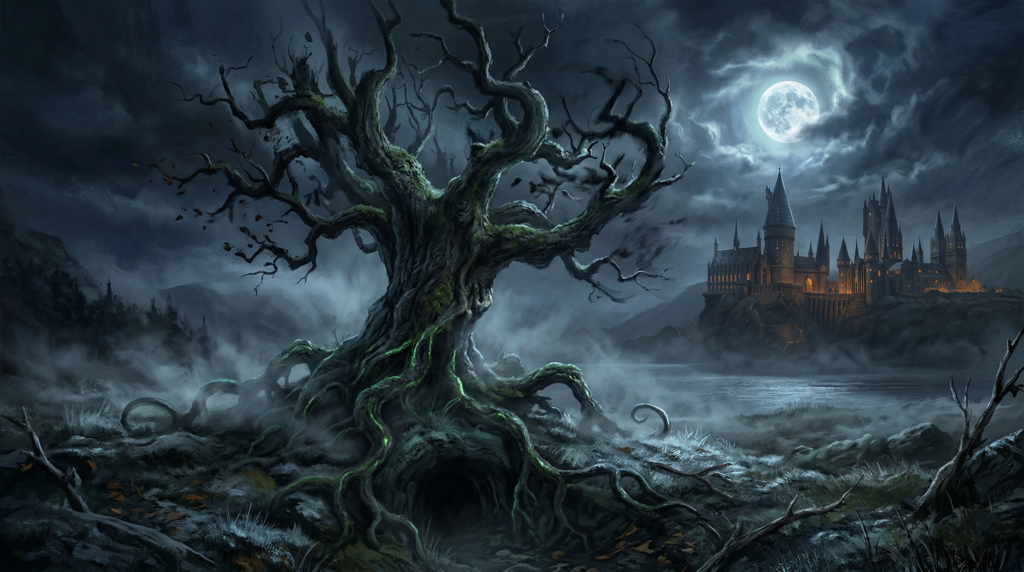
The Whomping Willow is a large, magical tree located on the grounds of Hogwarts School of Witchcraft and Wizardry, positioned near the edge of the Forbidden Forest and not far from the Quidditch pitch. What makes it unlike any ordinary tree — magical or otherwise — is its aggressive, almost predatory behavior toward anything that comes within striking distance of its long, powerful branches.
Touch it, fly into it, or simply get too close, and the Whomping Willow will attack without hesitation or remorse. Its branches move with speed and force capable of destroying a car, snapping a wand, and sending students to the hospital wing. It is, in every sense of the word, a weaponized piece of nature — and it was put there deliberately.
Unlike many of the magical creatures and enchanted objects scattered throughout Hogwarts, the Whomping Willow occupies a very specific and permanent place on the school grounds. It is not kept in a greenhouse like the other dangerous magical plants studied in Herbology. It is not locked away in a dungeon or protected behind enchanted doors. It stands in the open, fully exposed, and entirely unapologetic about what it is.
What Kind of Magic Does It Use?
One of the most frequently debated questions among Harry Potter fans is whether the Whomping Willow is a naturally sentient magical plant or an ordinary willow tree that has been enchanted to behave aggressively. The books and films lean toward the latter interpretation — that it is a willow tree that has been subjected to powerful, complex magic that gives it both awareness of movement and an instinctive, violent response to anything that triggers it.
What is particularly fascinating from a magical mechanics standpoint is the tree’s “freezing knot” — a specific spot located at the base of the trunk. When this knot is pressed, the Whomping Willow goes completely still, its branches freezing mid-swing, allowing a person to safely approach or even enter the tunnel hidden beneath its roots. This detail is crucial to the plot of Prisoner of Azkaban and is one of J.K. Rowling’s most elegant examples of world-building: a built-in override for a seemingly unstoppable magical force.
The fact that this knot exists is itself a clue, long before the big reveal, that the Whomping Willow was designed and installed by someone — that it has a purpose beyond mere territorial aggression.
The True Origin and History of the Whomping Willow
When Was It Planted at Hogwarts?
This is where the story of the Whomping Willow transforms from “dangerous magical curiosity” into something far more moving and complex. The tree was not planted centuries ago by some forgotten headmaster, nor is it an ancient magical phenomenon that predates the school itself. The Whomping Willow was planted during the 1970s — specifically during the years when Remus Lupin attended Hogwarts as a student.
This places the tree’s origin firmly within living memory of many characters in the series, which is precisely why its secret feels so explosive when it is finally revealed in Prisoner of Azkaban. The people who know the truth — Dumbledore, Lupin, Snape, and the Marauders — are all still alive when Harry, Ron, and Hermione come crashing into it.
Why Was It Really Planted? The Secret Purpose
Here is the truth that reframes everything: the Whomping Willow was planted at Dumbledore’s specific instruction to conceal the entrance to a secret underground tunnel running beneath the Hogwarts grounds. That tunnel stretches from the base of the tree all the way to the Shrieking Shack on the outskirts of Hogsmeade village — a distance of considerable magical engineering.
The reason for this elaborate construction? Remus Lupin was a werewolf.
When Dumbledore made the extraordinary decision to admit Lupin to Hogwarts — a decision that was itself radical and controversial for the wizarding world of that era — he needed a safe solution for what would happen to Lupin every full moon. Werewolf transformations are violent, uncontrollable, and extremely dangerous to those nearby. Keeping Lupin in the castle during a transformation was simply not an option.
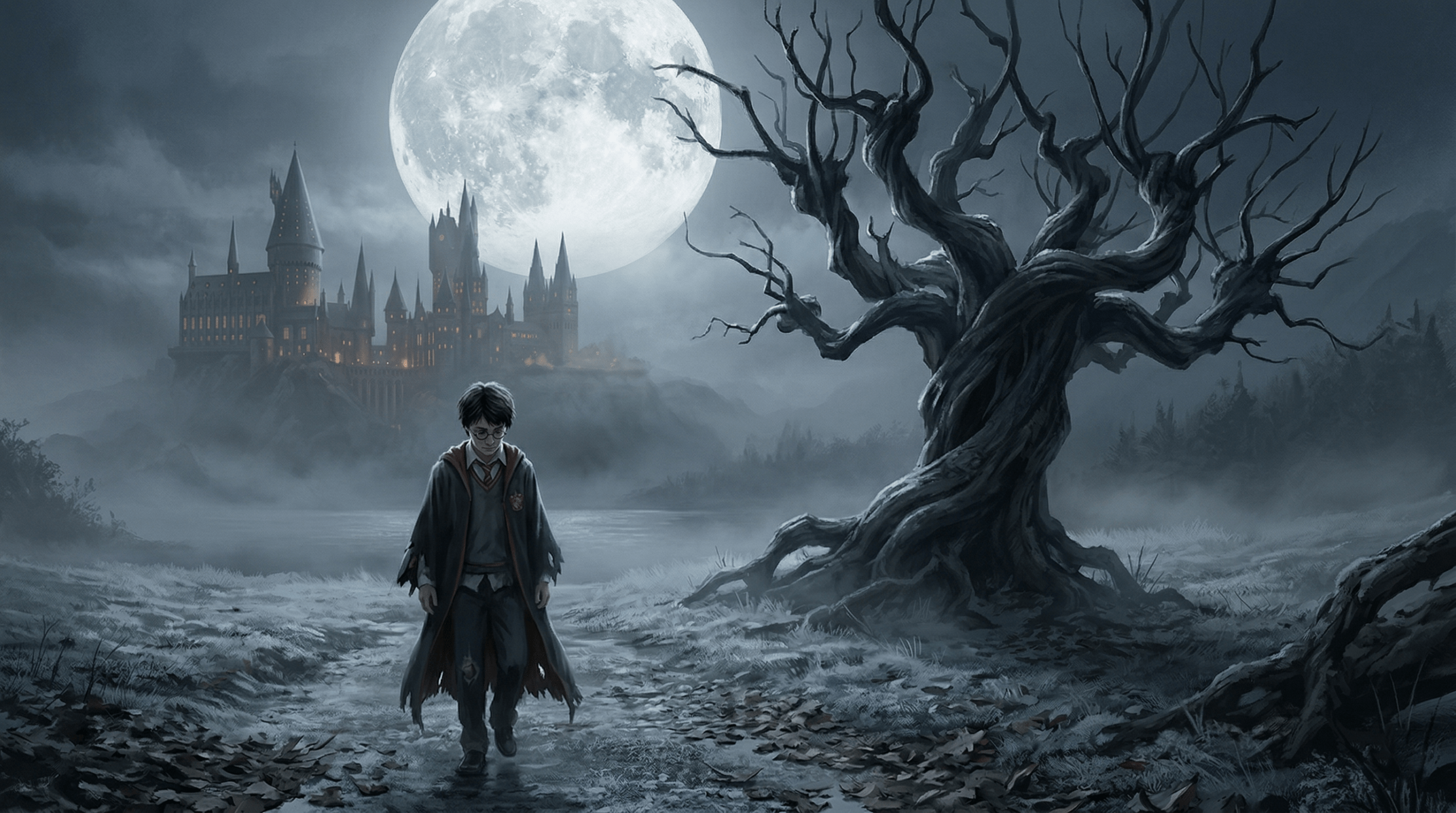 So Dumbledore arranged for a dedicated, isolated space to be prepared. Each month, when the full moon rose, a staff member would escort Lupin to the Whomping Willow, press the freezing knot with a long stick, and guide him safely into the tunnel, where he would travel to the Shrieking Shack and undergo his transformation in complete isolation. The thrashing and howling coming from inside the Shack each month led Hogsmeade villagers to believe it was haunted by particularly violent spirits — a rumor that served Dumbledore’s purposes perfectly.
The Whomping Willow, then, was not planted to protect the castle, to guard a treasure, or to intimidate students. It was planted to protect one lonely, frightened child who happened to carry a condition he never asked for. That context changes everything about how we see the tree.
The Shrieking Shack Connection Explained
The Shrieking Shack sits on a hill above Hogsmeade, visible from the village but avoided by virtually everyone due to its fearsome reputation. At the time of the Marauders’ era at Hogwarts, it was widely considered the most haunted building in Britain — a reputation that, as Lupin later explains to Harry, was entirely manufactured.
The “haunting” was simply the sound of a teenage werewolf in transformation, tearing apart furniture and screaming in pain, with no one to witness or explain it. Dumbledore apparently encouraged the legend, understanding that the more terrifying the Shack’s reputation, the less likely anyone would be to investigate.
The tunnel connecting the Shrieking Shack to the Whomping Willow is narrow, earthy, and runs entirely underground, emerging beneath the roots of the tree. It is along this tunnel that one of the most dramatic sequences in the entire Harry Potter series ultimately unfolds — a sequence that would not be possible without the tree standing guard above it.
Expert Insight: The Whomping Willow was not an accident of nature — it was a deliberate act of magical architecture designed to protect one vulnerable student while keeping an enormous secret from an entire school. It stands as one of Dumbledore’s most quietly compassionate — and quietly reckless — decisions in the entire series.
Every Major Appearance of the Whomping Willow in the Series
Chamber of Secrets — The Flying Car Incident (Year 2)
The first time readers and viewers encounter the Whomping Willow, it is as a source of spectacular, almost comedic chaos. Having missed the Hogwarts Express due to Dobby’s interference at Platform Nine and Three-Quarters, Harry and Ron make the catastrophically poor decision to fly Mr. Weasley’s enchanted Ford Anglia all the way to Scotland.
The car, exhausted after an overnight journey and increasingly rebellious in its mechanical behavior, finally deposits the two boys directly into the Whomping Willow upon arrival at Hogwarts. What follows is a frenetic, terrifying sequence in which the tree systematically destroys the car — smashing windows, buckling the roof, snapping Harry’s wand, and trapping Hedwig’s cage in its branches — before the car’s own self-preservation instincts kick in and it ejects both boys onto the grass before driving itself off into the Forbidden Forest.
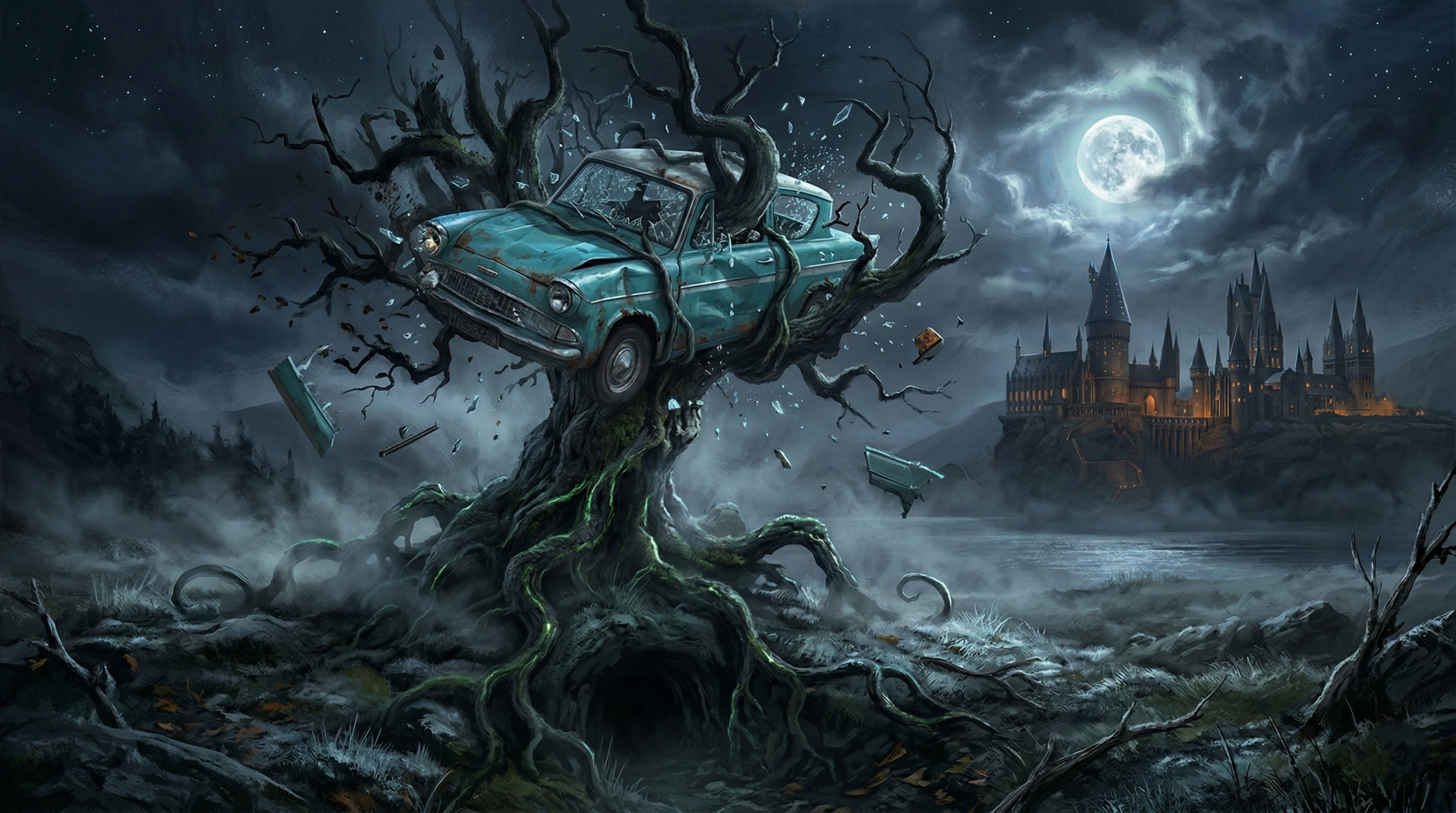 This scene serves several important narrative functions beyond pure entertainment. It establishes the Whomping Willow as a genuine physical threat within Hogwarts’ grounds. It demonstrates that Hogwarts is not entirely safe, even before you reach the dungeons or the Forbidden Forest. And crucially, it introduces the tree to readers in a way that feels self-contained — dangerous, memorable, but ultimately not connected to anything deeper.
That misdirection is deliberate. Rowling plants the Whomping Willow in readers’ consciousness as “the violent tree Harry crashed into” so that by the time it becomes central to the most important reveal of Prisoner of Azkaban, it feels both surprising and inevitable.
In terms of book-to-film differences, the movie adaptation by Chris Columbus captures the physical chaos of the scene with impressive visual energy, though the book spends considerably more time on the boys’ terror and the subsequent consequences — including a deeply uncomfortable encounter with Professor Snape and a memorable howler from Molly Weasley the following morning.
Prisoner of Azkaban — The Most Important Scene (Year 3)
If Chamber of Secrets introduces the Whomping Willow, Prisoner of Azkaban reveals its soul. The third installment of the series contains what is arguably the most plot-dense and emotionally complex sequence Rowling ever wrote, and the Whomping Willow sits at the very center of it.
The sequence begins on the night of a full moon, when the apparently escaped and supposedly dangerous Sirius Black grabs Ron by the ankle and drags him beneath the Whomping Willow — pulling him into the tunnel under the tree’s roots. Harry and Hermione, unwilling to abandon their friend, follow — but not before the tree subjects them to a vicious battering that leaves Hermione winded and Harry bruised.
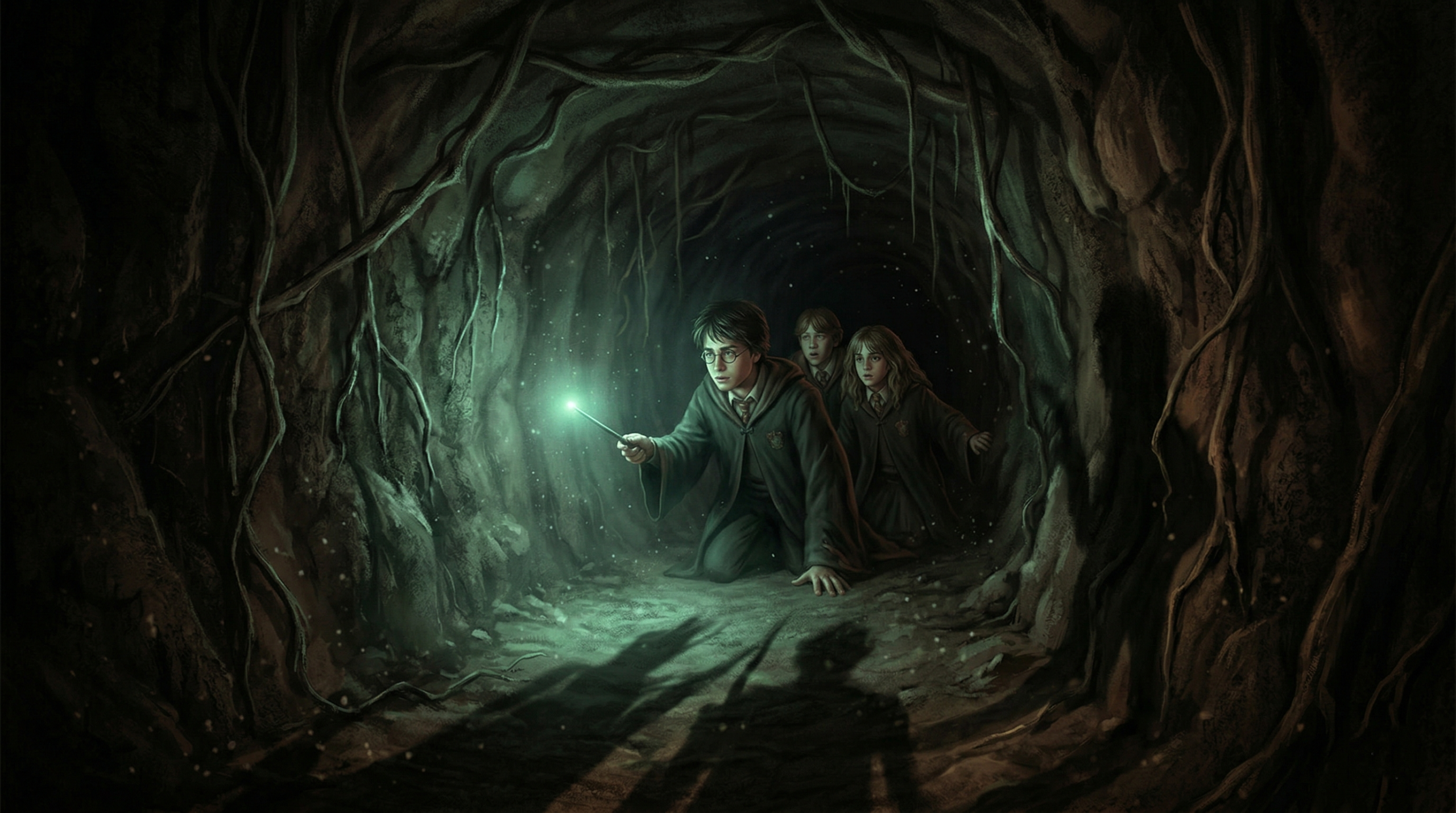 Inside the tunnel, the trio make their way to the Shrieking Shack, where they discover that Sirius Black is not quite what he has been presented as. This single sequence — made possible entirely by the Whomping Willow and the tunnel beneath it — triggers a cascade of revelations that redefines the entire Harry Potter story up to that point: the truth about Sirius’s innocence, the existence of Peter Pettigrew, the real story of the Marauders, and the full, heartbreaking history of Remus Lupin.
In Alfonso Cuarón’s film adaptation, this sequence is handled with remarkable atmospheric tension. The Whomping Willow itself is reimagined as a more organic, naturalistic presence — shown in a beautiful early scene shedding its leaves in an almost choreographed seasonal display, giving it a kind of living personality that makes its eventual role in the drama feel more earned.
Prisoner of Azkaban — Snape’s Memory (The Marauders’ Era)
Perhaps the most morally complicated moment in the entire history of the Whomping Willow comes not from Harry’s timeline, but from a memory — the story of what Severus Snape experienced at the base of that same tree during his own years at Hogwarts.
As revealed in Prisoner of Azkaban, a teenage Sirius Black — in a moment that the adult Sirius dismissively describes as “a prank” — told Snape about the freezing knot at the base of the Whomping Willow and suggested he press it to discover what was hidden beneath. His intention, whether fully thought through or not, was to lead Snape down the tunnel toward the Shrieking Shack on a full moon night — directly into the path of a transformed werewolf.
The implications of this are staggering. Sirius Black, later celebrated as one of the good guys, came genuinely close to getting Severus Snape killed — or worse, turned into a werewolf — through an act of casual cruelty dressed up as a joke. It was only James Potter’s intervention, sprinting after Snape and dragging him back from the tunnel entrance, that prevented a catastrophe.
Dumbledore covered the incident up. Snape was sworn to secrecy under threat of expulsion. And the Whomping Willow continued to stand, keeping its secret for another two decades.
This backstory — buried in one of the most plot-dense chapters Rowling ever wrote — adds an extraordinary layer of moral ambiguity to almost every character involved. It complicates our view of Sirius, deepens our understanding of Snape’s lifelong contempt for the Marauders, and raises genuinely uncomfortable questions about Dumbledore’s choices as a headmaster.
Brief Appearances and Background Moments
Beyond these two major storylines, the Whomping Willow appears in smaller capacities throughout the series. It is visible on the Hogwarts grounds in various background descriptions, referenced occasionally in dialogue, and features in several of the video game adaptations of the Harry Potter story, where players can interact with it in various ways.
Its presence in video games — particularly the earlier Harry Potter games released alongside the films — helped cement its status as one of Hogwarts’ most recognizable landmarks, alongside the Great Hall, the Quidditch pitch, and the Black Lake.
The Whomping Willow in Hogwarts Legacy
Does the Whomping Willow Appear in Hogwarts Legacy?
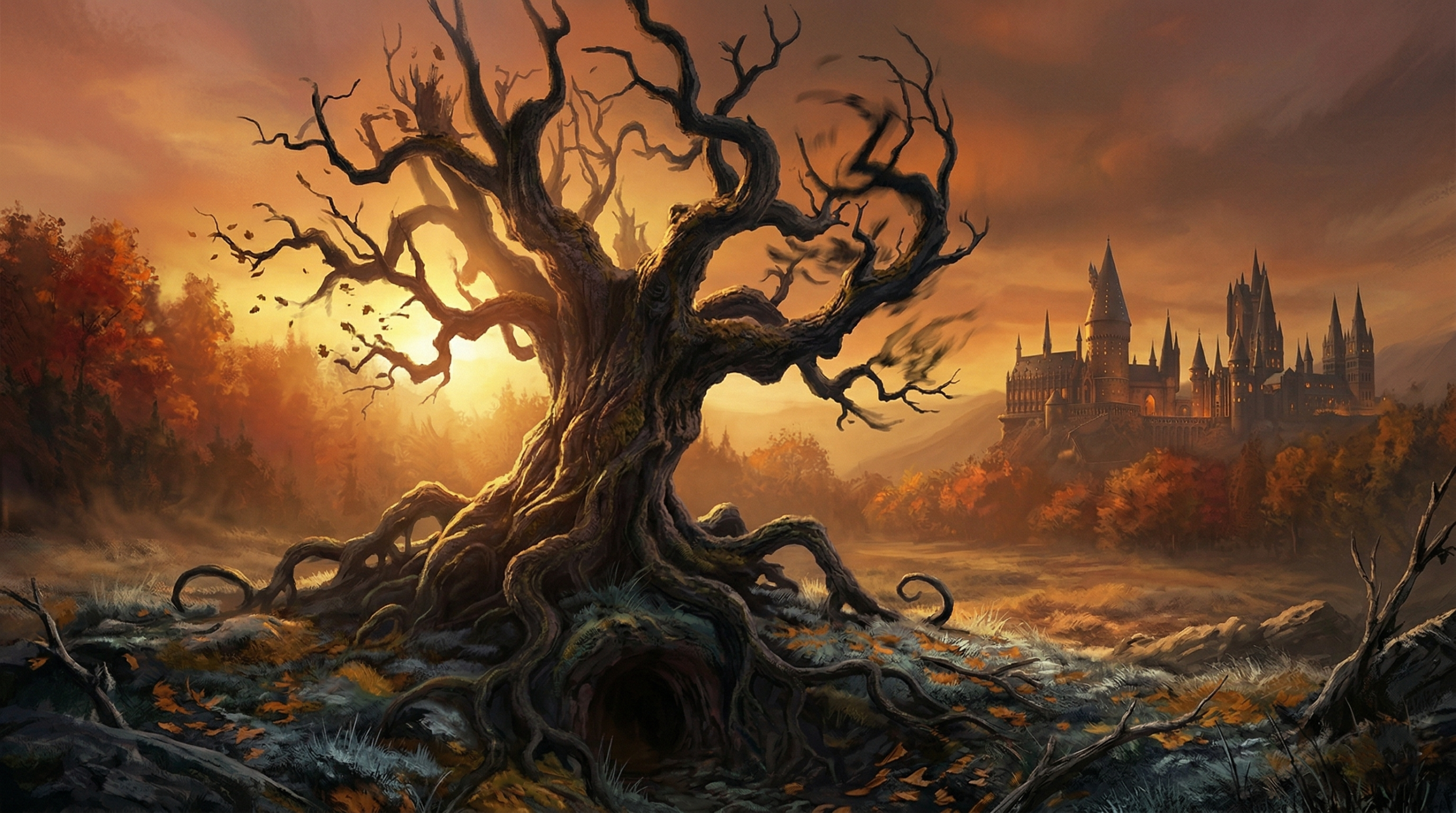
Yes — and its inclusion in Hogwarts Legacy is one of the many details that delighted longtime fans of the series when the open-world RPG was released in 2023. The Whomping Willow appears on the Hogwarts grounds in the game, positioned in a location consistent with its placement in the films, and players can approach and interact with it — though, true to form, getting too close results in the tree living up to its fearsome reputation.
 What the Game Adds to the Lore
Here is where things get particularly interesting from a lore perspective. Hogwarts Legacy is set in the late 1800s — nearly a full century before Remus Lupin was born, let alone enrolled at Hogwarts. If the canonical explanation for the Whomping Willow’s planting is that it was installed in the 1970s specifically for Lupin, then its presence in a game set in the 1890s creates a fascinating continuity question.
The game does not offer an explicit in-universe explanation for this discrepancy, leaving it open to fan interpretation. Some fans have suggested that the game’s version of the tree is simply an earlier, different Whomping Willow — perhaps one that was removed and replaced at some point between the 1890s and the 1970s. Others take it as a deliberate creative choice by the developers to include an iconic visual element of Hogwarts regardless of strict canonical timeline accuracy.
Whatever the explanation, the tree’s inclusion in Hogwarts Legacy has reignited fan discussions about its history and sparked a new wave of theories about whether Whomping Willows are more common in the wizarding world than previously understood.
Fascinating Facts and Hidden Details Most Fans Miss
The Whomping Willow Is Unique — There Are No Others at Hogwarts
One of the most overlooked details about the Whomping Willow is just how singular it is. Despite Hogwarts being a school that teaches Herbology as a core subject — a discipline that deals extensively with magical and often dangerous plants — there is only one Whomping Willow on the entire school grounds. This is not an accident of landscaping. It is a deliberate choice rooted in the tree’s specific, secret purpose.
Consider what Hogwarts’ greenhouses contain: Devil’s Snare, Mandrakes, Venomous Tentacula, and a host of other genuinely lethal magical flora. All of these are kept behind glass, within controlled environments, under careful supervision. The Whomping Willow alone is planted in the open air, accessible to any student who wanders too close — and yet there is only one of it, in one specific location, guarding one specific point on the grounds.
This singularity is meaningful. A school that wanted a dramatic hedge of aggressive trees could presumably have planted several. The fact that there is precisely one, in precisely that spot, is the clearest possible signal — in retrospect — that the tree was installed for a reason unique to that location. It was never meant to be a feature of the landscape. It was always meant to be a guardian of a secret.
For comparison, consider Devil’s Snare — another dangerous magical plant that appears in the series. Devil’s Snare is studied in a classroom context, treated as a subject of academic interest, and encountered by Harry, Ron, and Hermione as one of Dumbledore’s deliberate protections around the Philosopher’s Stone. The Whomping Willow operates on an entirely different level of magical intentionality. It is not a study subject. It is not a security measure for a treasure. It is a living monument to one headmaster’s effort to give a werewolf child a normal education.
Book vs. Movie Differences You Probably Didn’t Notice
The Harry Potter film adaptations are, by any measure, extraordinarily faithful to their source material — but no adaptation is without its adjustments, and the Whomping Willow scenes contain several differences worth examining for dedicated fans.
In the book version of Chamber of Secrets, the Whomping Willow attack on the Ford Anglia is described in considerably more terrifying detail than what appears on screen. Rowling emphasizes the boys’ genuine panic, the systematic nature of the tree’s assault, and the specific damage done to Harry’s wand — a plot point that carries consequences through the rest of the book. The film, directed by Chris Columbus, captures the visual spectacle brilliantly but compresses the sequence in ways that slightly reduce the sense of real danger.
The more significant differences appear in Prisoner of Azkaban, where Alfonso Cuarón’s directorial vision reshapes the Whomping Willow’s on-screen identity considerably. Cuarón’s version of the tree is softer and more organic in its early appearances — famously shown in the film’s elegant transitional sequence where the four seasons cycle rapidly around the Hogwarts grounds, with the Whomping Willow shedding and regrowing its leaves in perfect choreography with the changing weather. This sequence does not exist in the book at all, but it is one of the most praised moments in the entire film series precisely because it gives the tree a genuine personality — a sense of being alive in ways that go beyond mere violence.
Cuarón also makes the tree visually central to the film’s most dramatic exterior sequences in a way that the book, told entirely from Harry’s close third-person perspective, cannot quite replicate. The sight of the Whomping Willow at night, branches crashing against a full moon sky, with Sirius dragging Ron beneath the roots, is one of the most visually arresting moments in any of the eight films.
What Species Is the Whomping Willow?
From a botanical standpoint, the Whomping Willow belongs to the willow family — Salix in the real-world taxonomic classification — though its magical properties obviously place it well beyond anything found in a biology textbook. J.K. Rowling has elaborated on the tree in various interviews and through the Wizarding World platform (formerly Pottermore), confirming that Whomping Willows, while rare, do exist beyond Hogwarts in the broader wizarding world. They are simply uncommon enough that most wizards never encounter one.
Real-world willow trees carry a rich symbolic history that resonates interestingly with the Whomping Willow’s fictional role. In many cultural traditions, willows are associated with grief, mourning, and hidden depths — qualities that align remarkably well with a tree whose entire existence is rooted in protecting a secret born of compassion and sorrow. The weeping willow in particular, with its cascading branches and association with loss, feels like a thematic ancestor to Rowling’s violent but ultimately protective magical creation.
There is also something worth noting about the willow’s real-world physical properties. Willow branches are famously flexible and whip-like — capable of moving with considerable speed and force in the wind. Rowling’s choice of a willow as the basis for her aggressive magical tree is botanically intuitive in a way that, say, a Whomping Oak or a Whomping Elm would not quite be. The violence feels native to the species.
Could a Real Magical Tree Like This Exist?
This is, admittedly, the kind of question that belongs more to the realm of imagination than science — but it is precisely the type of question that keeps Harry Potter’s world feeling alive and endlessly explorable, so it deserves a thoughtful answer.
Real-world botany does offer some genuinely fascinating parallels to the Whomping Willow’s behavior. Certain plant species demonstrate what scientists call “thigmonasty” — the ability to respond to physical touch with rapid movement. The Venus flytrap is the most famous example, snapping shut within a fraction of a second when its trigger hairs are stimulated. The Mimosa pudica, or “sensitive plant,” folds its leaves inward almost instantly when touched. Even some tree species demonstrate measurable electrical responses to physical contact or environmental stress.
None of these real-world examples come anywhere close to the Whomping Willow’s speed, force, or apparent awareness — but they suggest that Rowling’s imaginative leap was not made from nothing. She extrapolated from a real biological principle — that plants can respond to physical stimuli — and amplified it to its most dramatically entertaining possible extreme. The result is a creature that feels, however impossibly, like it could exist at the edge of the natural world.
The Whomping Willow’s Role in the Bigger Themes of Harry Potter
A Symbol of Hidden Protection
The more carefully you examine the Whomping Willow’s place in the Harry Potter story, the more clearly it emerges as one of J.K. Rowling’s most elegant recurring symbols: the idea that true protection very often looks, from the outside, like danger.
The Whomping Willow does not look like a guardian. It looks like a threat. Every student at Hogwarts knows to stay away from it. Its reputation is built entirely on violence and unpredictability. And yet, at its core — literally, in the tunnel beneath its roots — it exists to shield something tender and vulnerable from a world that would not understand it.
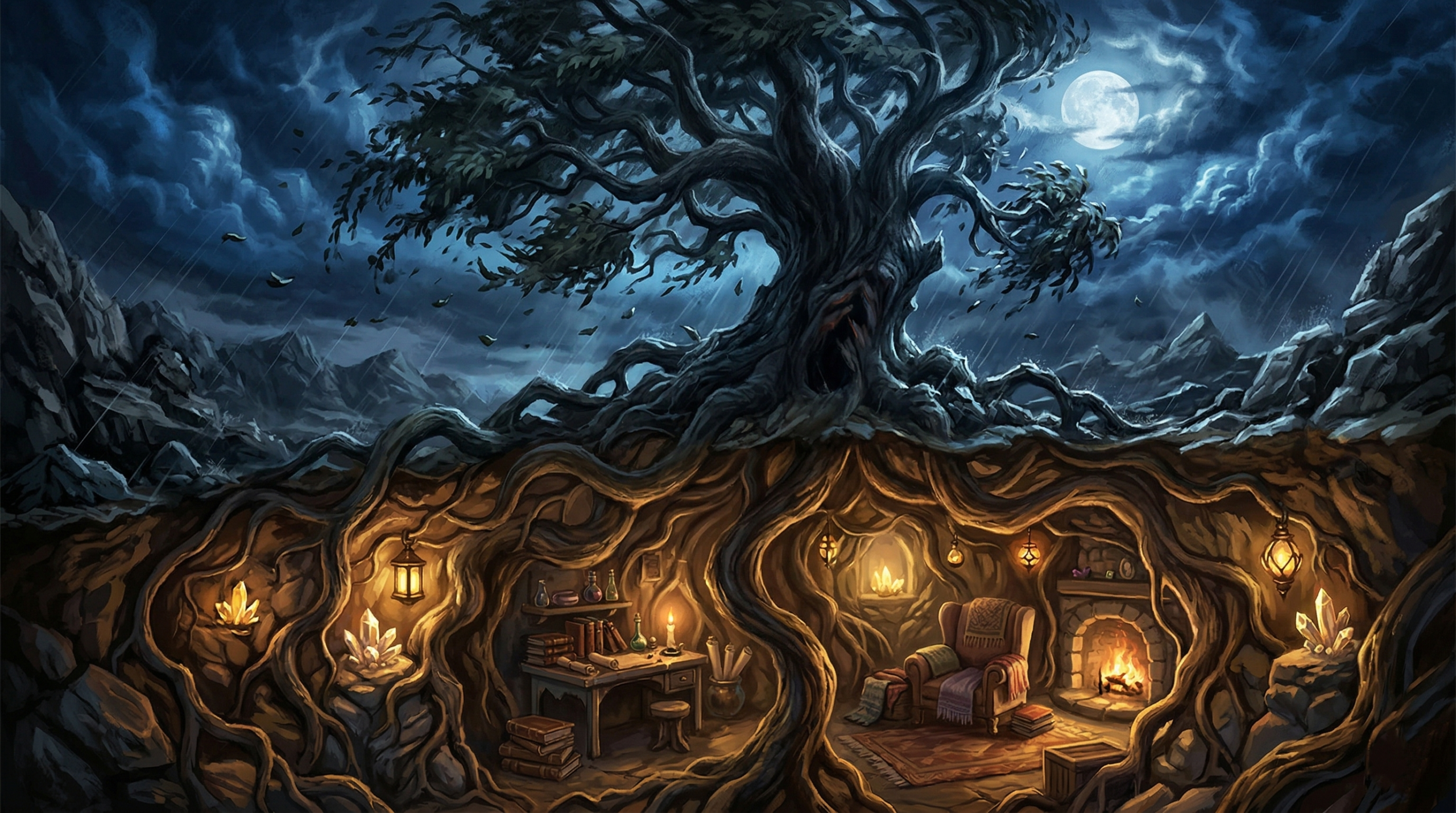 This mirrors one of the series’ most powerful and persistent character archetypes. Severus Snape, for seventeen years, presents himself to the world as cold, cruel, and contemptible — and is, at his core, performing the most profound act of protection in the entire story. Sirius Black appears to the wizarding world as a dangerous mass murderer — and is, in reality, an innocent man whose loyalty never wavered. Even Dumbledore, with his grandfatherly warmth and twinkling eyes, conceals depths of ruthlessness and moral complexity that only fully emerge after his death.
The Whomping Willow is the architectural embodiment of this theme. Do not judge by the surface. Do not mistake ferocity for malice. The most important things are often the hardest to approach.
How It Reflects Dumbledore’s Moral Ambiguity
The Whomping Willow also serves as one of the clearest windows into the ethical complexity of Albus Dumbledore — a character whose reputation as the greatest wizard of his age is consistently complicated by the questionable decisions he makes in service of larger goals.
Dumbledore’s choice to install the Whomping Willow is, at its heart, an act of genuine compassion. He wanted Lupin at Hogwarts. He believed — correctly — that Lupin deserved an education regardless of his condition. He went to considerable lengths to make that possible, including the construction of an entire secret tunnel and the installation of a full-sized aggressive magical tree on school grounds.
But consider the other side of that decision. Dumbledore planted a tree capable of seriously injuring or killing a student in an area accessible to the general school population — and told essentially no one why it was there. When Sirius’s prank nearly led Snape into the tunnel on a full moon night, Dumbledore’s response was to cover it up rather than address it transparently. He prioritized the protection of his secret over a full reckoning with what had almost happened.
This is Dumbledore at his most characteristic: simultaneously the most compassionate and the most controlling figure in the story, making unilateral decisions that affect everyone around him while remaining convinced, always, that he knows best. The Whomping Willow stands as a physical monument to both his greatness and his flaws — a tree that was planted with love and maintained through secrecy, dangerous to everyone and protective of one.
Frequently Asked Questions About the Whomping Willow
Why was the Whomping Willow planted at Hogwarts?
The Whomping Willow was planted on Dumbledore’s orders during the 1970s to conceal the entrance to a secret underground tunnel connecting the Hogwarts grounds to the Shrieking Shack in Hogsmeade. Its true purpose was to protect and conceal Remus Lupin, a werewolf student, who used the tunnel each month during his transformation. The tree’s aggressive behavior was designed to deter anyone from discovering the tunnel entrance beneath its roots.
Who planted the Whomping Willow?
The Whomping Willow was planted under the direct authority of Albus Dumbledore, who arranged the entire system — tunnel, tree, and Shrieking Shack — to accommodate Remus Lupin’s enrollment at Hogwarts. While Rowling does not name a specific witch or wizard who physically performed the planting, the operation was clearly a coordinated magical effort carried out at the headmaster’s instruction.
How do you stop the Whomping Willow?
The Whomping Willow can be temporarily immobilized by pressing a specific knot located at the base of its trunk. When this knot is pressed — typically using a long stick to avoid getting within range of the branches — the tree freezes completely, allowing safe passage to the tunnel beneath. This built-in override was part of the original design, allowing Lupin to be guided to and from the tunnel each month.
What is under the Whomping Willow?
Beneath the roots of the Whomping Willow lies the entrance to a long underground tunnel that runs from the Hogwarts grounds all the way to the Shrieking Shack on the outskirts of Hogsmeade village. This tunnel was constructed specifically for Remus Lupin and plays a central role in the events of Harry Potter and the Prisoner of Azkaban, when Sirius Black uses it to reach the Shrieking Shack and the truth about Peter Pettigrew begins to unravel.
Does the Whomping Willow appear in Hogwarts Legacy?
Yes. The Whomping Willow appears on the Hogwarts grounds in Hogwarts Legacy, the 2023 open-world RPG set in the 1800s — nearly a century before the tree’s canonical planting in the 1970s. The game does not address this timeline discrepancy explicitly, leaving fans to speculate about whether this represents an earlier tree, a creative liberty taken by the developers, or a hint at a deeper history for Whomping Willows at Hogwarts.
Was the Whomping Willow based on a real tree?
While no real tree behaves like the Whomping Willow, Rowling drew on the real-world willow species as her foundation — a tree known for its flexible, whip-like branches and its cultural associations with grief, hidden depth, and mourning. Some plant species do demonstrate rapid physical responses to touch, a phenomenon known as thigmonasty, which provides a loose real-world parallel to the tree’s movement. The willow family’s natural characteristics made it an intuitively fitting choice for a tree defined by its striking branches and its deeper, sorrowful purpose.
It would be easy, on the surface, to file the Whomping Willow away as one of Harry Potter’s most entertaining set pieces — a spectacular magical obstacle that makes for great cinema and provides a genuinely thrilling chapter or two across the books. And on that level alone, it succeeds magnificently. Few images in the entire series are more immediately arresting than a car being systematically dismantled by an enormous, furious tree.
But the Whomping Willow deserves far more credit than it typically receives, because it is not merely a spectacle. It is a story — one of the most quietly heartbreaking stories in Rowling’s entire universe. It is the story of a headmaster who believed that every child deserved an education, regardless of what the world thought of them. It is the story of a young boy who was different in a way that frightened people, growing up in a school that went to extraordinary lengths to make him feel like he belonged. It is the story of a secret kept for decades, beneath the roots of a violent tree, waiting for the moment when the truth could finally emerge into the light.
Every thrashing branch, every cracked window, every student who has ever given it a wide berth on the way to the Quidditch pitch — all of it is, at its heart, in service of that story. The Whomping Willow is proof of what J.K. Rowling does better than almost any other storyteller working in fantasy: she hides her most profound meanings inside her most spectacular surfaces, and trusts her readers to find their way through.
And now you have the full map.