Lord Voldemort recruited giants, Dementors, and werewolves to spread terror during both Wizarding Wars. His army was a nightmare amalgamation of the darkest creatures known to magic. Yet, one of the most famously terrifying dark creatures of all time was noticeably absent from the battlefield. When diving into Vampire Harry Potter lore, fans are often struck by a glaring question: why didn’t these classic monsters join the Dark Lord’s ranks alongside Fenrir Greyback and his werewolf pack?
Fans constantly debate the dynamics between werewolves and vampires within the Wizarding World. While lycanthropes were central to the plot and Voldemort’s reign of terror, vampires were reduced to fleeting background cameos and world-building footnotes. This article breaks down exactly what constitutes true vampire canon in J.K. Rowling’s universe, how they function within magical society, and the precise in-universe (and out-of-universe) reasons they stayed entirely out of the Second Wizarding War.
The Official Canon: Every Vampire Appearance in Harry Potter
To understand why vampires didn’t fight at the Battle of Hogwarts, we first need to establish what they actually do in the books. Unlike the heavily featured goblins, centaurs, or house-elves, vampires exist largely on the periphery of the Wizarding World.
Sanguini and the Slug Club
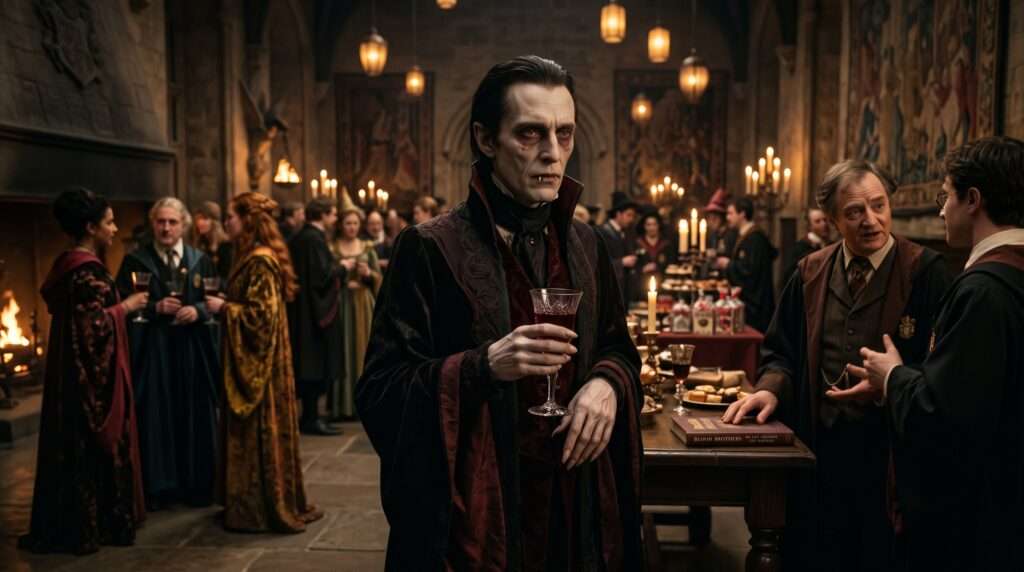
The most prominent, and indeed the only direct encounter Harry Potter has with a vampire occurs in Harry Potter and the Half-Blood Prince (Chapter 15, “The Unbreakable Vow”). During Horace Slughorn’s famous Christmas party, a vampire named Sanguini is introduced to readers.
Sanguini attends the gathering not as a threat, but as a guest of Eldred Worple, a former Slytherin student and author of the book Blood Brothers: My Life Amongst the Vampires. Sanguini is described as tall and emaciated, with dark shadows under his eyes. Rather than a terrifying predator, he appears somewhat bored by the high-society wizarding small talk.
The most revealing moment of vampire lore in this scene is Sanguini’s behavior toward a group of girls near him. He begins eyeing them with a hungry expression, prompting Worple to distract him by aggressively shoving a pasty into his hands. This brief, almost comedic interaction establishes that while a vampire’s bloodlust is real and present, it can be managed, suppressed, or at least distracted by non-lethal means in civilized magical society.
Quirrell’s Garlic and Hagrid’s Bar Fight
Long before Sanguini, vampires were established as a known, if distant, threat. In Harry Potter and the Sorcerer’s Stone, Professor Quirrell’s Defense Against the Dark Arts classroom famously reeks of garlic. The Hogwarts rumor mill suggests the garlic is to protect him from a Romanian vampire he allegedly met in the Black Forest. While Quirrell’s story was a cover for Voldemort’s possession, the fact that the students and staff believed a vampire could necessitate such extreme protective measures confirms their status as dangerous creatures.
We get another glimpse of their global presence in Harry Potter and the Order of the Phoenix. While recounting his secretive mission to recruit the giants, Rubeus Hagrid casually mentions getting into a “slight disagreement” with a vampire in a pub in Minsk. This passing comment suggests that vampires are integrated enough into magical society to frequent establishments alongside wizards and half-giants across Eastern Europe.
Honeydukes and Everyday Vampire Life
Perhaps the most telling piece of vampire lore comes from an unexpected place: a candy shop. In Harry Potter and the Prisoner of Azkaban, Hermione Granger points out “blood-flavored lollipops” in Honeydukes Sweetshop, explicitly noting that they are meant for vampires.
Expert Insight: The existence of commercially produced, blood-flavored candy sold in a popular wizarding village like Hogsmeade is a massive lore revelation. It proves that vampires are integrated into magical capitalist society. Unlike werewolves, who are socially ostracized, forced to the fringes, and denied basic employment, vampires are a recognized consumer demographic.
Vampire Biology and Magic in the Wizarding World
How exactly are these creatures classified, and what rules govern their existence alongside witches and wizards?
“Non-Wizard Part-Humans” (Their Legal Status)
In the eyes of the British Ministry of Magic, vampires are classified as “non-wizard part-humans.” They fall under the jurisdiction of the Department for the Regulation and Control of Magical Creatures. Specifically, there is a set of laws known as the Guidelines for the Treatment of Non-Wizard Part-Humans, which regulates their interactions with the wizarding public.
While prejudices certainly exist, their legal standing is remarkably different from werewolves. Werewolves are classified simultaneously as “Beasts” (when transformed) and “Beings” (when human), leading to immense bureaucratic discrimination and social ruin. Vampires, by contrast, seem to occupy a space closer to hags—creepy and dark, but capable of writing books, attending parties, and purchasing specialized goods.
Canon Weaknesses: Garlic, Wands, and Sunlight
The magical biology of a Harry Potter vampire borrows heavily from traditional folklore, but with a Wizarding World twist.
-
Garlic: As mentioned via Quirrell, garlic is a confirmed, canonical repellent.
-
Sunlight: While not explicitly shown bursting into flames, vampires in Harry Potter are nocturnal and strongly associated with darkness.
-
Wand Magic: One of the most debated topics among Potterheads is whether vampires can use wands. Given that they are classified as “non-wizard part-humans,” it is highly likely they are forbidden by the Wand Ban of 1631 (which prevents non-humans like goblins from wielding wands). Consequently, vampires likely rely on their own inherent supernatural abilities, physical strength, and dark magic rather than traditional spellcasting.
Why the Vampires Stayed Out of the Wizarding War
Given their lethal nature and classification as dark creatures, it seems almost illogical that Lord Voldemort wouldn’t enlist vampires to fight for the Death Eaters. He readily employed giants, Dementors, and Acromantulas to wage his war. Yet, there is no record of a single vampire fighting at the Battle of Hogwarts or participating in the First Wizarding War. Analyzing the lore reveals three distinct, canonical reasons for their neutrality.
Voldemort’s Obsession with True Immortality
To understand Voldemort’s military strategy, one must understand his deepest psychological fear: death. Tom Riddle sought true immortality, unaided and absolute, which he achieved through the creation of Horcruxes.
Vampirism, by contrast, offers a cursed “undeath.” While vampires do not age and possess extended lifespans, their existence is tethered to a physical dependency—the consumption of blood. Voldemort despised weakness and dependency of any kind. He likely viewed vampires as lesser beings because their immortality came with an undeniable, humiliating physical tether. To the Dark Lord, a creature that is a slave to its own thirst is not a master of death; it is just another beast to be pitied. Therefore, he did not revere them or see them as worthy, elite allies in his inner circle.
Werewolves Were Better Tools for Terror
Voldemort’s recruitment of magical creatures was heavily based on their ability to inflict psychological terror. This is where the contrast between vampires and werewolves becomes crucial.
Voldemort used Fenrir Greyback and his werewolf pack as a very specific political weapon. Greyback’s explicit goal was to bite and infect as many young wizards and witches as possible to create an army that hated normal society. Voldemort weaponized this by threatening to unleash Greyback on the children of Death Eaters and Ministry officials who failed him.
Vampires, on the other hand, do not seem to operate this way in the Harry Potter universe. They are solitary predators or exist in isolated covens. They manage their bloodlust (sometimes with blood-flavored lollipops) rather than seeking to actively dismantle wizarding society or mass-infect the populace. Because they lacked that unhinged, ideological drive to terrorize wizards, they were fundamentally useless to Voldemort’s campaign of terror.
Covens, Neutrality, and Isolation
Geopolitics play a massive role in the Wizarding World. The conflicts initiated by Voldemort—both the First and Second Wizarding Wars—were overwhelmingly British-centric. While Voldemort traveled abroad to find the Elder Wand, the core of his political takeover was focused on the British Ministry of Magic and Hogwarts School of Witchcraft and Wizardry.
The Harry Potter canon heavily implies that vampires are predominantly based in Eastern Europe (such as the Black Forest and Minsk). These ancient covens, living for centuries, likely viewed Voldemort’s uprising as a localized, mortal squabble that did not concern them. For an immortal vampire residing in Romania, the political machinations of a British dark wizard simply weren’t worth shedding blood over.
J.K. Rowling’s Real Reason for Sidelining Vampires
Moving beyond in-universe lore, there is a very practical, out-of-universe reason why vampires were largely excluded from the main narrative.
The “Overdone Trope” Explanation
J.K. Rowling has been remarkably transparent about her decision to keep vampires in the background. In official statements and Pottermore (now Wizarding World) essays, she explained that the vampire mythos had already been thoroughly explored in literature and pop culture.
By the time she was writing the Harry Potter series, vampires had been endlessly depicted in works ranging from Bram Stoker’s Dracula and Anne Rice’s Interview with the Vampire to the rising popularity of urban fantasy. Rowling felt she had nothing fresh or unique to add to the vampire trope. Conversely, she found that Dementors (which she created to personify depression) and her specific allegorical take on werewolves (representing the stigma of blood-borne illnesses) offered far more creative freedom and thematic resonance for Harry’s journey.
The Scrapped Vampire Teacher (Trocar)
Despite this, a vampire almost made it into the core cast. Behind-the-scenes trivia reveals that Rowling originally drafted a vampire professor early in her world-building process. His name was Trocar—a brilliant, slightly morbid nod to the medical instrument used to draw fluids from the body. However, Trocar was scrapped long before the publication of The Sorcerer’s Stone, cementing the author’s decision to leave vampires as background flavor rather than central characters.
Famous Vampires on Chocolate Frog Cards
Even if they didn’t fight in the war, vampires have made their mark on wizarding history. Fans who dig into the video games, peripheral books, and official Wizarding World lore will find several notable vampires immortalized on Chocolate Frog Cards.
| Vampire Name | Historical Significance | Canon Lore Details |
| Sir Herbert Varney | Victorian-era vampire | A short-lived, infamous vampire in 19th-century London who preyed on women before being captured. |
| Amarillo Lestoat | American author and socialite | Flamboyant American vampire known for writing the book A Vampire’s Monologue, designed to bore readers into a stupor so he could bite them. |
| Lady Carmilla Sanguina | Dark magic practitioner | A notorious female vampire who bathed in the blood of her victims to retain her youthful appearance. |
| Lorcan d’Eath | Wizarding pop culture icon | A part-vampire singer who became a massive sensation in the wizarding music world, proving some vampires integrate heavily into mainstream culture. |
Frequently Asked Questions (FAQ)
Was Severus Snape originally going to be a vampire?
This is one of the oldest and most persistent fan theories in the fandom. Because Snape is constantly described as resembling a “large, overgrown bat,” lives in the dungeons, avoids sunlight, and has a pallid complexion, fans speculated he was secretly a vampire. J.K. Rowling explicitly debunked this theory, confirming that Severus Snape is entirely human.
Are there vampires at Hogwarts?
There are no students or staff members in the Harry Potter books who are vampires. The only confirmed vampire to step foot in the castle during Harry’s time was Sanguini, who was merely a guest at a Christmas party.
Can a wizard be turned into a vampire in Harry Potter?
The exact mechanics of vampirism in the Wizarding World remain slightly murky, but it is treated as an affliction similar to lycanthropy, albeit one that renders the victim “undead.” It is highly implied that both wizards and Muggles can be turned if bitten, losing some of their previous societal standing to become “non-wizard part-humans.”
When examining Vampire Harry Potter lore, it becomes clear that their absence from the central narrative wasn’t an oversight, but a calculated world-building choice. In the universe, they are an accepted, regulated, and almost mundane part of the magical world—creatures who eat blood-flavored candy and attend high-society parties rather than fighting in wizarding wars. Out of the universe, they were sidelined to make room for unique creatures like Dementors and thematically poignant afflictions like lycanthropy.
While fans might occasionally wish we had seen a vampire duel a Death Eater, their shadowy, neutral existence makes the Wizarding World feel larger, older, and more complex. Ultimately, Voldemort’s war was a conflict of human supremacy and blood purity, and the vampires of the magical world were simply too ancient, and perhaps too apathetic, to care.