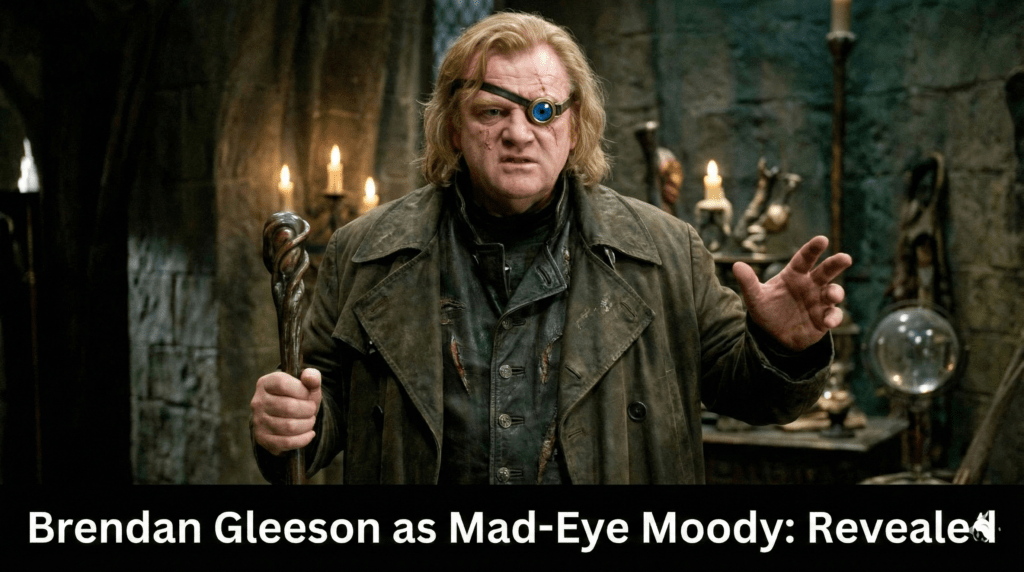
Imagine stepping into a dimly lit Hogwarts classroom for the first time. The door slams open, and in limps a grizzled wizard with a wooden leg that thumps ominously against the stone floor. His face is scarred and weathered, one normal eye glaring suspiciously while the other—a large, electric-blue magical orb—swivels independently in its socket, scanning every corner. “Constant vigilance!” he barks, and the room falls silent. That unforgettable entrance in Harry Potter and the Goblet of Fire (2005) introduced audiences to Alastor “Mad-Eye” Moody—and it was Brendan Gleeson who brought this paranoid, battle-hardened Auror to vivid, gritty life.
Brendan Gleeson Harry Potter fans often search for exactly this: how an Irish actor known for intense, grounded roles transformed into one of the wizarding world’s most iconic figures. Despite limited screen time across three films, Gleeson’s portrayal remains a benchmark for character depth in the franchise. He didn’t just wear the prosthetics; he infused Moody with raw authenticity, blending menace, humor, and vulnerability in ways that made the character feel real amid the magic.
In this in-depth exploration, we’ll uncover Gleeson’s reluctant journey to Hogwarts, the grueling transformation process, his masterful performance nuances, behind-the-scenes stories, and why his Mad-Eye Moody endures as a fan favorite more than two decades later. Whether you’re revisiting the films, preparing for the upcoming HBO series, or simply curious about what made this portrayal stand out, this guide delivers the comprehensive insights you’ve been seeking.
Who Is Alastor “Mad-Eye” Moody? A Quick Refresher
Alastor Moody, better known as “Mad-Eye,” is one of the most legendary Aurors in J.K. Rowling’s wizarding world. A veteran of the First Wizarding War against Voldemort, Moody earned his nickname from the constant paranoia born of relentless battles—he lost an eye, a leg, and chunks of his nose to dark magic. His magical eye, a replacement for the one he lost, can see through invisibility cloaks, solid doors, and even the back of his own head. His catchphrase, “Constant vigilance!”, encapsulates his worldview: trust no one, suspect everything.
In the books, Moody appears primarily in Harry Potter and the Goblet of Fire as the new Defense Against the Dark Arts professor, teaching Harry and his classmates about the Unforgivable Curses with brutal practicality. His true fate—being impersonated by Barty Crouch Jr. for most of the year—adds layers of tragedy and deception. In the films, Moody’s role is condensed but amplified: he serves as a mentor figure, a symbol of resistance against darkness, and a tragic casualty in the escalating war.
Gleeson’s version leans into the character’s gruff realism, making Moody less cartoonishly “mad” and more a hardened survivor whose paranoia feels earned. This grounded approach helped Moody stand apart in a series filled with larger-than-life personalities.
Brendan Gleeson’s Journey to Hogwarts
Brendan Gleeson didn’t set out to become a franchise star. Born in Dublin in 1955, he worked as a secondary school drama teacher for over a decade before pursuing acting full-time in his mid-30s. His breakthrough roles in films like Braveheart (1995), The General (1998), and 28 Days Later (2002) showcased his ability to portray complex, intense men with quiet menace and depth.
When the offer came to play Mad-Eye Moody in Harry Potter and the Goblet of Fire, Gleeson was hesitant. In a 2014 AV Club interview, he admitted: “I didn’t want to. I signed up for one. I didn’t really want to do a franchise. That’s not my thing.” His main concern? Working with child actors. Having taught for 10 years, he worried about “a bunch of brats” on set and feared it would be unbearable if the environment felt chaotic or unprofessional.
His family, however, had other ideas. Gleeson’s sons—particularly Domhnall, Fergus, and Brian—were thrilled. “My sons all roared: ‘Dad’s going to be Mad-Eye Moody. Wa-hey!’” he recalled in a 2011 Guardian interview. Their excitement helped sway him, and once on set, his fears dissolved. He praised the young cast’s professionalism: “The kids were really lovely. They were allowed to grow up at a proper pace.” He even noted being warned not to make Daniel Radcliffe giggle too much, as it was hard to stop him once started.
A personal bonus emerged later: Gleeson’s son Domhnall joined the franchise as Bill Weasley in Harry Potter and the Deathly Hallows. The father-son dynamic added emotional weight, especially in the scene where Bill announces Moody’s death. Gleeson described working with family as a “bonus,” noting they found ways to value each other’s opinions professionally without undermining the personal bond.
Bringing Mad-Eye Moody to Life: The Transformation Process
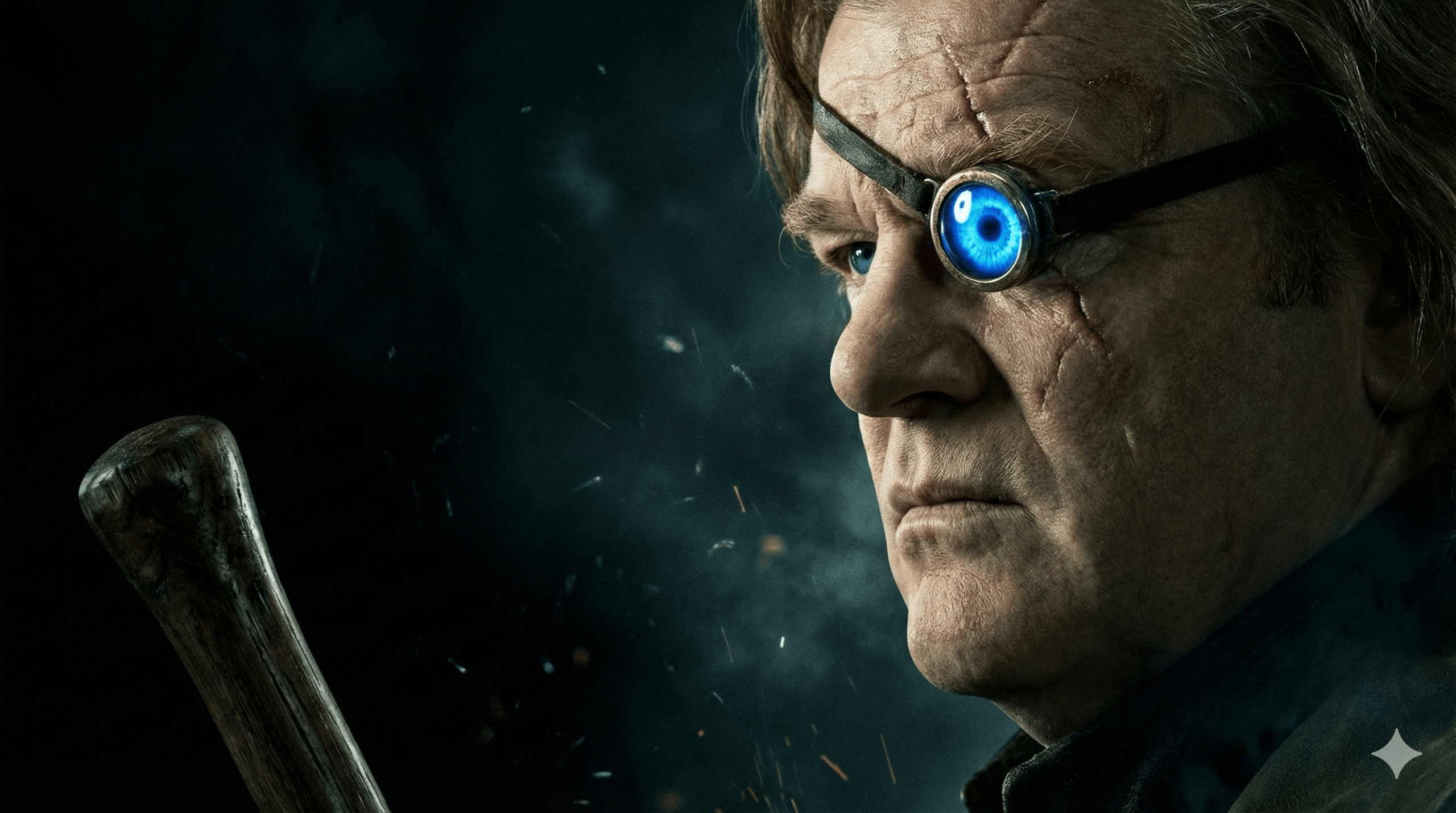
The physical creation of Mad-Eye Moody was a triumph of practical effects in an era when CGI was rising but not yet dominant. Prosthetic makeup artist Barrie Gower and his team spent months sculpting concepts starting in early 2004. The goal wasn’t a simple cyclops look; they wanted the magical eye to feel like a wizard-crafted artifact—functional, embedded, and grotesque.
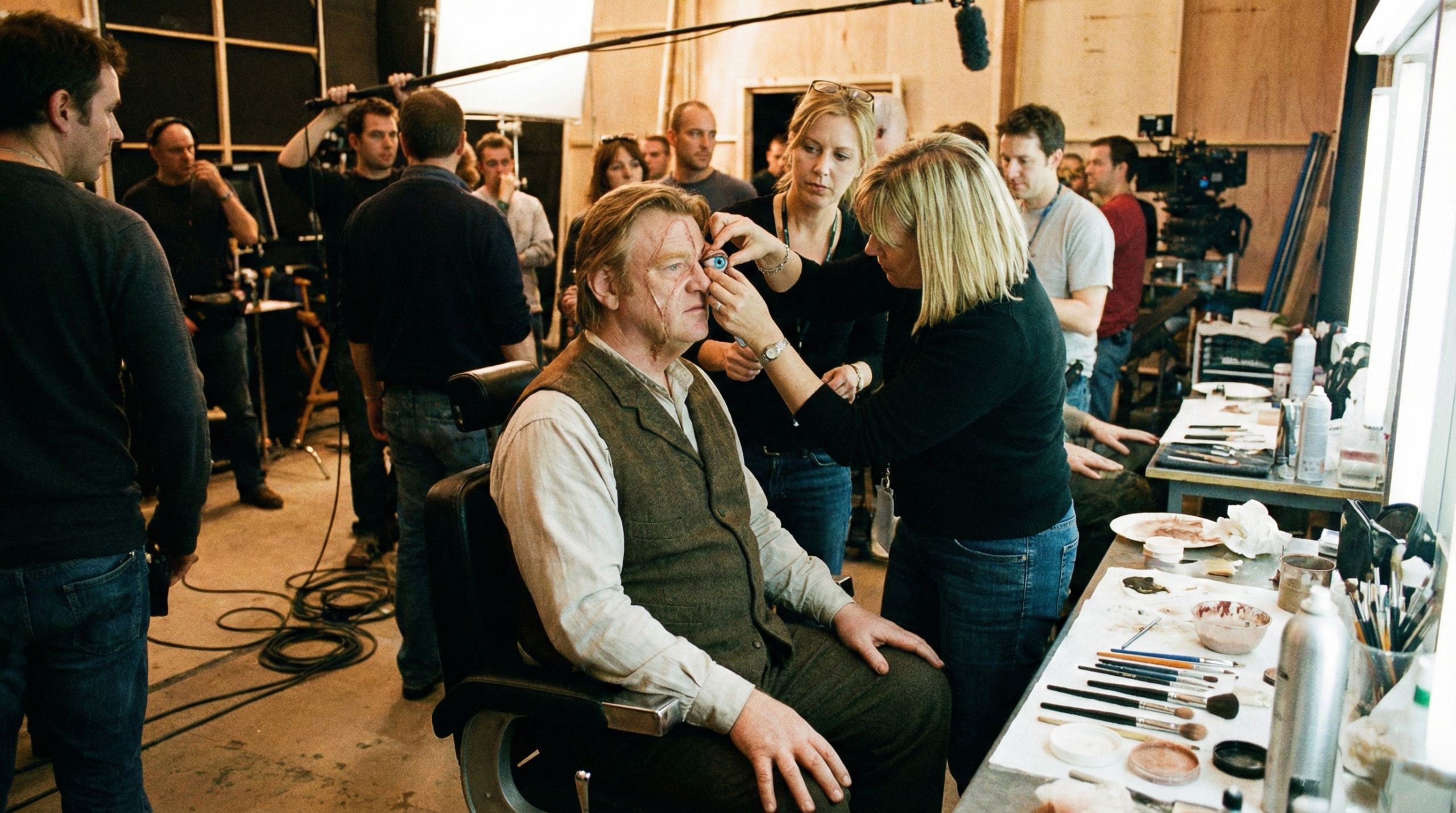 Application took around three hours each time. Gleeson sat patiently as layers of prosthetics built up his face: scars, a misshapen nose, and the socket for the magical eye. His real eye was taped shut underneath, and the blue orb was a practical prop manipulated on set (with some later VFX enhancement). The wooden leg required a limp and careful blocking, while chroma key material sometimes covered parts of his real leg for digital removal in wider shots.
Gleeson spent roughly 60 days in full prosthetics during Goblet of Fire alone. In interviews, he highlighted the “massive respect for the craftsmanship—kind of old-fashioned, in a way.” The team even created doubles for wider shots to reduce his time in the chair. Returning for Order of the Phoenix, they refined the makeup, fixing early material issues for better durability.
Gleeson drew on his teaching past for authenticity: throwing chalk, commanding a classroom, and projecting authority. “I played a teacher, and I had been a teacher for 10 years, so all this throwing chalk and dusters at people and stuff…I remember that from my own childhood,” he said. This real-world experience helped ground Moody’s eccentric professor persona.
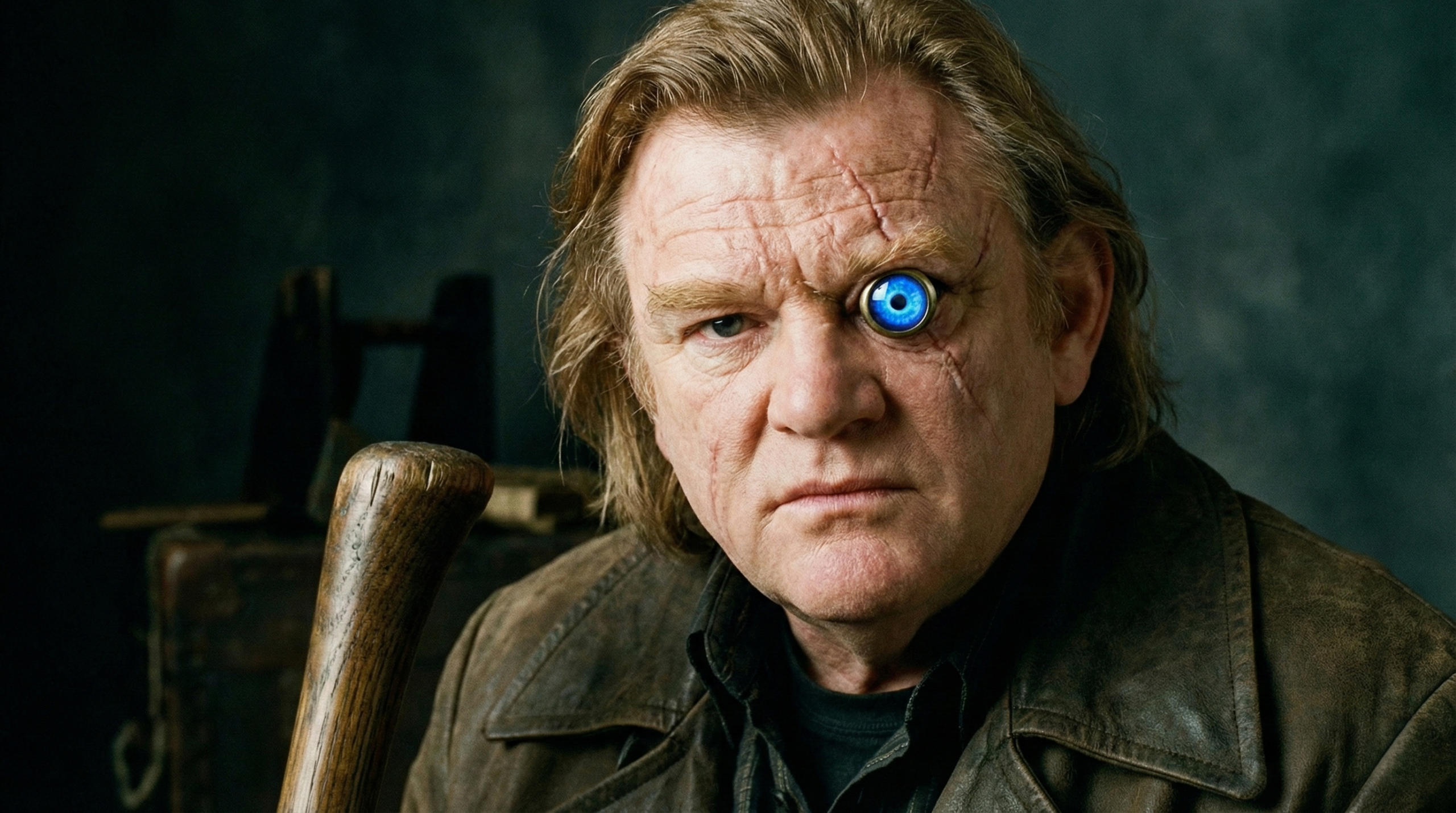
The voice was key too—Gleeson’s natural gravelly Irish accent added grit and menace. He modulated it for paranoia: sharp barks of “Constant vigilance!”, suspicious mutterings, and sudden intensity. The swiveling eye sold constant alertness, while subtle twitches conveyed a man forever on edge.
 Analyzing Gleeson’s Performance Across the Films
Brendan Gleeson’s Mad-Eye Moody appears in three Harry Potter films, but each appearance carries different weight and showcases distinct facets of his craft. His work stands out because he layered complexity into a character who could easily have been reduced to a one-note eccentric.
Goblet of Fire: The Impersonation Masterclass Most of Gleeson’s screen time in Harry Potter and the Goblet of Fire is actually Barty Crouch Jr. (played by David Tennant in human form) impersonating Moody using Polyjuice Potion. This created a fascinating dual performance challenge: Gleeson had to play Moody as interpreted through Crouch Jr.’s lens—slightly exaggerated, theatrical, and subtly off-kilter—while still convincing the audience (and the characters) that this was the real deal.
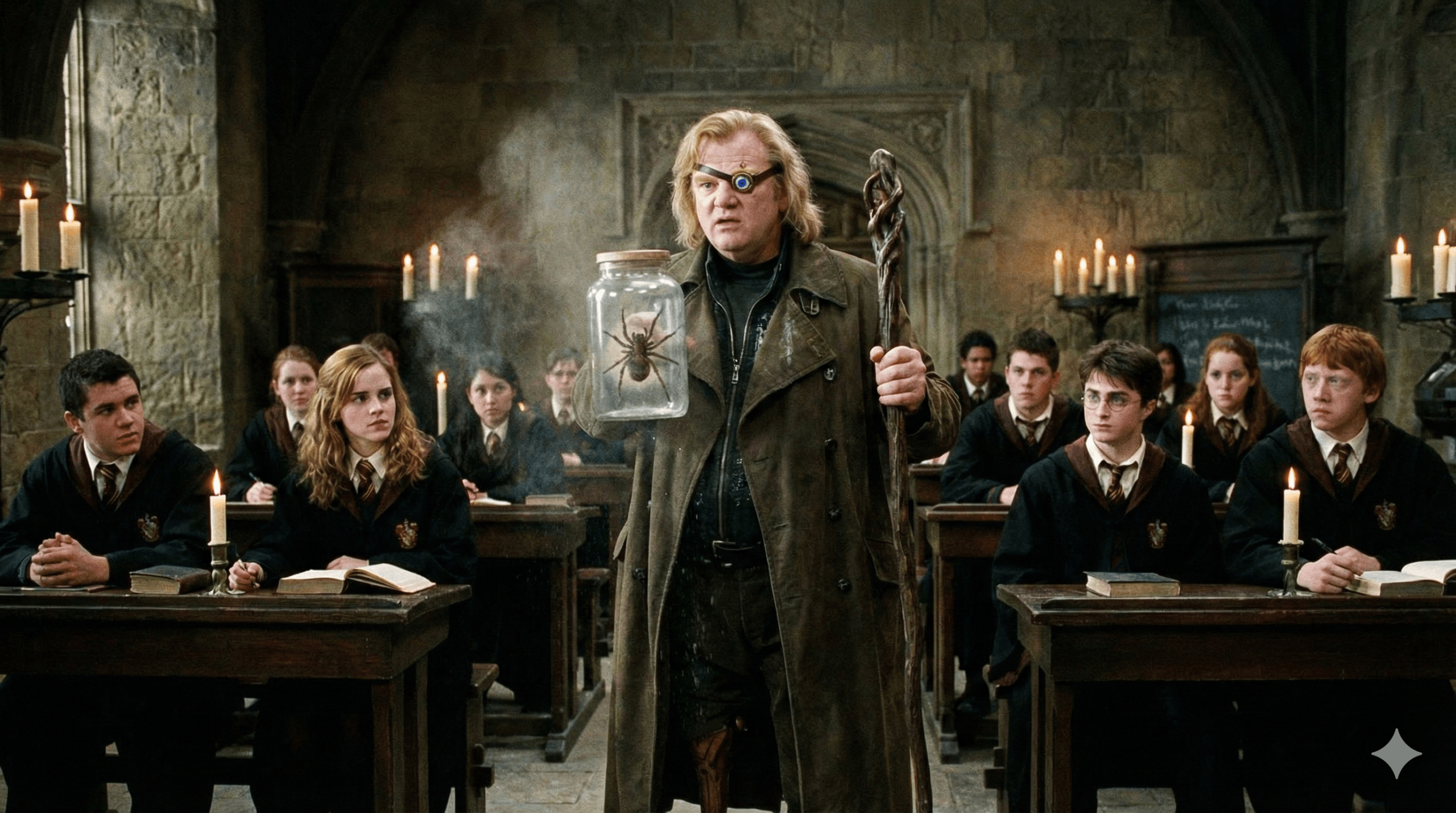 Gleeson leaned into the physicality to sell the deception. The constant swiveling of the magical eye, the exaggerated limp, the abrupt head turns, and the barked commands all felt authentic to a paranoid Auror, yet they carried just enough theatrical flourish to hint at something not quite right. His classroom scenes are particularly masterful: the way he demonstrates the Imperius Curse on a spider, the chilling delivery of “Anyone you trust could turn on you,” and the moment he forces Neville Longbottom to relive his parents’ torture under the Cruciatus Curse—all delivered with a mixture of grim authority and barely concealed glee that only makes sense in retrospect.
Critics and fans often cite these scenes as some of the strongest in the entire series. Gleeson’s gravelly voice, combined with the practical eye prop, created an immediacy that early CGI-heavy portrayals sometimes lacked. He made Moody feel dangerous in a way that felt earned rather than cartoonish.
Order of the Phoenix and Deathly Hallows – Part 1: The Real Moody In Order of the Phoenix (2007), Gleeson returns as the genuine Alastor Moody—scarred, no-nonsense, and fiercely loyal to the Order of the Phoenix. His screen time is brief but impactful: he escorts Harry from Privet Drive, barking orders and keeping watch with that ever-turning eye. The performance here is quieter, more restrained, revealing the weary soldier beneath the bluster.
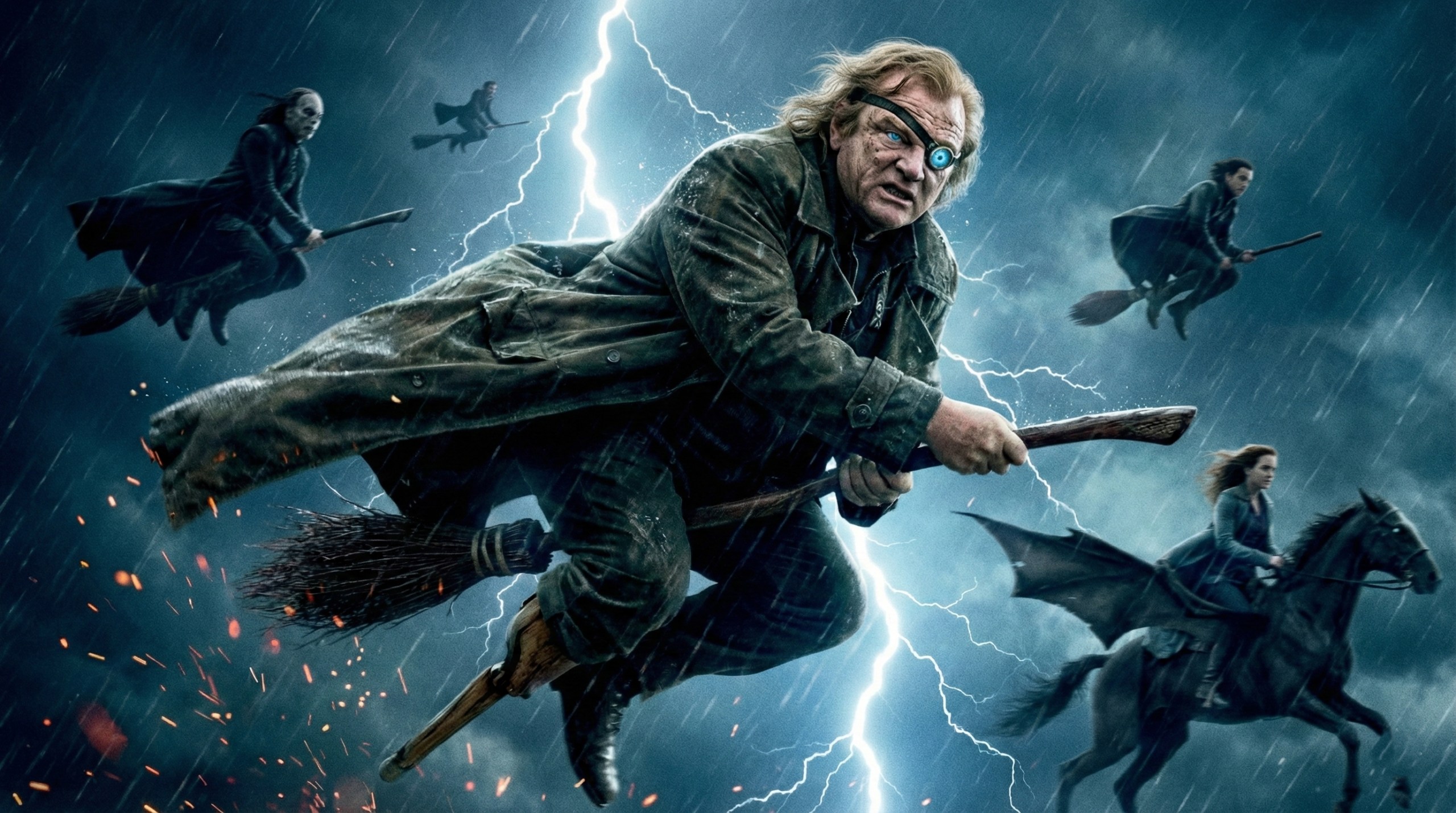 The most emotionally resonant moment comes in Harry Potter and the Deathly Hallows – Part 1 (2010). Moody leads the seven-Potter escape mission, riding his broomstick with characteristic bravado. When he is killed by Voldemort’s Killing Curse, the camera lingers on his lifeless body tumbling through the air. The tragedy lands harder because Gleeson had already established Moody as a survivor who had endured unimaginable horrors—only to meet his end in a moment of duty.
Domhnall Gleeson’s Bill Weasley delivers the news to the Weasley family, creating a poignant father-son parallel off-screen. Brendan later reflected that the moment carried extra weight because of their real-life relationship, though both kept their professionalism on set.
What Made It Iconic Gleeson’s Moody succeeds where many adaptations falter: he balances the character’s legendary status with human vulnerability. The books portray Moody as almost comically paranoid, but Gleeson grounds him in realism—making the paranoia feel like post-traumatic survival instinct rather than mere eccentricity. His Irish cadence adds texture, turning lines like “Constant vigilance!” into something both commanding and weary. The physical commitment—hours in prosthetics, mastering the limp, coordinating the eye movements—gave the performance a tactile authenticity that resonates even in today’s CGI-saturated blockbusters.
Behind-the-Scenes Stories and Interviews
Gleeson has spoken candidly about his Harry Potter experience in several interviews over the years. In a 2010 conversation with The Guardian, he described the makeup process as “extraordinary craftsmanship” and admitted he was “blown away” by the first time he saw himself in the mirror with the eye in place. “It was quite startling,” he said. “You do feel like you’re becoming something else.”
He also shared lighter moments: the young actors occasionally tried to make him laugh during takes (a difficult feat given the heavy prosthetics), and director Mike Newell encouraged him to draw on his teaching days for the classroom sequences. “I’d spent ten years throwing chalk at kids who weren’t paying attention,” Gleeson joked in a later interview. “It came in handy.”
Another recurring theme in his reflections is respect for the practical-effects era. “There was something lovely about the fact that the eye was actually there,” he noted. “You could see it moving. It wasn’t all green-screen trickery.” This old-school approach helped him stay immersed in character.
Gleeson also praised the set environment. Contrary to his initial fears, he found the child actors “incredibly professional” and enjoyed watching them grow across the years. His positive experience ultimately led him to return for the later films despite his original one-picture commitment.
Why Brendan Gleeson’s Mad-Eye Moody Endures Today
More than twenty years after his debut, Gleeson’s portrayal remains a high-water mark for supporting characters in the Harry Potter franchise. Fans still quote “Constant vigilance!” in memes, cosplay conventions feature meticulously recreated Moody costumes (complete with working LED eyes), and online discussions frequently rank him among the best-cast roles in the series.
His Moody feels timeless because he embodies a grounded realism that contrasts beautifully with the more whimsical elements of the wizarding world. In an era of ever-escalating spectacle, Gleeson’s commitment to character depth—through voice, physicality, and subtle emotional beats—makes Moody feel like a real person who happens to live in a magical universe.
 With the HBO Harry Potter series in development (as of 2026), fans are already speculating about who might portray Moody in a fresh adaptation. Many argue that Gleeson’s version will be difficult to surpass precisely because it balanced menace, humor, and humanity so effectively.
FAQs About Brendan Gleeson and Harry Potter
Did Brendan Gleeson appear in all the Harry Potter films? No. He appears in Harry Potter and the Goblet of Fire (2005), Harry Potter and the Order of the Phoenix (2007), and Harry Potter and the Deathly Hallows – Part 1 (2010).
Is Brendan Gleeson related to Domhnall Gleeson from the Harry Potter series? Yes—Brendan is Domhnall’s father. Domhnall played Bill Weasley, creating a real-life family connection that added poignancy to Moody’s death scene.
Why was Gleeson initially reluctant to take the role? He was wary of long-term franchise commitments and had concerns about working with large groups of child actors, based on his own experience as a teacher. Once on set, those fears proved unfounded.
How did the magical eye work on set? It was a practical prop with some mechanical movement, operated on set. Later VFX enhanced certain shots, but much of what audiences saw was in-camera.
Will Moody appear in the new HBO Harry Potter series? Moody’s timeline aligns with Goblet of Fire onward, so it’s likely the character will appear if the series follows the book chronology. No casting has been announced as of 2026.
Brendan Gleeson’s journey from reluctant participant to beloved interpreter of Mad-Eye Moody is a testament to the power of committed character acting. He took a potentially one-dimensional paranoid Auror and gave him scars, humor, weariness, and heart—qualities that made Moody feel like a real survivor of a brutal war rather than a collection of quirks.
His performance reminds us why the Harry Potter films endure: it’s not just the magic, but the humanity within it. Whether you’re rewatching the Battle of the Seven Potters, teaching a new generation about the wizarding world, or simply appreciating great acting, Gleeson’s Moody remains a masterclass in bringing fantasy to life.
What’s your favorite Mad-Eye Moody moment? Share in the comments below—and if you enjoyed this deep dive, check out our other Harry Potter actor profiles for more behind-the-magic insights.