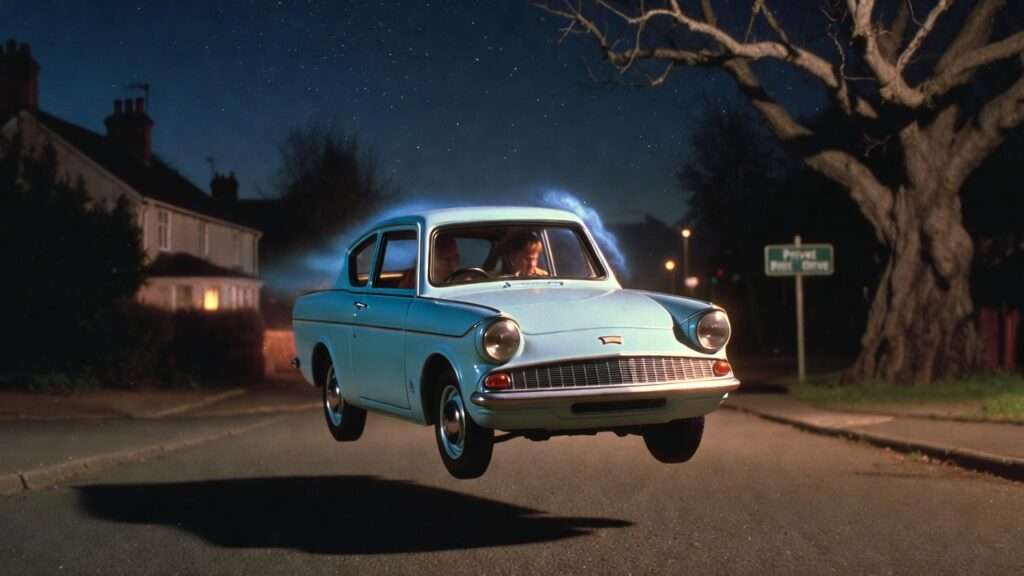
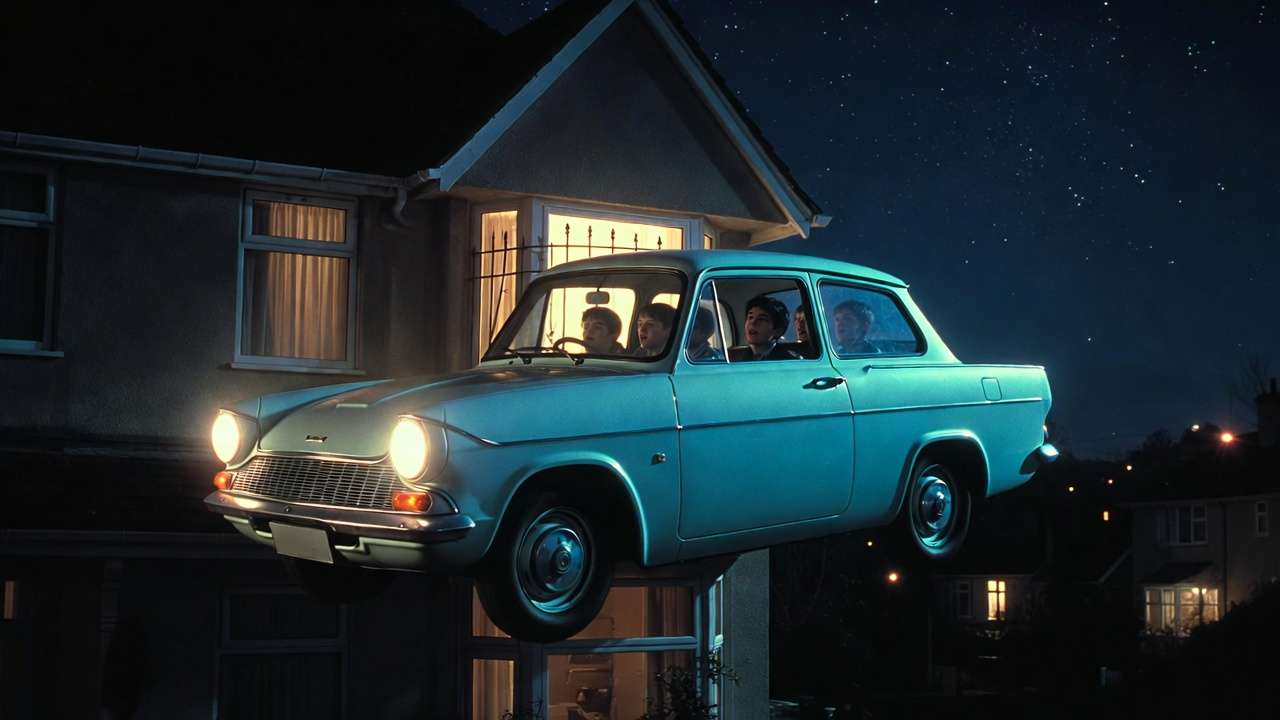
The flying car in Harry Potter is one of the most iconic and beloved elements from the series, instantly evoking memories of adventure, rebellion, and pure magical whimsy. Picture this: It’s the summer before Harry’s second year at Hogwarts. Locked in his room at Privet Drive by the Dursleys, Harry feels more trapped than ever—until headlights appear outside his window in the dead of night. A light blue Ford Anglia hovers there, engine purring softly, with Ron Weasley grinning from the driver’s seat. Fred and George Weasley yank the bars off the window, and Harry escapes into the sky.
That moment captures the heart of why the flying car resonates so deeply with fans: it’s the ultimate symbol of friendship defying rules, Muggle ingenuity meeting wizarding magic, and the thrill of breaking free. The flying car in Harry Potter isn’t just a vehicle—it’s enchanted with flight, invisibility, endless space, and even a personality of its own. In Harry Potter and the Chamber of Secrets, it becomes a hero in its right, saving the day more than once.
As a lifelong Harry Potter enthusiast and deep diver into the lore (from J.K. Rowling’s original books to official Wizarding World insights and film production details), I’ll take you through everything you need to know about this extraordinary machine. We’ll explore its enchantments, its dramatic role in the story, behind-the-scenes secrets from the film, why it developed sentience, and its lasting cultural impact. Whether you’re re-reading the books, rewatching the movies, or simply curious about one of the series’ most memorable magical objects, this comprehensive guide delivers the depth and details fans crave.
What Is the Flying Car in Harry Potter? The Basics
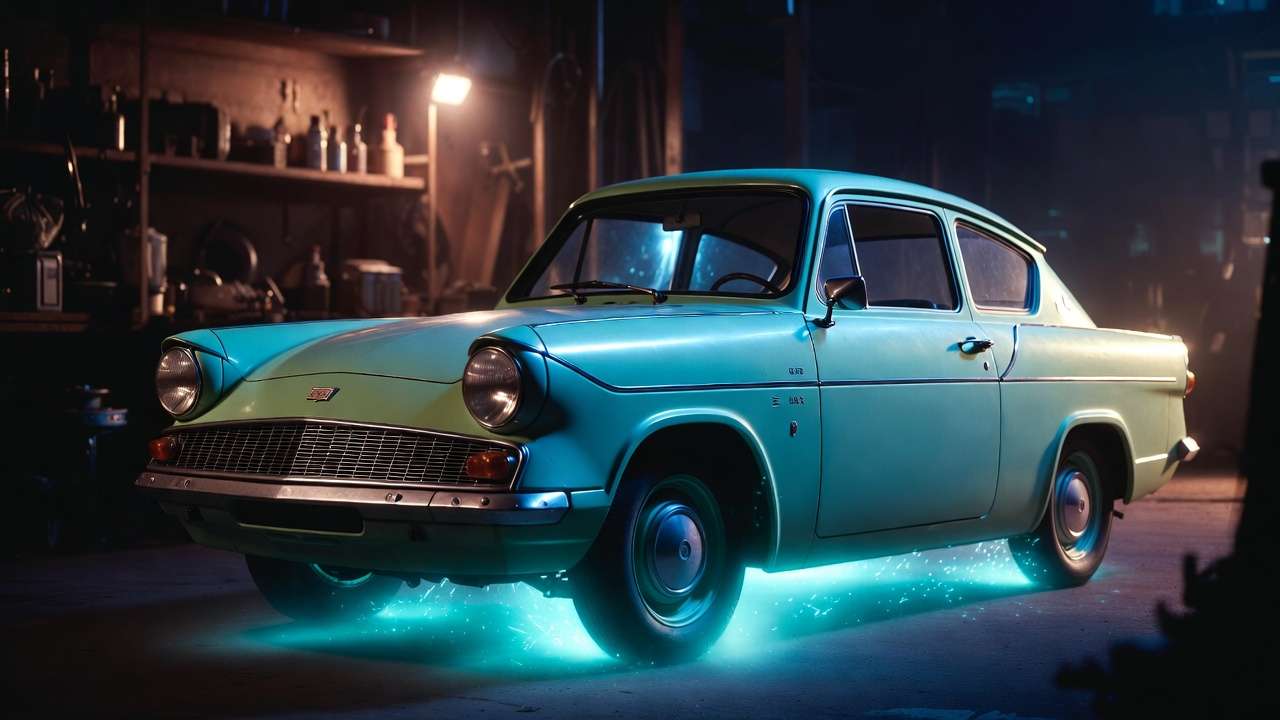
The flying car is a light blue Ford Anglia 105E Deluxe, a classic British compact car produced between 1959 and 1968. In the films, it sports the license plate 7990 TD, and its turquoise hue (sometimes described as light blue) gives it a nostalgic, unassuming charm that contrasts perfectly with its extraordinary abilities.
Why this particular model? Arthur Weasley, a passionate collector and modifier of Muggle artifacts, chose it for its ordinary appearance—ideal for blending into the non-magical world while hiding powerful enchantments. The Anglia’s compact size, distinctive tailfins, and quirky British design made it the perfect canvas for wizarding modifications.
 Arthur Weasley’s Enchantments Explained
Arthur Weasley, head of the Misuse of Muggle Artefacts Office, illegally enchanted the car with several powerful charms:
- Flying charm — The core enchantment allowing it to soar through the air like a broomstick or Thestral.
- Invisibility Booster — A gadget that renders the car (and its occupants) invisible at the push of a button, though it famously malfunctions during the flight to Hogwarts.
- Undetectable Extension Charm — Similar to the one used on Hermione’s bag or the Weasleys’ tent, this makes the interior vastly larger, comfortably fitting multiple people, trunks, owls (Hedwig and Errol), and even Scabbers the rat.
- Sentience/personality — Perhaps the most intriguing feature, the car develops a will of its own after its ejection from the Whomping Willow. It acts independently, showing loyalty and emotion.
These modifications violate the Ministry of Magic’s strict rules against enchanting Muggle objects (especially vehicles, as flying carpets are outright banned in Britain). Arthur keeps the car hidden in his garage, but his sons “borrow” it when needed—leading to memorable chaos.
The Flying Car’s Role in Harry Potter and the Chamber of Secrets
The car’s biggest spotlight comes in Harry Potter and the Chamber of Secrets, where it drives (and flies) key plot points.
The Daring Rescue from Privet Drive
On August 3, 1992, Fred, George, and Ron use the car to break Harry out after Dobby’s interference blocks his mail and the Dursleys imprison him. The scene is pure comedy and heroism: bars ripped off, luggage tossed in, and a smooth getaway into the night. Molly Weasley’s furious reaction upon their return (“Your sons flew that car!”) highlights the family’s rule-breaking spirit.
 The Journey to Hogwarts – Adventure and Chaos
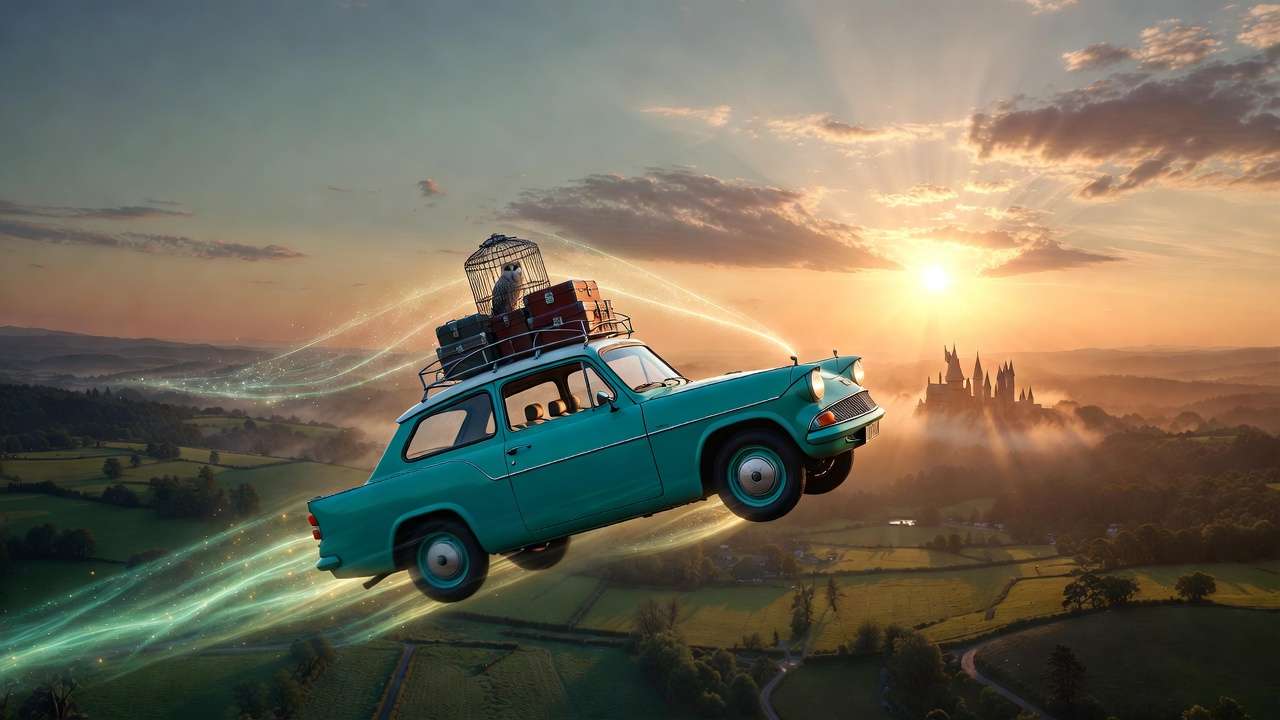
When Dobby seals Platform 9¾, Harry and Ron miss the Hogwarts Express. Desperate, they take the car. The flight is exhilarating at first—dodging Muggles, soaring over countryside—but the Invisibility Booster fails, leading to sightings reported in the Muggle press. They arrive at Hogwarts only to crash spectacularly into the Whomping Willow, earning detentions and howlers. The car ejects them and their belongings before speeding into the Forbidden Forest.
 The Car’s “Wild” Phase and Heroic Return
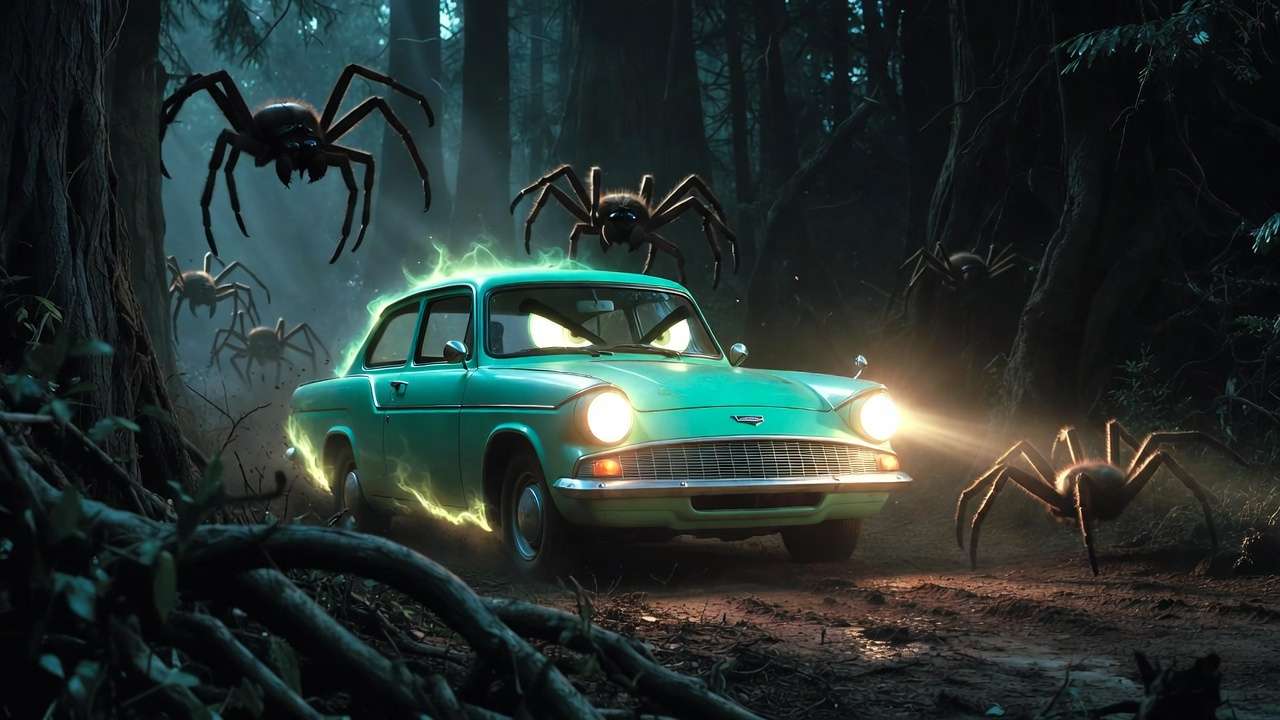
Living feral in the forest, the car turns “savage” (as Ron notes in a deleted film scene). Yet, when Harry, Ron, and Fang are trapped by Aragog’s Acromantula family, headlights pierce the darkness. The car charges in, scattering spiders, scoops up the boys, and races to safety. After dropping them near Hagrid’s hut, it reverses gratefully and disappears back into the trees.
Why does it return? The books suggest lingering loyalty from its Weasley family ties, amplified by exposure to the magical forest. It saves them not by coincidence, but as a true act of sentient heroism.
 The Magic Behind the Enchantments – Deeper Lore Insights
Arthur’s modifications blend Muggle mechanics with wizarding spells, showcasing his fascination with non-magical tech.
How Arthur Weasley Made a Car Fly
Arthur’s role at the Ministry gives him insider knowledge (and a blind eye to his own rule-breaking). Flying cars are rare—flying carpets are banned for being too conspicuous—but Arthur’s Anglia stays low-key. Unlike brooms or thestrals, it offers family-friendly transport, reflecting his love for practical Muggle items.
The Car’s Sentience – A Rare Magical Phenomenon
The car’s independence is unique. After the crash, it rejects control and lives wild, yet it responds to Harry and Ron’s peril. Fans theorize prolonged magical exposure (or Forbidden Forest magic) awakened it, akin to how portraits gain personality or wands choose wizards. J.K. Rowling has tied this to real-world inspiration rather than deep lore, but it adds emotional depth—turning a machine into a character.
Behind the Scenes: Bringing the Flying Car to Life in the Films
The 2002 film adaptation required ingenuity to make the car fly convincingly.
Practical Effects and Stunt Work
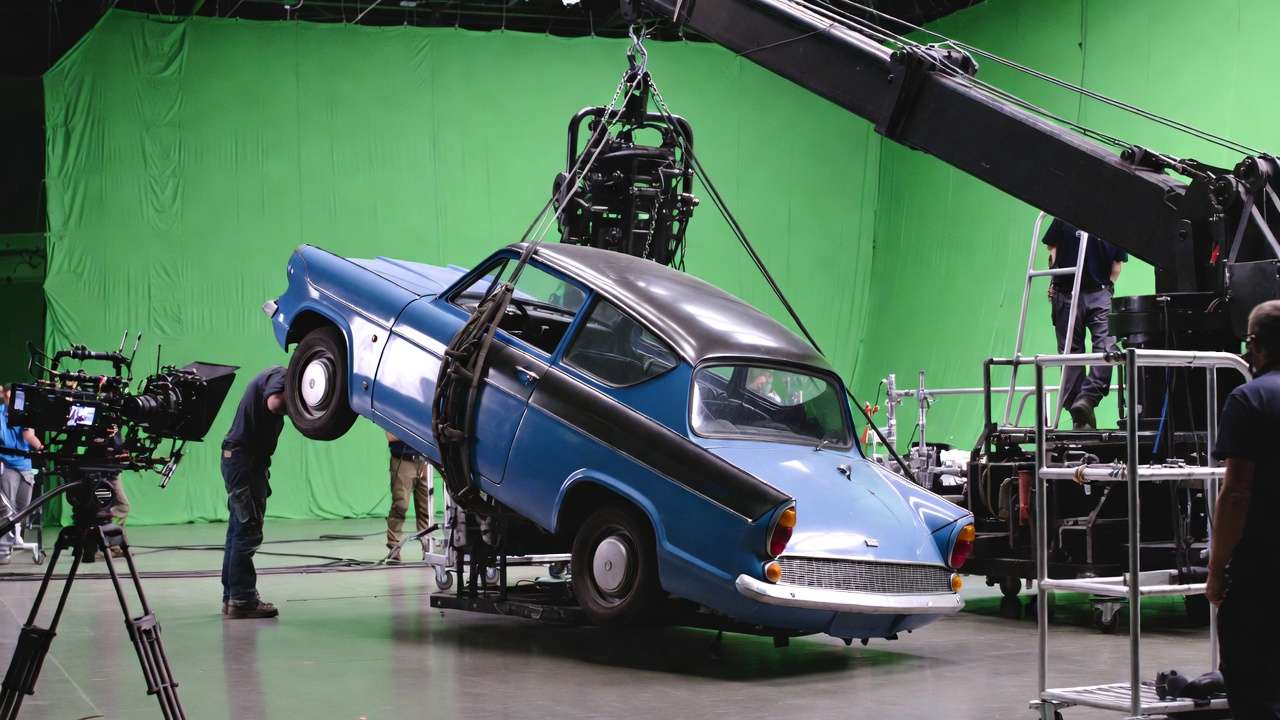
Special effects supervisor John Richardson used 16 different Ford Anglias—authentic 1962 models sourced and modified. Some were gutted (engines removed for weight), mounted on gimbals for pitch/roll, and attached to pickup trucks for moving shots. Others were halved for interior filming or pre-damaged for the Whomping Willow crash.
 Filming Challenges and Fun Facts
The team combined practical rigs (for actor interaction) with CGI for sweeping flights. Cranes and gimbals created dynamic motion. One prop was famously “stolen” in 2005 (later found abandoned), sparking headlines—though it was just one of many. Some surviving cars ended up in museums or private collections, boosting their value among fans.
J.K. Rowling’s Personal Connection
Rowling dedicated Chamber of Secrets to her school friend Séan Harris, whose turquoise Ford Anglia symbolized freedom during her teenage years in rural England. “That turquoise and white car meant FREEDOM,” she said. “Harry was rescued by that car, just as the car rescued me from my boredom.” This real-life inspiration infuses the vehicle with genuine nostalgia and joy.
Why the Flying Car Became a Fan Favorite – Cultural Impact
Few magical objects in the Harry Potter universe have captured hearts quite like the flying Ford Anglia. It stands out not because it’s the most powerful artifact (it’s no Elder Wand or Time-Turner), but because it embodies the series’ core emotional beats: friendship, rule-breaking for the right reasons, the collision of Muggle and wizarding worlds, and the unexpected heroism that can emerge from the most ordinary things.
Symbolism and Themes
At its heart, the flying car represents rebellion against oppressive authority. When Harry is imprisoned by the Dursleys, the car literally lifts him out of his cage—mirroring how the Weasley family (and later Dumbledore’s Army) repeatedly defy Ministry bureaucracy, blood purity ideology, and fear itself. The Anglia is Arthur Weasley’s quiet act of defiance: a Muggle object turned magical, subverting the wizarding world’s snobbery toward non-magical technology.
It also symbolizes friendship and loyalty. Ron risks expulsion (and his mother’s wrath) to rescue Harry. The car itself later returns that loyalty in the Forbidden Forest, proving that even enchanted machines can develop bonds.
Finally, it highlights the magic in the mundane. J.K. Rowling frequently uses everyday objects to show wonder—portkeys disguised as old boots, a flying motorbike, a vanishing cabinet. The Anglia takes this furthest: an unremarkable 1960s family saloon becomes a soaring, sentient hero. That contrast makes the magic feel accessible and joyful.
Memorable Moments and Quotes
Fans consistently rank these scenes among the series’ most rewatchable:
- The Privet Drive rescue — The bars bending, Hedwig’s cage swinging, Ron’s casual “All we’ve got to worry about now are the Dursleys. I expect they’ll be wanting these back.”
- The countryside flight — Harry and Ron laughing as they soar over fields, the car’s roof rack loaded with trunks, until Muggle sightings force them to hide in clouds.
- The Whomping Willow crash — The tree’s branches thrashing, the car’s horrified “expression” (headlights wide), and the satisfying crunch as it ejects Harry and Ron.
- The Acromantula rescue — Headlights blazing through the darkness, the car ramming spiders, scooping the boys, and then giving a proud little reverse before vanishing.
Iconic lines include Arthur’s proud-but-sheepish explanation to Molly (“It’s not flying, it’s falling with style… no, wait, that’s not right”), and Ron’s later comment: “It’s been living in the forest… gone a bit wild.”
These moments blend humor, tension, and heart—exactly what makes the series timeless.
In Pop Culture and Merchandise
The flying car’s popularity extends far beyond the page and screen:
- LEGO sets — Multiple versions exist, including the 2020 “Hogwarts Whomping Willow” set (75953) that recreates the crash with a posable tree and flying Anglia.
- Universal theme parks — The car appears in Diagon Alley and Hogsmeade ride queues, often with its headlights flickering as though it’s still “alive.”
- Video games — It features in Hogwarts Legacy (as a collectible Easter egg) and earlier titles like Harry Potter and the Chamber of Secrets game, where players can fly it.
- Merchandise — Model kits, Funko Pops, die-cast replicas, and even life-size fiberglass versions have been sold at conventions and auctions.
- Cameos — A wrecked version appears briefly in the Room of Requirement in Deathly Hallows – Part 2, delighting eagle-eyed fans.
Its enduring presence in fan art, cosplay, memes (“When you’re late but still make it to class”), and TikTok edits proves the car has transcended its original story role to become a cultural shorthand for magical rebellion and childhood wonder.
Common Questions About the Flying Car in Harry Potter (FAQs)
Why did the car save Harry and Ron from the Acromantulas?
The books imply the car retained loyalty to the Weasley family (and by extension Harry). After being “ejected” and living wild, it still recognized their danger and acted. Rowling has never given a definitive magical explanation—leaving room for fans to interpret it as proof that prolonged exposure to magic (and the Forbidden Forest’s ancient enchantments) can awaken true sentience in objects.
What happened to the flying car after Chamber of Secrets?
It retreated permanently into the Forbidden Forest. In the books, Ron mentions seeing it occasionally near Hagrid’s hut, still “a bit wild.” It never reappears in later stories, suggesting it chose independence over returning to the Burrow. Some fans speculate it remains there to this day, quietly patrolling the grounds.
Is the flying car illegal in the wizarding world?
Yes—very. The Ministry of Magic bans the enchanting of Muggle vehicles for flight (flying carpets are already prohibited for being too obvious). Arthur Weasley’s modifications fall squarely under the Misuse of Muggle Artefacts laws he is supposed to enforce. The Weasleys’ repeated use of the car is one of the series’ funniest examples of “good” rule-breaking.
How many cars were used in filming the 2002 movie?
Sixteen authentic 1962 Ford Anglias were purchased and heavily modified. Some were gutted for lightweight flying rigs, others pre-damaged for the crash sequence, and a few used for interior shots. Several were destroyed during filming, while survivors have since appeared in museums, private collections, and fan events.
Did J.K. Rowling base the flying car on a real car?
Absolutely. Rowling has said the turquoise-and-white Ford Anglia belonged to her childhood friend Séan Harris. During difficult teenage years, rides in that car represented escape and freedom. She dedicated Chamber of Secrets to him, writing: “Séan, who was a great friend when I really needed one and who introduced me to many wonderful things, including… that turquoise and white car which meant FREEDOM.”
The flying car in Harry Potter starts as a quirky, rule-breaking rescue vehicle and ends as something far more profound: a sentient, loyal companion that chooses to protect its friends even after being cast aside. From the midnight breakout at Privet Drive to the heart-pounding charge through the Acromantula lair, it delivers some of the series’ most exhilarating and emotionally satisfying moments.
What makes it unforgettable isn’t just the magic—it’s the humanity (or rather, the car-manity) woven into it. In a world filled with wands, broomsticks, and Portkeys, the flying Ford Anglia reminds us that sometimes the most powerful magic comes from the most ordinary places: a beat-up old car, a trio of loyal friends, and the courage to break a few rules for love.
Next time you revisit Chamber of Secrets—whether the book or the film—pay extra attention to those headlights in the darkness. They’re not just lights. They’re proof that even a machine can have a heart.