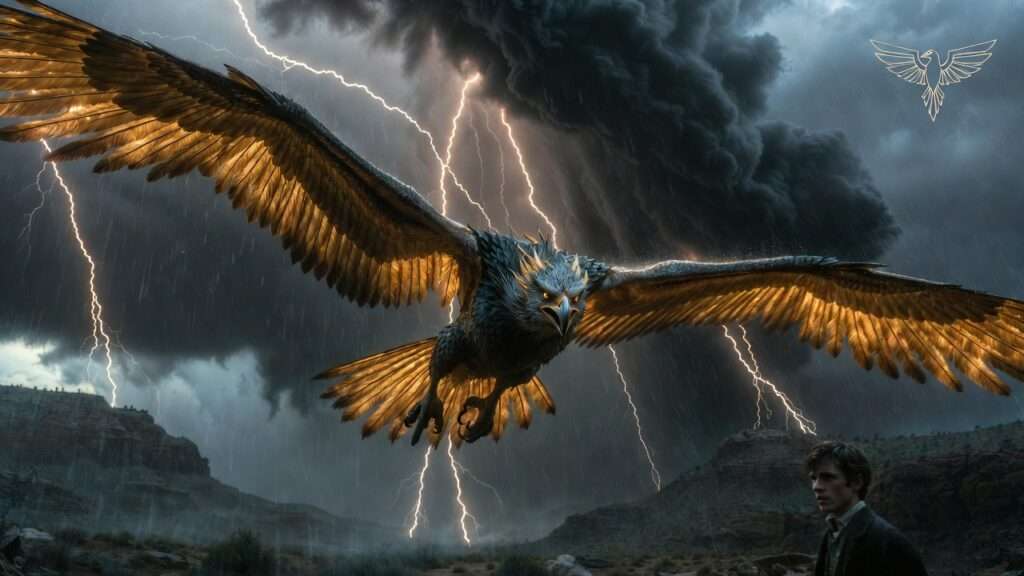
Imagine standing in the vast Arizona desert as dark clouds suddenly gather overhead. Thunder rumbles like distant drums, lightning cracks across the sky, and rain pours in sheets—all unleashed not by nature alone, but by the majestic wings of a single, enormous bird. This is the Harry Potter Thunderbird, one of the most awe-inspiring magical creatures in the entire wizarding world. A close relative of the phoenix, this regal avian beast commands the elements, senses impending danger with uncanny precision, and has left an indelible mark on American wizarding history—from the climactic rescue in Fantastic Beasts and Where to Find Them to the soul-representing house at Ilvermorny School of Witchcraft and Wizardry.
For Harry Potter fans eager to understand the Thunderbird’s full lore, powers, origins, and significance, this in-depth guide delivers everything you need. Whether you’re rewatching the films, exploring Ilvermorny house pride, curious about Native American mythological influences, or simply fascinated by magical creatures, we’ll cover the creature’s abilities, Frank’s unforgettable story, wand core connections, comparisons to other birds, and more. By the end, you’ll see why the Thunderbird stands as a symbol of raw power, adventure, and untamed magic in J.K. Rowling’s expanding universe.
What Is the Thunderbird in Harry Potter?
The Thunderbird is classified as a flying beast in the wizarding world, rated XXXX by the British Ministry of Magic’s system—indicating it is dangerous and requires specialist knowledge to handle. Native primarily to the arid regions of North America, especially Arizona’s deserts, this large, majestic bird boasts an immense wingspan, eagle-like features (often compared to a hippogriff’s head in wizarding texts), and iridescent feathers that shimmer with colors reflecting stormy skies: golds, blues, silvers, whites, and deep navies.
As a close relative of the phoenix, the Thunderbird shares an otherworldly aura but distinguishes itself through its elemental mastery rather than rebirth through fire. Official descriptions from the Wizarding World emphasize its regal presence and innate distrust of strangers, though it can form deep bonds with those who earn its trust—much like Newt Scamander’s relationship with the individual known as Frank.
Real-World Mythological Origins
The Harry Potter Thunderbird draws heavily from Native American folklore, particularly legends from Pacific Northwest, Plains, and Southwestern tribes (including influences from Choctaw and other groups). In indigenous stories, the Thunderbird is a powerful spirit being symbolizing strength, protection, and the forces of nature. It creates thunder by flapping its wings, lightning by flashing its eyes or releasing serpents from its talons, and serves as a guardian against evil spirits.
J.K. Rowling adapted these elements thoughtfully into the wizarding canon, presenting the creature as a magnificent beast rather than a direct spiritual entity. This respectful integration adds cultural depth to the American wizarding world while highlighting themes of harmony with nature—though fans should approach such lore with sensitivity to real-world indigenous traditions.
Key Differences from Myths
While sharing storm-creation and protective traits, the wizarding Thunderbird emphasizes practical magical abilities: heightened danger-sensing (extending to supernatural threats) and weather manipulation tied directly to flight. Unlike some folklore versions where Thunderbirds battle underwater creatures or serve as divine messengers, the Harry Potter iteration is a wild, independent beast—powerful yet vulnerable to capture, as seen in trafficking incidents.
The Thunderbird’s Magical Powers and Abilities
Few creatures in the Harry Potter series match the Thunderbird’s elemental dominance. Its abilities make it both a force of nature and a symbol of awe.
Storm Creation and Weather Mastery
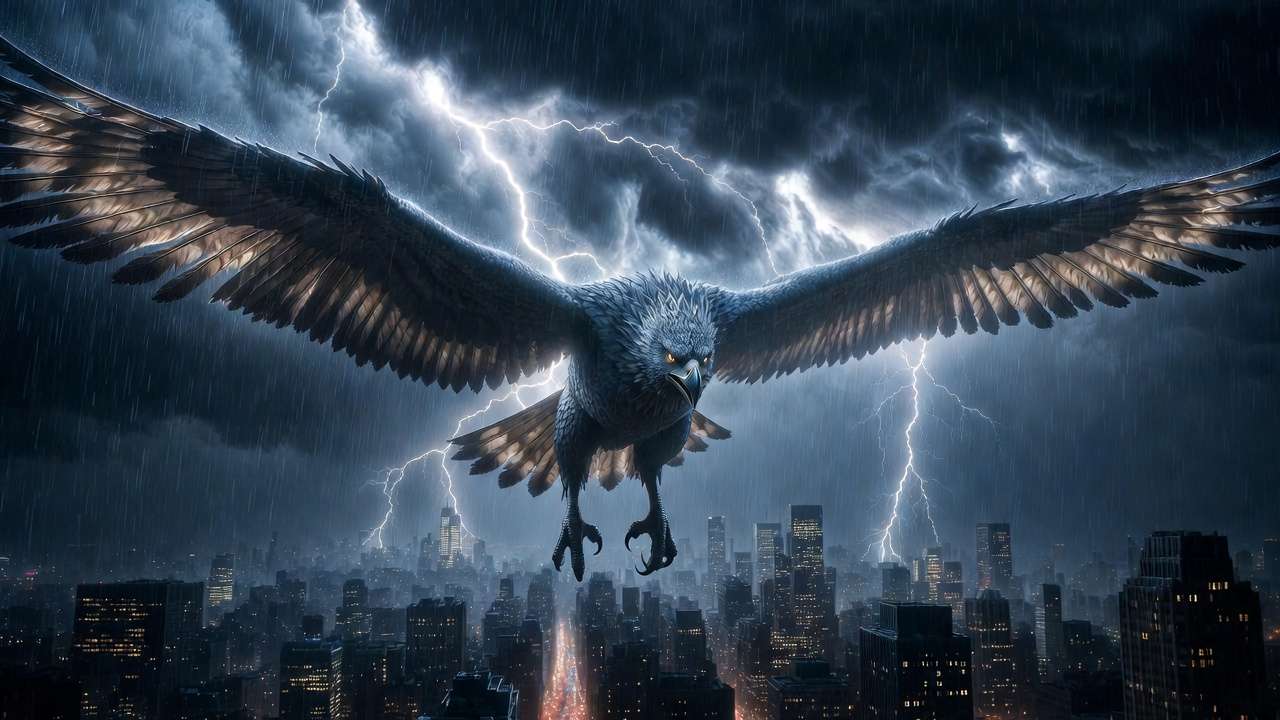
The Thunderbird’s signature power is generating thunderstorms simply by flying. Each powerful wingbeat summons thunder, lightning, and torrential rain, often transforming the sky in moments. In Fantastic Beasts and Where to Find Them, Frank demonstrates this spectacularly: his storm blankets New York City, diffusing Swooping Evil venom to erase memories from No-Majs and allowing wizards to repair the damage from Grindelwald’s (disguised) Obscurial rampage.
The bird’s feathers shift colors dramatically during these displays—flashing black and gold when sensing threats—creating a visually stunning spectacle that mirrors storm clouds and sunlight breaking through.
Danger Sensing and Preemptive Instincts
Thunderbirds possess an almost precognitive awareness of danger, particularly supernatural or magical threats. This sensitivity extends to their tail feathers when used as wand cores (more on that later), allowing wands to cast protective curses independently or preemptively. In the wild, this trait helps them evade predators and dark forces, making them difficult to approach or capture.
Other Traits
Beyond storms and vigilance, Thunderbirds exhibit immense physical strength, capable of carrying heavy loads and enduring long flights. They are distrustful by nature but loyal once trust is established—qualities that humanize them in canon narratives.
Frank the Thunderbird – The Star of Fantastic Beasts
No discussion of the Harry Potter Thunderbird is complete without Frank, the most famous individual in the series.
 Rescue and Journey
In the 1920s, Albus Dumbledore alerted Newt Scamander to traffickers in Egypt holding a captured Thunderbird. Newt rescued the bird, naming him Frank and vowing to return him to Arizona’s wilds—his natural habitat. Frank traveled hidden in Newt’s magical suitcase aboard a Muggle ship to New York, avoiding MACUSA scrutiny over creature possession laws.
Role in Fantastic Beasts and Where to Find Them
Frank’s climactic moment defines the film’s resolution. After the Obscurial attack devastates New York, Newt releases Frank to create a massive storm. The rain, laced with Swooping Evil venom from a dropped vial, serves as a mass Obliviate—erasing magical memories from No-Majs while preserving the wizarding world’s secrecy. This act symbolizes freedom, sacrifice, and magical responsibility.
Personality Insights
Newt describes Frank as “majestic, powerful, and regal” yet “a wee-bit sensitive to strangers.” This blend of grandeur and vulnerability makes Frank relatable— a creature of immense power who still needs care and respect.
Legacy and Symbolism
Frank represents themes of captivity versus liberation, human (or wizard) interference in nature, and redemption through action. His protected status post-1927 (extended by MACUSA President Seraphina Picquery to all North American beasts) underscores growing wizarding conservation efforts.
Thunderbird in Ilvermorny School of Witchcraft and Wizardry
One of the most enduring legacies of the Thunderbird in the Harry Potter universe is its role as the namesake and symbol of one of the four houses at Ilvermorny School of Witchcraft and Wizardry, North America’s premier magical institution.
 House Origins and Meaning
Ilvermorny was founded in the early 17th century by Isolt Sayre (a descendant of Salazar Slytherin) and her No-Maj husband James Steward, along with their adopted sons William and Chadwick Boot. When it came time to name the houses, each family member chose a magical creature that resonated with their values. Chadwick Boot—eldest son and a passionate adventurer—selected the Thunderbird.
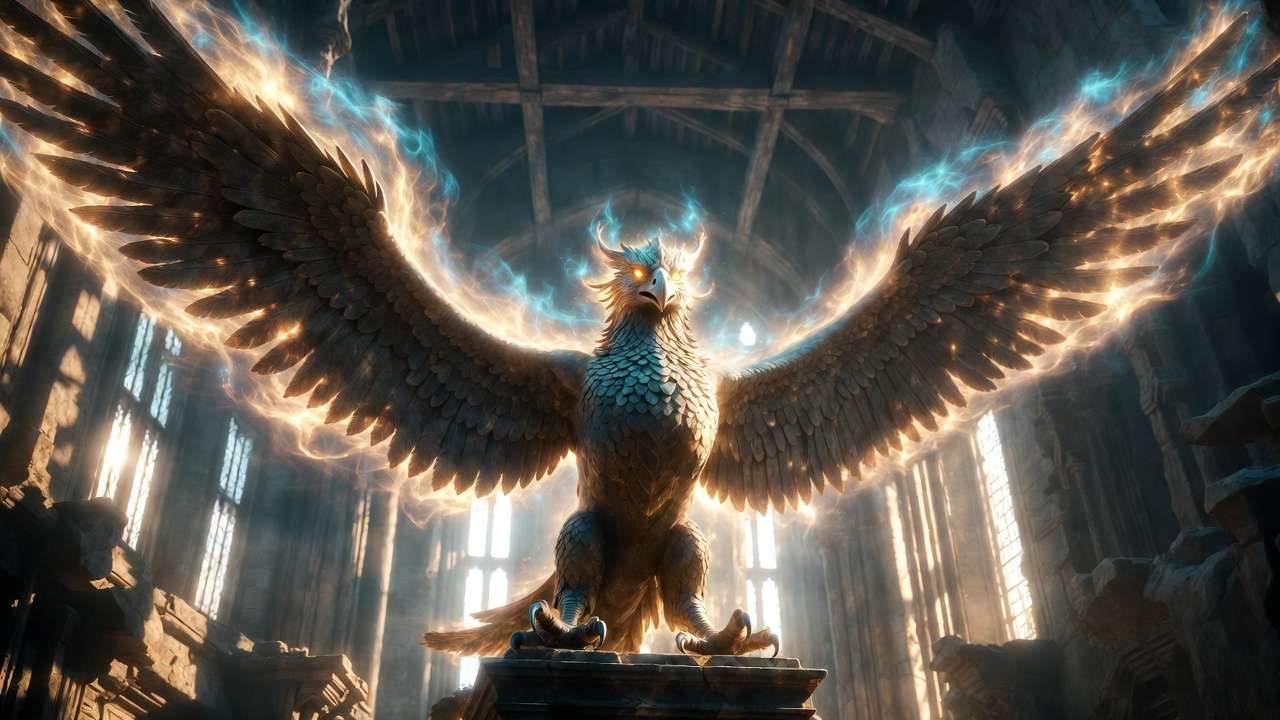
The house of Thunderbird represents the soul. According to Wizarding World lore, it favors witches and wizards who are dreamers, adventurers, those drawn to the wide open sky, and individuals who seek freedom and exploration above all else. Its colors are blue and gold, and its emblem is the Thunderbird itself, wings spread wide as if ready to take flight.
Sorting Ceremony Connection
Ilvermorny’s sorting process is uniquely dramatic. Rather than a hat speaking to students, four stone statues of the house creatures (Horned Serpent, Wampus, Thunderbird, and Pukwudgie) react when a student stands on the Gordian Knot in the entrance hall. When a student belongs in Thunderbird, the carved Thunderbird beats its wings, sending a gentle gust of air through the hall as a sign of acceptance.
This physical, visible reaction creates a sense of spectacle and destiny that many fans find more theatrical than Hogwarts’ Sorting Hat ceremony.
Famous Thunderbird Alumni and Traits
J.K. Rowling herself revealed that she would be sorted into Thunderbird house, aligning with her own sense of adventure and creativity. Other notable connections include several actors from the Fantastic Beasts films who have expressed affinity for the house.
Traits commonly associated with Thunderbird students include:
- A love of travel and new experiences
- Independence and a free-spirited nature
- Strong intuition and imagination
- A tendency toward restlessness if confined
In fan communities, characters like Newt Scamander are frequently headcanoned as Thunderbird material due to his global creature-rescuing lifestyle, while others debate whether Harry Potter himself might have been sorted there had he attended Ilvermorny.
Thunderbird vs. Other Ilvermorny Houses
To understand Thunderbird’s place, it’s helpful to contrast it with the other three houses:
- Horned Serpent (mind/scholars) – favors the wise, the scholarly, and those with sharp intellect.
- Wampus (body/warriors) – values strength, courage in battle, and physical prowess.
- Pukwudgie (heart/healers) – prioritizes loyalty, healers, and those who care deeply for others.
Thunderbird stands apart as the house most oriented toward the intangible—the soul, dreams, and the boundless horizon—making it a natural fit for artists, explorers, and visionaries.
Thunderbird Tail Feathers as Wand Cores
While dragon heartstring, unicorn hair, and phoenix feather dominate European wandlore, American wandmaking features a wider variety of magical cores—including Thunderbird tail feathers.
 Properties and Makers
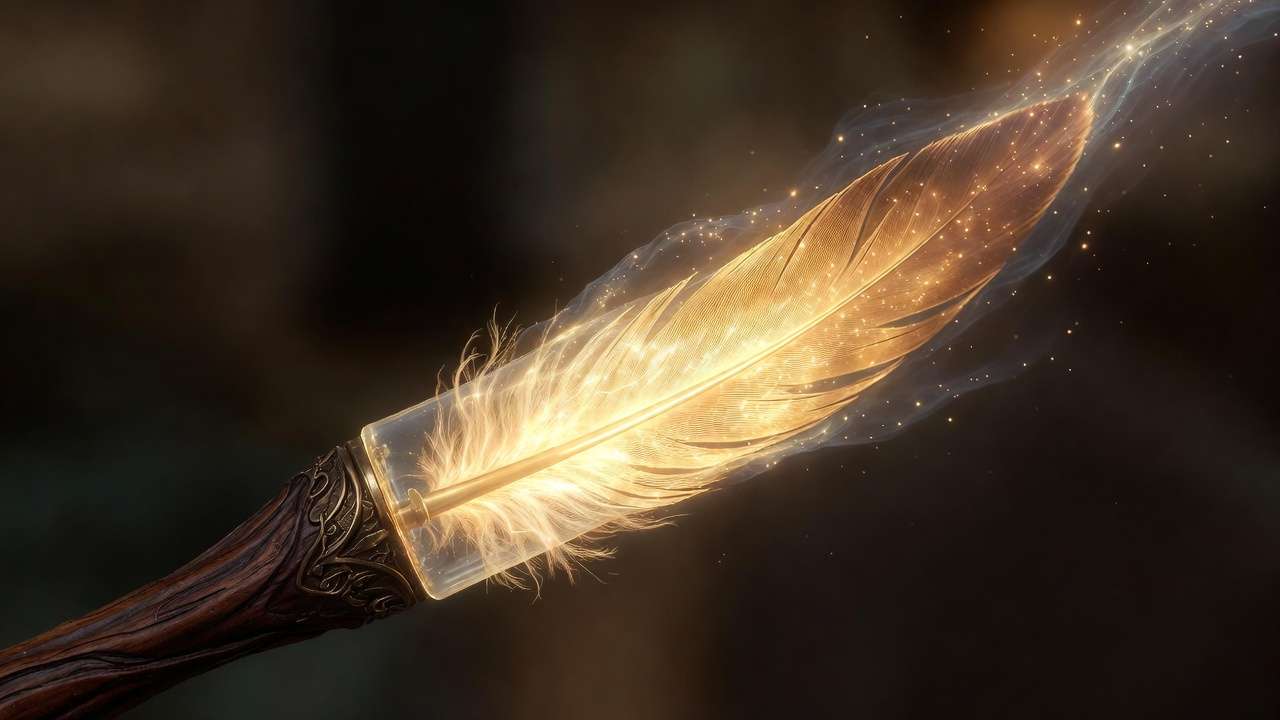
Thunderbird tail feather cores are most famously used by the American wandmaker Shikoba Wolfe (of the Wovey clan), who specializes in crafting powerful, instinctive wands. These cores produce wands of exceptional strength, particularly when it comes to elemental and protective magic.
Unique Behaviors
Wands with Thunderbird feather cores are known for their remarkable danger-sensing ability. They can cast curses, hexes, or protective spells independently or preemptively when they detect a threat to their owner—sometimes even before the witch or wizard consciously registers the danger. This mirrors the creature’s own heightened instincts in the wild.
However, like the Thunderbird itself, these wands are selective. They bond deeply only with owners who earn their trust, and they can be temperamental or uncooperative with those they deem unworthy.
Rarity and Appeal
Thunderbird feather wands remain relatively rare outside North America due to the difficulty of obtaining feathers ethically (Thunderbirds are fiercely protective and distrustful). Among American wandmakers, they are prized for dueling, weather-related charms, and any spellwork requiring quick, instinctive reaction.
Other Appearances and Mentions in Harry Potter Canon
While Frank in Fantastic Beasts remains the most prominent Thunderbird, the creature appears in other corners of the wizarding world.
Hogwarts Mystery and Games
In Harry Potter: Hogwarts Mystery, players can unlock and care for a Thunderbird in the Magical Creatures Reserve. Through feeding, bonding, and leveling up the creature, students learn more about its storm-summoning abilities and personality. These interactions provide one of the few hands-on experiences fans have with the species outside the films.
Books, Pottermore/Wizarding World Insights
The original Fantastic Beasts and Where to Find Them textbook (both the in-universe version and the real-world companion written by J.K. Rowling) includes an entry on the Thunderbird, describing its habitat, classification, and powers. Pottermore (now WizardingWorld.com) expanded on Ilvermorny lore, Thunderbird wand cores, and the house system in detailed articles released around 2016.
Broader Wizarding World Ties
Thunderbirds are occasionally referenced in passing in discussions of American magical history, particularly the 1920s era of MACUSA regulation and creature trafficking crackdowns.
Comparing the Harry Potter Thunderbird to Other Magical Birds
To fully appreciate the Thunderbird, it’s useful to place it alongside other avian magical creatures.
Vs. Phoenix, Hippogriff, Augurey
- Phoenix – Shares a mythical, near-divine status and fiery beauty, but focuses on rebirth, healing tears, and loyalty rather than elemental destruction.
- Hippogriff – Proud and majestic like the Thunderbird, but more terrestrial and proud; requires formal respect rather than trust-building.
- Augurey – Known as the Irish Phoenix, it predicts death with its mournful cry and avoids bright light; far more melancholic than the Thunderbird’s commanding presence.
 Why the Thunderbird Feels Unique
The Thunderbird’s scale of power—summoning city-wide storms—and its distinctly American flavor set it apart. It feels wilder and less domesticated than European creatures, embodying the untamed spirit of the New World.
Fan Theories, Trivia, and Fun Facts
- Some fans theorize that Thunderbirds could appear in future Fantastic Beasts sequels or a potential Ilvermorny-focused story.
- J.K. Rowling has said she feels a personal kinship with birds in general and chose Thunderbird for herself because of its association with freedom and vision.
- Thunderbird imagery is hugely popular in fan art, house merchandise, cosplay, and Ilvermorny-themed events at Universal Studios.
Frequently Asked Questions (FAQ)
Is the Thunderbird a real creature in Harry Potter mythology? Yes—it’s fully canonical, appearing in Fantastic Beasts, Ilvermorny lore, and supplementary writings.
What Ilvermorny house is named after the Thunderbird? Thunderbird house, representing the soul and favoring adventurers and dreamers.
Can a Thunderbird be kept as a pet? Highly unlikely and inadvisable. They are wild, powerful XXXX-class creatures that distrust strangers and require vast open spaces.
How does Frank’s storm work in Fantastic Beasts? Frank’s thunderstorm diffuses Swooping Evil venom through the rain, creating a city-wide memory charm (Obliviate) on No-Majs.
Are there differences between the movie Thunderbird and book descriptions? The films emphasize visual spectacle and Frank’s personality, while written sources focus more on classification, habitat, and wand-core properties.
What Native American tribes inspired the Thunderbird? Primarily Pacific Northwest, Plains, and Southwestern traditions, though J.K. Rowling adapted elements broadly rather than tying it to one specific tribe.
Could Harry Potter have been sorted into Thunderbird? Many fans think so—his adventurous spirit, loyalty to friends, and desire for freedom align well with Thunderbird traits.
The Harry Potter Thunderbird is far more than a dramatic storm-bringer or cinematic set piece. It embodies elemental power, protective instinct, untamed freedom, and the soul’s yearning for adventure. From Frank’s liberating flight over New York to the beating wings of Ilvermorny’s sorting statue, to the quiet strength of its tail feathers in a wand, the Thunderbird reminds us that magic is wild, unpredictable, and deeply connected to the natural world.
If this guide has sparked your curiosity, consider taking the official Ilvermorny Sorting quiz on WizardingWorld.com, rewatching Fantastic Beasts and Where to Find Them with fresh eyes, or exploring respectful sources on real-world Thunderbird legends. Whenever you hear thunder rolling across the sky, pause for a moment—you might just catch a glimpse of golden wings flashing through the clouds.