Have you ever been deep in a Harry Potter reread, completely absorbed in the magic of Hogwarts, only to pause and realize that the math of a certain character’s timeline doesn’t quite add up? You are certainly not alone. For decades, eagle-eyed readers have pointed out a glaring continuity error involving Marcus Flint from Harry Potter. As the hulking, aggressive Captain of the Slytherin Quidditch team, Flint is a memorable antagonist in the early installments of the series. However, he is also at the center of one of the most famous literary mistakes in the entire franchise—a mistake that author J.K. Rowling herself eventually had to address publicly.
If you have ever wondered why this particular Slytherin seemed to linger at Hogwarts School of Witchcraft and Wizardry far longer than the standard seven years, you have stumbled upon a fascinating piece of deep wizarding world trivia. In this comprehensive guide, we will break down the famous timeline anomaly, J.K. Rowling’s official and highly amusing retcon, the silent edits made by modern publishers, and how this specific character accidentally birthed an entirely new slang term within the fandom lexicon.
Who is Marcus Flint? (Character Background)
To fully understand the weight of the timeline discrepancy, it is essential to first understand who Marcus Flint is within the context of the Harry Potter universe. He is not merely a background character; he is a prominent antagonist who sets the tone for the fierce house rivalries that define Harry’s early years at school.
The Brutal Slytherin Quidditch Captain
Marcus Flint served as a Chaser and the Captain of the Slytherin Quidditch team from 1991 to 1994. Coming from the notoriously pure-blood Flint family—a family with known historical ties to dark magic and pure-blood supremacy—Marcus embodied the most negative stereotypes of his Hogwarts house.
Unlike Gryffindor’s Oliver Wood, who valued strategic gameplay, sheer talent, and rigorous practice, Flint’s leadership philosophy relied heavily on intimidation, brute strength, and outright foul play. He famously recruited players based on their size and physical malice rather than their flying abilities, turning the Slytherin team into what was essentially a gang of airborne thugs.
Throughout the books, Flint’s lack of sportsmanship is heavily documented. He intentionally blocks Harry during matches, collides with opponents, and notoriously tries to crush Oliver Wood’s fingers during the mandatory pre-match handshakes. Physically, Rowling describes him as having a rather “troll-like” appearance, a trait that the film adaptations leaned into heavily to emphasize his brutish nature.
 The Actor Behind the Scowl (Jamie Yeates)
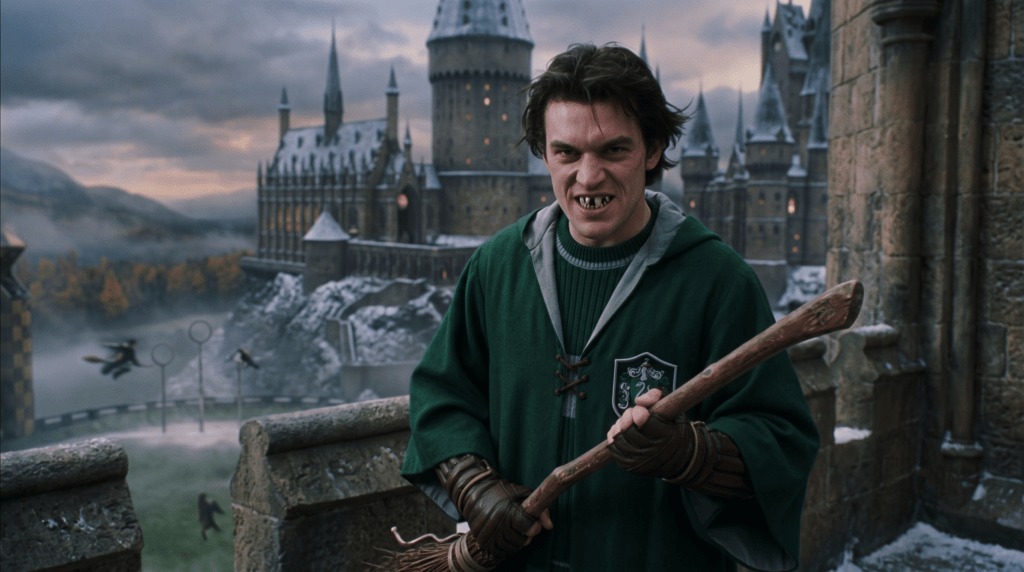
In the cinematic adaptations of Harry Potter and the Sorcerer’s Stone and Harry Potter and the Chamber of Secrets, Marcus Flint was brought to life by British actor Jamie Yeates. The filmmakers utilized heavy makeup and prosthetics to capture the character’s unappealing book description.
Most notably, Yeates was required to wear a set of oversized, jagged fake teeth. This specific cosmetic choice has become a highly searched piece of behind-the-scenes trivia, as many fans believed the actor naturally had severe dental issues. In reality, it was simply exceptional special effects makeup designed to make Flint look as menacing and unapproachable as possible.
Expert Note: There is also a well-known credits error in the first film. A different young actor, Will Theakston, was accidentally credited as Marcus Flint in some regional releases and early IMDB listings, though Theakston actually played the role of Terence Higgs, the Slytherin Seeker. Jamie Yeates is the true face of Marcus Flint on screen.
 The Timeline Discrepancy: A Hogwarts Math Problem
The core issue surrounding Marcus Flint is a simple matter of chronology. Hogwarts School of Witchcraft and Wizardry operates on a strict seven-year curriculum. Students arrive at age eleven and graduate at age seventeen or eighteen after taking their N.E.W.T.s (Nastily Exhausting Wizarding Tests). However, Marcus Flint’s timeline breaks this fundamental rule.
The Setup in The Sorcerer’s Stone
The root of the problem can be traced directly back to the original, first-edition printing of Harry Potter and the Sorcerer’s Stone. In Chapter 11, “Quidditch,” during Harry’s very first match, J.K. Rowling explicitly introduces Flint with his academic standing.
The original text reads:
“He was a sixth-year, and Harry thought he looked as though he had some troll blood in him.”
If we apply basic Hogwarts math to this statement, the timeline should look like this:
-
1991–1992 School Year (Harry’s 1st Year): Marcus Flint is in his sixth year.
-
1992–1993 School Year (Harry’s 2nd Year): Marcus Flint is in his seventh year.
By the end of the events in Harry Potter and the Chamber of Secrets (June 1993), Marcus Flint should have completed his final exams, graduated from Hogwarts, and left the castle for good.
The Impossibility in The Prisoner of Azkaban
The continuity error rears its head in the third book, Harry Potter and the Prisoner of Azkaban, which takes place during the 1993–1994 school year. When the Quidditch season begins, who leads the Slytherin team onto the pitch? Marcus Flint.
According to the established lore of the first book, Flint would currently be in his eighth year at Hogwarts—a grade level that simply does not exist. He continues to play a major role in the third book’s sports narrative, constantly clashing with Oliver Wood and attempting to sabotage Gryffindor’s chances at the Quidditch Cup.
For early fans reading the books as they were released, this was a glaring oversight. The internet was in its infancy, but early Harry Potter forums and mailing lists quickly lit up with discussions about the “eighth-year Slytherin.” How was he still there? Was there a secret postgraduate Quidditch program? Or was it simply a rare authorial slip-up?
The Real Reason: J.K. Rowling’s Official Explanation
As the Harry Potter series exploded into a global phenomenon in the late 1990s and early 2000s, the fandom grew incredibly detail-oriented. The “eighth-year Slytherin” became one of the most frequently asked questions at book signings and fan events. Eventually, the pressure to address the plot hole became too great for the author to ignore.
The “Failed Exams” Retcon
J.K. Rowling has famously and frequently admitted that mathematics is not her strong suit—a trait that has led to several minor inconsistencies regarding dates, student populations, and galleon-to-pound exchange rates throughout the series. When finally cornered in an interview regarding Marcus Flint’s impossible timeline, Rowling offered a swift, cheeky, and now-iconic response.
Instead of simply admitting it was an editorial oversight, she declared: “He had to do a year again!”
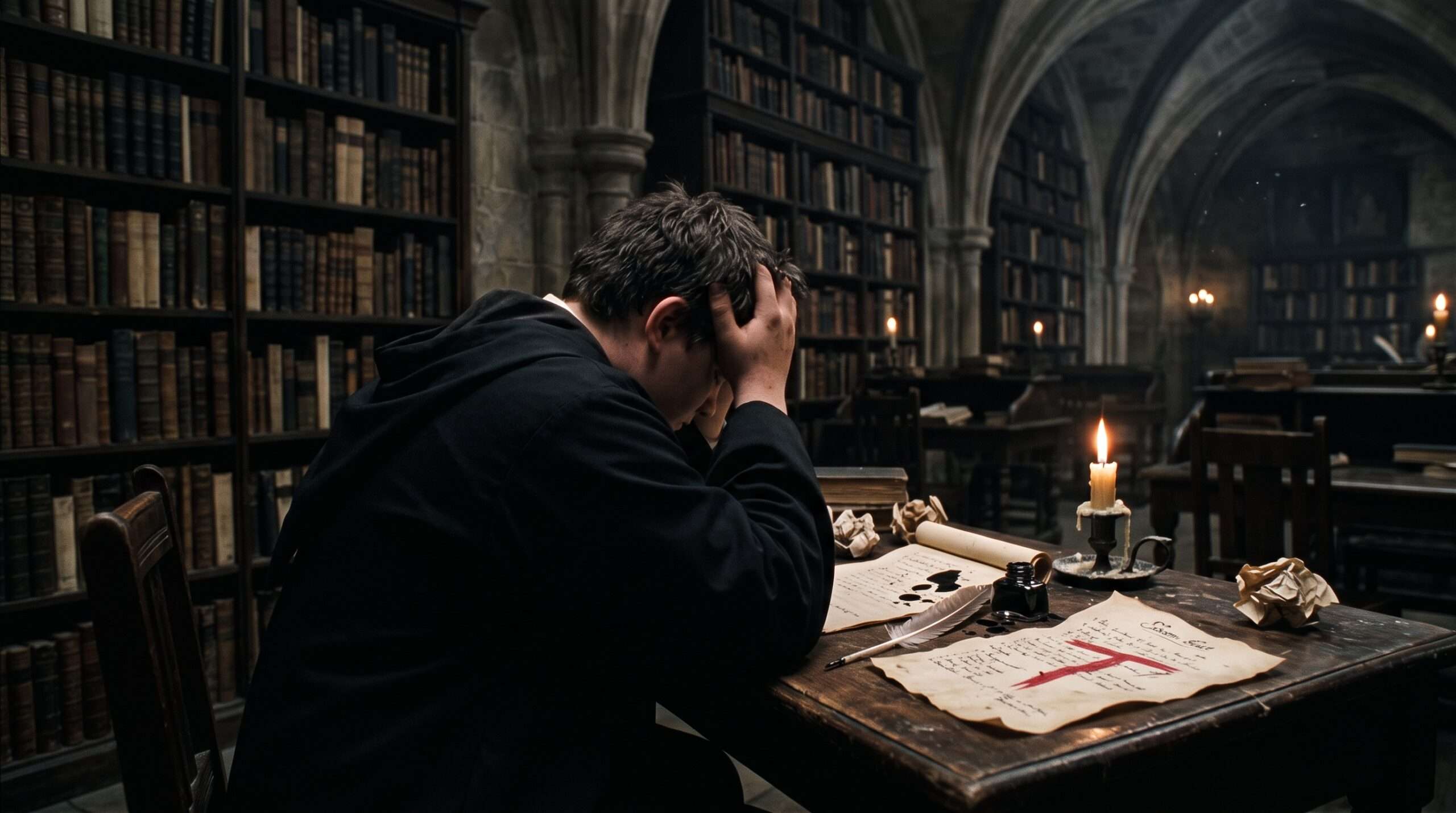
According to this authorial retcon, Marcus Flint was not a secret postgraduate student, nor was he the beneficiary of a time-turner. He simply failed his N.E.W.T.s (Nastily Exhausting Wizarding Tests) at the end of his seventh year so spectacularly that the Hogwarts administration required him to repeat his final year of schooling.
 Does It Make Sense in the Lore?
While the explanation was largely delivered as a joke to cover up a mistake, it actually fits perfectly into the established lore of the wizarding world. Does Hogwarts hold students back? Yes, it does.
We see evidence of academic consequences later in the series. For example, Vincent Crabbe and Gregory Goyle are noted to have failed their Defense Against the Dark Arts O.W.L.s (Ordinary Wizarding Levels) and are forced to retake the class with younger students. Given Flint’s documented lack of intelligence—Harry frequently compares him to a troll in both looks and brainpower—it is entirely plausible, and even completely in character, that he would fail his crucial final exams. Thus, a simple math error was transformed into a canon-compliant character flaw.
How “The Flint” Became Fandom Slang
The Marcus Flint continuity error did more than just establish that Hogwarts students can be held back; it permanently altered the vocabulary of the Harry Potter fandom.
Coining the Term for Continuity Errors
In the early days of the internet, long before Reddit or Twitter, adult Harry Potter fans congregated on mailing lists and message boards, most notably the Harry Potter for Grown Ups (HPFGU) Yahoo Group. This community was deeply invested in analyzing the text with a critical eye.
Because Marcus Flint’s timeline was the very first major, undeniable continuity error discovered in the books, the community began using his name as shorthand. In classic Harry Potter fandom slang, any genuine continuity error or plot hole in the text became known as a “Flint.” If a fan found a date that didn’t make sense or a character appearing somewhere they physically could not be, they would log onto the forums and announce, “I think I found a Flint!”
 Other Famous “Flints” in the Series
While Marcus Flint was the namesake, several other “Flints” gained notoriety over the years:
-
The Priori Incantatem Error: In early editions of Harry Potter and the Goblet of Fire, when Harry and Voldemort’s wands connect, the ghosts of Voldemort’s victims emerge from the wand in the reverse order of their deaths. However, James Potter emerged before Lily Potter, which contradicted the established fact that James died first. This “Flint” was later corrected in subsequent printings.
-
The September 1st Sunday: The Hogwarts Express always leaves on September 1st, and classes always seem to start on a Monday, regardless of what day of the week September 1st actually falls on in the real-world calendar.
The Silent Fix: How Newer Book Editions Corrected It
While J.K. Rowling’s “failed exams” excuse was highly entertaining and embraced by the fandom, the publishers at Bloomsbury and Scholastic took a more pragmatic approach to the problem.
The Text Revision
Years after the initial publication, when the books were being reprinted to fix minor typos and formatting issues, editors quietly altered the text in Chapter 11 of The Sorcerer’s Stone.
In all modern editions, digital copies, and current audiobooks, the introduction of Marcus Flint has been changed. The text now reads:
“He was a fifth-year, and Harry thought he looked as though he had some troll blood in him.”
By simply changing “sixth-year” to “fifth-year,” the publishers entirely eradicated the math problem. If Flint is a fifth-year in book one, he is a seventh-year in book three. The timeline fits perfectly, and there is no need for him to have repeated a year at all.
Canon vs. Print: Which is Real?
This silent edit sparked an interesting philosophical debate within the fandom regarding canon. Which version of the story is the “true” version? Do you accept the published, corrected text where Flint was simply a fifth-year? Or do you embrace J.K. Rowling’s off-the-cuff interview answer that he was a dim-witted sixth-year who failed his exams?
Because the idea of the brutish Slytherin Captain failing his N.E.W.T.s is so deeply satisfying to fans, the vast majority of the community—and comprehensive wikis—continue to treat the “held back” explanation as the primary canon, largely ignoring the publisher’s sanitized edit.
Marcus Flint’s Legacy in the Wizarding World
Despite being a secondary character, Marcus Flint left a lasting impression on the series, primarily serving as the gold standard for Slytherin antagonism before characters like Draco Malfoy grew into more threatening roles.
The Rivalry with Oliver Wood
The dynamic between Oliver Wood and Marcus Flint is one of the most compelling sports rivalries in modern fantasy literature. Wood is obsessively passionate, strategically brilliant, and demands excellence. Flint is ruthlessly violent, relies on intimidation, and cares only about winning by any means necessary.
Their rivalry peaks during The Chamber of Secrets, notably during the “Mudblood” incident. When Flint reveals the new Nimbus 2001 brooms bought by Lucius Malfoy to secure Draco’s spot on the team, it is Flint who stands chest-to-chest with Wood, mocking Gryffindor’s lack of wealth. The visual of the two Captains nearly coming to blows perfectly encapsulates the broader ideological war between Gryffindor and Slytherin.
 Life After Hogwarts (Fan Theories vs. Canon)
Because Marcus Flint is not mentioned again after graduating following the events of Prisoner of Azkaban, fans are left to speculate about his adult life. Did he play professional Quidditch?
Given his aggressive tendencies and pure-blood lineage, many fans have theorized that he may have naturally aligned with the Death Eaters during the Second Wizarding War. However, there is no canonical evidence to suggest he took the Dark Mark. A more popular (and less sinister) fan theory suggests that because his flying style was entirely reliant on dirty tricks and foul play rather than genuine skill, his Quidditch career fizzled out the moment he tried to compete against actual professionals, leaving him to rely on his family’s wealth.
Frequently Asked Questions (FAQs)
Why did Marcus Flint have bad teeth in the movies?
The filmmakers used heavy prosthetics and fake teeth on actor Jamie Yeates to match J.K. Rowling’s description of Flint having a “troll-like” appearance. The exaggerated dental work was designed to make him look physically intimidating and outwardly unappealing, reflecting his inner cruelty.
What house was Marcus Flint in?
Marcus Flint was sorted into Slytherin House. He perfectly embodied the negative traits associated with the house during that era, including blood prejudice, cunning without intellect, and a win-at-all-costs mentality.
Did Marcus Flint become a Death Eater?
While the Flint family is noted as one of the “Sacred Twenty-Eight” (truly pure-blood families) and held pure-blood supremacist beliefs, Marcus Flint is never explicitly named as a Death Eater in the books or extended canon.
Who played Marcus Flint in the Harry Potter movies?
He was portrayed by British actor Jamie Yeates in the first two films. A common misconception stems from a credits error in The Sorcerer’s Stone, where actor Will Theakston (who played Seeker Terence Higgs) was accidentally credited as Flint in some early materials.
The mystery of Marcus Flint from Harry Potter is a prime example of how a passionate fandom can transform a simple editorial oversight into a beloved piece of world-building. What started as a basic math error by J.K. Rowling evolved into a hilarious canonical punishment, an entire category of fandom slang, and a testament to the intense scrutiny applied to the wizarding world.
While modern editions of the books may have smoothed over the timeline by quietly demoting him to a fifth-year, the legend of the “eighth-year Slytherin” lives on. Marcus Flint will forever be remembered not just as the brutal Quidditch Captain who terrorized Gryffindor, but as the boy who failed his exams so badly, he fundamentally altered Harry Potter history.