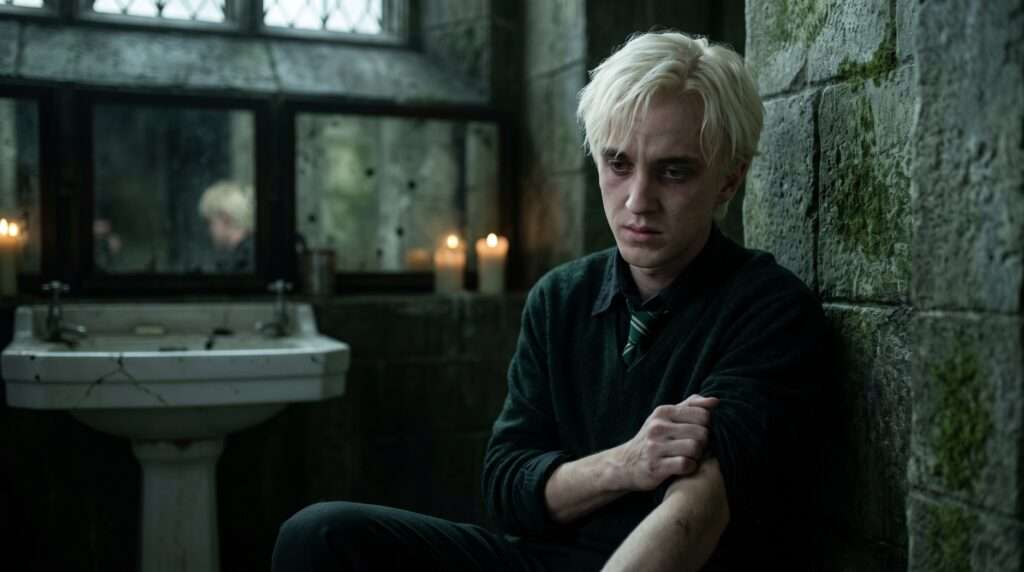
Picture the smug 11-year-old boy on the Hogwarts Express, hair slicked back, offering a pale hand to Harry Potter with arrogant certainty. Now contrast that image with the gaunt, trembling 16-year-old bleeding on a bathroom floor, weeping in front of a broken Vanishing Cabinet. How did we get here?
For over two decades, the fandom has remained bitterly divided on the true nature of Slytherin’s resident antagonist. Was he a junior Death Eater destined for cruelty, or a child soldier trapped by generational trauma? To unlock the definitive answer, we have to deeply analyze the Draco Malfoy teenager years—a definitive timeline where childhood entitlement fractured under the weight of mortal terror. This is not a story of a villain’s rise; it is the psychological collapse of a boy crushed by impossible family pressures and lethal pure-blood dogma.
The Making of a Pure-Blood Heir: Upbringing and Early Indoctrination
Before Draco ever set foot in the Great Hall, his worldview was meticulously engineered. To understand the teenager who would later hold a wand to Albus Dumbledore’s chest, we must first look at the foundation built at Malfoy Manor.
The Shadow of Malfoy Manor
Within the sprawling, opulent walls of his ancestral home, Draco was raised in an environment of extreme privilege paired with intense conditional approval. Lucius and Narcissa Malfoy loved their son, but that love was inextricably tied to status, blood purity, and social dominance. Lucius, in particular, operated through a lens of strict hierarchy.
For Draco, early emotional development was heavily restricted. Vulnerability was viewed as a weakness associated with “lesser” wizards or Muggles. Instead of emotional resilience, he was armed with superiority. This pure-blood indoctrination served as an insulating bubble, keeping him entirely separated from the realities of the wider Wizarding World. His childhood was an exercise in emotional isolation, masking a deep-seated need for his father’s validation.
 Learned Entitlement vs. Real Agency (Ages 11–13)
During his first three years at Hogwarts, Draco’s malice is remarkably superficial. When examining his early interactions—mocking Ron Weasley’s poverty, insulting Hermione Granger’s heritage, or attempting to get Harry expelled—it becomes clear that Draco is rarely acting on independent ideology. He is engaged in high-stakes mimicry. Every sneer and threat is a calculated imitation of Lucius Malfoy.
The infamous Buckbeak incident in Prisoner of Azkaban perfectly encapsulates this era. Draco provokes a Hippogriff, gets injured, and immediately weaponizes his family’s political leverage to demand the creature’s execution. This isn’t the plotting of a tactical mastermind; it is the reflexive behavior of a sheltered child accustomed to his father erasing his mistakes. At this stage, Draco possesses immense learned entitlement but zero true agency. He is simply playing the role of the pure-blood prince, entirely unaware of the darkness that title demands.
The Turning Point: The Shift from Bully to Reluctant Soldier (Ages 14–15)
The illusion of safety shatters as adolescence sets in. The transition from a schoolyard bully to an active participant in a wizarding war strips away Draco’s carefully curated armor, exposing a deeply frightened teenager beneath.
The Graveyard Awakening (Goblet of Fire)
The climax of Draco’s fourth year marks a silent, tectonic shift in his character arc. When Lord Voldemort returns in the Little Hangleton graveyard, the romanticized, theoretical pure-blood supremacy Draco grew up revering suddenly materializes into terrifying, violent reality.
Lucius Malfoy is present at the graveyard, but instead of the dignified, powerful aristocrat Draco knows, Lucius is forced to grovel at the Dark Lord’s feet. The Malfoy family’s status as untouchable elites is instantly dissolved. They are no longer the apex predators of the Wizarding World; they are merely servants. While Draco is not present in the graveyard, the ripple effects are immediate. The rhetoric he previously parroted for schoolyard dominance is now tied to torture, murder, and unquestioning obedience.
 The Inquisitorial Squad: Desperate Overcompensation (Order of the Phoenix)
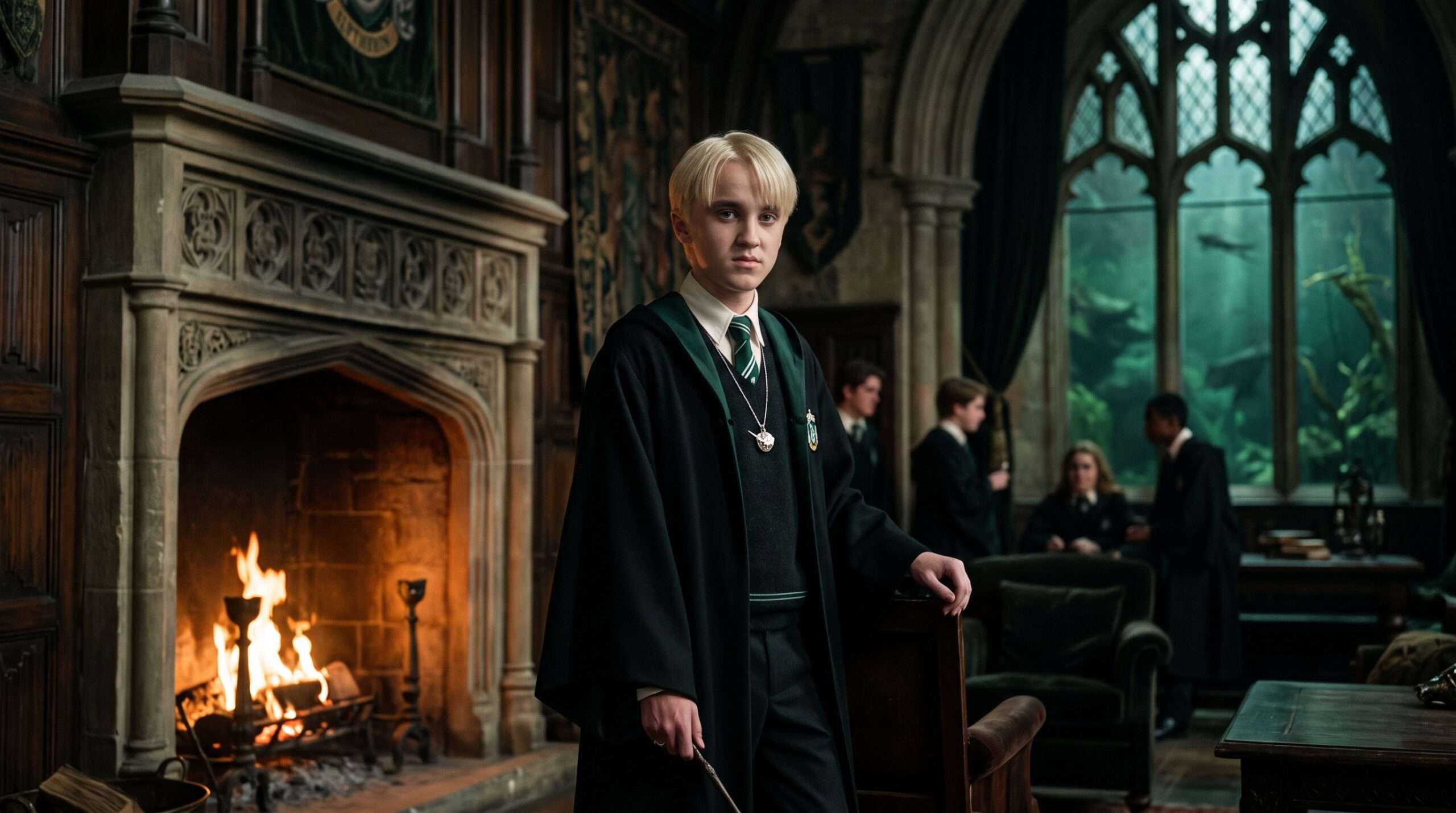
By his fifth year, Draco’s behavior becomes erratic and sharply aggressive. The arrival of Dolores Umbridge offers him a temporary, toxic lifeline. By joining the Inquisitorial Squad, Draco attempts a desperate overcompensation. He seeks to reclaim the power and prestige his family is rapidly losing behind closed doors.
He abuses his newfound authority, docking points and physically restraining other students. However, this is a hollow victory. The climax in the Department of Mysteries seals his fate. Lucius Malfoy fails to retrieve the prophecy, is publicly outed as a Death Eater, and is sent to Azkaban in disgrace. In a single night, the Malfoy family safety net is annihilated. Draco is left entirely exposed, furious, and terrified—setting the stage for the darkest chapter of his life.
Year Six: The Breaking Point and The Vanishing Cabinet (The Half-Blood Prince)
If the first five years were about learned entitlement, Draco Malfoy’s sixth year is a masterclass in psychological deconstruction. This is the era where the bravado completely evaporates, replaced by a desperate, hollow-eyed survival instinct.
The Task as a Death Sentence, Not an Honor
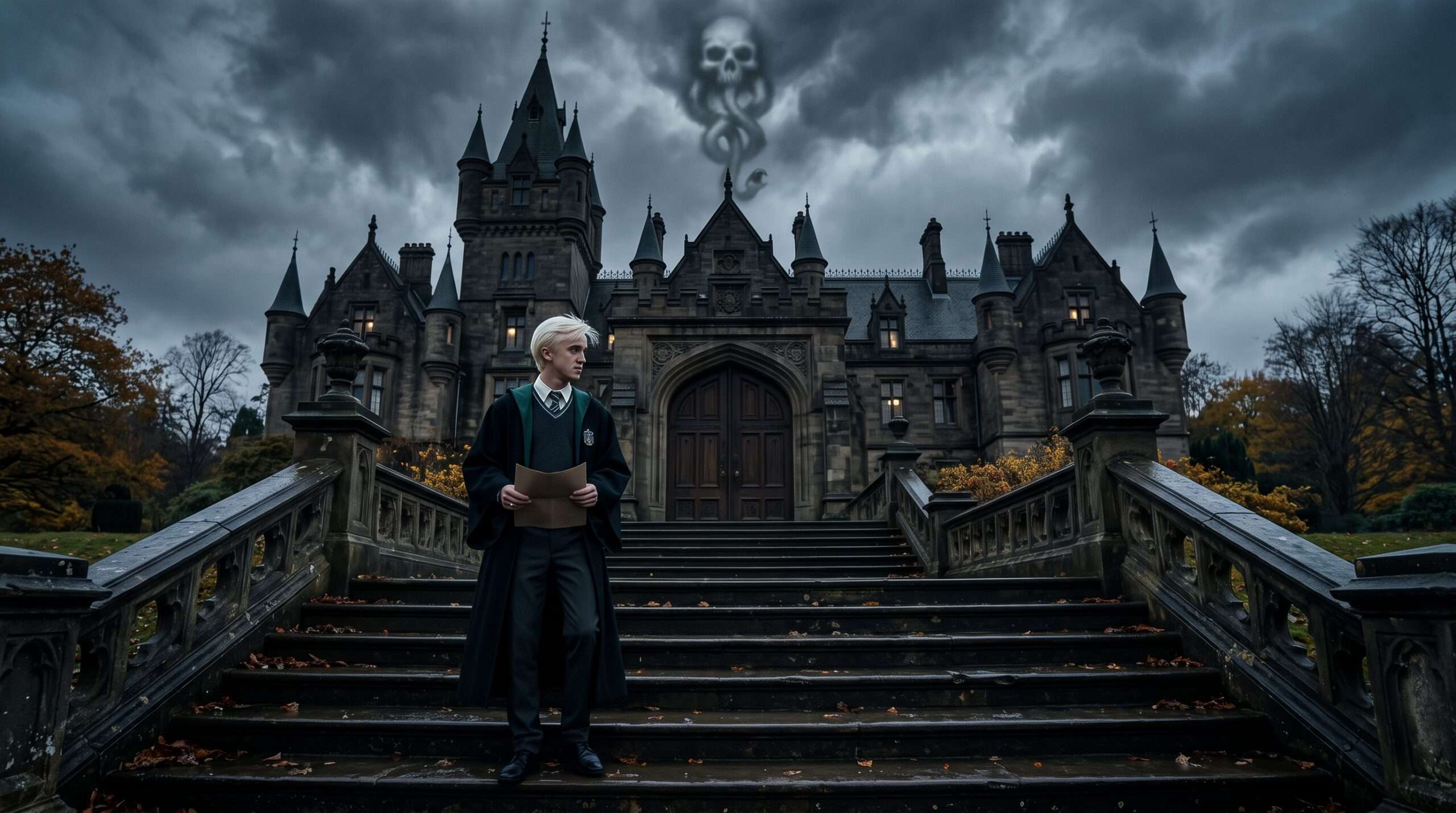
Following Lucius’s failure at the Ministry, Lord Voldemort takes up residence at Malfoy Manor, effectively holding Narcissa and Draco hostage. Voldemort brands Draco with the Dark Mark and assigns him a mission: assassinate Albus Dumbledore, the greatest wizard of the age.
While Bellatrix Lestrange views this as a tremendous honor, Narcissa correctly identifies it for what it is—a death sentence. Voldemort never expected a sixteen-year-old boy to succeed where seasoned Death Eaters had failed; the task is a protracted, psychological torture designed to punish Lucius by guaranteeing his only son’s death.
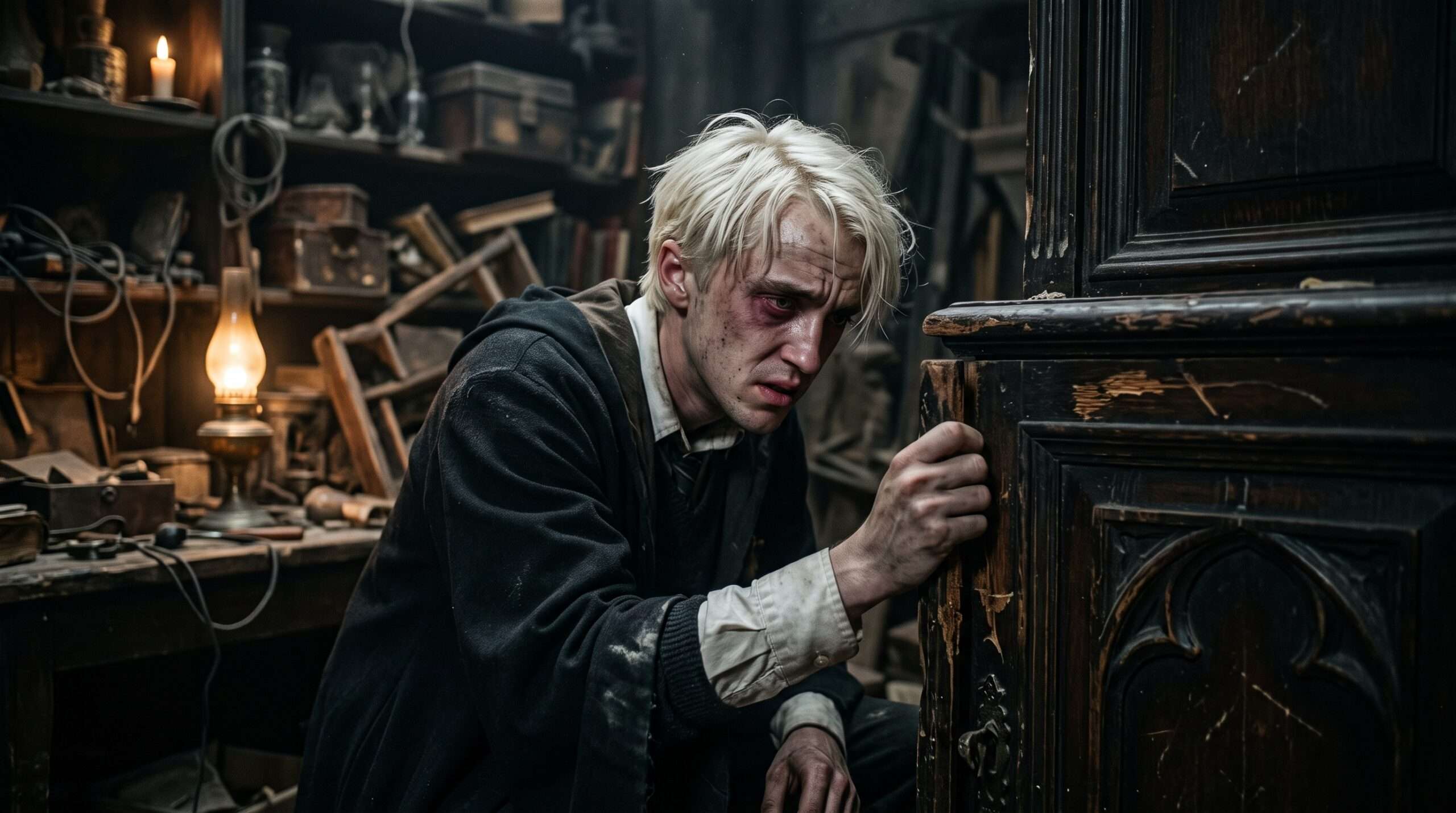
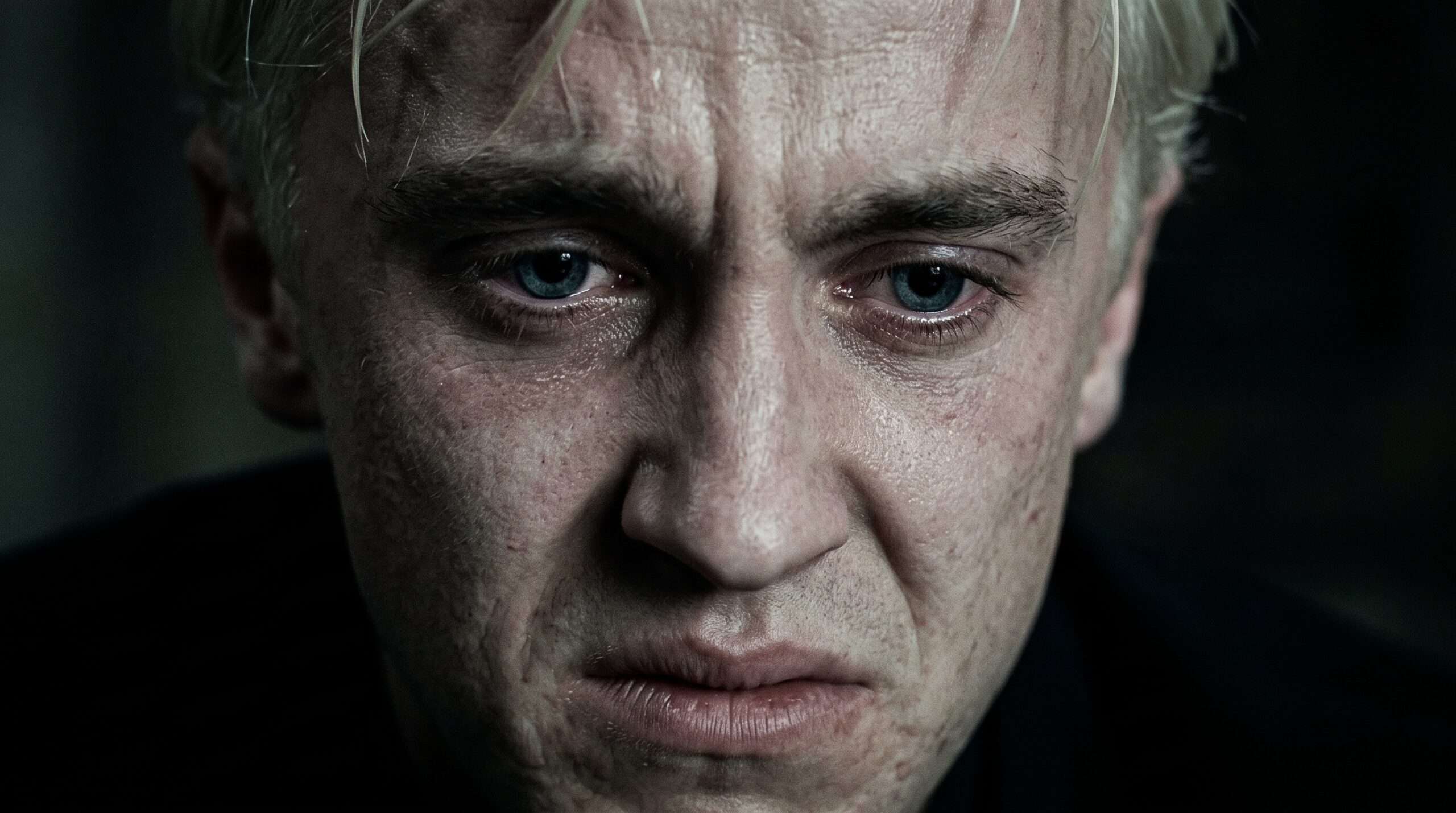
The physical toll on Draco is vividly documented in the text. He suffers from extreme weight loss, dark circles under his eyes, and chronic insomnia. He completely withdraws from his Slytherin peers, abandoning Quidditch and his prefect duties. The Vanishing Cabinet in the Room of Requirement becomes his obsession and his prison. He is no longer a schoolyard bully; he is a trapped animal chewing off its own leg to survive.
 The Sanctuary of Moaning Myrtle and the Bathroom Duel
One of the most telling details of Slytherin psychology during this era is Draco’s choice of confidant. Unable to speak to Crabbe, Goyle, or Pansy Parkinson—who lack the emotional depth to understand his terror—Draco seeks refuge in a bathroom with Moaning Myrtle, a Muggle-born ghost. It is a profound stripping away of his pure-blood prejudice in the face of raw human despair.
When Harry Potter discovers Draco weeping in the bathroom, the resulting duel is catastrophic. The use of Sectumsempra physically maims Draco, but narratively, it highlights the tragedy of their dynamic. Here are two boys, both weaponized by the adults in their lives, lashing out in the dark. It is the absolute nadir of Draco’s Hogwarts experience, exposing just how fragile he truly is beneath the dark suits and sneers.
The Astronomy Tower Confrontation
The climax on the Astronomy Tower is the defining moment of the Draco Malfoy teenager arc. After disarming Dumbledore, Draco has the Headmaster cornered. Dumbledore is weak, wandless, and dying. This is the moment Draco has spent a year agonizing over.
Yet, he cannot do it.
As Dumbledore gently interrogates him, stripping away the Death Eater facade, Draco repeatedly lowers his wand. He admits, “I haven’t got any options… He’ll kill my family.” Dumbledore does not treat Draco as a villain, but as a frightened child in over his head. Draco’s fundamental inability to murder in cold blood proves that despite his upbringing, his soul is not completely fractured. When Severus Snape steps in to cast the killing curse, he is not just fulfilling an Unbreakable Vow; he is saving Draco’s soul from being irreparably torn.
Harry vs. Draco: The Parallel Burdens of Prophecy and Bloodline
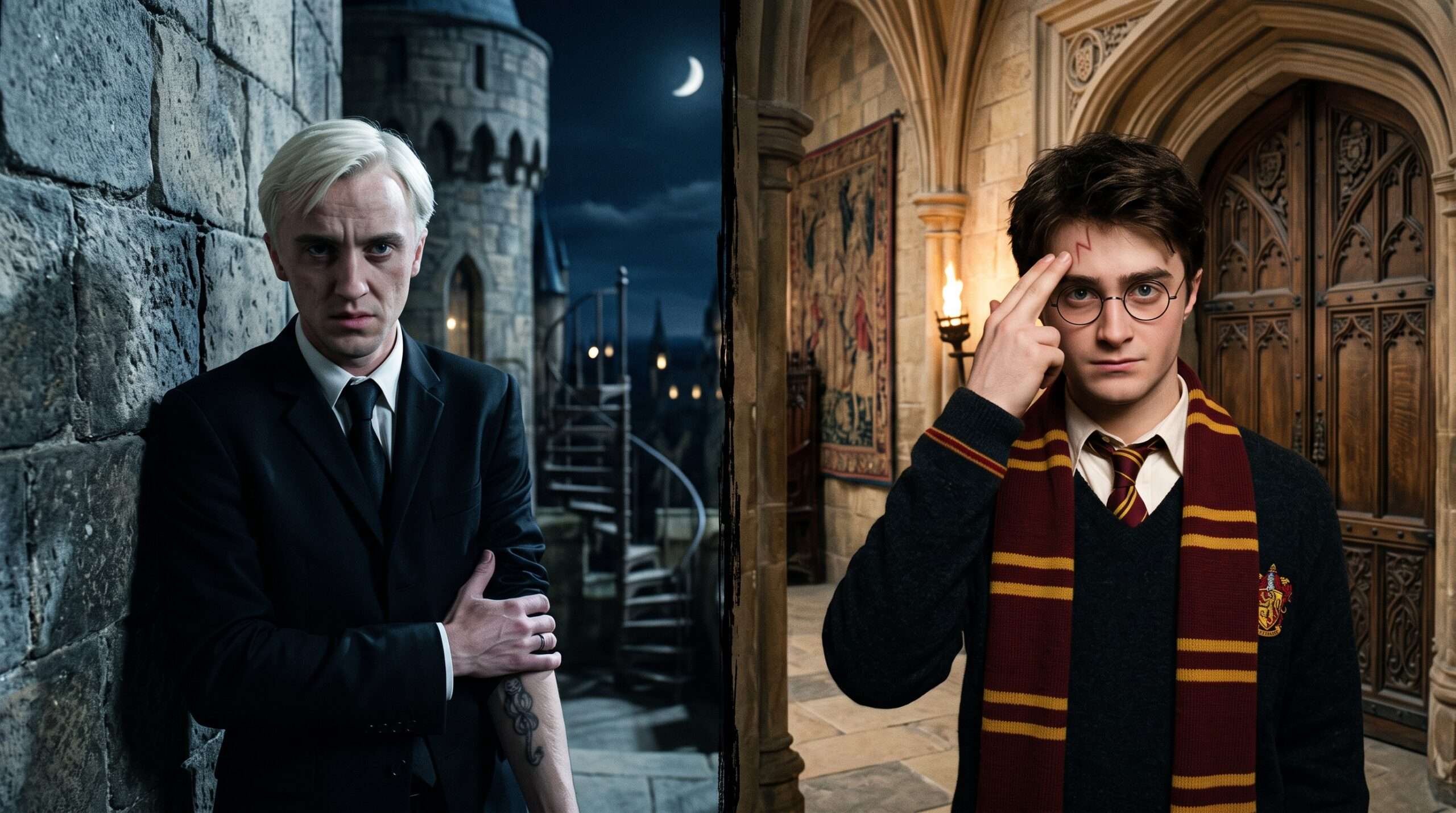
To fully understand Draco’s character, we must analyze him as the literary inversion of Harry Potter. Both boys were forced into a war they did not start, heavily burdened by the legacies of their parents.
Comparative Breakdown: The Boy Who Had No Choice vs. The Boy Who Had Choices Stripped
| Analytical Metric | Harry Potter | Draco Malfoy |
| Systemic Pressure | The Wizarding World’s Savior, burdened by prophecy | The Malfoy Family’s Sacrificial Lamb, burdened by bloodline |
| Support System | Unconditional love: Dumbledore, Sirius, Hermione, Ron | Transactional dynamics: Fearful parents, Voldemort, cronies |
| Moral Catalyst | Autonomy, sacrifice, and the protection of others | Self-preservation, fear, and shattered illusions |
| Climactic Choice | Walked willingly into the Forbidden Forest | Lowered his wand on the Astronomy Tower |
 The Inversion of the Hero Archetype
J.K. Rowling utilizes Draco to showcase the destructive nature of radicalization in adolescents. While Harry is guided by mentors who encourage bravery and selflessness, Draco is surrounded by adults who teach him that love is a weakness and power is everything. When that power dynamic flips, Draco has no moral compass to fall back on—only fear. Harry rises to his destiny; Draco collapses under his.
The Aftermath: Malfoy Manor and the Battle of Hogwarts
By the final installment, The Deathly Hallows, Draco is completely disillusioned with the pure-blood cause. He is a hostage in his own home, watching Voldemort murder Charity Burbage above his dining room table.
The Skirmish at Malfoy Manor: Passive Resistance
When Snatchers capture Harry, Ron, and Hermione and bring them to the Manor, the Malfoys’ redemption hangs by a thread. Draco is asked to identify a disfigured Harry. Despite knowing exactly who is standing in front of him, Draco hesitates. He refuses to give a definitive answer.
This passive resistance is crucial. It is not an act of roaring Gryffindor bravery, but for Draco, it is a monumental defiance. He recognizes that survival now requires deceiving his own side, refusing to hand over his childhood rival to a certain death.
 The Room of Requirement: The Final Collapse
During the Battle of Hogwarts, Draco’s loss of control is finalized in the Room of Requirement. Crabbe, corrupted by the Carrow siblings’ teachings, actively defies Draco’s orders and unleashes Fiendfyre. Draco has lost all authority, even over his lackeys.
When Harry turns back on his broomstick to pull Draco from the flames, it is the physical manifestation of moral closure. The life debt is cemented. Draco survives not because of his pure-blood status, but because the boy he tormented for years showed him unmerited grace.
Expert Analysis: Was Draco Malfoy Redeemed or Merely Survived?
A heated debate in literary circles questions whether Draco achieved a true redemption arc. The consensus? He achieved a realistic one.
The Anatomy of an Incomplete Redemption
A conventional hero’s redemption—where Draco suddenly fights alongside the Order of the Phoenix—would have felt narratively dishonest. Draco was too deeply entrenched in fear to become a sudden martyr. His arc is not about becoming a hero; it is about unlearning hatred.
As revealed in later canon, including author commentary and The Cursed Child, Draco grows into an adult who actively rejects pure-blood doctrine, raising his son Scorpius with far more warmth and tolerance than Lucius ever showed him. Breaking a cycle of generational abuse is its own quiet victory.
Key Literary Takeaway
Draco represents the silent tragedy of extremist environments. He is the quintessential portrait of a teenager forced to dismantle his entire worldview while under mortal threat, serving as a cautionary tale about the rot at the core of supremacist ideologies.
Frequently Asked Questions
Did Draco Malfoy ever genuinely want to kill Dumbledore?
No. Textual evidence shows Draco’s botched attempts—the cursed necklace to Katie Bell, the poisoned mead for Slughorn—were desperate, distanced acts. He wanted the approval that would come with success, but he lacked the ruthless conviction required to commit premeditated murder up close.
Why did Draco’s personality change so drastically in Year 6?
The imprisonment of Lucius Malfoy and Lord Voldemort occupying his home transformed his theoretical supremacy into direct, life-or-death trauma. He realized the Dark Arts were not a glamorous game of superiority, forcing a rapid, agonizing disillusionment.
Is Draco Malfoy considered a tragic villain?
Most literary critiques classify Draco as an anti-villain or a tragic foil rather than a pure antagonist. His defining actions in the later books are driven by coercion, isolation, and survival instincts rather than genuine malice.
The Draco Malfoy teenager years offer one of the most compelling, realistic depictions of adolescent breakdown in modern fantasy. He was an entitled bully who discovered that the ideology he was raised to revere was actually a death trap. Stripped of his arrogance, his family’s protection, and his illusions, he was forced to confront the darkest parts of himself—and ultimately chose to lower his wand.
What do you think about Draco’s journey? Was his hesitation on the Astronomy Tower enough to absolve him, or did his earlier years of bullying make him irredeemable? Drop your thoughts in the comments below—let’s settle the Slytherin debate!