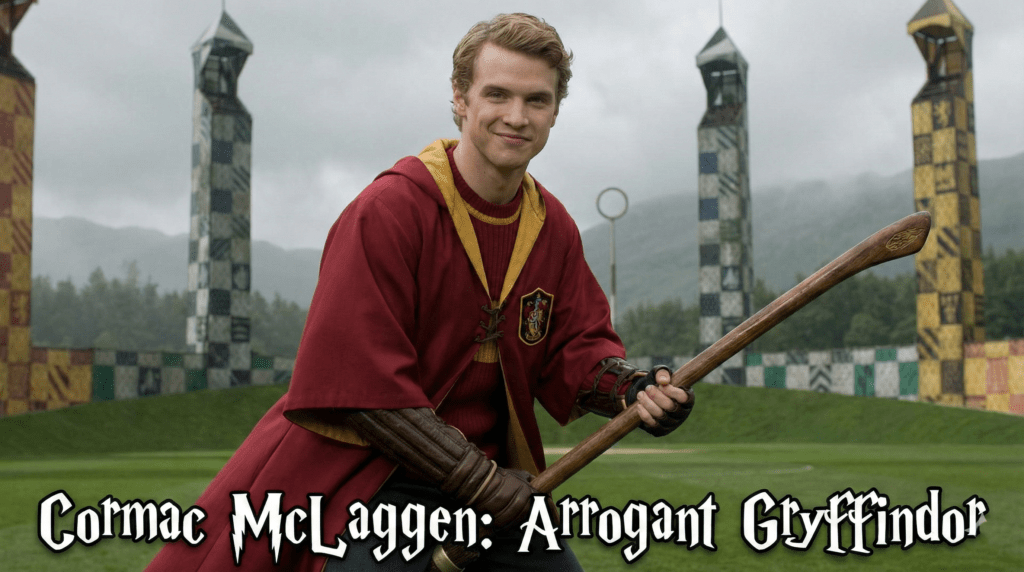
Imagine this: It’s the fall of 1996 at Hogwarts School of Witchcraft and Wizardry. Quidditch tryouts are underway, and a towering, broad-shouldered sixth-year Gryffindor strides onto the pitch with the absolute certainty that the Keeper position already belongs to him. He barely acknowledges the other hopefuls. When things don’t go his way, he doesn’t sulk quietly—he complains loudly, bosses his teammates around, and ultimately costs his house the match in spectacular fashion.
That character is Cormac McLaggen—better known to many fans simply as “Cormac from Harry Potter.”
For a figure who appears in only one book (Harry Potter and the Half-Blood Prince) and has limited screen time in the film adaptation, Cormac McLaggen leaves an outsized impression. He’s loud, overconfident, tactless, and utterly convinced of his own superiority. Yet he’s no Death Eater, no dark wizard, no true villain. He’s just… insufferably Gryffindor in all the wrong ways.
Why does a relatively minor character generate such strong reactions—ranging from eye-rolling amusement to genuine irritation—among readers and viewers more than fifteen years after his debut? And what does his presence tell us about J.K. Rowling’s world-building, the complexity of house identities, and the very human flaws that even “the good guys” can carry?
In this in-depth guide, we’ll explore every canonical detail about Cormac McLaggen, analyze his key moments, compare book vs. film portrayals, examine why fans so often “love to hate” him, and uncover the deeper narrative purpose behind one of the series’ most polarizing side characters. Whether you’re revisiting Half-Blood Prince or simply trying to remember why that one Quidditch scene makes you groan every time, this article aims to give you the complete picture.
Who Is Cormac McLaggen? Background and Origins
To understand Cormac, we first need to place him within the social and magical fabric of the wizarding world.
Family Ties and Ministry Connections
Cormac McLaggen comes from a prominent pure-blood family with deep ties to the Ministry of Magic. In Half-Blood Prince, Horace Slughorn casually mentions that the McLaggens are “big in the Ministry,” a line that immediately signals privilege and influence. We later learn that Cormac’s uncle, Tiberius, is a favorite former student of Slughorn’s—someone wealthy and well-connected enough to host hunting parties where young Cormac apparently shot at garden gnomes with a Muggle twelve-bore.
This background is crucial. Cormac isn’t just another Hogwarts student; he’s the product of a charmed, entitled upbringing where doors open automatically because of who his family knows. That inherited confidence (or arrogance) shapes nearly every interaction he has in the series.
Hogwarts Years and House Placement
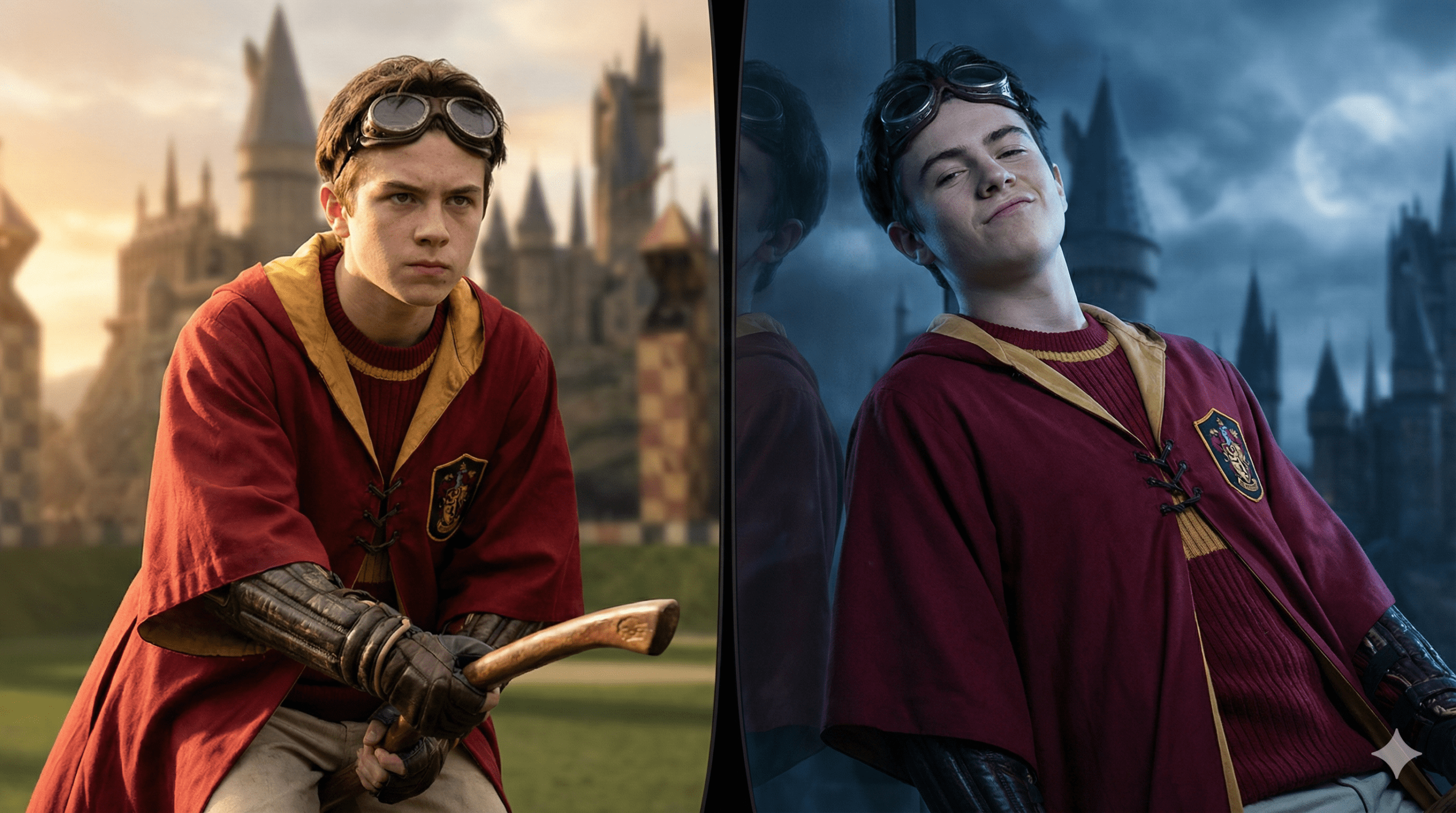
Cormac is a sixth-year Gryffindor during Harry’s sixth year—one year above the Golden Trio. Being sorted into Gryffindor makes perfect surface-level sense: he’s brave (or at least fearless), outspoken, and unafraid to put himself forward for positions of visibility and power.
Yet Rowling uses him to quietly subvert the house stereotype. Gryffindor is celebrated for courage, chivalry, and nerve—but those same qualities, when unchecked by humility or empathy, can curdle into recklessness, entitlement, and bullying behavior. Cormac is living proof that bravery without self-awareness is just another form of selfishness.
 Physical Description and First Impressions
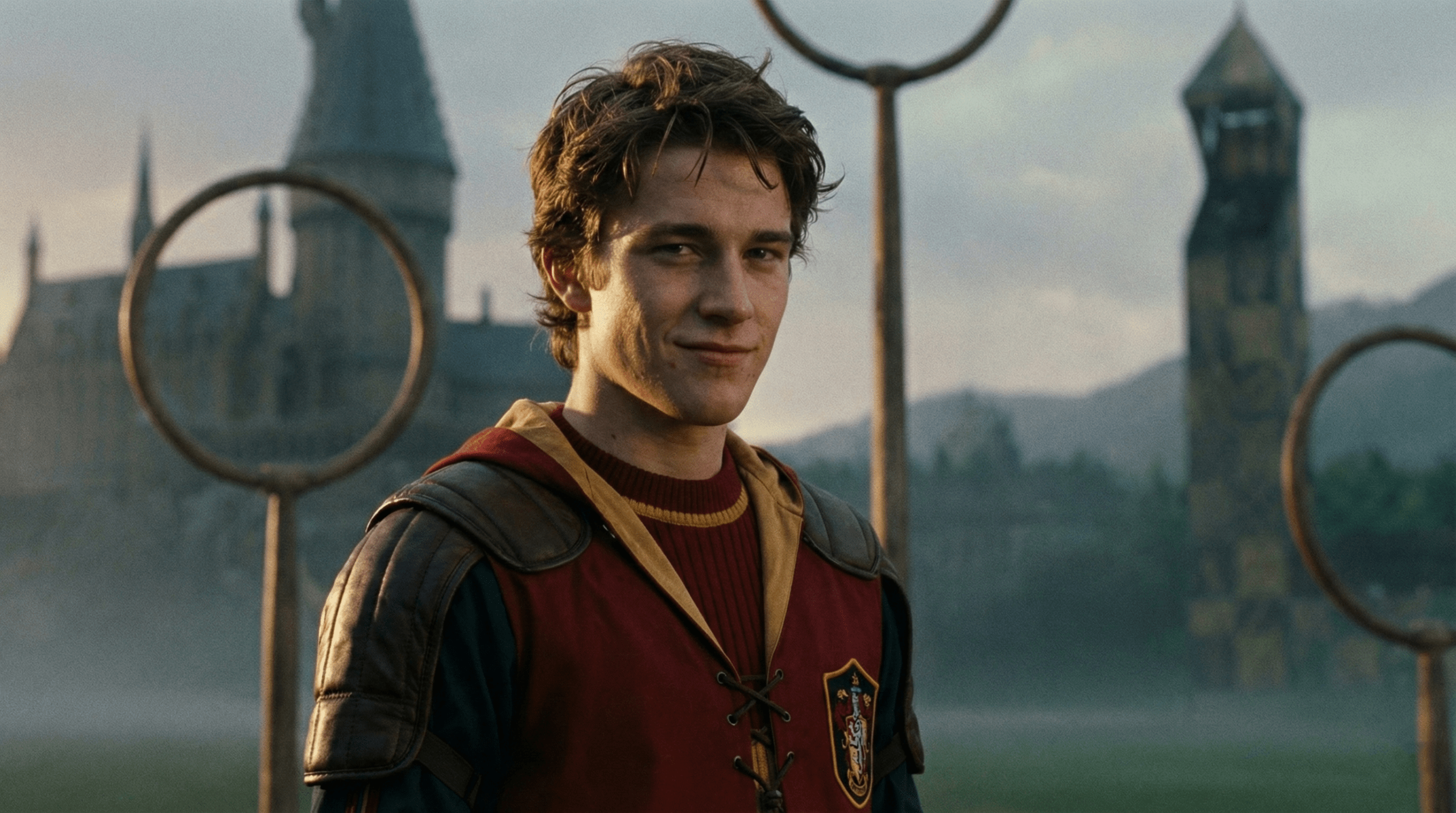
In the book, Cormac is described as a “large, wire-haired youth” with a “rather fish-like” mouth when he speaks. The physicality matters: he’s physically imposing, which amplifies his already dominant personality. He fills space—literally and figuratively—and expects everyone else to make room.
In the 2009 film adaptation, actor Freddie Stroma brings a polished, almost preppy energy to the role. His Cormac has perfectly coiffed hair, a confident smirk, and an athletic build that makes his Quidditch scenes believable. Stroma plays the character with just enough charm to make you understand why someone like Hermione might briefly consider him date material—before the arrogance becomes impossible to ignore.
Cormac McLaggen’s Key Appearances in Half-Blood Prince
Cormac doesn’t appear until late in the story, but when he does, he makes every scene count.
Slug Club Membership and Social Climbing
Cormac is a proud member of Professor Slughorn’s exclusive “Slug Club”—a social network built on talent, connections, and future promise. Slughorn clearly sees potential in Cormac, not necessarily for academic brilliance (we never see him excel in class), but for the kind of social capital that comes with Ministry lineage and pure-blood status.
This detail is subtle but important: Cormac’s presence in the Slug Club underscores how much of wizarding society still runs on nepotism and inherited privilege, even among those who fight on the “right” side of the war.
The Disastrous Christmas Party Date with Hermione
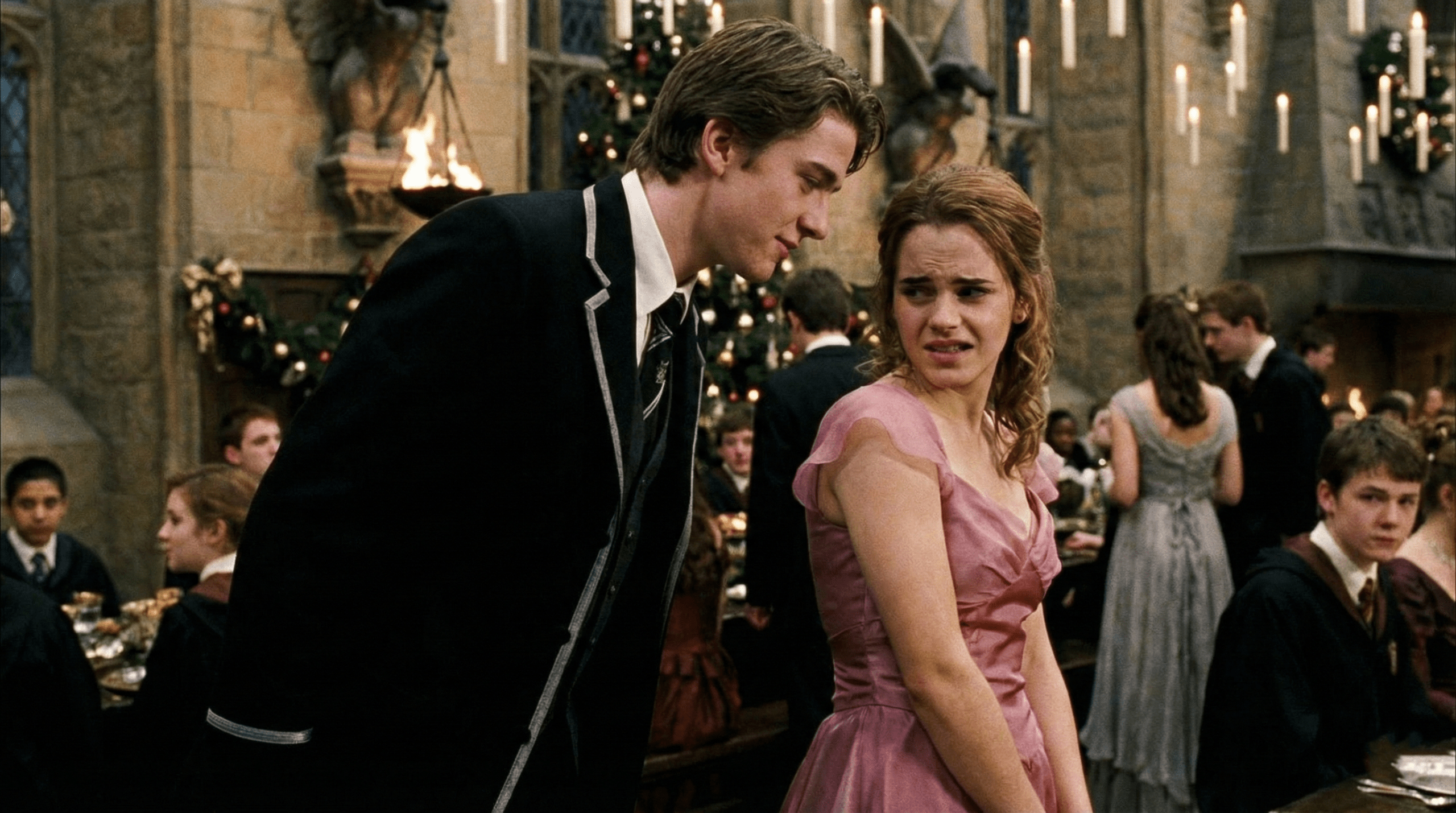
Perhaps the moment that cements Cormac’s reputation as insufferable is his date with Hermione Granger to Slughorn’s Christmas party.
Hermione, hoping to make Ron jealous, accepts Cormac’s invitation—then immediately regrets it. Cormac spends the evening:
- Talking endlessly about himself
- Bragging about his Quidditch prowess
- Eating like he’s in a pie-eating contest
- Referring to Hermione as “Granger” in the third person while standing right next to her
- Generally treating the event as a platform to showcase his own importance
The book version is mortifying enough, but the film amps up the cringe: Cormac corners Hermione against a wall, leans in far too close, and talks over her repeatedly. By the end of the night, Hermione is hiding behind a tapestry just to escape him.
It’s a small but telling scene. Cormac doesn’t see Hermione as an equal partner; he sees her as an accessory to his own story.
 The Quidditch Tryouts and the Confundus Charm Controversy
Cormac’s most infamous moment arrives during Gryffindor’s Quidditch tryouts for the 1996–1997 season.
Harry, now team captain, holds open tryouts after Katie Bell’s prolonged absence leaves a Chaser spot vacant and the team needs fresh blood. Cormac shows up late—having missed the previous year’s tryouts entirely because he bet a friend he could eat a dozen doxy eggs on a dare. (He lost the bet and spent a week in the hospital wing recovering from the venom.)
Despite his absence from regular training, Cormac is convinced he’s the best Keeper candidate. He performs well in the tryouts—better than most—but Ron ultimately wins the position, thanks to a combination of skill, Harry’s deliberate choice to give Ron a fair shot, and a little help from Hermione.
That “little help” becomes one of the most debated minor plot points in the entire series.
Hermione, desperate to ensure Ron keeps the spot (and perhaps to spite Cormac’s arrogance), casts a non-verbal Confundus Charm on Cormac just before his final save attempt. Cormac flies in the wrong direction, misses the Quaffle spectacularly, and Ron secures the role.
The ethics of this moment are murky. Hermione later admits what she did, but only to Harry—and she shows zero remorse. Many fans argue it was justified payback against someone who clearly believed the position was his by right. Others point out that using magic to sabotage a fair competition, even against an unlikeable opponent, crosses a line.
Either way, the incident perfectly encapsulates Cormac: his overconfidence makes him an easy target, but it also exposes the lengths even “good” characters will go to protect their own interests.
The Fateful Match: When Arrogance Cost Gryffindor
Cormac finally gets his chance to play Keeper when Ron is poisoned by tainted mead at Slughorn’s office and hospitalized just before the crucial match against Hufflepuff.
Harry reluctantly puts Cormac in goal. What follows is one of the most painful Quidditch sequences in the series.
Cormac immediately begins barking orders at the Chasers and Beaters, treating the team like his personal employees rather than teammates. He ignores Harry’s instructions, constantly leaves his hoops unguarded to shout criticism, and generally behaves as though he’s the only competent player on the pitch.
The result is predictable—and disastrous:
- Hufflepuff scores repeatedly while Cormac is out of position yelling at others.
- In a moment of pure karmic comedy, Cormac swings a Beater’s bat at a Bludger aimed at a Hufflepuff Chaser—but misses wildly and instead hits Harry square in the head.
- Harry falls fifty feet, cracks his skull, and spends the night in the hospital wing.
- Gryffindor loses badly.
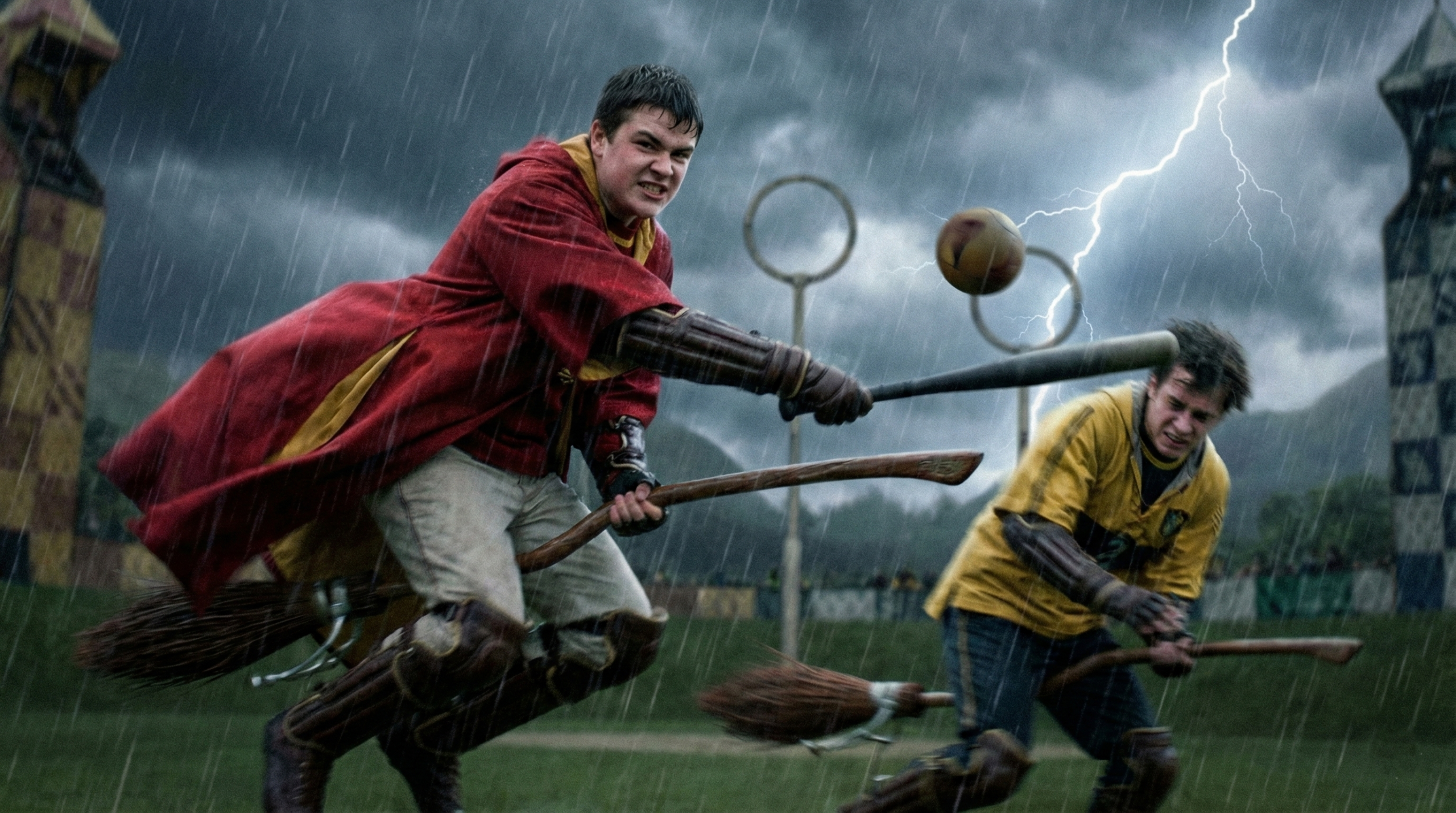 Cormac’s brief tenure as Keeper becomes legendary among fans for all the wrong reasons. It’s the textbook example of how unchecked ego can sabotage even a talented player and a strong team.
Personality Breakdown: Why Fans “Love to Hate” Cormac
Cormac McLaggen isn’t evil. He doesn’t support Voldemort. He doesn’t bully first-years or cheat on exams (as far as we know). So why does he inspire such visceral dislike?
The answer lies in how perfectly he embodies the shadow side of Gryffindor house.
The Dark Side of Gryffindor Traits
Gryffindor values courage, daring, and chivalry. Cormac has courage in abundance—he’ll charge into any situation, volunteer for anything high-profile, and never back down from a challenge.
But courage without humility becomes bravado. Daring without consideration becomes recklessness. Chivalry without respect becomes condescension.
Cormac is what happens when those noble traits go unexamined and unmoderated. He’s brave enough to try out for Keeper without recent practice, but too arrogant to accept he might need to earn the spot. He’s daring enough to ask Hermione out, but too self-absorbed to notice she’s uncomfortable.
In many ways, he’s a dark mirror to James Potter at a similar age—popular, athletic, confident, and prone to showing off—but lacking the redeeming qualities (deep loyalty to friends, eventual growth, genuine bravery in war) that redeem James in readers’ eyes.
 Entitlement and Lack of Self-Awareness
Cormac expects the world to bend to him because, in his experience, it usually does. Ministry connections, family wealth, natural athleticism, and Hogwarts social status have all reinforced his belief that he deserves the best of everything.
When reality doesn’t match that expectation—Ron beats him at tryouts, Hermione ditches him at the party, Harry benches him after one disastrous match—he doesn’t reflect. He blames others, complains, or simply doubles down.
That total lack of self-awareness is what makes him so infuriating. Villains like Draco Malfoy know they’re awful and lean into it. Heroes like Harry question themselves constantly. Cormac exists in a blissful middle ground of mediocrity wrapped in certainty.
Fan Reception and the “Love to Hate” Phenomenon
Online communities remain divided:
- Some fans find him hilarious precisely because he’s so awful—a perfect comic foil who makes Ron look sympathetic and Harry look mature by comparison.
- Others genuinely dislike him, seeing him as a stand-in for every entitled, overconfident person they’ve encountered in real life.
- A smaller but vocal group defends him, arguing that his flaws are realistic and that the narrative unfairly punishes him (Hermione’s Confundus Charm, Harry’s obvious favoritism toward Ron).
On platforms like Reddit, TikTok, and Tumblr, “Cormac McLaggen hate” has become its own micro-meme. Clips of Freddie Stroma’s smarmy party scene regularly rack up thousands of “this man gives me secondhand embarrassment” comments.
He’s not hated like Umbridge or Lockhart. He’s hated in the way you hate that one coworker who always takes credit and never listens—petty, personal, and deeply relatable.
Cormac’s Role in the Larger Harry Potter Story
Cormac McLaggen may be a side character with limited appearances, but his function in Harry Potter and the Half-Blood Prince is surprisingly layered. He serves multiple narrative purposes that enrich the world-building and deepen the thematic resonance of the sixth book.
Foil to Main Characters
Cormac exists primarily as a foil—someone whose traits throw the protagonists’ qualities into sharper relief.
- Vs. Ron Weasley Ron’s biggest Quidditch problem in Half-Blood Prince is crippling insecurity. He’s terrified of failure, convinced he doesn’t deserve his spot, and nearly sabotages himself through nerves. Cormac is the polar opposite: absolute, unshakable confidence regardless of merit. Where Ron second-guesses every move, Cormac never questions himself once. The contrast makes Ron’s eventual growth (and the reader’s sympathy for him) feel more earned.
- Vs. Harry Potter Harry is a natural leader who earns respect through humility, fairness, and quiet competence. Cormac attempts to lead through volume, intimidation, and self-aggrandizement. When Harry gets hit by the Bludger, it’s Cormac’s bat that does the damage—literally and symbolically. Harry’s leadership style succeeds because he puts the team first; Cormac’s fails because he puts himself first.
- Vs. Hermione Granger Hermione’s date with Cormac exposes her rare moment of pettiness and insecurity (wanting to make Ron jealous). Cormac’s boorish behavior makes her decision to Confund him feel almost excusable to many readers—yet it also highlights how even the most principled characters can bend their own rules when emotionally compromised.
Commentary on House Stereotypes
One of J.K. Rowling’s great strengths is refusing to make the Hogwarts houses one-dimensional. Slytherin isn’t all evil, Ravenclaw isn’t all wise, Hufflepuff isn’t all nice—and Gryffindor isn’t all heroic.
Cormac is proof that Gryffindor can produce entitled, obnoxious, self-centered individuals just as easily as it produces selfless heroes. He reminds us that bravery and “daring” are neutral traits: they can fuel resistance against Voldemort (Neville, Ginny) or fuel personal aggrandizement (Cormac, young James Potter). House identity is never destiny; it’s a starting point.
By placing Cormac in Gryffindor rather than Slytherin (where his ambition and connections might have fit more stereotypically), Rowling quietly challenges the reader’s assumptions. The “good” house can shelter flaws just as serious as those in the “bad” house—they’re simply expressed differently.
Themes of Ego, Ambition, and Growth
Half-Blood Prince is, in many ways, a book about ego:
- Slughorn’s ego makes him collect people like trophies.
- Dumbledore’s ego (in his youth) led to tragedy with Grindelwald.
- Harry wrestles with his own ego after being named captain and Chosen One.
- Voldemort’s ego is literally killing him.
Cormac is the most cartoonishly uncomplicated version of this theme. He has ambition (Quidditch glory, social status, romantic conquests), but no introspection, no willingness to learn from failure, no capacity for growth. He remains static while every major character around him evolves.
His presence subtly asks: What happens when someone has all the external markers of success—family name, athletic talent, confidence—but none of the internal work required to become a truly admirable person?
Book vs. Film: How Cormac McLaggen Differs
The film adaptation of Half-Blood Prince (2009) gives Cormac significantly more screen time and a slightly different flavor than the book.
Key differences:
- More aggressive behavior In the book, Cormac is mostly oblivious and self-absorbed. In the film, he’s borderline predatory—looming over Hermione, invading her personal space, and speaking over her constantly. This makes him feel more actively unpleasant rather than just cluelessly arrogant.
- Expanded Quidditch role The film shows more of the disastrous Hufflepuff match, including close-ups of Cormac shouting orders and the infamous Bludger-to-Harry’s-head moment. Freddie Stroma’s physical comedy (the wide-eyed panic when he realizes what he’s done) adds a layer of slapstick that isn’t as pronounced in the book.
- Charismatic edge Stroma plays Cormac with genuine movie-star good looks and a certain roguish charm. You can almost see why someone might initially find him attractive—before the personality ruins it. This makes his downfall more satisfying for viewers.
Overall, the film leans harder into “love to hate” territory, turning Cormac into broader comic relief. The book version is subtler: less overtly villainous, more quietly infuriating.
Cormac McLaggen After Half-Blood Prince
Cormac largely disappears from the main narrative after his Quidditch debacle.
In the books, he makes only passing mentions in Deathly Hallows:
- He’s on the Hogwarts Express when Death Eaters board it (though he doesn’t play a significant role).
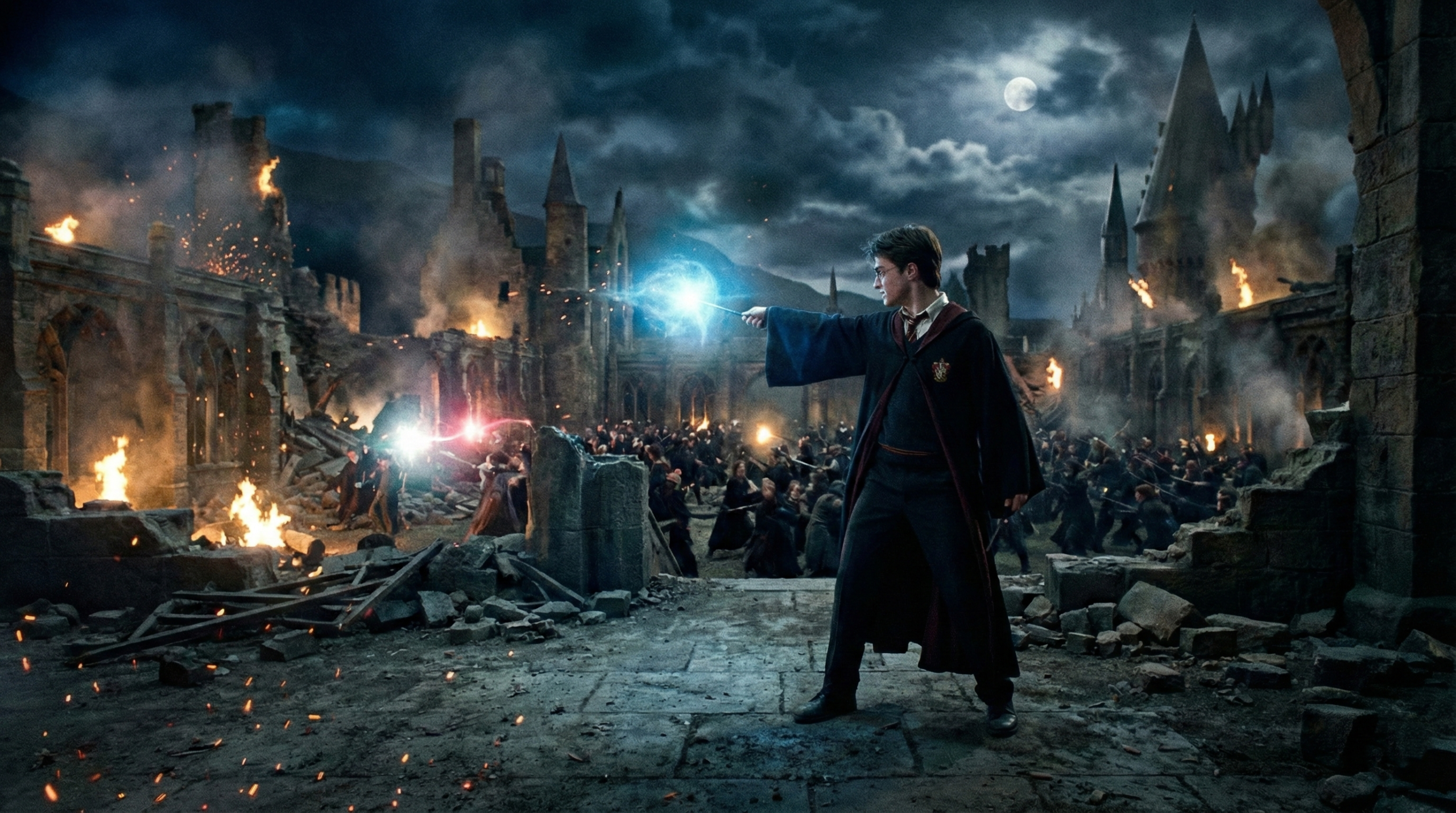
- He’s presumably present during the Battle of Hogwarts, as most able-bodied students and staff fight, but he receives no specific mention.
In the films, he gets two tiny cameos:
- A brief shot during the wedding sequence at the Burrow (standing in the background).
- A slightly larger moment during the Battle of Hogwarts, where he’s seen fighting alongside other students.
J.K. Rowling has never provided canonical information about Cormac’s ultimate fate. Fan theories range from:
- He joins the Ministry post-war thanks to family connections and coasts through life.
- He becomes a minor Quidditch celebrity in a lower league.
- He matures slightly after the war and becomes marginally less insufferable.
None of these are supported by canon, so Cormac remains frozen in amber as the quintessential arrogant sixth-year Gryffindor.
 Expert Insights and Fun Facts
As someone who has spent years dissecting the Harry Potter series—both as a lifelong fan and through countless discussions in fan communities, rereadings, and analysis of Rowling’s interviews and supplemental material—here are some deeper insights and lesser-known details about Cormac McLaggen that go beyond surface-level summaries.
- Rowling’s deliberate house subversion J.K. Rowling has repeatedly emphasized in interviews and on Pottermore (now Wizarding World) that the Sorting Hat takes the student’s potential and innermost qualities into account—but it is not infallible, and people can embody the worst versions of their house traits. Cormac appears to be one of her clearest examples of this philosophy applied to Gryffindor. Unlike Peter Pettigrew (a cowardly Gryffindor) or young James Potter (arrogant but redeemable), Cormac never gets a redemption arc or growth moment. He exists to show that some people simply stay flawed.
- The “Ministry brat” archetype Cormac belongs to a small but recurring group of characters who represent the old pure-blood establishment that fought on the right side during the war but was never particularly noble about it (think: the Malfoys without the active evil). Characters like Dirk Cresswell (a Ministry worker) or even some of Slughorn’s other favorites hint at the same social stratum. Cormac is the teenage version—entitled, shallow, and blissfully unaware of how privilege has shaped him.
- Freddie Stroma’s post-Potter career trajectory Interestingly, actor Freddie Stroma has spoken in interviews about how much fun he had playing such an unlikeable character. After Harry Potter, he went on to roles in Pitch Perfect, 2 Broke Girls, The Inbetweeners 2, and later became a recognizable face in superhero projects (he played Hunter Zolomon / Zoom in The Flash TV series). Many fans joke that playing Cormac gave him excellent practice at being convincingly smug.
- The doxy egg bet detail The offhand mention that Cormac missed previous tryouts because he bet he could eat a dozen doxy eggs is one of Rowling’s classic tiny world-building touches. Doxy eggs are highly venomous in canon; the fact that he attempted it (and failed spectacularly) tells us everything we need to know about his judgment and bravado.
- No confirmed wand, Patronus, or future profession Unlike many supporting characters, Cormac has no Pottermore/Wizarding World profile giving wand wood, core, length, Patronus, or post-Hogwarts career. This scarcity actually adds to his mystique—he remains a snapshot of a particular teenage personality rather than a fully fleshed-out person with a neat resolution.
FAQs About Cormac McLaggen
Here are the questions that come up most frequently when fans discuss “Cormac from Harry Potter”:
Who plays Cormac McLaggen in the Harry Potter movies? Freddie Stroma portrays him in Harry Potter and the Half-Blood Prince (2009). Stroma was 21 during filming, which made him convincingly look like a slightly older, more physically mature sixth-year student compared to the main trio.
Why did Hermione use the Confundus Charm on Cormac? Hermione confesses to Harry that she Confunded Cormac during tryouts because she wanted Ron to keep the Keeper position and because she found Cormac’s arrogance intolerable. In her words (book): “He deserved it.” Many readers see this as one of Hermione’s rare morally gray moments—petty revenge mixed with house loyalty.
Is Cormac McLaggen related to any other named characters? No direct family connections are confirmed in canon beyond his uncle Tiberius (mentioned by Slughorn). There’s no evidence linking him to the Weasleys, Potters, Malfoys, or any other major bloodline despite the shared pure-blood status of many wizarding families.
Why do so many fans dislike Cormac McLaggen? He combines several traits people find especially grating in real life: loud overconfidence, lack of self-awareness, entitlement, poor sportsmanship, and treating others (especially women) as props rather than equals. Because he’s never portrayed as dangerous or evil, the dislike feels personal rather than abstract—more like irritation at a specific type of person than hatred of a villain.
Did Cormac fight in the Battle of Hogwarts? The books do not mention him specifically during the Battle of Hogwarts. However, as an able-bodied seventh-year student who presumably returned for his N.E.W.T.s (or at least was of age), it is reasonable to assume he was present and fought. The films give him a very brief background appearance during the battle sequence, confirming he at least participated.
Is Cormac McLaggen a Slytherin in some fan interpretations? Occasionally—some fans argue his ambition, connections, and self-interest would fit Slytherin better. However, Rowling deliberately placed him in Gryffindor to show that negative traits exist across all houses, not just one.
Cormac McLaggen will never be anyone’s favorite Harry Potter character. He doesn’t have Harry’s courage, Ron’s loyalty, Hermione’s brilliance, or even Draco’s tragic complexity. Yet that’s exactly why he matters.
In a series filled with epic heroes, tragic villains, and lovable misfits, Cormac represents something quieter but no less real: the average, flawed, privileged teenager who believes the world owes him success and never quite understands why it doesn’t deliver. He’s proof that not every Gryffindor is destined for greatness, and not every pure-blood with Ministry ties is secretly evil. Sometimes people are just… annoying.
Revisiting Harry Potter and the Half-Blood Prince with Cormac in mind reveals new layers. The Quidditch scenes become funnier (and more frustrating). Hermione’s date becomes more cringe-worthy. Ron’s insecurities feel more justified. And the wizarding world feels that much more lived-in—because even among the “good guys,” not everyone is noble.
So the next time you watch or reread Half-Blood Prince, pay attention when that large, wire-haired youth struts onto the pitch or corners Hermione at the Christmas party. You may still roll your eyes. You may still mutter “ugh, Cormac” under your breath. But you’ll also understand exactly why J.K. Rowling put him there—and why, against all odds, he’s become one of the most memorably hateable (and therefore oddly beloved) side characters in the entire series.
What do you think—does Cormac deserve all the hate, or is he just a product of his upbringing and circumstances? Drop your thoughts in the comments below, and if you enjoyed this deep dive into underrated (or over-hated) characters, subscribe for more Harry Potter character breakdowns, house analyses, and canon explorations.