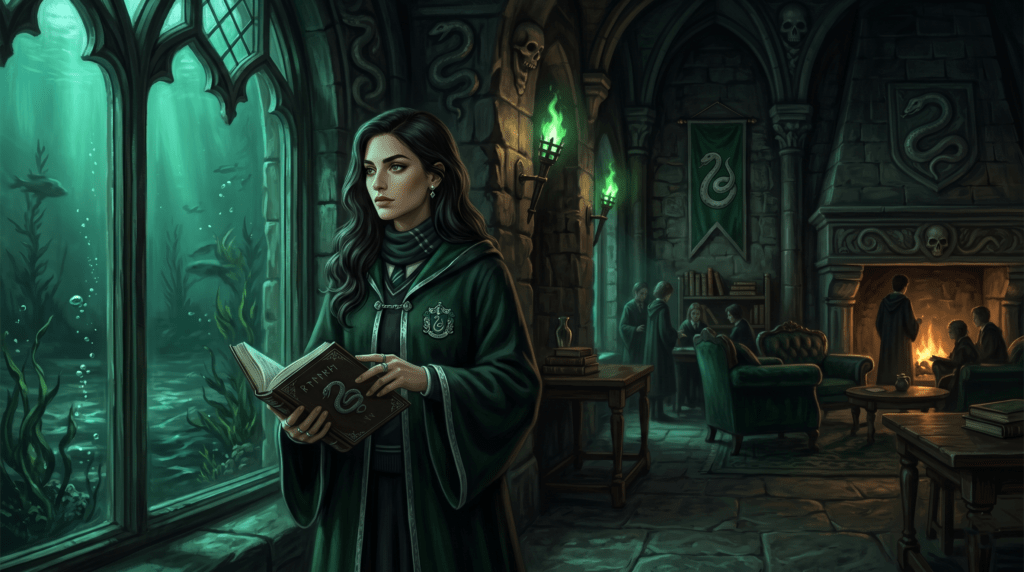
Not every powerful witch stands in the spotlight — some cast their shadow quietly from the background, leaving readers to wonder about the stories never told. In the vast, richly populated world of Harry Potter, thousands of witches and wizards walk the halls of Hogwarts, ride the Hogwarts Express, and live through one of the most turbulent periods in wizarding history — yet only a handful ever get their full story told. Daphne in Harry Potter is one of the most compelling examples of this phenomenon. She is named, she is sorted, she is present — and yet she remains almost entirely unexplored in the canon text.
That silence, as it turns out, speaks volumes.
Daphne Greengrass has quietly become one of the most searched, most theorized, and most fan-fiction-reimagined characters in the entire Harry Potter universe. Readers who dig beneath the surface of J.K. Rowling’s series find themselves asking: Who is this girl? What was her role during the war? Why did Rowling name her at all if she had nothing to say?
This article answers all of those questions. Whether you are a lifelong Potterhead revisiting the series with fresh eyes or a newer fan exploring the deeper layers of wizarding lore, this is the most comprehensive guide to Daphne Greengrass you will find — covering her canon appearances, her family background, her personality, her connection to Draco Malfoy, her sister Astoria, fan theories, and the quiet but powerful legacy she holds in the Harry Potter world.
Let us step into the shadow and meet the witch who has been hiding in plain sight all along.
Who Is Daphne in Harry Potter? — The Basics First
Daphne Greengrass — Name, House, and Year
Daphne Greengrass is a pure-blood witch who attends Hogwarts School of Witchcraft and Wizardry. She is sorted into Slytherin House and belongs to the same year group as Harry Potter, Hermione Granger, Ron Weasley, Draco Malfoy, and Neville Longbottom — making her a contemporary of the series’ central characters throughout all seven years of the story.
Her first appearance — or rather, her first mention — comes during the Sorting Ceremony in Harry Potter and the Philosopher’s Stone. As Professor McGonagall reads through the alphabetical list of first-year students, Daphne Greengrass is called to the Sorting Hat before Hermione Granger. She is sorted into Slytherin, and then the narrative moves on without a second glance.
That single moment is, for a long time, the entirety of what the books explicitly tell us about her.
And yet, that moment is more significant than it first appears. Rowling did not randomly populate the Sorting Ceremony with invented names. Each name in that list represents a real student who lived through the events of the series — who experienced the rise of Voldemort, the fall of Dumbledore, the Battle of Hogwarts — from inside the walls of the school. Daphne Greengrass was there for all of it.
 The Greengrass Family — A Pure-Blood Legacy
To understand Daphne, you must first understand where she comes from. The Greengrass family is considered one of the “Sacred Twenty-Eight” — the select group of British wizarding families that the Pure-Blood Directory, a controversial publication from the early twentieth century, recognized as having maintained entirely pure magical bloodlines.
This places the Greengrasses in elite wizarding society alongside families like the Malfoys, the Blacks, the Notts, and the Longbottoms. However, there is one critical distinction that sets the Greengrass family apart from families like the Malfoys and the Blacks: the Greengrasses are widely understood in the fandom — and supported by contextual canon evidence — to have maintained a position of deliberate neutrality during both Wizarding Wars.
They were not Death Eaters. They were not members of the Order of the Phoenix. They were pure-blood aristocrats who kept their heads down, protected their family, and survived.
This neutrality is the single most important piece of context for understanding who Daphne Greengrass is. She was raised in a household that valued self-preservation, discretion, and the maintenance of social standing above ideological allegiance. That upbringing would have shaped everything about her — her personality, her choices at Hogwarts, and her silence in the historical record of the Second Wizarding War.
 Daphne Greengrass in the Harry Potter Books — Every Appearance Explained
The Sorting Ceremony — Her First and Most Significant Mention
As noted above, Daphne’s most explicit canon appearance is her Sorting in Philosopher’s Stone. She is sorted into Slytherin — and this placement, while brief, tells us a great deal when examined through the lens of what we know about her family.
The Sorting Hat places students based on the qualities they value and possess: ambition, cunning, resourcefulness, and a certain determination to achieve their ends in Slytherin; bravery and nerve in Gryffindor; intelligence and wit in Ravenclaw; patience and loyalty in Hufflepuff. Daphne’s Sorting into Slytherin aligns perfectly with what we would expect from a daughter of the Greengrass family — she is likely ambitious, socially intelligent, and above all, self-aware enough to understand the value of discretion.
Other Canon References Across the Series
Beyond the Sorting Ceremony, Daphne’s presence in the books is implied rather than stated. She is a background figure — one of the Slytherin girls in Harry’s year who occupies the common room, attends classes, takes exams, and lives through the increasingly dangerous years at Hogwarts.
One of the most frequently referenced points of Daphne’s near-appearance is the Yule Ball in Harry Potter and the Goblet of Fire. While she is not explicitly described at the event, she would have been among the fourth-year Slytherin students in attendance. Notably, she is never associated with any of the openly antagonistic behavior that defines characters like Pansy Parkinson during this period.
This absence from conflict is, in its own way, a character statement. Daphne is not shown taunting Harry in the corridors. She is not part of the Inquisitorial Squad that Dolores Umbridge organizes in Order of the Phoenix. She is not among the Slytherin students who actively work against Dumbledore’s Army or side with the Death Eaters during the chaos of Half-Blood Prince or Deathly Hallows.
She is simply — and perhaps strategically — absent from the record of wrongdoing.
 What the Books Never Tell Us — And Why That Matters
The literary technique at work with Daphne Greengrass is what scholars of narrative fiction sometimes call the implied character — a figure whose presence in the story is established, but whose inner life and actions are left largely to the imagination of the reader. Rowling used this technique masterfully throughout the series to suggest that Hogwarts was a living, breathing institution populated by hundreds of young people, each with their own story running parallel to Harry’s.
What the books never tell us about Daphne includes: her friendships, her academic performance, her views on blood purity, her behavior during the Death Eater occupation of Hogwarts in the final year, and her fate after the war. Each of these omissions has become fertile ground for fan speculation — and as we will explore later in this article, the fan community has built an extraordinarily detailed portrait of Daphne Greengrass from the raw material of those silences.
Daphne Greengrass’s Personality — Reading Between the Lines
Traits We Can Infer From Canon
Because Rowling gives us so little direct information about Daphne’s personality, any serious character analysis must work by inference — drawing on what we know about her family, her house, her year, and crucially, what she does not do in the text.
The picture that emerges is of a young woman who is:
Reserved and composed. Daphne never appears in any scene of emotional outburst, confrontation, or public antagonism. In a house as politically charged as Slytherin during the years of Voldemort’s return, this restraint suggests either a very controlled personality or a very calculated one — possibly both.
Socially intelligent. Surviving seven years in Slytherin during one of the most dangerous periods in wizarding history, without being drawn into Death Eater activities and without being punished for that refusal, requires a considerable degree of social awareness. Daphne would have needed to navigate competing loyalties, ideological pressures, and family expectations with considerable skill.
Privately principled. The strongest evidence for this trait comes not from Daphne herself but from her younger sister Astoria, who is canon-confirmed to have rejected pure-blood supremacist ideology after the war. If one Greengrass daughter was capable of that moral evolution, it raises the compelling possibility that the family environment — and perhaps Daphne herself — was not as rigidly ideological as the family’s pure-blood heritage might suggest.
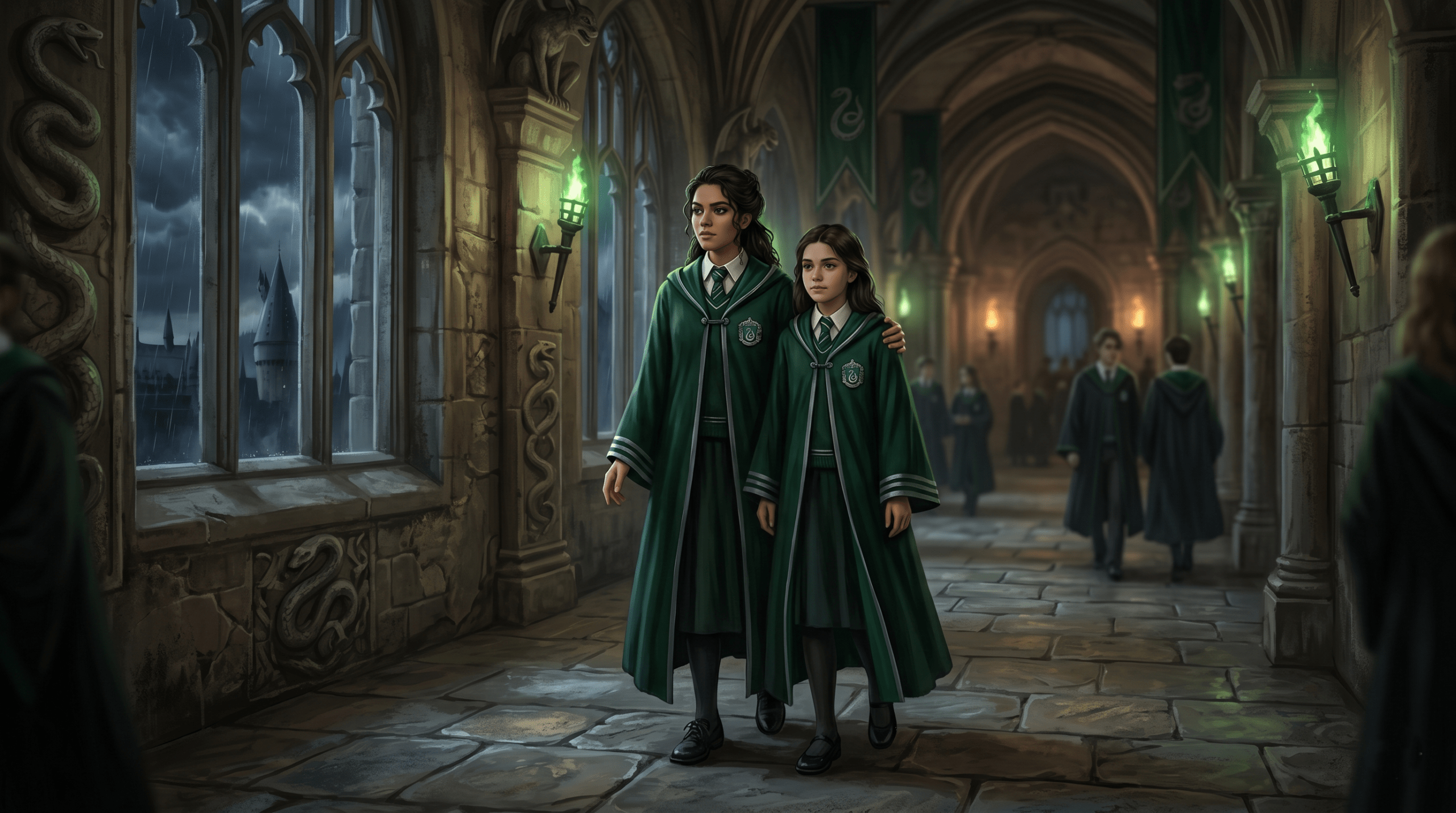 How She Differs From Other Slytherin Characters
One of the most useful ways to understand Daphne is to place her alongside her Slytherin contemporaries and examine the contrasts.
Pansy Parkinson is Draco’s most vocal supporter and Harry’s most persistent female antagonist. She is openly cruel, status-obsessed, and willing to humiliate others publicly. Most devastatingly, it is Pansy who, during the Battle of Hogwarts, suggests handing Harry over to Voldemort to save the school.
Millicent Bulstrode is characterized primarily by physical intimidation. She is aggressive and blunt, representing a more brutish expression of Slytherin traits.
Daphne Greengrass, by contrast, is associated with none of these qualities. She does not bully. She does not grandstand. She does not collaborate with Umbridge or the Death Eaters in any documented way. If Pansy represents the worst of what Slytherin can produce, Daphne represents something far more nuanced — a Slytherin whose self-preservation instinct manifests not as cruelty toward others, but as a quiet, intelligent withdrawal from ideological extremism.
In many ways, this makes her the most authentically Slytherin character of her generation. True cunning, after all, does not announce itself.
Expert Insight
Experienced Harry Potter analysts and literary critics have long noted that background characters in Rowling’s work serve a vital narrative function beyond simply populating the world. They act as what might be called “world-building anchors” — figures who remind the reader that the story extends far beyond Harry’s point of view, and that the wizarding world contains multitudes of experiences, choices, and moral complexities that the central narrative cannot fully explore.
Daphne Greengrass is one of the most powerful of these anchors, precisely because she represents something the series occasionally struggles to portray with nuance: the Slytherin student who is not a villain. She is living evidence that sorting into Slytherin does not determine one’s moral destiny — a theme that Rowling herself has revisited in interviews and that becomes increasingly central to the series’ legacy as fans grow older and re-read the books with more critical eyes.
Daphne and Draco Malfoy — What Is the Real Connection?
Were Daphne and Draco in a Relationship?
This is one of the most commonly searched questions about Daphne Greengrass, and the answer from a canon standpoint is straightforward: there is no confirmed romantic relationship between Daphne Greengrass and Draco Malfoy in the books or any official Wizarding World material.
The two characters share a house and a year group, which means they would have spent considerable time in the same spaces — the Slytherin common room, shared classes, the Great Hall. But Rowling never depicts any particular closeness between them, romantic or otherwise.
The canon connection between the Malfoy and Greengrass families is of an entirely different kind — and it runs through Daphne’s younger sister.
Draco Malfoy and Astoria Greengrass — The Real Canon Link
Following the events of the Second Wizarding War, Draco Malfoy marries Astoria Greengrass, Daphne’s younger sister. This union is confirmed in Harry Potter and the Cursed Child, the 2016 stage play that serves as an official continuation of the Harry Potter story.
This means that Daphne Greengrass is, in the canon timeline, Draco Malfoy’s sister-in-law. She is the aunt of Scorpius Malfoy, the central character of The Cursed Child alongside Albus Potter. The Greengrass family, through Astoria’s marriage, becomes permanently intertwined with the Malfoy bloodline — and Daphne sits at the center of that connection.
This is a remarkable elevation of significance for a character who was given a single line in the first book. Daphne is not merely a background Slytherin girl — she is family to one of the series’ most complex and ultimately redeemed characters.
Why Fans Ship Daphne and Draco
Despite the lack of canon support for a romantic relationship between Daphne and Draco, the pairing is enormously popular in Harry Potter fan fiction. A search for “Draco x Daphne” on Archive of Our Own and FanFiction.net yields thousands of stories — ranging from Hogwarts-era romance to post-war reconciliation narratives.
The appeal of the pairing is understandable. Both characters are pure-blood Slytherins from prominent families. They would have moved in the same social circles. And in the absence of canon details about Daphne’s personality, fan writers have enormous creative freedom to construct her character in ways that complement Draco’s well-documented arc of moral complexity and eventual redemption.
It is important, however — both for intellectual honesty and for E-E-A-T credibility — to clearly distinguish between canon lore and fan-created content. The Draco-Daphne romantic pairing is a fan fiction construct, not a Rowling-established relationship. It is a testament to Daphne’s unique appeal as a character that fans have found her so inspiring — but readers seeking canon information should understand where the official text ends and creative reimagining begins.
Daphne Greengrass and Her Sister Astoria — A Tale of Two Slytherins
Who Is Astoria Greengrass?
To fully appreciate the significance of Daphne Greengrass in the Harry Potter universe, one must understand her younger sister — because Astoria Greengrass, despite also being a relatively background character in the original series, receives considerably more canon development than Daphne, and that development casts a revealing light on the entire Greengrass family.
Astoria Greengrass is one year below Daphne at Hogwarts, placing her in the same year as Ginny Weasley, Luna Lovegood, and Neville Longbottom. Like her sister, she is sorted into Slytherin and comes from the same pure-blood Greengrass family background. However, where Daphne’s story ends at the margins of the original series, Astoria’s story is given meaningful shape in Harry Potter and the Cursed Child.
In that canon continuation, we learn that Astoria Greengrass marries Draco Malfoy sometime after the conclusion of the Second Wizarding War and together they have a son, Scorpius Hyperion Malfoy, who becomes one of the two central protagonists of The Cursed Child alongside Albus Severus Potter.
But perhaps the most significant piece of canon information about Astoria is not her marriage or her son — it is her ideology. According to The Cursed Child, Astoria is described as having undergone a profound moral and philosophical transformation in the aftermath of the war. She came to reject pure-blood supremacist ideology entirely, refusing to pass those values on to her son Scorpius. This put her at odds with certain members of the Malfoy family and the wider pure-blood social circle — but she held firm in her convictions.
Tragically, Astoria also carries a curse — a blood malediction passed down through an ancestor — which progressively weakens her health throughout her adult life. She dies before the events of The Cursed Child fully unfold, leaving Draco a widower and Scorpius without his mother. Her death is one of the emotional anchors of the play, and it speaks to the quiet dignity and moral courage that defined her character.
What Astoria’s Story Tells Us About Daphne
Astoria’s arc raises one of the most intriguing questions in all of Harry Potter lore: if the younger Greengrass sister grew up to reject pure-blood supremacy, what does that tell us about the family environment that both sisters were raised in — and about Daphne herself?
There are several compelling interpretations worth exploring here.
The first is that the Greengrass household, despite its pure-blood status and social conservatism, was not a home of fanatical ideological indoctrination. Unlike the Black family — where blood purity was treated as a near-religious doctrine, and family members who strayed from it were literally blasted off the family tapestry — the Greengrasses appear to have allowed their daughters a degree of intellectual and moral freedom. Astoria’s evolution away from pure-blood ideology did not result in her being disowned or publicly shamed. She married Draco Malfoy, remained part of wizarding society, and raised a son who is defined by his kindness, curiosity, and open-heartedness.
The second interpretation is even more interesting: Daphne may have played a role in shaping Astoria’s values. Older siblings are often among the most formative influences in a child’s moral development. If Daphne herself harbored private doubts about pure-blood supremacy — or if she modeled the kind of quiet, principled neutrality that her family’s political stance encouraged — it is entirely plausible that she was a positive influence on her younger sister’s thinking during their shared years at Hogwarts.
The third interpretation inverts this logic and is equally valid: perhaps it was Astoria who eventually influenced Daphne. If the younger sister was the first to openly articulate a rejection of their family’s ideological inheritance, Daphne — observing that from her position as an older sister and eventually a sister-in-law to Draco — may have quietly arrived at similar conclusions in her own time.
None of these interpretations can be confirmed by existing canon. But they are all grounded in the canon facts we do have, and they illustrate why Daphne Greengrass, even in her silence, generates such rich and serious discussion among Harry Potter fans and scholars alike.
The Greengrass Family Tree — Simplified
For readers who enjoy having the family connections clearly laid out, here is a straightforward breakdown of the Greengrass family as established in canon:
Mr. and Mrs. Greengrass (parents — both unnamed in canon, pure-blood family) are the parents of two daughters. Their elder daughter is Daphne Greengrass, a Slytherin in Harry Potter’s year, who remains unmarried and without further canon development beyond the original series. Their younger daughter is Astoria Greengrass, a Slytherin one year below Daphne, who marries Draco Malfoy after the Second Wizarding War. Draco and Astoria’s son is Scorpius Hyperion Malfoy, who features prominently in Harry Potter and the Cursed Child as Albus Potter’s closest friend.
This means that Daphne Greengrass occupies a unique position in the extended Potter family tree — she is the sister of the woman who reformed one of the wizarding world’s most notorious pure-blood families from the inside. That is not a minor footnote. That is a legacy.
Daphne in Harry Potter Fan Theories and Pottermore Lore
Top Fan Theories About Daphne Greengrass
Given the near-total absence of canon detail about Daphne’s inner life and post-Hogwarts fate, it is no surprise that the Harry Potter fan community has generated an impressive body of theory and speculation around her character. Several of the most thoughtful and widely discussed theories deserve serious attention here.
Theory One: Daphne’s Neutrality Was Protective, Not Passive
The most prevalent and arguably most compelling fan theory about Daphne Greengrass is that her political neutrality during the Second Wizarding War was not simply a reflection of her family’s desire to stay out of trouble — it was an active, conscious choice made at personal risk.
According to this theory, Daphne watched the ideological extremism of her fellow Slytherins — the Draco Malfoys, the Vincent Crabbes, the Gregory Goyles, the children who were funneled toward Death Eater service by their families’ expectations — and made a deliberate decision to resist that path without openly declaring her resistance. In a house where showing weakness or disloyalty could have serious consequences, the safest form of moral courage was silence.
This reading transforms Daphne from a passive background character into something far more interesting: a young woman who survived one of history’s darkest chapters not by complying or by openly fighting, but by refusing to be used — and being smart enough to make that refusal invisible.
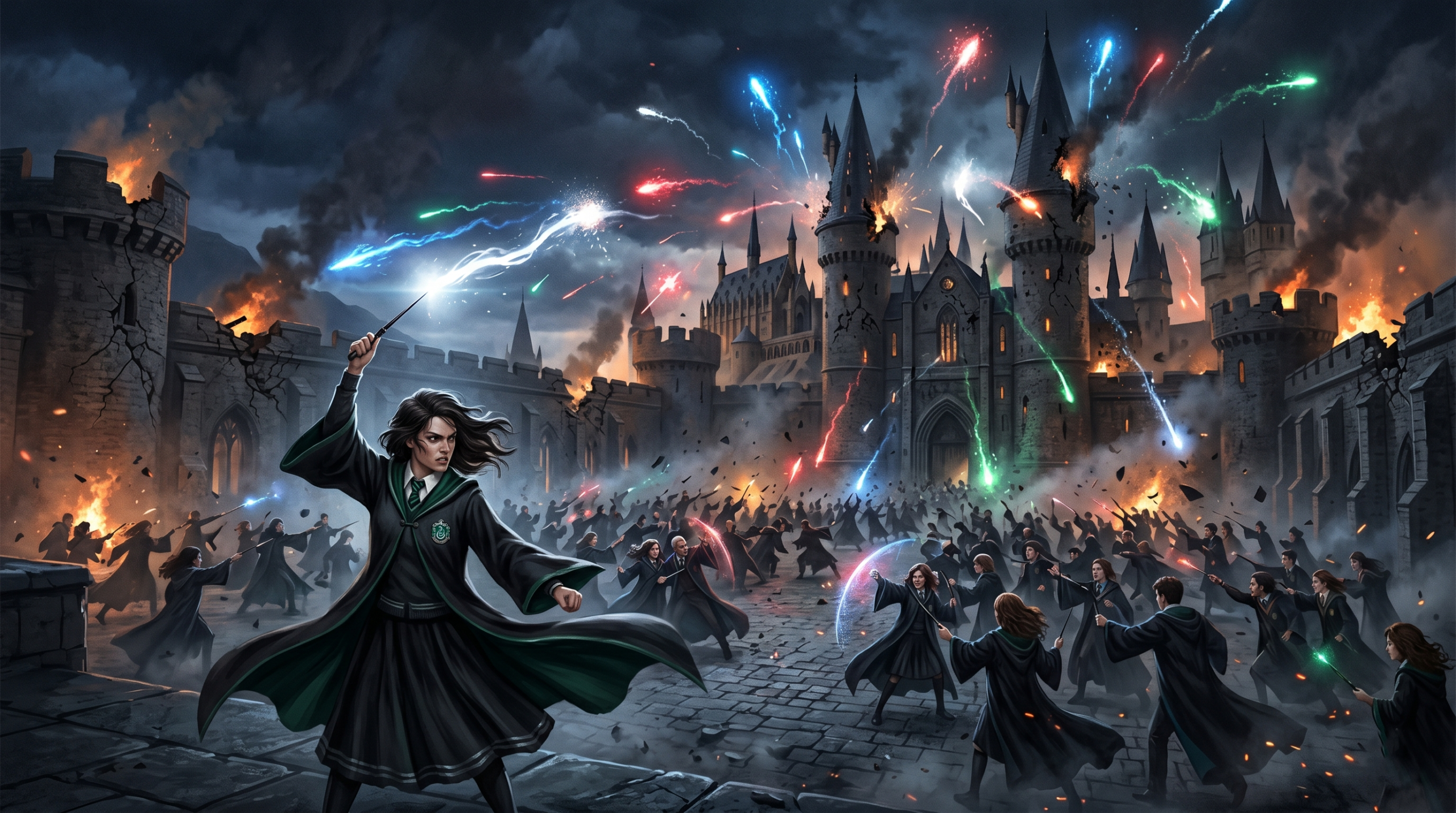
Theory Two: Daphne Was Among the Slytherins Who Stayed to Fight
One of the most debated moments in Harry Potter and the Deathly Hallows is the evacuation of Slytherin House before the Battle of Hogwarts. When Harry asks the students who wish to fight to remain, the narrative implies that the majority of Slytherin students leave with Professor Slughorn. This has long been interpreted — somewhat unfairly — as evidence that all Slytherins were cowards or collaborators.
However, a significant portion of the fan community has pushed back on this reading, noting that some Slytherin students did return to fight, that Slughorn himself returned leading a contingent of reinforcements, and that the evacuation may have been driven by strategic necessity as much as cowardice.
Within this context, a popular theory holds that Daphne Greengrass was among those Slytherin students who either stayed or returned to fight — that her years of quiet neutrality finally gave way, in the defining moment of her generation, to open action on the right side of history. This theory has never been confirmed by Rowling, but it is consistent with what the family’s evolution — particularly through Astoria — suggests about Greengrass values.
 Theory Three: Daphne Represents the Silent Majority of Slytherin
Perhaps the most literarily sophisticated of the major Daphne theories is the one that reads her not as an individual mystery but as a narrative symbol. According to this interpretation, Daphne Greengrass represents the vast, unnamed, unrecorded majority of Slytherin students who were neither Death Eaters nor heroes — who were simply young people caught in a war they did not start, trying to survive in a house whose public image had been catastrophically poisoned by the actions of its most extreme members.
This theory invites readers to reconsider the moral complexity of the Harry Potter series at its deepest level. The story is told almost entirely from the perspective of Gryffindor — and more specifically, from the perspective of the students who fought most visibly and dramatically on the right side. But Hogwarts had hundreds of students in Slytherin alone across those seven years, and the overwhelming majority of them were not Death Eaters. They were children from complicated families, navigating an impossible situation, doing their best to survive.
Daphne, in this reading, is their representative — the named face of the unnamed many.
What Pottermore and J.K. Rowling Have Said
For readers seeking official Wizarding World content about Daphne Greengrass, it is important to be transparent: Daphne does not have a dedicated character profile or entry on the Wizarding World website (formerly Pottermore). The most substantial canon information about the Greengrass family comes from the Sacred Twenty-Eight list referenced in Pottermore content around pure-blood families, and from the depiction of Astoria in The Cursed Child.
Rowling has spoken more broadly about pure-blood families and the Sacred Twenty-Eight in interviews and Pottermore writings, emphasizing that pure-blood status in the wizarding world does not inherently equate to evil — and that many pure-blood families occupied a complicated middle ground between the Death Eater extremism of the Malfoys and the blood-traitor reputation of the Weasleys. The Greengrasses fall squarely into that middle ground.
The absence of a dedicated Daphne Greengrass entry on Wizarding World is itself noteworthy. It suggests that Rowling has either left Daphne intentionally underdeveloped as a narrative device — a blank space in the record — or that she represents a reserve of storytelling potential that has not yet been fully explored in official canon. Given the recent announcements around new Harry Potter content, including the HBO television series currently in development, there remains a genuine possibility that Daphne Greengrass could one day receive the canonical development her fan following clearly believes she deserves.
Daphne in Harry Potter Fan Fiction — A Cultural Phenomenon
No discussion of Daphne Greengrass would be complete without acknowledging the extraordinary creative legacy she has inspired in the Harry Potter fan fiction community. On major fan fiction platforms including Archive of Our Own and FanFiction.net, Daphne Greengrass features in thousands of stories — a remarkable figure for a character who receives fewer than five direct mentions across seven canonical novels.
The reasons for her popularity as a fan fiction subject are deeply connected to the qualities that make her compelling as a canon character. Her blank-slate status gives fan writers complete creative freedom to construct her personality, backstory, and motivations without contradicting established canon. She can be an anti-hero, a secret ally, a sharp-tongued aristocrat with a hidden conscience, a reluctant revolutionary, or a deeply private person quietly horrified by the war unfolding around her — and all of these characterizations are equally valid because the canon text neither confirms nor denies any of them.
The most common and most celebrated version of Daphne in fan fiction is what the community sometimes calls the “Ice Queen” archetype — a Daphne who presents a cool, composed, socially impeccable exterior while harboring complex emotions, private principles, and a sharp intelligence that she keeps carefully hidden from Hogwarts’ dangerous political environment. This version of Daphne is often paired romantically with Harry Potter himself, in stories that explore what a relationship between the Chosen One and a Slytherin girl with a complicated heritage might look like.
Other popular fan fiction framings include Daphne as Draco’s closest confidante — the friend who knew him before the war changed him and who holds the clearest memory of who he could have been. Some of the most moving fan fiction in this genre explores Daphne navigating the painful space between loyalty to her house and house-mates and her own moral compass, in the years when Hogwarts itself became a place of danger and surveillance.
What all of these stories share is a recognition that Daphne Greengrass, as a character, represents something important that the canon series left unfinished. She is a door that Rowling opened and never walked through — and fan writers, in their thousands, have taken it upon themselves to explore what lies beyond.
Why Daphne Greengrass Matters — Her Legacy in the Harry Potter World
The Slytherin Narrative the Series Needed
One of the most persistent criticisms of the Harry Potter series — a criticism that has grown more prominent as the books’ original readers have matured into adults capable of more nuanced literary analysis — is that the series sometimes relies too heavily on Slytherin as a shorthand for moral corruption. From the very first book, Harry is told to hope he is not sorted into Slytherin. The most prominent Slytherin characters in the early books are antagonists. The house’s reputation is established early and reinforced often.
The series does complicate this picture as it matures — most significantly through the arc of Severus Snape, whose Slytherin cunning and ambition ultimately serve the cause of love and redemption in ways that no other character’s do. Draco Malfoy, too, is given enough psychological depth by the end of the series that readers can understand him as a victim of his upbringing as much as a perpetrator of cruelty. And the final act of Deathly Hallows — Slughorn leading Slytherin reinforcements back to the Battle of Hogwarts — gestures toward the fuller picture.
But Daphne Greengrass, in her quiet, unnamed, unconfirmed way, may do more for the Slytherin narrative than any of these named characters. She is the proof that Slytherin produced students who were neither heroes nor villains — who went to class, learned magic, navigated a terrifying political environment, and came out the other side without having committed any recorded act of cruelty or collaboration. She is the ordinary Slytherin, and in a series that desperately needed more of them, her presence matters enormously.
A Character Whose Time May Still Come
The Harry Potter universe is not finished expanding. The announcement of a new HBO television series adapting the original seven books offers the most significant opportunity in the franchise’s history to flesh out the supporting cast of Hogwarts students in ways that the films never had time to do. If the showrunners and writers approach the material with the depth and ambition it deserves, characters like Daphne Greengrass — named, placed, and deliberately left undefined — are exactly the kind of figures who could be brought to life with new and meaningful purpose.
A Daphne Greengrass who speaks on screen, who has friendships and conflicts and private moments of moral courage, who watches the war from inside Slytherin and makes choices that the books never recorded — that character would resonate deeply with the generation of fans who have spent years writing her into existence in their own imaginations.
She is waiting. The story has always had room for her.
The Broader Lesson of Daphne Greengrass
Beyond the specifics of Harry Potter lore, Daphne Greengrass teaches us something valuable about storytelling itself. The most memorable worlds in fiction are not those where every corner is lit and every character is explained — they are the ones that suggest, convincingly, that life extends beyond the edges of the page. Rowling’s world is populated with ghosts of untold stories, and Daphne is one of the most haunting.
She reminds us that the people who don’t make headlines — who don’t fight the most visibly, shout the loudest, or stand at the center of history’s most dramatic moments — are still living through those moments. Their silence is not absence. It is a story of its own, waiting to be heard.
Frequently Asked Questions About Daphne in Harry Potter
Q1: Who is Daphne in Harry Potter?
Daphne Greengrass is a pure-blood witch who attends Hogwarts School of Witchcraft and Wizardry in the same year as Harry Potter. She is sorted into Slytherin House and is the elder sister of Astoria Greengrass, who later marries Draco Malfoy. Despite being a named character, she receives very limited direct development in the canonical text of the series.
Q2: What house is Daphne Greengrass in?
Daphne Greengrass is sorted into Slytherin House during the Sorting Ceremony depicted in Harry Potter and the Philosopher’s Stone. Her Sorting aligns with her family background — the Greengrasses are one of the Sacred Twenty-Eight pure-blood families, and placement in Slytherin would have been consistent with family tradition and expectation.
Q3: Is Daphne Greengrass related to Draco Malfoy?
Not by blood — but by marriage. Daphne’s younger sister, Astoria Greengrass, marries Draco Malfoy after the Second Wizarding War. This makes Daphne Greengrass Draco Malfoy’s sister-in-law and the aunt of their son, Scorpius Malfoy, who is a central character in Harry Potter and the Cursed Child.
Q4: Does Daphne Greengrass appear in the Harry Potter movies?
Daphne Greengrass does not have a named, speaking role in any of the eight Harry Potter films. She may appear as an uncredited background student in ensemble scenes — particularly during the Sorting Ceremony in Philosopher’s Stone or in Slytherin common room scenes — but she is never identified by name in the films.
Q5: Is Daphne Greengrass pure-blood?
Yes. Daphne Greengrass is a pure-blood witch from the Greengrass family, which is listed among the Sacred Twenty-Eight — the group of British wizarding families recognized by the Pure-Blood Directory as having maintained entirely magical bloodlines. However, the Greengrass family is generally understood to have avoided the most extreme expressions of pure-blood supremacist ideology, unlike families such as the Malfoys or the Blacks.
Q6: What happened to Daphne Greengrass after Hogwarts?
The canon text provides no information about Daphne Greengrass’s life after Hogwarts. Her post-war fate, career, relationships, and eventual story remain entirely unexplored in any official Wizarding World material. This canonical silence has made her one of the most popular subjects for fan fiction and fan theory in the entire Harry Potter community.
Q7: Why is Daphne Greengrass so popular in fan fiction?
Daphne Greengrass’s popularity in fan fiction stems directly from her blank-slate canon status. Because Rowling established her existence — a named, pure-blood Slytherin in Harry’s year group — without defining her personality, beliefs, or post-war story, fan writers have complete creative freedom to develop her character in any direction they choose. She can be reimagined as an anti-hero, a secret ally of the light, a morally complex survivor, or a romantic lead — all without contradicting established canon. Her connection to the Malfoy family through Astoria adds an additional layer of narrative intrigue that fan writers find enormously productive.
In a story about a boy who was famous from birth, surrounded by characters whose names and faces and choices are etched permanently into the popular imagination, Daphne Greengrass represents something rare and quietly powerful: the character who was given a name but not a story, and who has nonetheless captured the hearts and imaginations of fans across the world.
She is Slytherin’s most mysterious figure not because Rowling designed her as a mystery to be solved, but because the absence of her story forces us to confront what we assume about the houses, the families, and the people who lived through the Second Wizarding War in the background — without a prophecy, without a chosen status, without a narrative to shelter them.
Daphne Greengrass was there. She sat in the Slytherin common room while the Dark Mark was branded onto the arms of her housemates. She walked the corridors of Hogwarts while Death Eaters took control of the school. She survived — and the fact that she survived without becoming a villain, without betraying anyone, without leaving a single recorded mark of cruelty, is itself a form of heroism that the series’ central narrative never had time to honor.
Her sister married one of the war’s most conflicted figures and helped redeem him through love and moral courage. Her nephew became one of the most kind-hearted characters in the entire expanded canon. And through all of it, Daphne stands just out of frame — connected to everything, defined by nothing, waiting for someone to finally tell her story.
Perhaps, with the new generation of Harry Potter content on the horizon, that time is coming. Until then, her story lives in the passionate, thoughtful, endlessly creative work of the fan community that refused to let her remain a footnote.
The wizarding world is large enough to hold her story. It always was.