

Imagine the flicker of a wand tip igniting a cozy hearth in the Gryffindor common room, or the roaring, uncontrollable inferno that engulfs the Room of Requirement in a blaze of destruction. Fire spells in the Harry Potter series embody the dual nature of magic itself: a tool for warmth and utility, yet a force capable of unimaginable devastation. Among these, the harry potter fire spell most fans first encounter is Incendio, the reliable Fire-Making Charm. But the Wizarding World holds far more potent fiery magic — from the cursed Fiendfyre to the elite dark protective ring of Protego Diabolica.
In this comprehensive guide, we explore the mechanics, canon examples, risks, and deeper lore of these spells. Drawing directly from J.K. Rowling’s books, the films, Fantastic Beasts, and modern extensions like Hogwarts Legacy, we’ll break down how to understand (and appreciate) these spells safely. Whether you’re a longtime Potterhead revisiting key moments, a gamer mastering Hogwarts Legacy, or someone curious about why certain flames can destroy Horcruxes while others cannot, this guide delivers the depth and insight you’ve been searching for.
Fire magic appears throughout the series as both everyday charm and dark art. Incendio lights campfires and torches; Fiendfyre nearly ends the trio’s quest; Protego Diabolica showcases advanced control in the hands of a powerful dark wizard. By the end, you’ll grasp not just the spells, but the lessons of power, control, and responsibility they teach.
What Is Incendio? The Essential Harry Potter Fire Spell
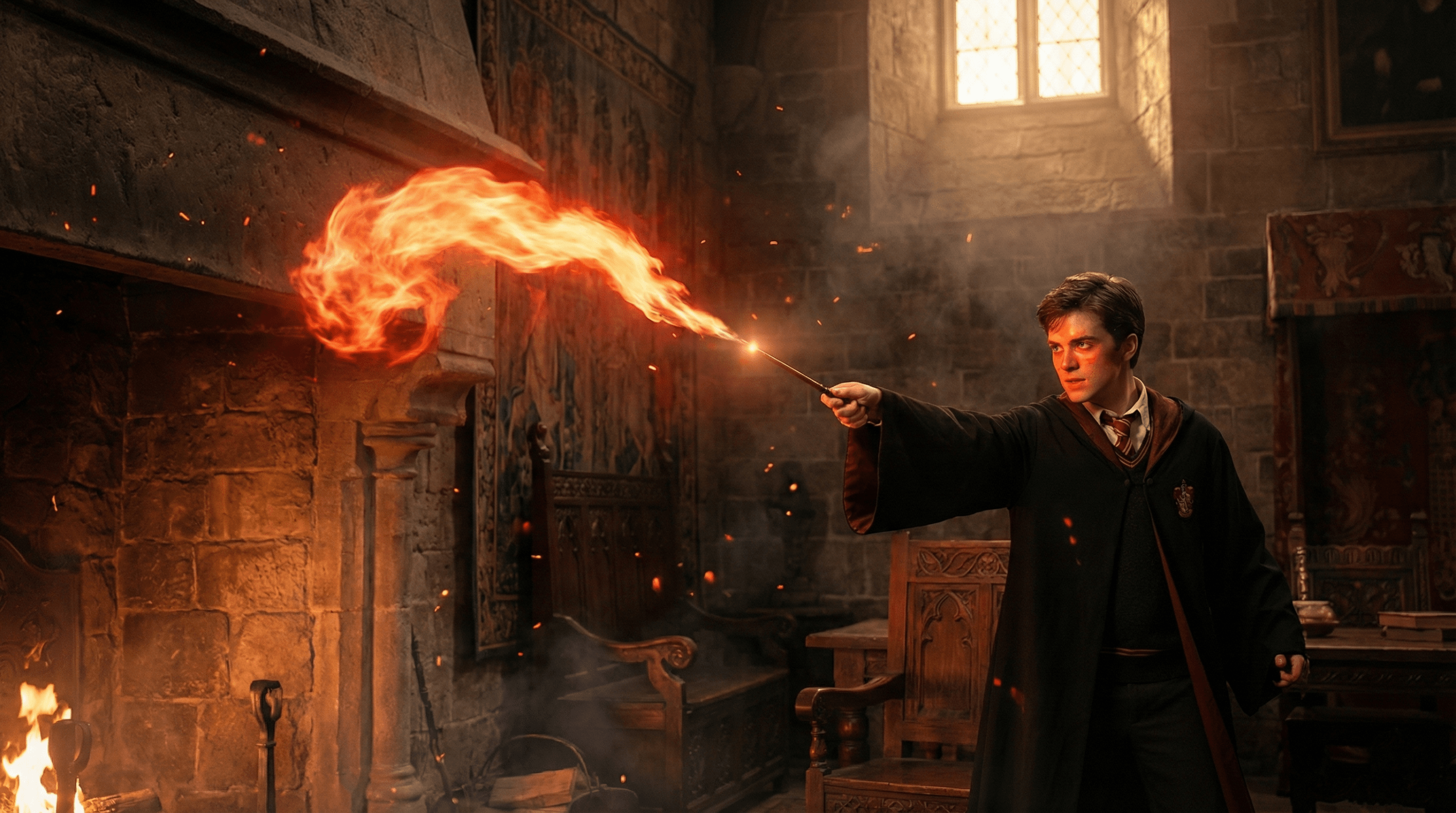
Incendio stands as the foundational fire spell in the Wizarding World — a straightforward charm that conjures a jet of flames to set objects alight. It’s one of the most practical and frequently used spells, taught early in Hogwarts education.
 Incendio Basics – Incantation, Pronunciation, and Wand Movement
The incantation is Incendio, pronounced “in-SEN-dee-oh,” with emphasis on the second syllable. The etymology draws from Latin “incendio,” meaning “by fire” or “to set ablaze,” reflecting its purpose.
Wand movement typically involves a sharp, forward flick or upward slash — a motion that mimics striking a match or igniting a spark. In depictions across media, including video games like Wizards Unite, the gesture is precise and energetic to channel the conjuration effectively.
Intent and focus are crucial: the caster must visualize the flame and direct it toward the target. Without proper concentration, the spell might fizzle or produce only weak sparks.
Everyday Uses in the Wizarding World
Incendio serves countless practical purposes. It lights fireplaces, candles, and torches — essential in a world without electricity. Hagrid famously uses it to ignite the fireplace when first bringing Harry to the Wizarding World. Hermione employs bluebell flames (a controlled variant) for warmth and light during camping in Deathly Hallows.
In Herbology and Care of Magical Creatures classes, it’s used to burn away obstacles like cobwebs or incinerate pests such as Flesh-Eating Slugs. It’s versatile for camping, dueling (as short-range offense), and even puzzle-solving in magical environments.
Incendio in the Books and Films – Key Moments
One memorable early use occurs in Harry Potter and the Sorcerer’s Stone (or Philosopher’s Stone), where Hermione sets Snape’s robes ablaze with blue flames during a Quidditch match to save Harry from a jinxed broom. Though some adaptations attribute this to “Lacarnum Inflamari,” the intent aligns with fire conjuration.
In Chamber of Secrets, characters use fire-based charms in Herbology. Later books show it in defensive contexts, highlighting its reliability when control is maintained.
Incendio in Hogwarts Legacy – Gameplay Mechanics and Tips
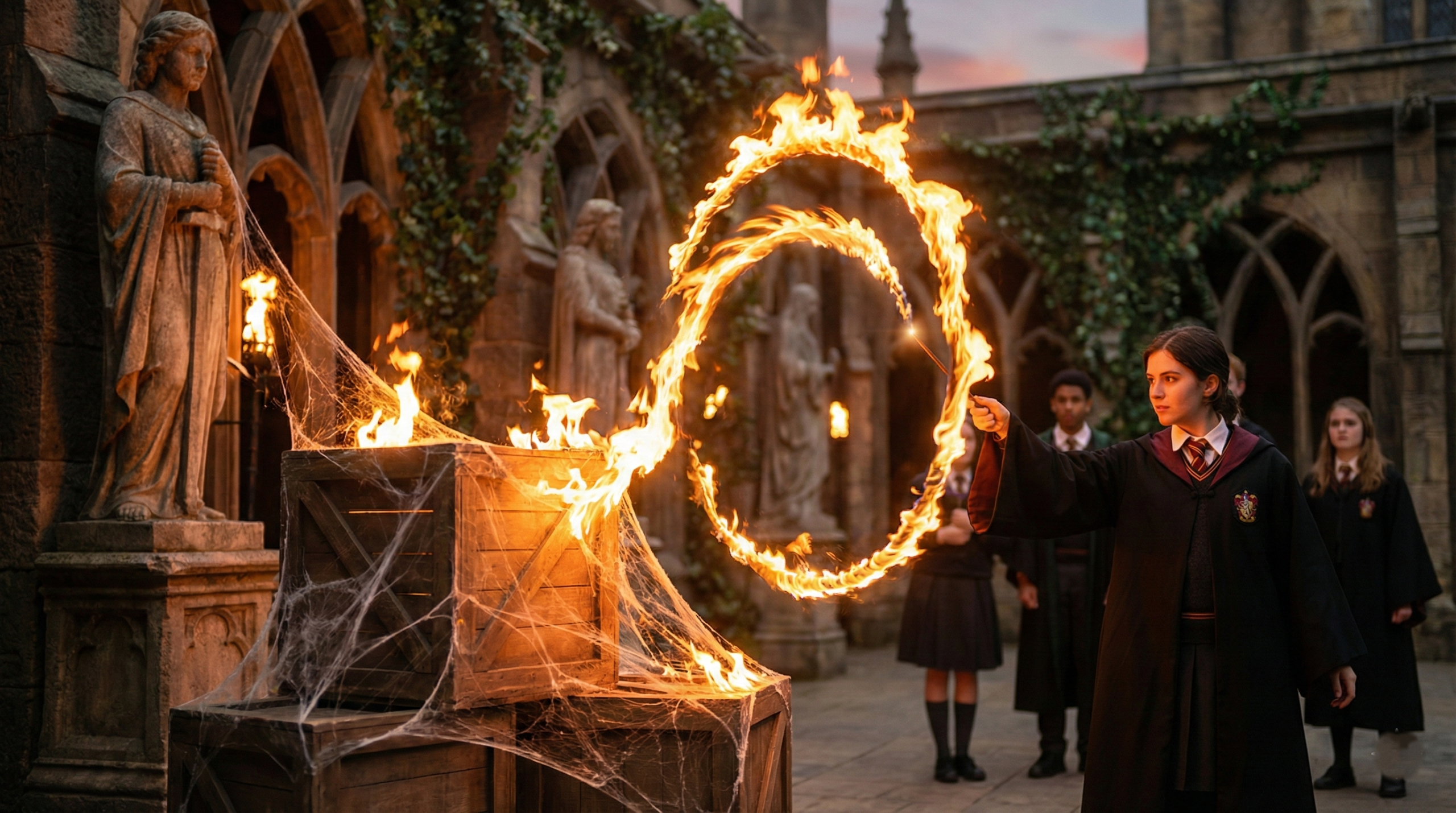
In the open-world game Hogwarts Legacy, Incendio is unlocked early through Professor Hecat’s assignment. Players learn it as a short-range fire spell that deals damage and ignites enemies over time. Upgrades can add effects like a brief ring of fire for area control.
It’s invaluable for combat against spiders and Inferi, burning webs in puzzles, lighting braziers to open paths, and solving environmental challenges. Tip: Combine it with Accio or Levioso for creative combos — pull enemies close, then blast them with flames. Always upgrade for better range and damage, as base Incendio stays close-quarters.
Why Incendio Is the Perfect Starter Fire Spell
Unlike advanced curses, Incendio is accessible, controllable, and low-risk. It teaches fundamental spellcasting principles: precise pronunciation, wand technique, and intent. Mastering it builds confidence before tackling volatile magic, making it ideal for young witches and wizards — and fans imagining their own Hogwarts experience.
The Dark Side of Fire Magic – Fiendfyre Explained
While Incendio represents controlled, everyday fire magic, Fiendfyre stands at the opposite extreme — one of the most dangerous and feared spells in the entire Wizarding World. This cursed flame is not merely a conjuration; it is sentient, voracious, and almost impossible to extinguish once unleashed.
What Is Fiendfyre? The Cursed Flames of Destruction
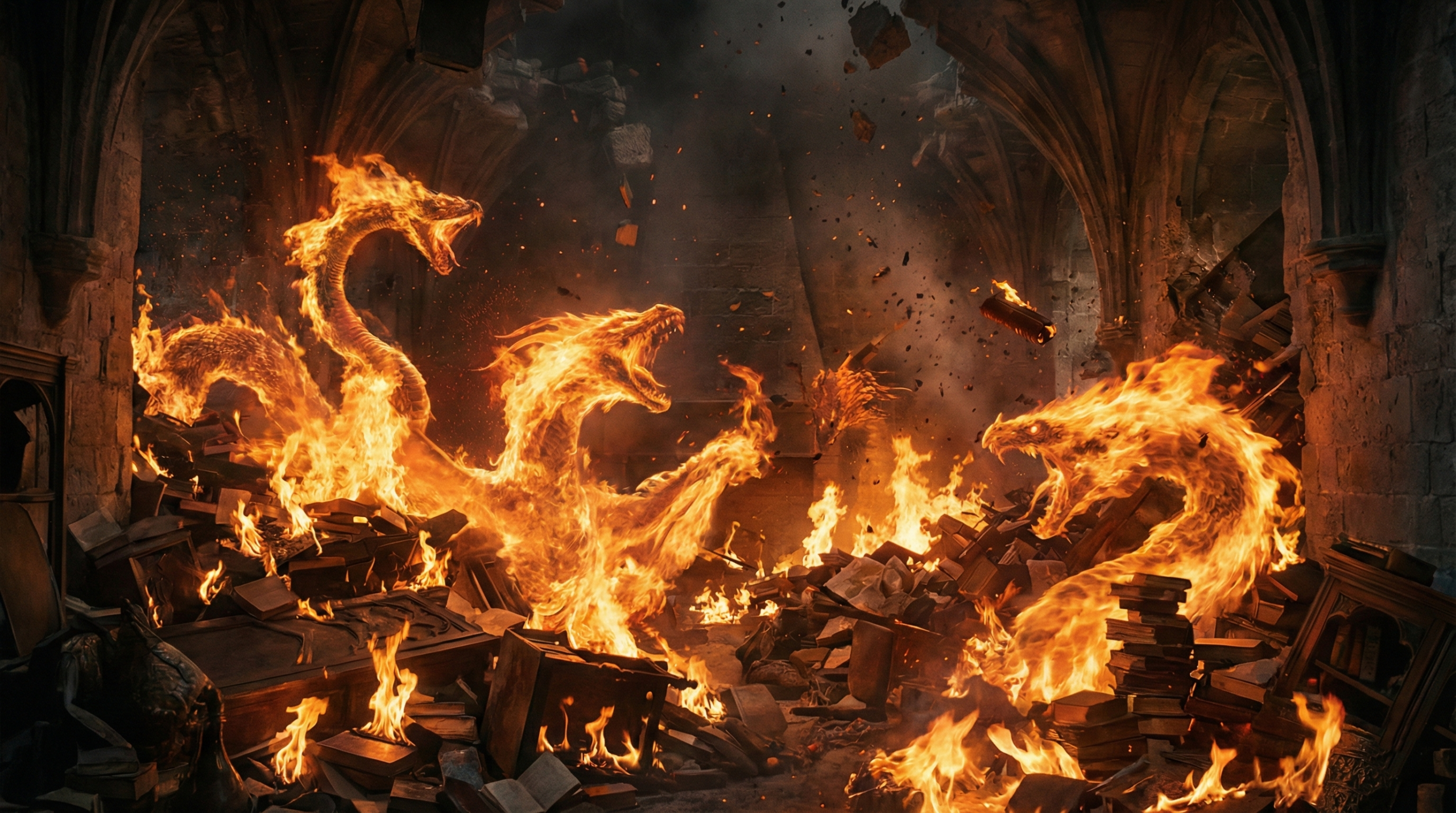
Fiendfyre (sometimes referred to with the incantation Pestis Incendium in extended lore and fan translations) is a form of Dark magic that summons enormous, living flames capable of taking the shapes of mythical beasts — dragons, serpents, chimaeras, and other monstrous forms. These flames are not ordinary fire; they possess a rudimentary will of their own, seeking out anything combustible with terrifying speed and hunger.
Key characteristics include:
- Extreme heat capable of melting stone and metal
- Immunity to ordinary water-based counter-spells (Aguamenti is useless against it)
- Rapid, exponential growth that can consume entire rooms or buildings within seconds
- High risk to the caster — the spell often turns on its summoner if control is lost
Unlike Incendio, Fiendfyre requires exceptional magical power, dark intent, and precise mastery. Even skilled witches and wizards rarely attempt it due to the near-certain risk of self-destruction.
 Fiendfyre in Canon – Iconic Scenes and Consequences
The most devastating appearance of Fiendfyre occurs in Harry Potter and the Deathly Hallows during the Battle of Hogwarts. In the Room of Requirement, Vincent Crabbe — a relatively unskilled Death Eater — casts the spell in an attempt to kill Harry, Ron, and Hermione. The flames immediately spiral out of control, forming roaring dragon and serpent shapes that devour everything in their path.
Crabbe himself perishes in the inferno, unable to stop what he started. The trio barely escapes on broomsticks as the Room of Requirement is consumed. This scene powerfully illustrates why Fiendfyre is considered one of the most reckless and lethal pieces of magic in the series.
Earlier hints appear in Order of the Phoenix when Dumbledore mentions the spell’s existence during discussions of powerful dark magic, though he never demonstrates it. Its rarity underscores its status as forbidden knowledge even among dark wizards.
Why Fiendfyre Can Destroy Horcruxes (And Ordinary Fire Cannot)
One of the most fascinating aspects of Fiendfyre is its unique ability to destroy Horcruxes — something ordinary fire, even magical fire like Incendio or bluebell flames, cannot accomplish.
Horcruxes are protected by extraordinarily powerful dark enchantments that render them nearly indestructible by conventional means. Basilisk venom, the Sword of Gryffindor (imbued with basilisk venom), and Fiendfyre are among the very few substances or forces capable of breaking these protections.
The reason lies in the spell’s nature: Fiendfyre is not just heat and flame; it is a manifestation of chaotic, destructive dark magic. Its sentient hunger and overwhelming power seem to overwhelm the protective enchantments that shield a soul fragment. This is why the diadem of Rowena Ravenclaw is destroyed in the Room of Requirement blaze — the flames consume the object and the piece of Voldemort’s soul within it.
In contrast, Incendio produces normal (albeit magically conjured) fire. It can burn objects and cause injury, but it lacks the dark, corrosive essence needed to annihilate a Horcrux.
The Dangers and Why Even Experts Avoid It
Fiendfyre is feared for good reason. The caster must maintain ironclad control over the flames at all times; the moment focus wavers, the fire turns on its creator. Crabbe’s death is the clearest canon example, but the spell’s reputation suggests many dark wizards have met similar fates attempting it.
Hermione’s reaction in the Room of Requirement — screaming “Crabbe, what have you done?!” — reflects the horror even battle-hardened students feel toward the spell. Dumbledore, Voldemort, and Grindelwald are among the few characters powerful enough to theoretically control Fiendfyre, yet none of them are ever shown using it casually.
The lesson is clear: power without mastery is suicide. Fiendfyre teaches responsibility through terror.
Protego Diabolica – The Most Advanced Protective Fire Spell
If Fiendfyre represents chaos and raw destructive power, Protego Diabolica stands as the pinnacle of controlled, lethal fire magic. This rare and extraordinarily advanced spell appears only in the extended Wizarding World canon, primarily in Fantastic Beasts: The Crimes of Grindelwald, and it showcases a level of mastery few wizards ever achieve.
Origins and Mechanics in Fantastic Beasts
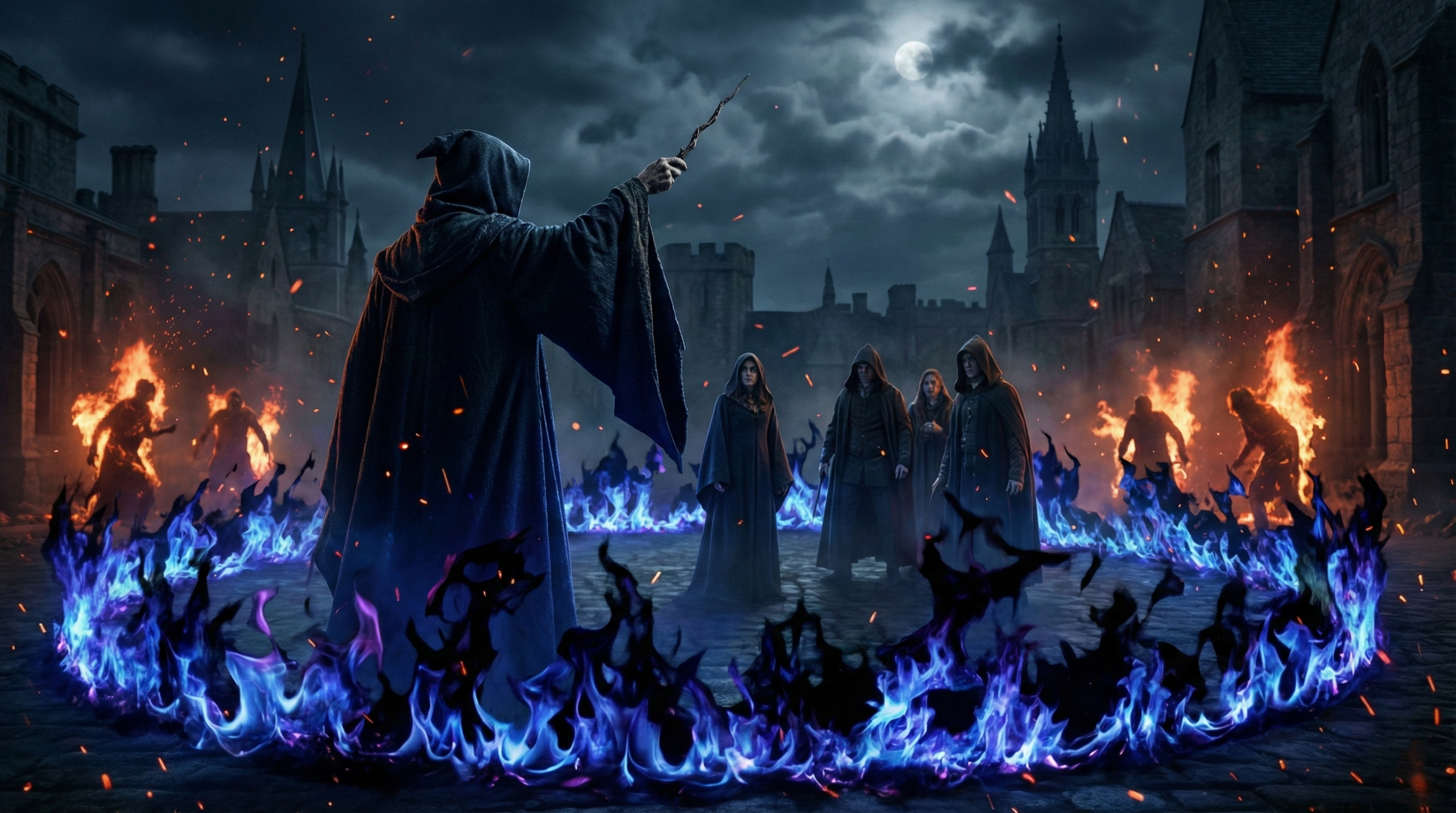
Protego Diabolica is cast by Gellert Grindelwald during his dramatic escape sequence in Paris. With a sweeping circular motion of his wand, he conjures a ring of intense blue-black flames that expands outward in a perfect circle. The fire selectively incinerates anyone Grindelwald deems an enemy while mysteriously sparing his followers and allies who stand within or step into the ring.
Key features include:
- A rapidly expanding ring of dark fire that can engulf city blocks in moments
- Intelligent targeting — it distinguishes friend from foe based on the caster’s will
- Extreme heat and destructive force capable of reducing stone structures to ash
- Apparent immunity to standard counter-charms and water-based magic
The spell’s name translates roughly from Latin as “Devil’s Protection,” hinting at its dark magical classification and morally ambiguous nature. While it serves a defensive purpose (protecting the caster and chosen allies), its offensive power and indiscriminate potential make it one of the most terrifying displays of fire magic in the franchise.
 Comparison: Fiendfyre vs. Protego Diabolica
At first glance, both spells appear as massive, dark fire conjurations — yet their differences are profound and reveal much about the caster’s skill and intent.
| Aspect | Fiendfyre | Protego Diabolica |
|---|---|---|
| Control | Almost none — sentient and turns on caster | Precise and directed by caster’s will |
| Targeting | Indiscriminate destruction | Selective — spares allies, burns enemies |
| Growth Pattern | Chaotic, exponential spread | Controlled circular expansion |
| Risk to Caster | Extremely high (often fatal) | Low when mastered |
| Magical Classification | Cursed, dark, forbidden | Advanced dark protective charm |
| Canon User | Vincent Crabbe (uncontrolled) | Gellert Grindelwald (masterful) |
| Purpose | Pure destruction | Protection + targeted elimination |
Fiendfyre is a blunt instrument of annihilation — a spell even Voldemort never casually employed. Protego Diabolica, by contrast, demonstrates supreme wand skill, mental discipline, and magical power. It is protection elevated to an art form of annihilation.
Why This Spell Represents the Pinnacle of Fiery Magic
Protego Diabolica illustrates the highest evolution of fire-based magic: transforming raw destructive force into a precise, intelligent weapon under complete control. Only a wizard of Grindelwald’s caliber — or perhaps Dumbledore or Voldemort at their peak — could hope to wield it without catastrophe.
Its appearance in the films serves as a visual reminder that the most dangerous magic is not always the loudest or most chaotic, but the most refined and purposeful. It elevates fire from a blunt tool of destruction to an extension of the caster’s will.
Other Notable Fire-Based Spells and Charms
While Incendio, Fiendfyre, and Protego Diabolica dominate discussions of fire magic, several other spells and charms draw on flame or heat in various contexts.
Confringo and Other Offensive Fire Variants
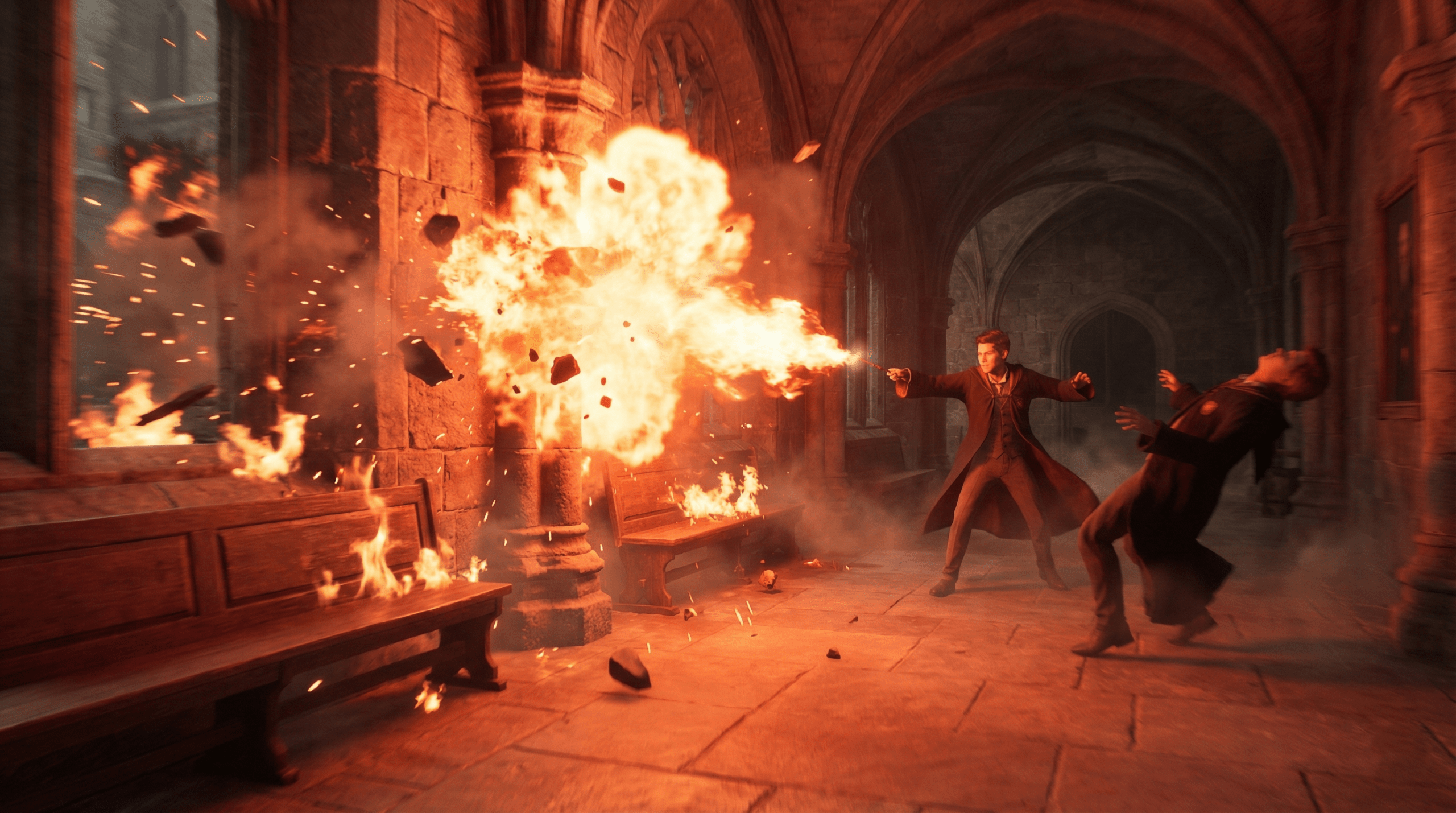
Confringo — the Blasting Curse — produces explosive fiery blasts rather than sustained flames. It shatters objects and can ignite surroundings as a secondary effect. Seen frequently in duels (e.g., Deathly Hallows), it is more combat-oriented than Incendio.
Other minor fire-related magic includes:
- Lacarnum Inflamari — used by Hermione in some adaptations to set Snape’s cloak ablaze
- Bluebell Flames — a non-burning, portable blue fire conjured by Hermione for light and warmth
- Incendio Maxima / Incendio Trio — more powerful variants occasionally referenced in games and fan lore
 Lesser-Known or Related Magic
Fire also appears in non-verbal or wandless contexts (Dumbledore’s phoenix-related flame manipulation) and in creature-based magic (dragons, salamanders, Ashwinder eggs that spontaneously combust). These examples reinforce fire’s deep integration into the magical ecosystem.
Fire in Defensive and Utility Contexts
Beyond offense, fire serves defensive roles — burning away Devil’s Snare, repelling Acromantulas, or creating barriers. Its versatility underscores why control remains the central theme of all fire magic.
Mastering Fire Spells – Tips, Safety, and Ethical Considerations
True mastery of fire magic — even the “safe” Incendio — requires more than correct pronunciation and wand movement.
How to “Cast” Safely (In Canon and Imagination)
- Focus and intent — visualize the desired outcome clearly
- Precision — use minimal power for small tasks; reserve maximum effort for combat or necessity
- Practice control — start with candles and hearths before attempting anything larger
- Know your limits — never attempt Fiendfyre or similar curses without extraordinary skill
Counters and Defenses Against Fiery Magic
Options are limited:
- Fiendfyre resists Aguamenti and most extinguishing charms
- Protego shields can block Incendio and Confringo
- Physical barriers, Apparition, or flight offer the best escape from large-scale fire
- The only reliable “counter” to Fiendfyre is prevention — don’t let it be cast
 Lessons from the Wizarding World – Power and Responsibility
Every major fire spell carries a moral lesson:
- Incendio teaches precision and utility
- Fiendfyre warns against hubris and lack of control
- Protego Diabolica shows that even protective magic can become tyrannical in the wrong hands
Fire magic is never neutral — it mirrors the caster’s character.
Fire Spells in Modern Harry Potter Media
In Hogwarts Legacy, fire spells remain fan favorites for both combat and puzzle-solving. Incendio’s short-range burn, combined with upgrades and combos, makes it a staple in player arsenals. Fan communities continue debating whether Fiendfyre could appear in future titles — and how it might be balanced for gameplay.
The enduring appeal lies in fire’s visual spectacle and emotional weight: warmth versus terror, creation versus destruction.
FAQs
What is the main Harry Potter fire spell? Incendio is the primary, everyday fire-making charm used throughout the series for lighting fires, candles, and hearths.
Can Incendio destroy a Horcrux? No. Ordinary magical fire, including Incendio and bluebell flames, cannot destroy a Horcrux. Only exceptional forces like Fiendfyre, basilisk venom, or the Sword of Gryffindor can.
Is Fiendfyre an Unforgivable Curse? No, it is not classified as one of the three Unforgivable Curses (Avada Kedavra, Crucio, Imperio). However, it is considered highly dangerous dark magic and its use would almost certainly result in severe legal and moral consequences.
How do you learn Incendio in Hogwarts Legacy? It is taught early in the main story during Professor Hecat’s assignment in Charms class. Complete the tutorial and you’ll unlock it for combat and puzzle use.
What’s the difference between Fiendfyre and Protego Diabolica? Fiendfyre is uncontrollable, sentient, and turns on the caster; Protego Diabolica is a precisely controlled protective ring that selectively targets enemies while sparing allies.
From the gentle flicker of Incendio lighting a Hogwarts common room to the apocalyptic roar of Fiendfyre consuming a Horcrux, fire spells capture the full spectrum of magic in J.K. Rowling’s world. They remind us that power is only as good as the hands that wield it — and that even the simplest charm can become deadly when control is lost.
Whether you’re re-reading Deathly Hallows, replaying Hogwarts Legacy, or simply marveling at the cinematic spectacle of Grindelwald’s black fire ring, these spells offer endless fascination. Which fire moment resonates most with you? Share your favorite scene or theory in the comments — and stay safe with your wandwork.