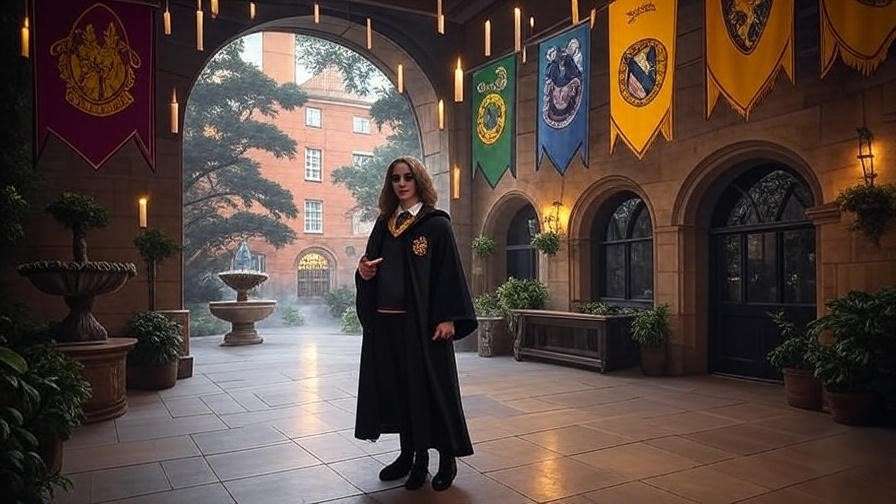
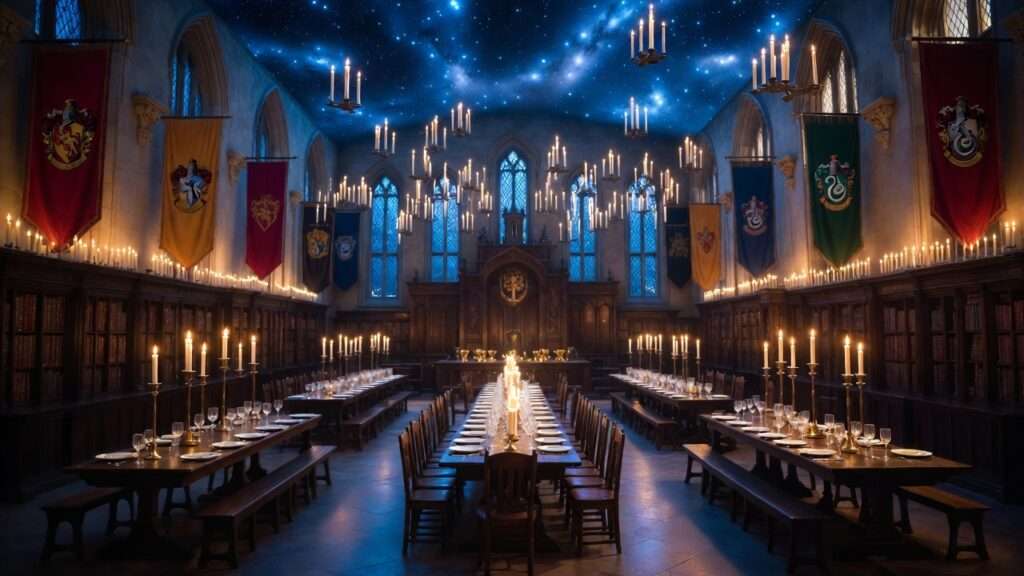
Imagine stepping through the massive oak doors of Hogwarts Castle for the first time. The air hums with anticipation, hundreds of voices murmur in excitement, and above you stretches an endless night sky dotted with twinkling stars—yet you’re indoors, safe from the chill wind outside. Floating candles cast a warm golden glow over four long house tables laden with gleaming dishes that appear out of thin air. At the far end, on a raised platform, the professors sit in watchful silence, their robes shimmering. This is the Harry Potter Great Hall, the beating, magical heart of Hogwarts School of Witchcraft and Wizardry.
For millions of readers and viewers worldwide, the Great Hall isn’t just a setting—it’s the emotional core of J.K. Rowling’s wizarding world. Here, first-years face the Sorting Hat’s judgment, friends share laughter over endless feasts, triumphs are celebrated, and in the darkest hours, the final battle against Lord Voldemort unfolds. Whether you’re revisiting the series for nostalgia, introducing a new generation to the magic, or simply craving deeper insight into one of literature’s most beloved locations, this comprehensive guide explores every facet of the Great Hall: its history, enchanting features, pivotal events, hidden secrets, differences between books and films, and ways to experience it today.
As a longtime Harry Potter enthusiast and analyst of the canon—from the original seven books to official Wizarding World statements, film production details, and fan communities—this article draws on primary sources to deliver the most thorough explanation available. Let’s step inside and uncover why the Great Hall remains Hogwarts’ most iconic and beloved space.
The History and Origins of the Harry Potter Great Hall
The Great Hall’s story begins nearly a thousand years ago, during the founding of Hogwarts in the late 10th century. Godric Gryffindor, Helga Hufflepuff, Rowena Ravenclaw, and Salazar Slytherin—four of the greatest witches and wizards of their age—collaborated to build a school where young magical folk could learn safely away from Muggle persecution.
The Great Hall served as the castle’s primary communal space from day one. It was designed for daily meals, assemblies, and fostering the inter-house unity the Founders envisioned (despite Slytherin’s eventual departure over blood purity debates). As Hermione Granger frequently reminds us, much of this is detailed in Hogwarts: A History, the definitive (if slightly stuffy) reference book on the school.
Over the centuries, the Hall has endured countless headmasters, magical innovations, and even wars. It has hosted everything from routine feasts to emergency gatherings, proving its resilience as the castle’s central hub. Its enduring design reflects the Founders’ values: grandeur to inspire awe, practicality for large gatherings, and subtle magic to make everyday life extraordinary.
Architectural Wonders and Magical Features
What makes the Great Hall truly unforgettable are its magical elements, which blend practical wizardry with breathtaking wonder.
The Enchanted Ceiling – A Sky of Endless Wonder
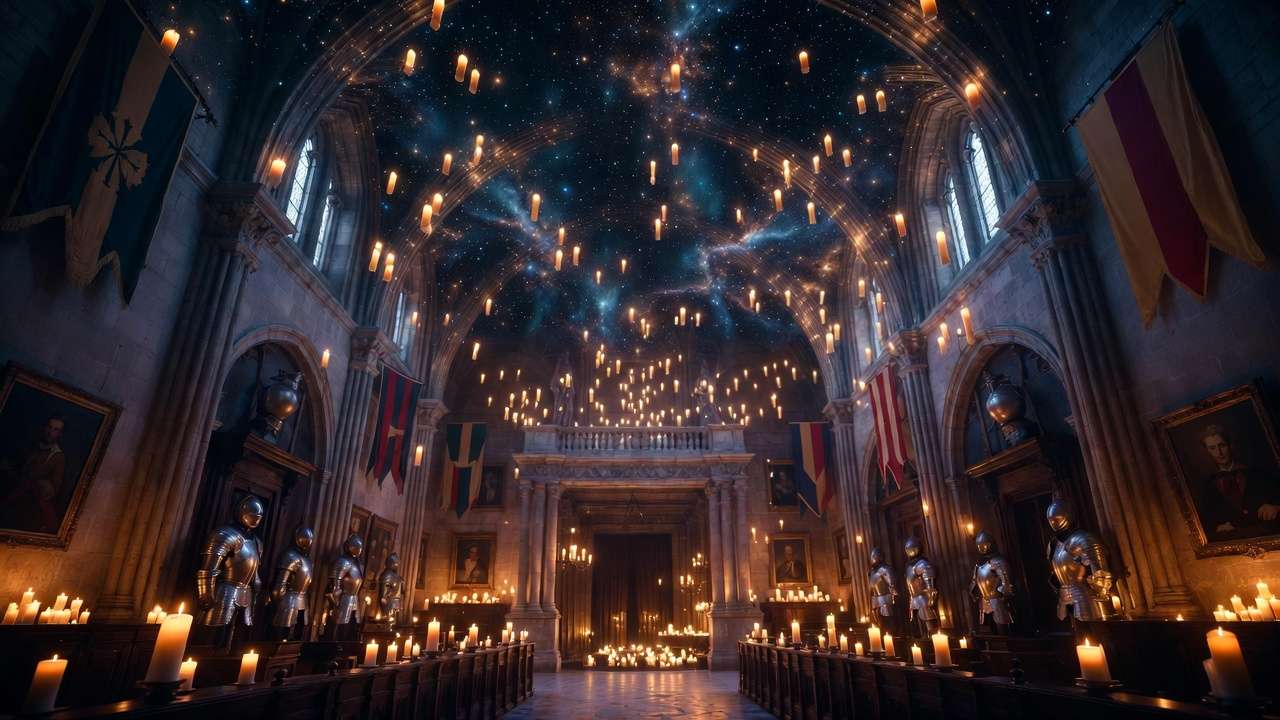
Perhaps the most famous feature is the enchanted ceiling, bewitched to reflect the exact sky outside Hogwarts at any given moment. As Hermione explains in Harry Potter and the Philosopher’s Stone, “It’s bewitched to look like the sky outside. I read about it in Hogwarts: A History.” Harry gazes up on his first night and sees a “velvety black ceiling dotted with stars,” so realistic it’s hard to believe there’s a roof at all.
The ceiling mirrors weather precisely: storms rage with lightning during thunderstorms (as seen in Goblet of Fire), sunrise glows red-gold, and clouds drift lazily on clear days. It has even displayed enchanted snow falling gently during Christmas feasts or colorful confetti for special celebrations. This charm, likely cast by Rowena Ravenclaw or a later headmaster skilled in charms, extends to other grand wizarding spaces, like the Ministry atrium.
In the films, the ceiling appears mostly at night or during dramatic weather, but the books show it in varied conditions, emphasizing its role in setting mood and time of day.
Floating Candles and Illumination
Thousands of candles hover overhead, providing soft, flickering light without dripping wax or fire hazards. These are likely charmed to levitate and self-extinguish, contributing to the Hall’s warm, timeless atmosphere. They never interfere with the ceiling’s view, floating just below it for perfect illumination.
The Four House Tables – Layout and Symbolism
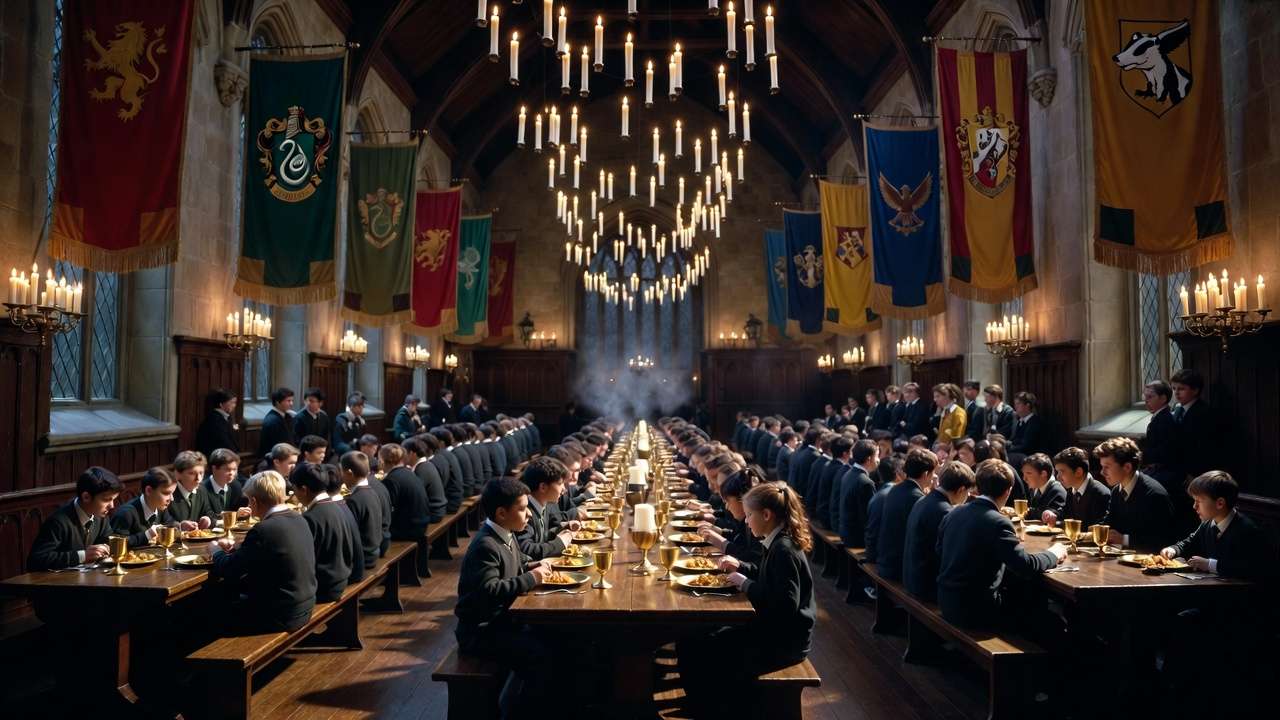
The Hall’s floor features four enormously long tables running lengthwise, one for each Hogwarts house. Students sit according to their house, fostering loyalty and rivalry while allowing inter-house interaction during meals.
Canon sources, particularly Goblet of Fire, describe the layout: entering from the Entrance Hall doors, the tables are arranged with Slytherin closest to the entrance, followed by Ravenclaw, Hufflepuff, and Gryffindor farthest away near the far wall. House banners hang above each table, displaying colors and emblems—scarlet and gold for Gryffindor, emerald and silver for Slytherin, and so on.
This arrangement symbolizes hierarchy or tradition in some interpretations, though it shifts slightly in films for cinematic needs. The tables magically fill with food prepared by house-elves in the kitchens below, disappearing just as efficiently.
The High Table (Staff Table)
Raised on a dais at the front, the High Table seats the entire teaching staff, with a throne-like chair in the center for the Headmaster or Headmistress. Dumbledore’s seat commands the room, reflecting his authority. Professors like McGonagall, Snape, and Hagrid occupy fixed spots, their presence a constant reminder of guidance and discipline.
Iconic Events and Moments in the Great Hall
The Great Hall hosts Hogwarts’ most memorable milestones, serving as both stage and witness to joy and tragedy.
The Sorting Ceremony – Where Houses Are Born
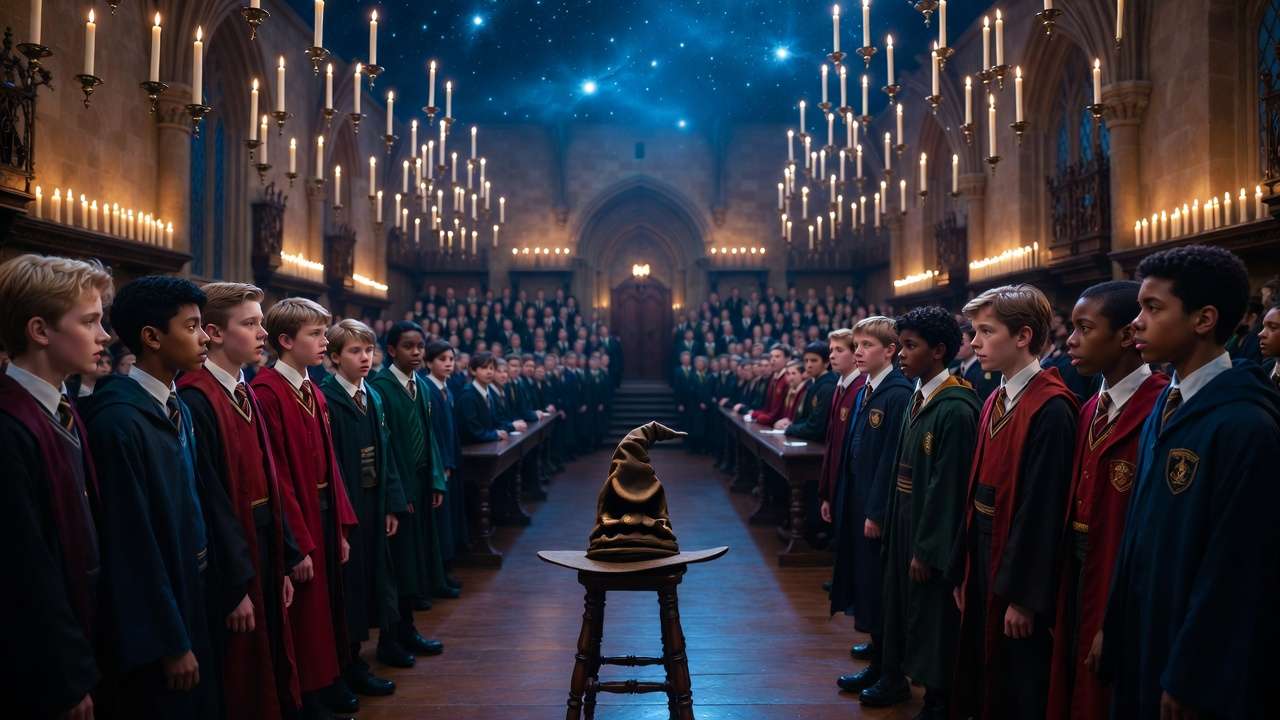
Every September 1st, first-years enter nervously for the Sorting Ceremony. The ancient Sorting Hat, placed on a stool, sings its annual song before calling names. It places students based on traits: bravery for Gryffindor, cunning for Slytherin, intelligence for Ravenclaw, loyalty for Hufflepuff. Harry’s own Sorting—agonizing minutes of internal debate—remains one of the series’ most tense moments.
Feasts and Celebrations
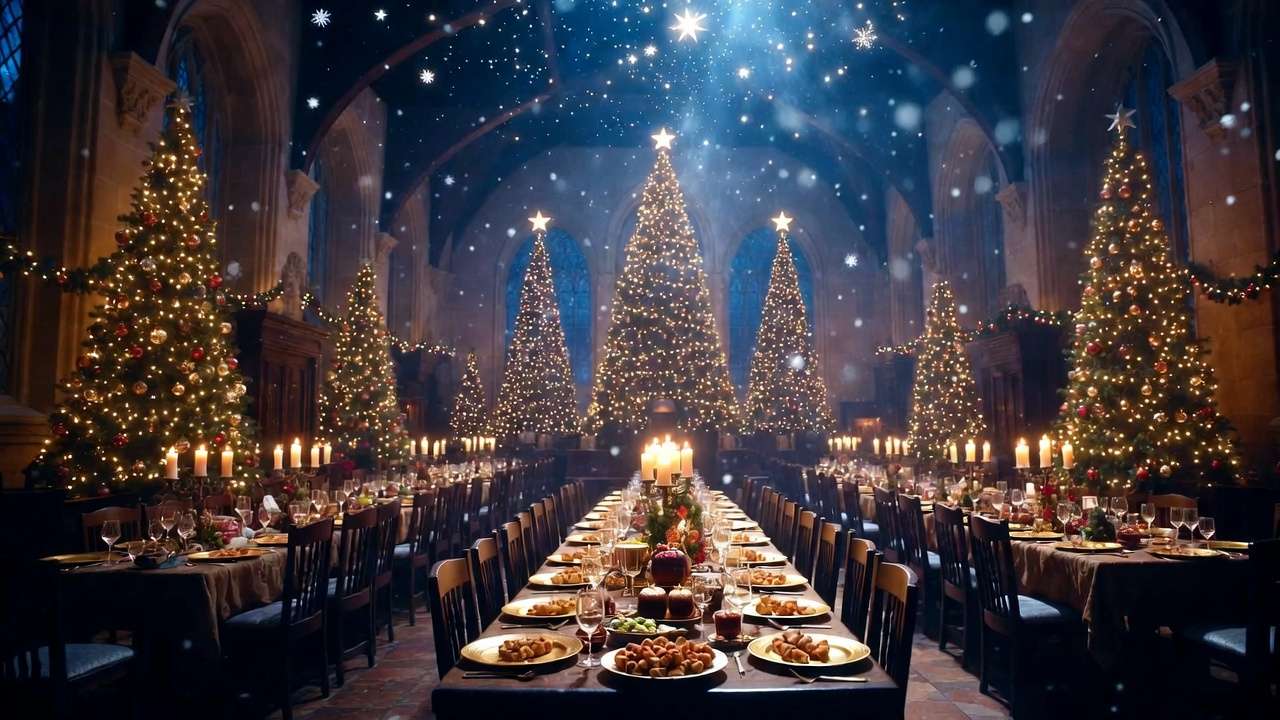
Daily meals are magical affairs: food appears on golden plates, pumpkin juice flows endlessly, and owls deliver post mid-breakfast. Special feasts transform the Hall—Halloween with live bats and jack-o’-lanterns, Christmas with twelve towering trees and enchanted snow, End-of-Year with house point awards.
Memorable ones include the troll-interrupted Halloween feast in year one, the lavish Yule Ball setup in year four, and the subdued celebrations after Quidditch victories.
The Triwizard Tournament Announcements and More
In Goblet of Fire, the Hall hosts the Goblet of Fire’s champion selection, with dramatic flames and cheers (or boos). It also serves as venue for dueling club lessons and spontaneous assemblies.
The Battle of Hogwarts – From Refuge to Battlefield
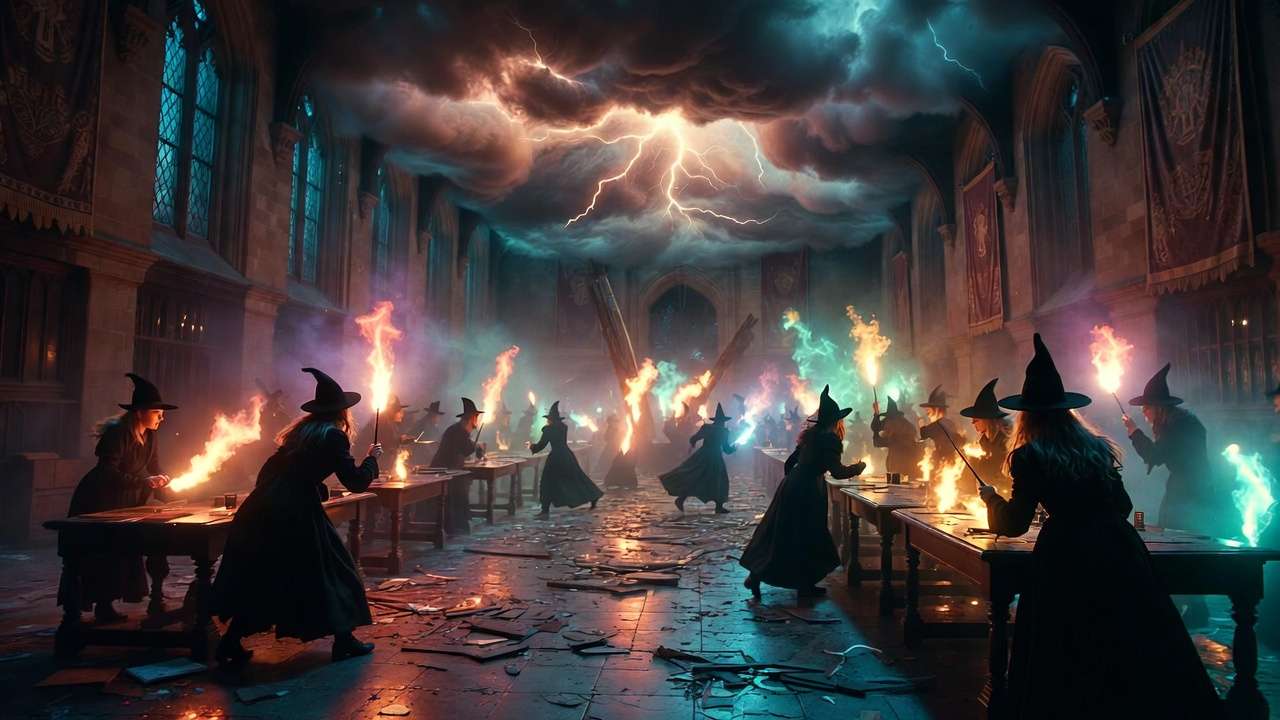
In Deathly Hallows, the Great Hall becomes the war’s epicenter. Tables are overturned for cover, students and teachers fight desperately, and Voldemort’s forces breach the castle. Molly Weasley’s iconic duel with Bellatrix (“Not my daughter, you bitch!”) ends with victory, and Harry confronts Voldemort here, defeating him once and for all. The Hall then transforms into a hospital and place of mourning, underscoring its role in the wizarding world’s darkest and brightest hours.
Book vs. Film Depictions – Key Differences
While J.K. Rowling’s descriptions in the books paint the Great Hall as a living, breathing space full of subtle magic and atmosphere, the film adaptations—produced by Warner Bros. and directed across eight movies by Chris Columbus, Alfonso Cuarón, Mike Newell, and David Yates—brought it to vivid life on screen with practical sets, visual effects, and deliberate artistic choices.
The most striking difference lies in the enchanted ceiling. In the books, it is constantly active, mirroring the sky in all conditions—blue skies during breakfast, stormy clouds during tense moments, starry nights for feasts. The films, however, tend to show it primarily at night or during dramatic weather, likely to heighten cinematic mood and because rendering a constantly changing sky across multiple daylight scenes would have been prohibitively expensive in the early 2000s VFX era. The ceiling’s first appearance in Philosopher’s Stone (2001) is breathtaking, with stars and aurora-like wisps, but later films use it more sparingly.
Table layout also varies slightly. Book descriptions place the house tables in a consistent order (Slytherin nearest the doors, Gryffindor farthest), but the films occasionally adjust camera angles and seating for better shot composition or dramatic emphasis. For example, during the Sorting Ceremony, the camera often centers Gryffindor prominently to follow Harry’s journey.
The physical set itself is one of the most impressive aspects of the film production. Built at Leavesden Studios, the Great Hall features real York stone flooring, hand-carved wooden tables that seat over 400 extras, and a 70-foot-high ceiling rigged with practical floating candles suspended on wires (later enhanced with CGI for safety and flexibility). The High Table dais was constructed with authentic medieval-inspired detailing, and the banners were hand-embroidered.
Some changes were practical: the films removed the house point hourglasses (canonically located in the Entrance Hall but referenced during Hall events) to streamline set design. Others were narrative—adding visual spectacle like the ceiling displaying the solar system in Prisoner of Azkaban (not in the book) or the dramatic lighting during Voldemort’s final confrontation.
These adaptations don’t diminish the Hall’s magic; they translate it into a visual language that has become instantly recognizable worldwide, making the set one of the most visited attractions at the Warner Bros. Studio Tour.
Secrets and Lesser-Known Facts About the Harry Potter Great Hall
Beyond the obvious wonders, the Great Hall holds subtle details and deeper symbolism that reward close reading and analysis.
- House point hourglasses connection: Although the giant hourglasses displaying house points are technically in the Entrance Hall, their presence is felt strongly in the Great Hall during End-of-Year feasts when points are dramatically awarded (or deducted). The rubies, emeralds, sapphires, and diamonds clinking into place are one of the series’ most satisfying visual rewards.
- Symbolic architecture: The Hall embodies Rowling’s recurring theme of unity versus division. The four tables sit parallel yet separate, mirroring house rivalries, but all face the same High Table—symbolizing shared authority and the potential for cooperation. The enchanted ceiling, open to the sky, represents freedom and possibility, contrasting the enclosed, protective castle walls.
- Rare magical events: The Hall has hosted unusual gatherings, such as the emergency assembly in Order of the Phoenix when Dolores Umbridge takes control, or the brief dueling club sessions in Chamber of Secrets. In Deathly Hallows, it temporarily becomes a morgue and hospital wing, showing how even the most celebratory space can adapt to tragedy.
- Food production logistics: The kitchens lie directly beneath the Great Hall, with house-elves using a complex system of dumbwaiters and apparition to send food upward. The ceiling’s charm prevents any kitchen smells or steam from interfering.
- Cultural echoes: Rowling has said the Great Hall draws inspiration from medieval great halls in British boarding schools and colleges, particularly the dining hall at Christ Church, Oxford, which served as the primary filming location reference and partial set inspiration.
These details add layers of richness, turning the Great Hall from a mere backdrop into a character in its own right.
Experiencing the Great Hall in Real Life
For fans who want to step beyond imagination, several real-world opportunities bring the Great Hall closer than ever.
Warner Bros. Studio Tour London – Step Inside the Actual Set
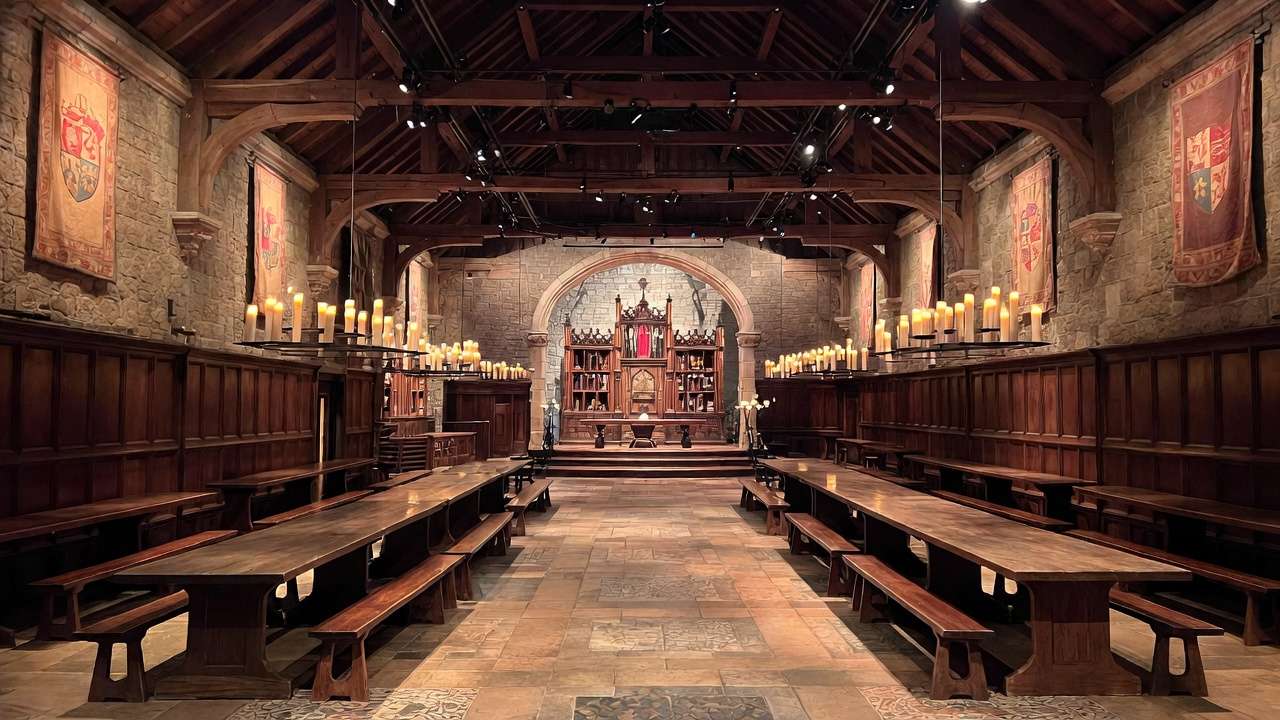
The Warner Bros. Studio Tour in Leavesden remains the gold standard. The original Great Hall set is preserved almost exactly as it appeared in the final films: real stone floor, 100-foot-long tables, floating candles rigged overhead, and the enchanted ceiling backdrop (though static for practical reasons). Visitors walk the length of the Hall, sit at the house tables, and see original costumes and props.
Seasonal events elevate the experience—Hogwarts in the Snow features a snow-covered Hall with Christmas trees and falling snow effects, while Back to Hogwarts displays floating pumpkins and autumnal decorations. It’s the closest most fans will come to attending a feast.
LEGO Harry Potter Great Hall Sets – Build Your Own
LEGO has released several impressive Great Hall sets over the years. The 2024 modular version (set 76435) includes detailed house tables, movable benches, the High Table, and a buildable enchanted ceiling section. Older sets like 75954 (2018) and the smaller 75947 (2021) allow collectors to recreate iconic scenes.
Tips for fans: Combine multiple modular Hogwarts sets for a larger display, add LED lighting kits for floating candle effects, and position the ceiling piece to catch light for a starry illusion.
Other Ways Fans Can Relive It
- Video games: Hogwarts Legacy (2023) features a faithfully recreated Great Hall with dynamic ceiling, house tables, and feast animations.
- Theme parks: The Wizarding World of Harry Potter at Universal Studios includes a Great Hall walk-through in the Hogwarts Castle ride queue, complete with projected ceiling effects.
- Fan communities: Many fans recreate the Hall in Minecraft, Roblox, or tabletop RPGs, sharing detailed builds online.
Why the Great Hall Endures as Hogwarts’ Most Iconic Location
The Great Hall isn’t just the largest room in Hogwarts—it’s the emotional center. Every major rite of passage happens here: first arrival, belonging confirmed by Sorting, friendships forged over meals, victories celebrated, and ultimate sacrifice witnessed. It represents community, wonder, and the bittersweet truth that even magic cannot shield us from loss.
For readers who feel a pang of homesickness for a school that never existed, the Great Hall offers comfort: a place where you are always welcome, where food appears when you’re hungry, and where the sky above never stops shining.
FAQs
What is the Harry Potter Great Hall enchanted ceiling made of? It’s not physically “made” of anything tangible—it’s a permanent magical charm that reflects the real sky outside, as explained in Hogwarts: A History.
How many students can the Great Hall seat? The books imply around 600–1,000 students (plus staff), based on roughly 40 students per year across four houses over seven years. The film set seated over 400 extras comfortably.
Is the Great Hall layout the same in books and films? Mostly yes, but the films adjust camera perspectives and occasionally table placement for dramatic effect. The core order (Slytherin near entrance, Gryffindor farthest) remains consistent.
Can you visit the real Great Hall set? Yes—at the Warner Bros. Studio Tour London, where the original film set is permanently displayed.
What happens to the Great Hall after the Battle of Hogwarts? The books end shortly after Voldemort’s defeat, with the Hall serving as a place of healing and celebration. J.K. Rowling has confirmed in interviews that Hogwarts was repaired and reopened, so the Great Hall presumably returned to its role as the heart of school life.
The Harry Potter Great Hall is far more than a dining room—it is the stage where courage is tested, friendships are sealed, and the wizarding world’s fate is decided. From its thousand-year history to the floating candles and ever-changing sky, every detail reinforces the magic of belonging.
Whether you’re rereading the series, planning a Studio Tour visit, or building your LEGO version, the Great Hall reminds us why we fell in love with Hogwarts: because in its glow, we all feel a little bit magical.
What is your favorite Great Hall moment—your Sorting, a Christmas feast, or the final battle? Share in the comments below, and explore more deep dives into Hogwarts lore right here on the blog.