
We’ve all been there. You are settling in for a cozy movie marathon, returning to the magical halls of Hogwarts, when a sudden realization hits you. You vividly remember a specific monster terrorizing a first-year student, but the details in your memory suddenly feel a bit fuzzy. If you’ve recently found yourself searching for the Harry Potter ogre in the bathroom, you are definitely not alone. It is one of the most common search queries related to the first installment of the beloved wizarding franchise. However, it is also a massive case of collective misremembering.
The creature that crashed the Halloween feast and cornered Hermione Granger wasn’t an ogre at all; it was a fully-grown Mountain Troll.
As experts in wizarding lore, we understand exactly why this confusion happens. In this comprehensive guide, we will unpack this widespread Mandela Effect, dive deep into the specific magical lore that separates these distinct fantasy beasts, and explore exactly why this specific bathroom brawl remains one of the most critical turning points in the entire series. Prepare to upgrade your wizarding world trivia.
The Core Misconception: Was it an Ogre or a Troll?
The Exact Search Term: “Harry Potter Ogre in the Bathroom” Explained
Search data shows that thousands of fans turn to Google every month looking for the “ogre scene” in Harry Potter and the Sorcerer’s Stone (or Philosopher’s Stone for international fans). If you are one of them, there is no need to hand in your fan card. The confusion is incredibly common, and it stems from how our brains categorize fantasy archetypes over time.
When casual viewers or readers recall a massive, dim-witted, club-wielding brute, the term “ogre” is often the first word that jumps to mind. This search intent perfectly highlights a gap in casual pop-culture memory. By validating this confusion, we can look closer at the actual text and film to see how distinctly the creature was categorized by the professors and students of Hogwarts. Professor Quirrell’s infamous, dramatic entrance into the Great Hall was not to announce an ogre in the dungeons—it was a troll.
Why the “Mandela Effect” Happens in Fantasy Fandoms
The Mandela Effect—a phenomenon where a large mass of people believes an event occurred in a way it did not—thrives in the fantasy genre. Why do we misremember the Harry Potter troll as an ogre? The answer lies in the early 2000s pop culture landscape.
During the exact same era that the first Harry Potter movie was dominating theaters, audiences were heavily exposed to other massive fantasy properties. Shrek (2001) cemented the image of the green, swamp-dwelling ogre into the mainstream consciousness. Simultaneously, Peter Jackson’s The Lord of the Rings: The Fellowship of the Ring (2001) featured a massive, gray, club-wielding Cave Troll. Because these creatures share overlapping traits in the broader fantasy lexicon—immense size, low intelligence, and brute strength—the terminology simply blends together over decades. Our brains combine the “ogre” archetype with the “troll” visual, resulting in the mythical “Harry Potter ogre.”
 Mountain Trolls vs. Ogres: A Deep Dive into Wizarding Lore
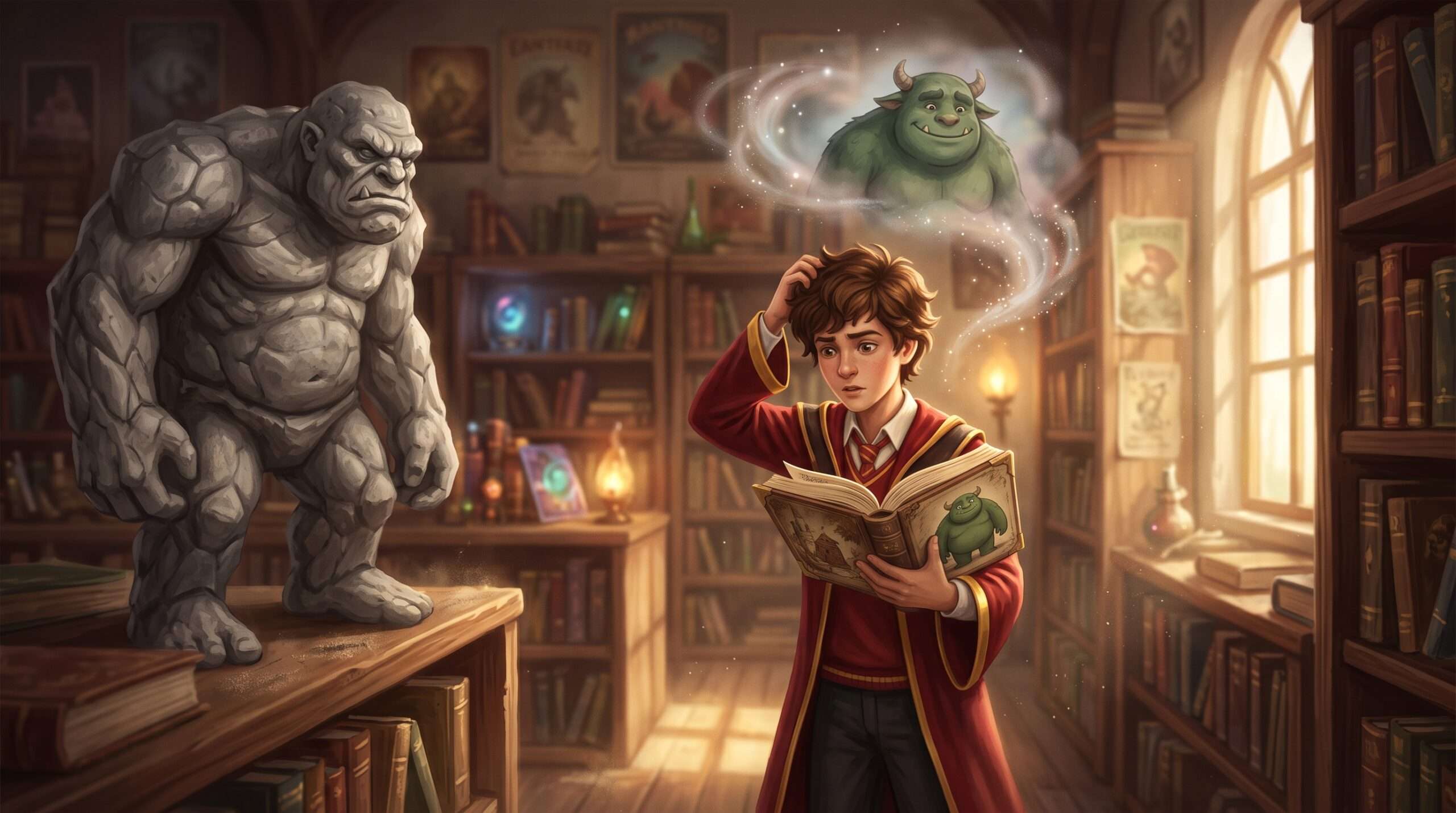
To truly understand why the creature in the girls’ lavatory was a troll and not an ogre, we must look at the specific classifications of magical creatures within the wizarding universe.
Characteristics of the Mountain Troll
In the established lore, the creature encountered by Harry Potter, Ron Weasley, and Hermione Granger is specifically a Mountain Troll. According to the foremost authorities on magical creatures in the wizarding world, trolls are highly dangerous, earning a severe threat rating from the Ministry of Magic.
The Mountain Troll is the largest and most vicious breed of troll. Key characteristics include:
-
Size and Weight: Standing at an imposing twelve feet tall and weighing over a ton.
-
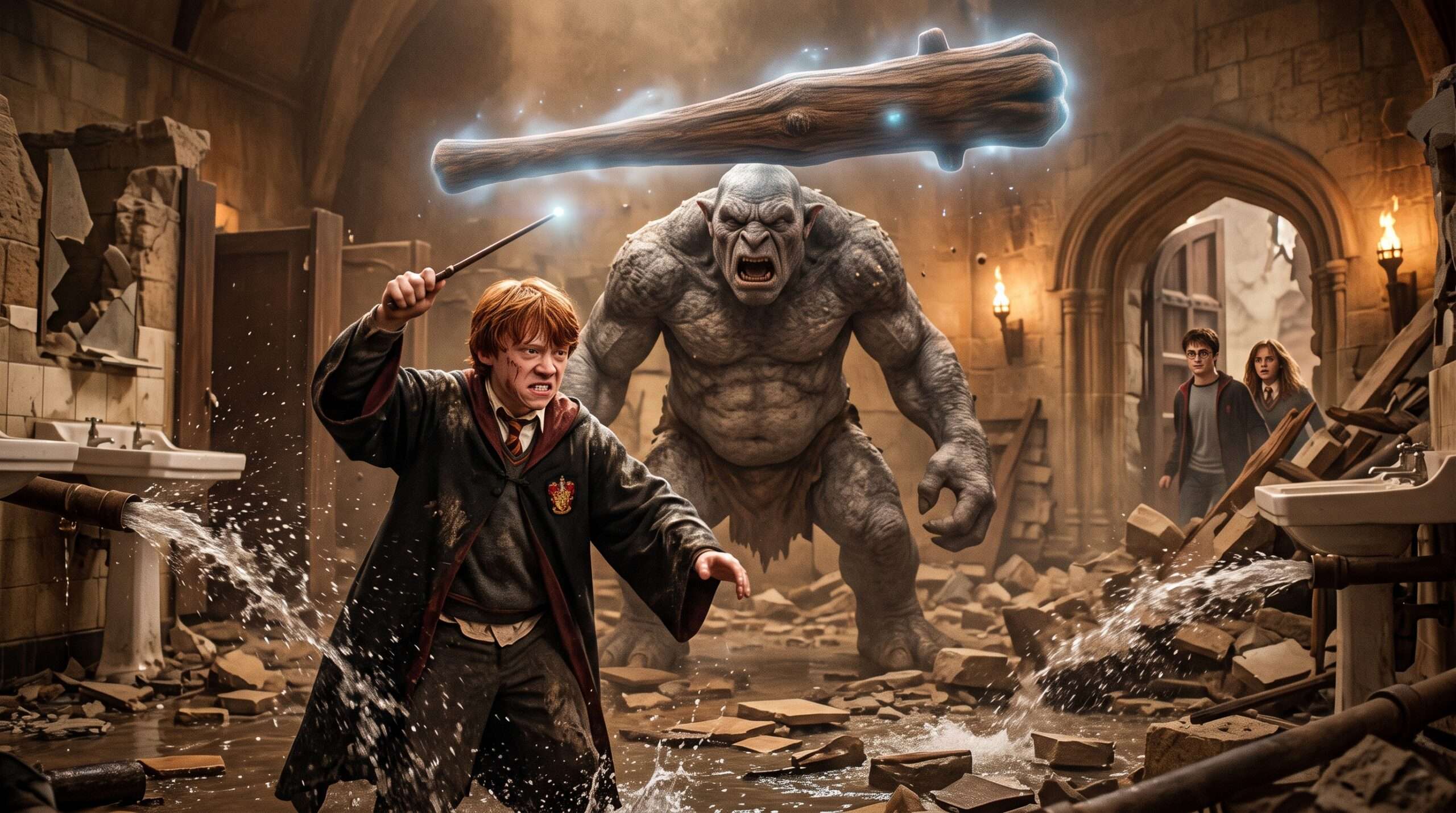
Appearance: They possess dull, granite-gray skin, a lumpy, boulder-like body, and disproportionately short, thick legs. Their heads are remarkably small compared to their massive bodies, which accurately reflects their notorious lack of intelligence.
-
Scent: One of the most defining features mentioned in the lore (and vividly experienced by the Golden Trio) is their overpowering, foul stench, often compared to a mixture of old socks and unwashed public toilets.
-
Weaponry: They typically drag massive wooden clubs, relying on sheer brute force rather than magical ability or strategy.
 What Are Ogres in Traditional Fantasy Folklore?
If the creature was a troll, what exactly is an ogre, and how does it differ? In broader European folklore and fantasy literature, an ogre is generally depicted as a large, hideous, man-like monster.
While they share the troll’s penchant for violence and massive size, ogres are typically distinct in a few key ways. They are usually far more humanoid in their proportions. Furthermore, in many mythologies, ogres possess a slightly higher degree of intelligence than trolls; they are often capable of rudimentary speech, crafting primitive armor, and cunning behavior. Trolls, particularly the Mountain Troll variant seen in the wizarding world, operate almost entirely on violent instinct.
Quick Reference: Mountain Troll vs. Folklore Ogre
| Trait | Hogwarts Mountain Troll | Traditional Fantasy Ogre |
| Average Height | 12 feet | 8 to 10 feet |
| Skin Color | Granite-gray | Varies (often green, brown, or pale) |
| Intelligence | Extremely low (instinct-driven) | Low to Moderate (capable of basic speech) |
| Weapon of Choice | Giant wooden club | Clubs, crude axes, or bare hands |
| Defining Feature | Horrendous odor, very small head | Humanoid proportions, cannibalistic lore |
Do Ogres Actually Exist in the Wizarding World?
This is where the trivia gets particularly interesting for hardcore fans. While you won’t find one smashing up the Hogwarts plumbing, ogres do technically exist within the extended Harry Potter universe. They are briefly referenced in passing in the literature. For instance, they are mentioned as native to certain parts of Britain, and references to “ogre-like” figures appear in historical magical texts. However, they are entirely absent from the main events of the books and movies, confirming that the bathroom invader was 100% troll.
Breaking Down the Iconic Bathroom Scene & Its Significance
The Catalyst: A Ruined Halloween Feast
To truly appreciate why this particular monster encounter resonates so deeply with audiences, we have to look at the masterclass in pacing and tension that leads up to it. The setting is the annual Hogwarts Halloween feast. The Great Hall is illuminated by thousands of live bats and floating jack-o’-lanterns, and the students are enjoying a lavish magical banquet. The warm, inviting atmosphere is abruptly shattered by the arrival of the Defense Against the Dark Arts teacher, Professor Quirrell.
Quirrell sprints into the hall, wildly declaring that there is a troll in the dungeons, before dramatically fainting. The ensuing panic forces Headmaster Albus Dumbledore to intervene, commanding the prefects to lead their respective houses back to their dormitories. However, in the chaos, Harry Potter and Ron Weasley realize a glaring problem: Hermione Granger is unaware of the danger. She has been crying in the girls’ lavatory all afternoon after Ron made an insensitive comment about her having no friends. This realization forces the two young Gryffindors to break away from their peers, setting the stage for the franchise’s first real life-or-death confrontation.
Forging the Golden Trio: Why This Fight Matters
From a narrative standpoint, the bathroom brawl is arguably the most pivotal moment in the first installment of the series. Before this incident, Harry, Ron, and Hermione were not the “Golden Trio” fans know and love today. Hermione was viewed by the boys as an insufferable know-it-all, and she viewed them as lazy and immature rule-breakers.
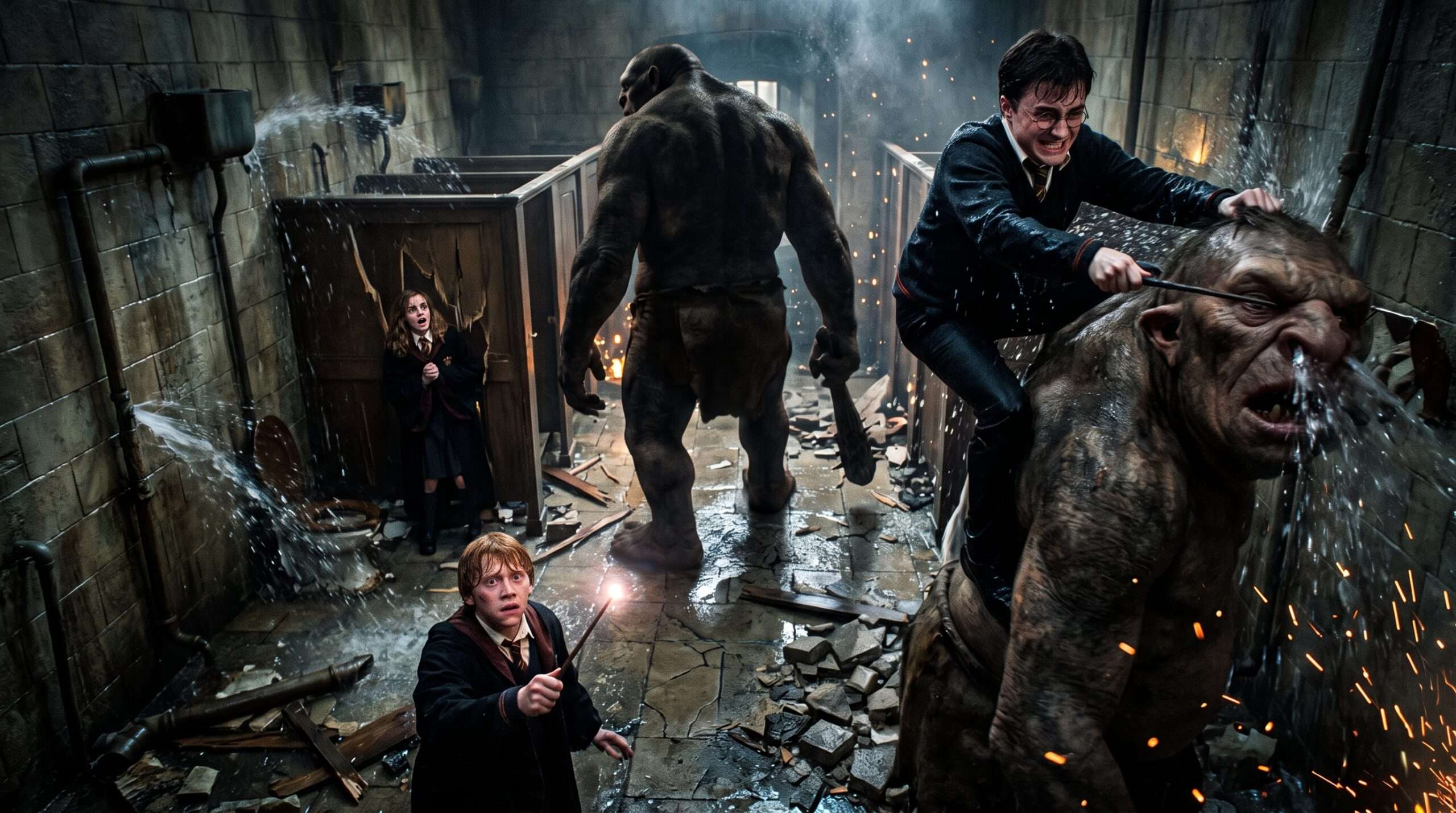
Facing down a twelve-foot Mountain Troll forces them to rely on one another. Harry exhibits exceptional bravery by jumping onto the creature’s back and shoving his wand up its nose to distract it from Hermione. Ron overcomes his crippling panic to execute a spell under extreme duress. Most importantly, when the professors finally arrive, the fiercely rule-abiding Hermione takes the blame, lying to the teachers to protect Harry and Ron. As the lore brilliantly summarizes: there are some things you cannot share without ending up liking each other, and knocking out a massive mountain troll is one of them. This single encounter cements a friendship that will ultimately save the wizarding world.
 Practical Magic: The Levitation Charm in Action
The brilliance of the scene also lies in how it seamlessly integrates classroom learning into high-stakes action. Earlier in the story, the students are taught the Levitation Charm, Wingardium Leviosa, by Professor Flitwick. During that lesson, Hermione famously condescends to Ron, correcting his wand movement (the “swish and flick”) and his pronunciation, insisting it is “Levi-O-sa, not Levio-SA.”
When the trio is cornered by the beast, brute physical force is entirely useless. Instead, Harry yells for Ron to use magic. Remembering Hermione’s instruction in a moment of pure adrenaline, Ron perfectly executes the Levitation Charm, hovering the monster’s own massive wooden club high into the air before letting it drop squarely on its skull. This moment establishes a core theme of the wizarding world: intellect, presence of mind, and fundamental magic can overcome overwhelming physical threats.
 Behind the Magic: Bringing the Scene to the Big Screen
CGI vs. Practical Effects in 2001
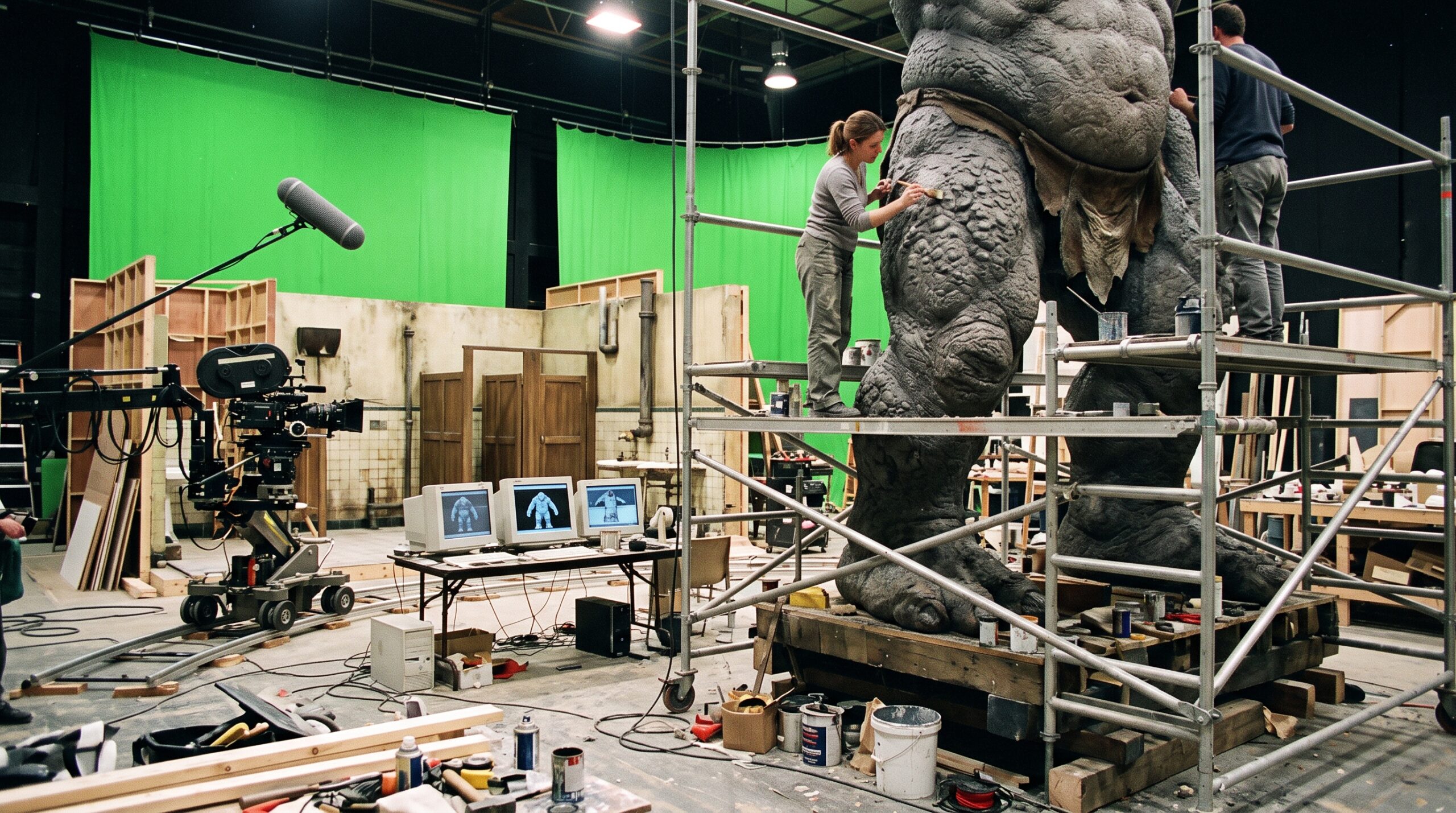
Translating this massive creature from the pages of a book to the big screen in 2001 required groundbreaking cinematic techniques. Director Chris Columbus and the visual effects team at Industrial Light & Magic (ILM) had to figure out how to make a fully computer-generated monster interact convincingly with three child actors in a physical set.
While the upper body and face of the creature were entirely CGI, the filmmakers relied heavily on practical effects to ground the scene in reality. When Daniel Radcliffe (playing Harry) had to jump on the beast’s back, he wasn’t just holding onto a green screen placeholder. The prop department built a physical, life-sized model of the creature’s massive legs and lower torso. Furthermore, the destruction of the bathroom—the shattering of the sinks, the exploding wooden stalls, and the water spraying everywhere—was largely achieved through practical rigging. This blend of early 2000s CGI and tangible, physical destruction is what makes the fight feel so incredibly dangerous and weighty.
 The Sound Design: Creating a Monster
Visuals are only half the battle when bringing a mythical beast to life; the sound design is what truly sells the terror. The audio engineering team layered multiple animalistic sounds to create the creature’s deafening, guttural roars. Furthermore, they emphasized the sheer mass of the monster through heavy, booming footsteps that visibly shake the water on the bathroom floor. By combining the high-pitched shattering of porcelain with the low-frequency, bass-heavy thuds of the monster’s club swinging through the air, the sound designers created a sensory experience that left a lasting impression on a generation of viewers.
Frequently Asked Questions (FAQs)
To further clarify the lore and answer the most pressing questions surrounding this iconic scene, here are some expert insights into the most common inquiries from fans.
Did an ogre ever appear in the Harry Potter movies?
No. While the term “ogre” is searched frequently by fans misremembering the series, a literal ogre never makes a physical appearance in any of the eight mainline films. The beasts featured in the franchise include trolls, giants, goblins, and dragons, but ogres remain relegated to background lore and brief mentions in textbooks within the universe.
What spell was used to defeat the troll in the bathroom?
The spell used was the Levitation Charm, with the incantation Wingardium Leviosa. Ron Weasley cast the spell to levitate the creature’s own club out of its hand, dropping it onto its head to knock it unconscious. The spell requires a specific “swish and flick” wand movement.
Why was the troll in the castle in the first place?
The creature did not wander into the castle by accident. It was intentionally let in by Professor Quirrell (who was sharing his body with a weakened Lord Voldemort) as a massive diversion. Quirrell hoped that while the teachers were busy dealing with the chaos in the dungeons, he could sneak up to the third-floor corridor and steal the Sorcerer’s Stone.
Why couldn’t the teachers find the troll before it found Hermione?
Professor Quirrell announced that the beast was in the dungeons. Headmaster Dumbledore immediately dispatched the teachers to the lower levels to intercept it. However, the creature had wandered away from the dungeons and made its way up to the first floor, which is why Harry and Ron intercepted it near the girls’ lavatory before the staff could locate it.
The internet is filled with fascinating pop culture mysteries, and the case of the Harry Potter ogre in the bathroom is a prime example of how shared memories can evolve over time. While it is easy to see how decades of overlapping fantasy tropes from Shrek to The Lord of the Rings could trick our brains into swapping a troll for an ogre, the lore itself remains crystal clear.
The creature that brought Harry, Ron, and Hermione together was a twelve-foot, incredibly foul-smelling Mountain Troll. Understanding this distinction doesn’t just correct a simple trivia mistake; it enriches our appreciation of the meticulously crafted magical classifications that make this universe so immersive. The next time you sit down for a franchise marathon, you can watch that iconic Halloween scene with the keen eye of a true Magizoologist.