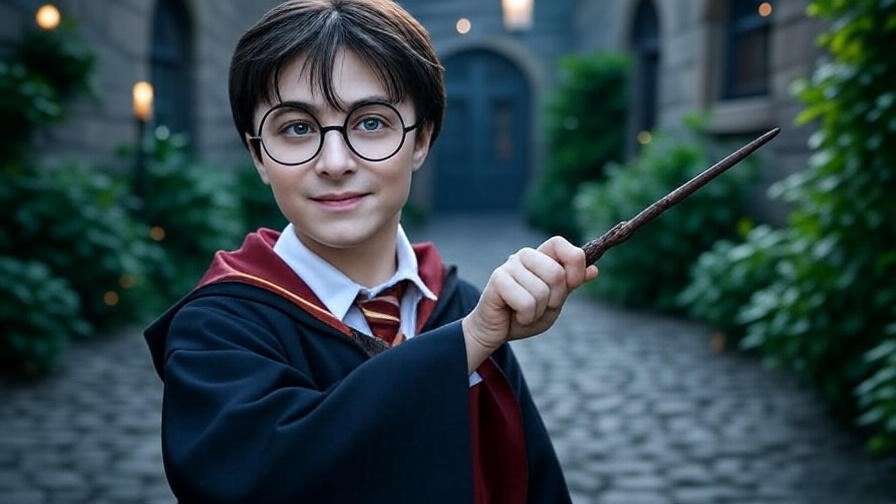
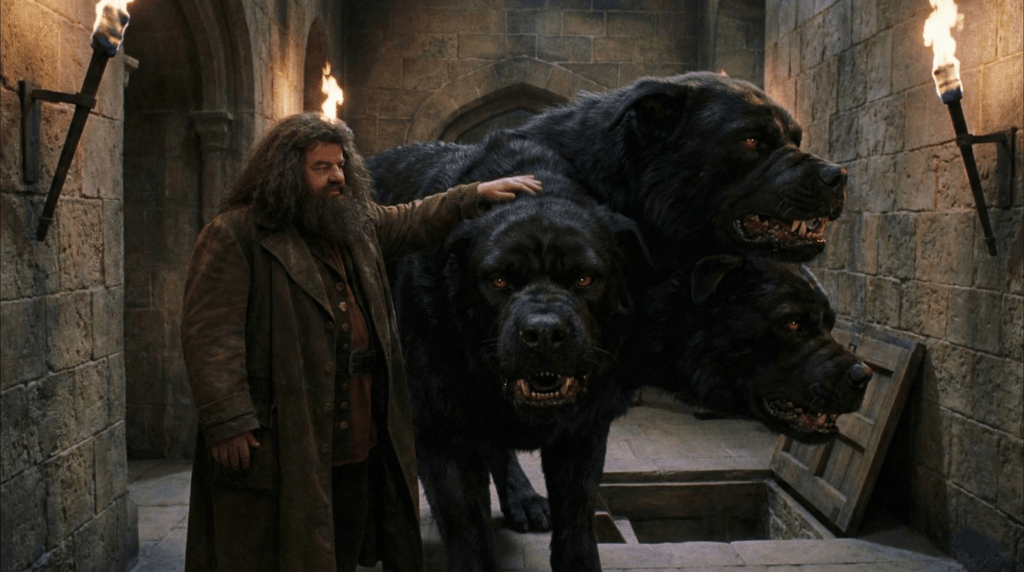
Imagine opening a trapdoor beneath your feet and staring straight into the drooling jaws of not one, not two, but three massive heads — each one snarling, each pair of eyes glowing with feral intelligence, and every fang longer than your forearm. That heart-stopping moment in Harry Potter and the Philosopher’s Stone when Harry, Ron, and Hermione first encounter the 3 headed dog Harry Potter fans still talk about remains one of the most unforgettable introductions to the dangers lurking beneath Hogwarts.
This enormous, slobbering beast — affectionately (and somewhat ironically) named Fluffy by Hagrid — is far more than just a scary obstacle in the first book. Fluffy represents J.K. Rowling’s brilliant fusion of ancient mythology with her modern magical world, serves as the first truly terrifying guardian in the series, and leaves fans asking the same question more than twenty-five years later: What exactly is this three-headed dog, where did he come from, and what happened to him after that fateful year?
In this in-depth guide, we’ll explore everything you need to know about Fluffy — his mythological origins, his pivotal role in Philosopher’s Stone, the clever ways Rowling adapted the legend of Cerberus, the differences between book and film portrayals, his canonical fate, and his lasting legacy in Harry Potter fandom. Whether you’re revisiting the series for the hundredth time or discovering the wizarding world for the first time, this comprehensive article will answer every question you’ve ever had about the 3 headed dog Harry Potter phenomenon.
Who (or What) Is the 3 Headed Dog in Harry Potter?
Meet Fluffy — Hagrid’s Giant, Multi-Headed Beast
From the moment the trio stumbles into the forbidden third-floor corridor, Fluffy is described in unforgettable detail. In the book, J.K. Rowling writes:
“It was… a monstrous dog, a dog that filled the whole space between ceiling and floor. It had three heads, three pairs of rolling, mad eyes; three noses, twitching and quivering; three drooling mouths, saliva hanging in glistening ropes.”
This isn’t a regular dog scaled up — it’s a creature of nightmare proportions, roughly the size of a small elephant, covered in thick black fur, with legs thick as tree trunks. Yet despite his terrifying appearance, Fluffy displays surprising personality traits. He’s fiercely loyal to Hagrid, responds to music, and even shows a certain playfulness when not on guard duty.
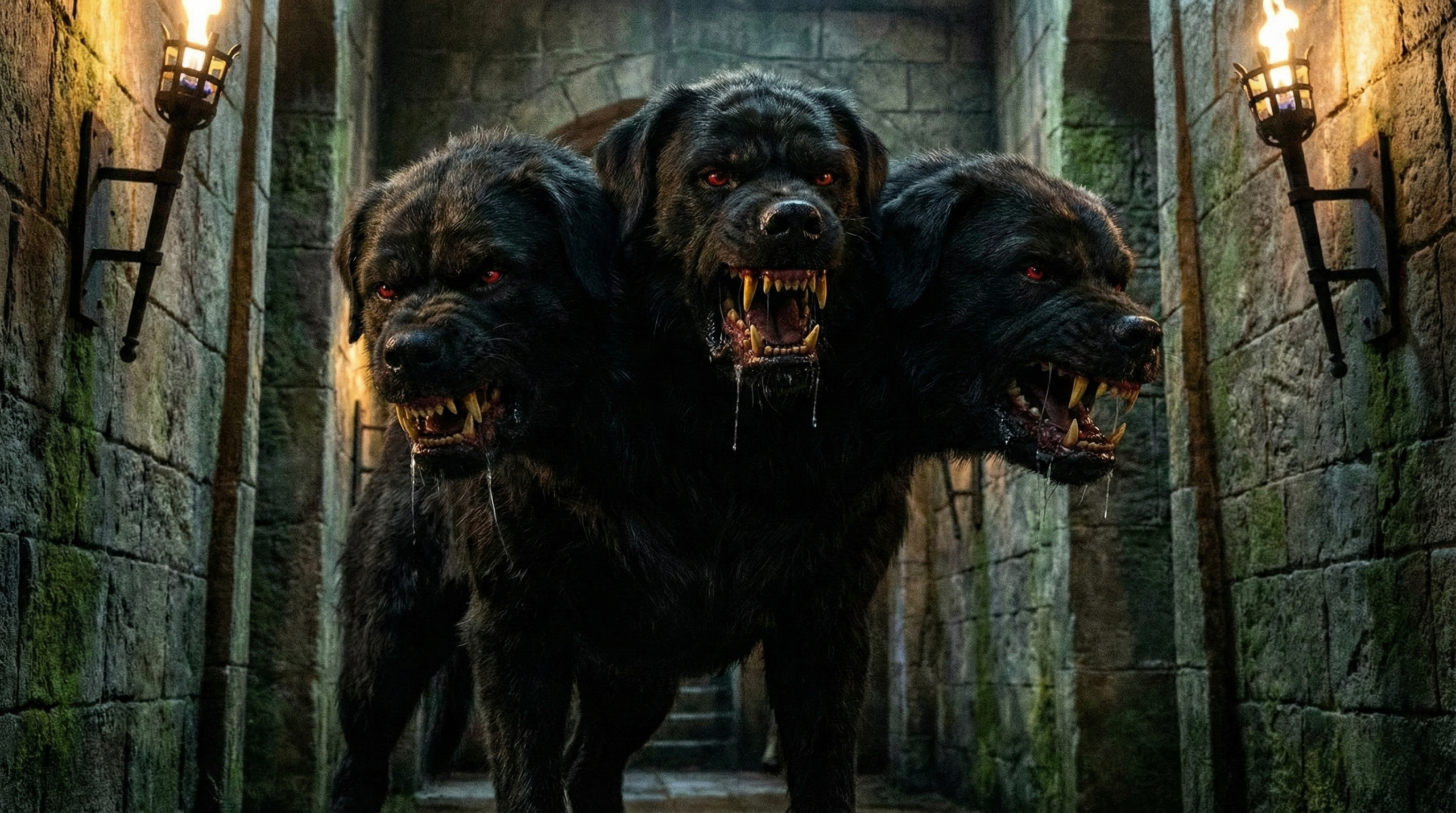 Hagrid himself acquired Fluffy through somewhat questionable means. In the book, he casually mentions picking him up from “a Greek chappie I met in the pub last year.” The film adaptation changes this line to “an Irish feller,” likely to make the origin sound slightly less exotic to American audiences. This small discrepancy actually highlights an important detail: Fluffy is explicitly a foreign magical creature, not native to Britain, which ties directly into his mythological heritage.
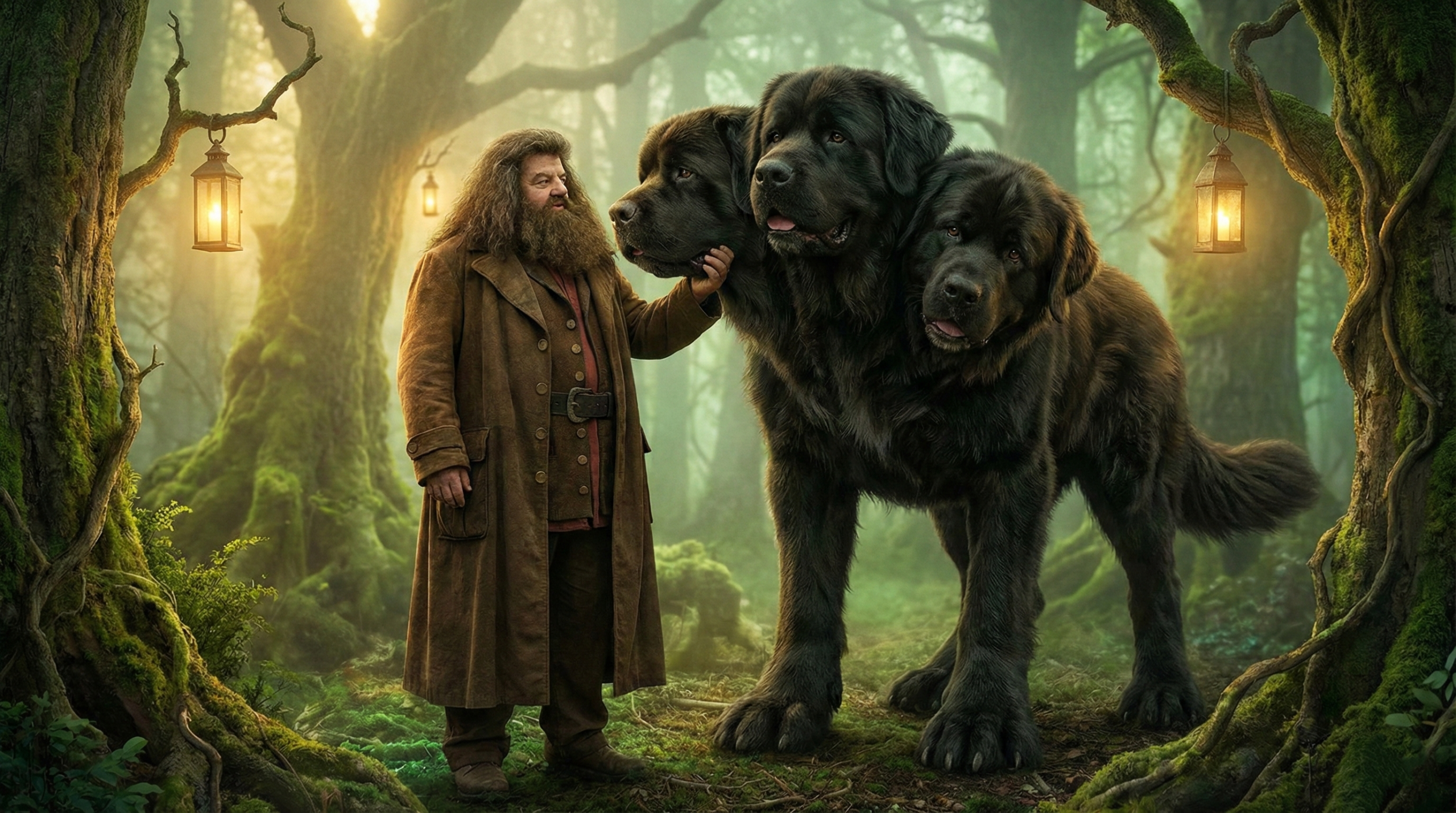
Interestingly, Hagrid’s habit of keeping extremely dangerous creatures as pets is already well-established by this point. He owns a dragon egg, keeps giant spiders, and later adopts a hippogriff and an acromantula colony. Fluffy fits perfectly into Hagrid’s pattern: massive, misunderstood, and capable of great affection toward the half-giant gamekeeper.
Fluffy’s Surprising Weakness: Music Lulls Him to Sleep
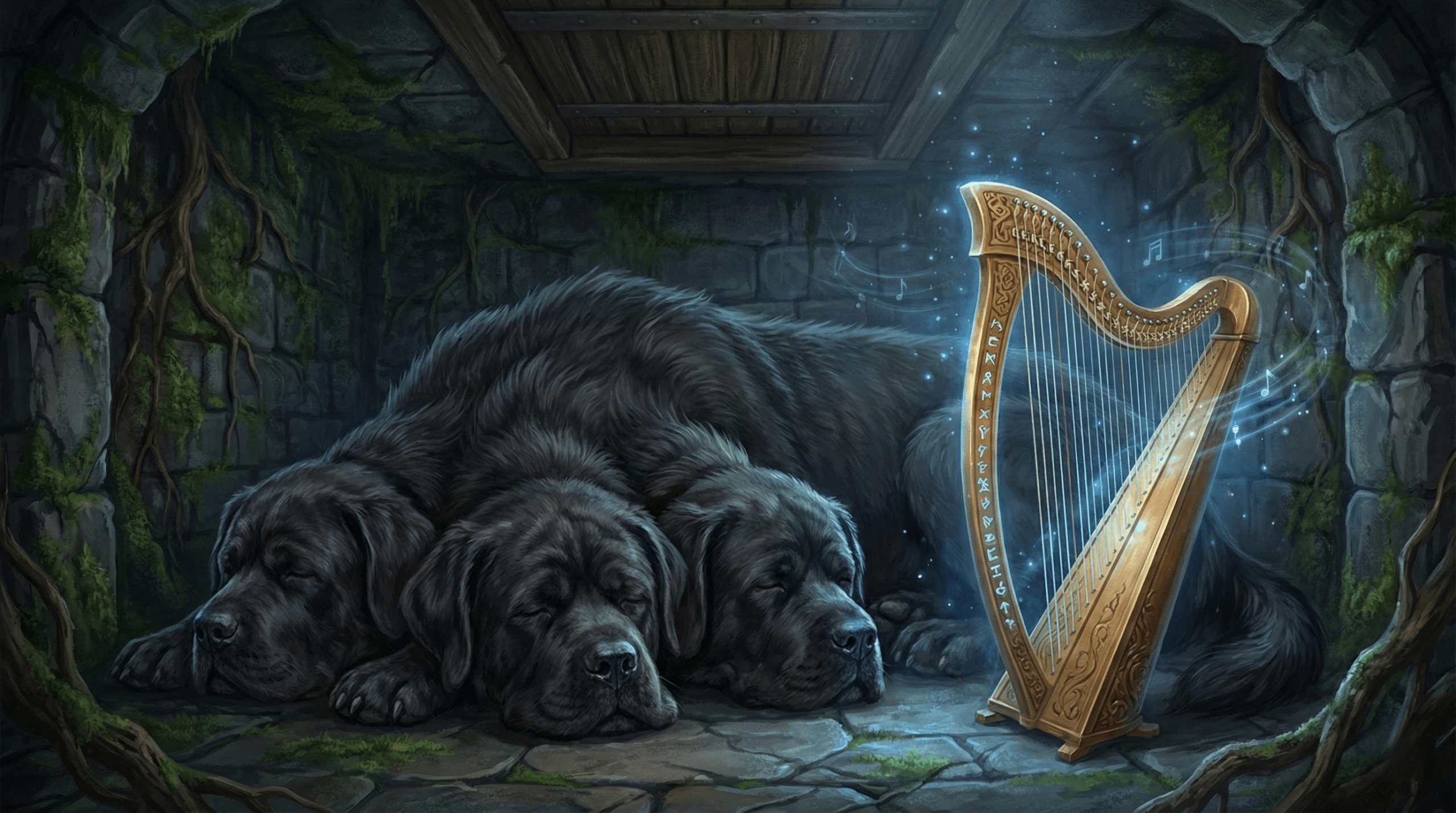
One of the most ingenious elements of Fluffy’s design is his Achilles’ heel — music.
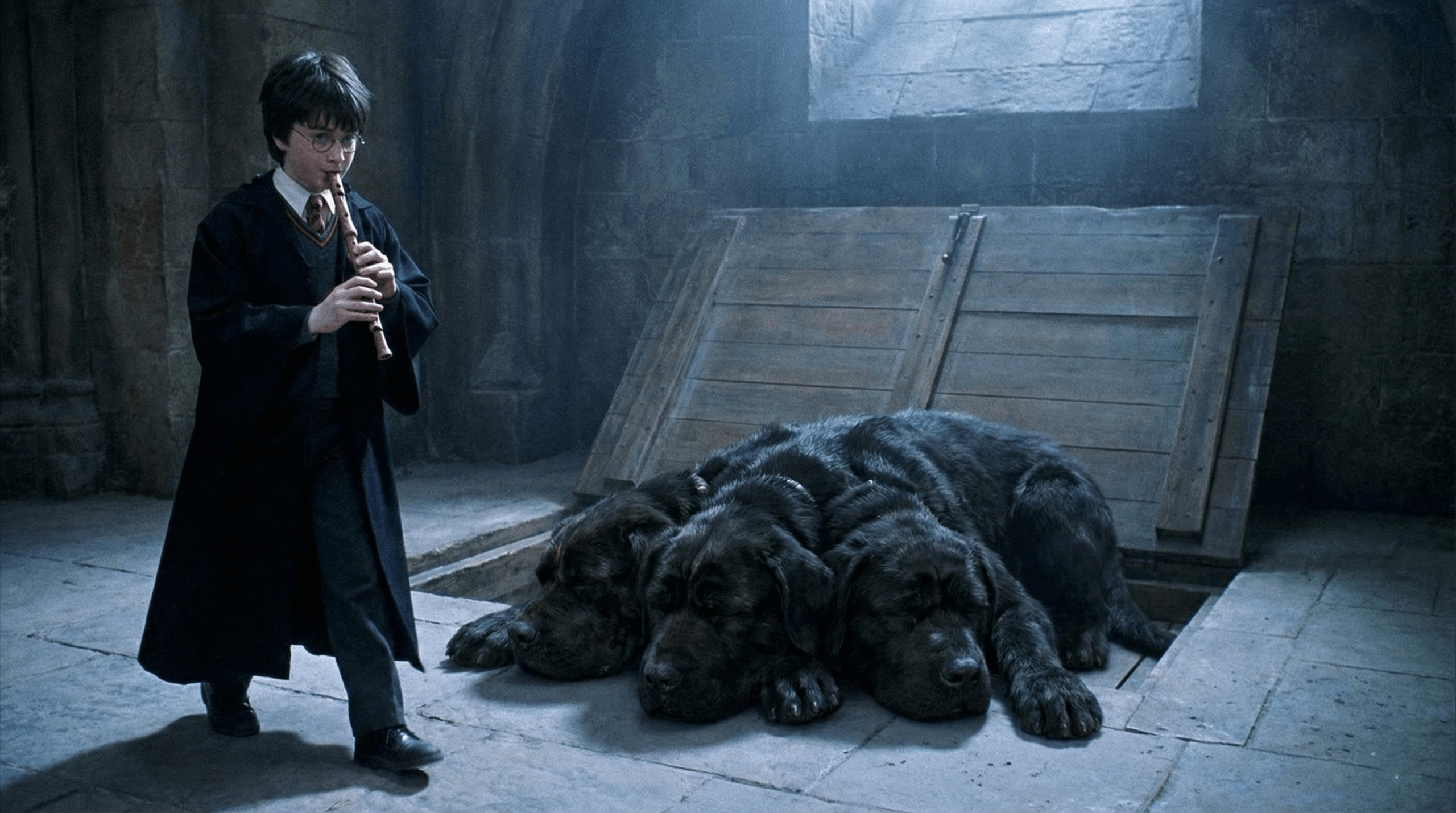
In the book, Harry plays a wooden flute he received for Christmas, sending the three heads gradually into a deep, snoring slumber. In the film, an enchanted harp plays itself, achieving the same effect. This vulnerability is not random; it is a deliberate nod to the ancient Greek myth of Cerberus, who was similarly soothed by Orpheus’s lyre.
This musical weakness serves multiple narrative purposes:
- It gives the eleven-year-old protagonists a realistic chance of success
- It reinforces the theme that knowledge (in this case, knowledge of mythology) is as powerful as raw magic
- It creates one of the series’ most memorable visual and auditory moments
The fact that something as gentle as a lullaby can tame a monster the size of a house perfectly encapsulates Rowling’s recurring theme: even the most fearsome creatures can have a softer side.
 The Mythological Roots — Fluffy as a Modern Cerberus
Cerberus in Greek Mythology: The Original Three-Headed Guardian
The three-headed dog is instantly recognizable to anyone familiar with Greek mythology as Cerberus, the monstrous hound that guarded the gates of the Underworld.
According to Hesiod, Homer, and later Roman poets like Virgil and Ovid, Cerberus had three heads (sometimes fifty in earlier versions), a serpent for a tail, and snakes sprouting from his back. His primary duty was to prevent the living from entering Hades and the dead from escaping.
Several famous myths feature heroes overcoming Cerberus:
- Orpheus charmed the beast to sleep with his lyre so he could retrieve Eurydice
- Hercules captured Cerberus as his twelfth labor, dragging him to the surface world
- Psyche distracted him with honey cakes during her quest
 Fluffy is a direct, intentional homage. Rowling even places him underground (beneath Hogwarts), guarding something immensely valuable — the Philosopher’s Stone — much like Cerberus guarded the entrance to the realm of the dead.
How J.K. Rowling Cleverly Adapted the Myth
Rowling doesn’t simply copy Cerberus; she adapts him brilliantly for a children’s adventure story while preserving the core elements that make the myth enduring:
- Guarding a threshold — Cerberus protects the boundary between life and death; Fluffy protects the path to the Stone (and, symbolically, to Voldemort’s return)
- Musical vulnerability — the same weakness that allowed Orpheus to pass is used by three first-year students
- Greek origin — Hagrid’s “Greek chappie” line is no throwaway detail; it explicitly connects Fluffy to ancient Greece
Rowling also adds a layer of whimsy that the ancient myth lacks. Cerberus is pure terror; Fluffy is terrifying but also comically named and ultimately harmless when properly handled.
Other Mythological Three-Headed Creatures in Harry Potter Lore
While Fluffy is the most prominent, the wizarding world includes other nods to multi-headed beasts:
- The Hydra is referenced in Fantastic Beasts lore
- The Chimera appears in Quidditch Through the Ages as an extremely dangerous creature
- The Runespoor, a three-headed snake from Africa, appears in Fantastic Beasts and Where to Find Them
These creatures reinforce the idea that multi-headed monsters are rare, ancient, and extraordinarily dangerous — making Fluffy’s presence at Hogwarts even more remarkable.
Fluffy’s Role in Harry Potter and the Philosopher’s Stone
The Forbidden Corridor Encounter — How Harry, Ron, and Hermione First Met Fluffy
The introduction of the three-headed dog is perfectly paced for maximum impact. Early in the school year, Harry, Ron, and Hermione are fleeing from Filch after a disastrous attempt to practice Quidditch at night. In their panic, they dash through the third-floor corridor — a place Dumbledore explicitly warned students to avoid.
What they find is pure terror:
“It was a three-headed dog… The dog’s jaws opened wide in a snarl, and a long, slimy tongue lolled out of each mouth.”
The creature’s sheer size and ferocity immediately establish the stakes: Hogwarts is not just a school of wonder; it is also a place of genuine, life-threatening danger. The trio barely escapes when the door slams shut behind them, but the encounter plants the first real seed of mystery.
This moment also serves as a brilliant character introduction for each member of the trio:
- Harry’s instinctive bravery (he’s the first to notice the trapdoor)
- Ron’s fear of spiders (foreshadowing his later arachnophobia)
- Hermione’s quick thinking (she’s already piecing together why such a creature would be at school)
The Climactic Trial — Getting Past the 3 Headed Dog
The second, and far more deliberate, encounter with Fluffy comes during the final trials to reach the Philosopher’s Stone.
By this point, the trio has deduced that Fluffy is guarding something important — and that Snape (they believe) is trying to steal it. Armed with knowledge from Hagrid and a bit of musical talent, they return to the forbidden corridor.
The sequence is one of the most satisfying set-pieces in the entire series:
- The music solution — Harry plays the flute (or the harp plays itself in the film), causing all three heads to droop and eventually snore.
- The leap of faith — They jump through the trapdoor, landing in the Devil’s Snare.
- Teamwork under pressure — Hermione’s knowledge, Ron’s chess mastery (coming later), and Harry’s courage all prove essential.
Fluffy is not defeated through combat or spells — he’s bypassed through cleverness and preparation. This reinforces one of the core messages of the series: brains and friendship can overcome even the most terrifying obstacles.
 Book vs. Movie Differences: Which Version Is Scarier?
The book and film portrayals of Fluffy differ in several key ways, and fans continue to debate which is more effective.
| Aspect | Book Version | Film Version | Which is more effective? |
|---|---|---|---|
| Origin | “A Greek chappie I met in the pub” | “An Irish feller” | Book — stronger mythological tie |
| Music source | Harry plays a wooden flute | Self-playing enchanted harp | Film — more magical, atmospheric |
| Appearance | Described in vivid, grotesque detail | CGI three-headed dog, drooling, massive | Tie — both terrifying in their mediums |
| Behavior | Snarling, drooling, clearly vicious | Growling, lunging, but slightly cartoonish | Book — more primal fear |
| Aftermath | Hagrid mentions plans to set him loose | No mention of fate | Book — gives more closure |
Many fans argue the book version feels scarier because of the raw, unfiltered description and the implication that Hagrid casually brought a mythical monster into a school. The film, however, delivers one of the most iconic visual moments of the entire franchise — the slow reveal of the three heads rising in unison.
What Happened to Fluffy After the Philosopher’s Stone?
Immediate Aftermath — Release into the Forbidden Forest?
After the Stone is destroyed and the threat ends, Fluffy’s future becomes uncertain. Hagrid initially seems unconcerned — he even jokes about setting the dog loose in the Forbidden Forest.
However, J.K. Rowling has since clarified that this was never a serious plan.
The Official Canon Fate — Repatriated to Greece
In various interviews and statements (including on the old Pottermore site and in a 2005 BBC interview), Rowling confirmed Fluffy’s ultimate fate:
“Dumbledore sent him back to Greece. He’s back with his original owner, or at least back in his native habitat.”
This decision makes perfect narrative and world-building sense:
- Magical Creature Regulation likely prohibits keeping such a dangerous beast in Britain long-term
- Fluffy’s Greek origin ties him to the land of his mythological inspiration
- It provides closure without killing off a beloved (if terrifying) creature
The repatriation also fits Dumbledore’s character: pragmatic, compassionate toward magical creatures, and unwilling to let Hagrid keep something that could endanger students.
Fluffy in Later Canon and Fan Theories
Fluffy is never mentioned again in the main series after Philosopher’s Stone, which is somewhat surprising given Hagrid’s attachment to dangerous animals.
This absence has spawned several popular fan theories:
- Fluffy occasionally roams the Forbidden Forest and is the source of some unexplained howling sounds
- He appears (uncredited) in the background of certain Hogwarts exterior shots in later films
- Some fans speculate he could have returned for the Battle of Hogwarts as a secret guardian (though this is pure headcanon)
While none of these are canon, they speak to how deeply Fluffy has embedded himself in the collective imagination of Harry Potter fans.
 Merch, Theme Parks, and Pop Culture Impact
Few creatures from the Harry Potter universe have achieved the same level of merchandise ubiquity and theme-park immortality as Fluffy.
Official licensed products featuring the three-headed dog include:
- Plush toys (ranging from adorable chibi versions to surprisingly detailed life-size heads)
- Funko Pop! figures (both standard and limited chase variants)
- LEGO sets recreating the forbidden corridor scene
- T-shirts, hoodies, and mugs with slogans like “Don’t Wake Fluffy” or “Three Heads Are Better Than One”
But Fluffy’s biggest real-world presence is undoubtedly at the Wizarding World theme parks.
At Universal Orlando’s Islands of Adventure (and later at Universal Studios Hollywood and Beijing), the Hagrid’s Magical Creatures Motorbike Adventure ride prominently features Fluffy. Riders encounter the massive three-headed animatronic beast multiple times — first as a roaring guardian, then (in a clever narrative twist) as a surprisingly affectionate creature who recognizes Hagrid’s motorbike and lets the riders pass.
This ride moment has become one of the most photographed and talked-about scenes in the entire Wizarding World experience, with countless fan videos capturing the exact instant the three heads rise in unison.
Fluffy has also appeared in:
- Harry Potter video games (notably Hogwarts Legacy Easter eggs and Harry Potter: Hogwarts Mystery)
- Various stage productions and live events
- Countless pieces of fan art, cosplay, and Halloween costumes
Why Fans Still Love (and Fear) the 3 Headed Dog
Fluffy occupies a special place in the Harry Potter emotional landscape.
He represents several powerful ideas at once:
- The first real proof that the wizarding world contains genuine, primal danger
- A reminder of Hagrid’s enormous heart and questionable judgment
- The perfect blend of terror and whimsy that defines the early books
- A symbol of childhood wonder — that thrilling mixture of being scared and knowing you’re safe because the grown-ups (and music) have it under control
Many adult fans now say that Fluffy was the creature that first made them truly believe in the magical world’s darker edges. He’s not a villain, not a misunderstood victim like some later creatures — he’s simply a force of nature doing his job, and that simplicity makes him enduringly memorable.
Frequently Asked Questions About the 3 Headed Dog Harry Potter
Is Fluffy based directly on Cerberus? Yes — J.K. Rowling has openly acknowledged that Fluffy is her version of Cerberus, the three-headed hound of Hades. She kept the core elements (three heads, guarding a threshold, vulnerability to music) while adding Hagrid’s personality and a more child-friendly tone.
Why the name “Fluffy” for such a terrifying creature? Hagrid’s habit of giving ridiculously gentle names to extremely dangerous animals is one of his most endearing (and dangerous) character traits. Examples include Norbert the Norwegian Ridgeback dragon, Aragog the giant acromantula, and Fang the massive boarhound. “Fluffy” is the perfect ironic contrast to the beast’s appearance.
Could Fluffy have returned in later books or movies? There’s no canonical evidence he ever came back to Hogwarts. Rowling’s statement about him being returned to Greece appears to be definitive. However, fans love theorizing about secret cameos or a surprise appearance during the Battle of Hogwarts.
Are there real three-headed dogs in mythology outside of Greece? Multi-headed canines appear in several mythologies, though three heads are most famously Greek. Slavic folklore has the three-headed Zmey Gorynych (more dragon than dog), and some interpretations of the Hindu Sharvara describe a multi-headed guard dog of Yama’s realm. None are as iconic or directly comparable as Cerberus.
How would you “tame” a creature like Fluffy in real life? Purely hypothetically — and for entertainment purposes only — the canonical answer is music. A powerful lullaby, harp, or even a well-played flute might do the trick. In real-world animal behavior terms, positive reinforcement, calm energy, and never startling the creature would be your best (and safest) bet!
From the moment three terrified first-years stumbled upon his slavering jaws in a forbidden corridor to his quiet repatriation back to the land of his mythological ancestors, Fluffy the three-headed dog remains one of the most perfectly executed creatures in the entire Harry Potter series.
He’s terrifying, funny, memorable, and strangely lovable — all at the same time. He teaches young readers (and reminds older ones) that courage, knowledge, and a little music can overcome even the most impossible obstacles.
In a franchise filled with dragons, dementors, giant spiders, and dark lords, Fluffy still stands out as the creature that first made our hearts race and our imaginations soar.
So the next time you hear a particularly haunting melody or spot a suspiciously large shadow in the corner of a dark room… just remember: if you can hear music, Fluffy might already be dozing peacefully.
Have a favorite Fluffy moment from the books, films, theme parks, or your own imagination? Share it in the comments below — we’d love to hear from fellow Potterheads!