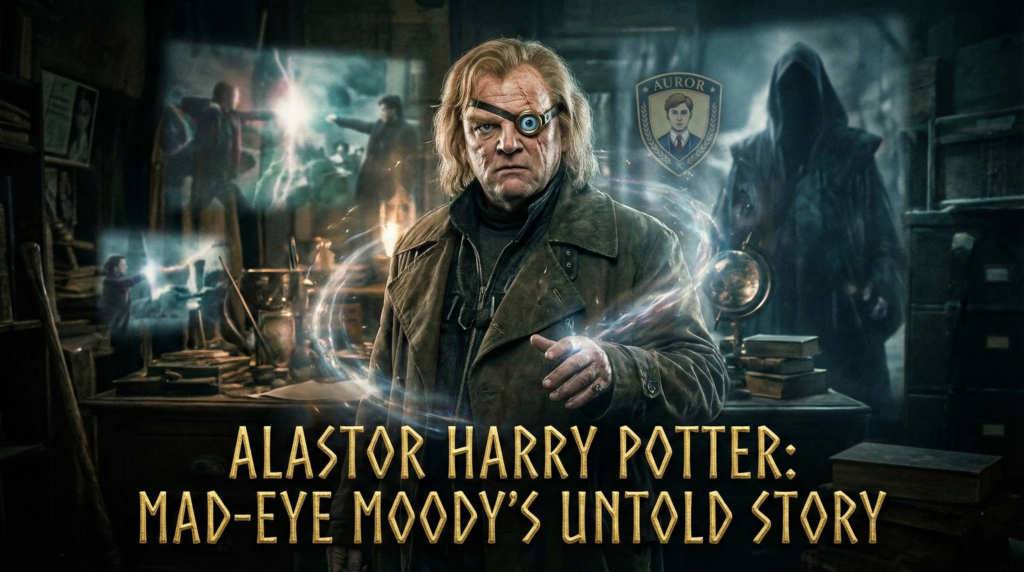
In the chaotic night skies above the skies of Little Whinging, during the desperate flight known as the Battle of the Seven Potters, one of the wizarding world‘s most formidable figures met his end. Alastor “Mad-Eye” Moody, the legendary Auror whose name struck fear into Dark wizards for decades, plummeted from his broomstick after a direct hit from Lord Voldemort’s Killing Curse. His body tumbled into the darkness below, a final sacrifice in the war against evil. This moment in Harry Potter and the Deathly Hallows shocked readers and viewers alike—not just because of the loss, but because it came after so little time truly knowing the real man behind the scars, the magical eye, and the ever-present growl of “Constant vigilance!”
Alastor from Harry Potter—the focus keyword that brings fans searching for deeper insights into this iconic character—often leads to questions about who Alastor Moody truly was. Beyond the impersonation by Barty Crouch Jr. in Goblet of Fire, beyond the brief but intense appearances in the Order of the Phoenix, Moody’s life was a tapestry of heroism, sacrifice, trauma, and unyielding dedication to fighting the Dark Arts. This comprehensive guide uncovers the untold layers of his story, from his early days as an Auror who single-handedly filled half of Azkaban to his tragic demise and enduring legacy. Whether you’re revisiting the series, exploring fan theories, or seeking to understand why his mantra resonates so deeply, this deep dive provides the clarity and value fans crave—more detailed, insightful, and canon-grounded than typical summaries.
Who Is Alastor Moody? The Man Behind the Nickname “Mad-Eye”
Alastor Moody, born sometime in the mid-20th century (likely around the 1950s, though exact dates remain unconfirmed in canon), hailed from a pure-blood family with deep ties to law enforcement. His parents were respected Aurors, instilling in him from a young age the values of justice and vigilance. Scottish roots have been suggested through various portrayals and fan analyses, fitting his rugged, no-nonsense demeanor.
 Origins and Family Background
Little is detailed about Moody’s childhood, but his early access to a family wand—possibly inherited before his Hogwarts letter—hints at a household steeped in magical tradition and Auror pride. He attended Hogwarts School of Witchcraft and Wizardry, though his house remains unrecorded in official Ministry records (leading to endless fan debates: Gryffindor for his bravery, Ravenclaw for his strategic mind, or even Slytherin for his cunning tactics against Dark wizards). After graduation, he joined the Auror Office during a time of rising Dark activity, quickly rising through the ranks due to his exceptional dueling prowess and unrelenting pursuit of justice.
How He Earned the Nickname “Mad-Eye”
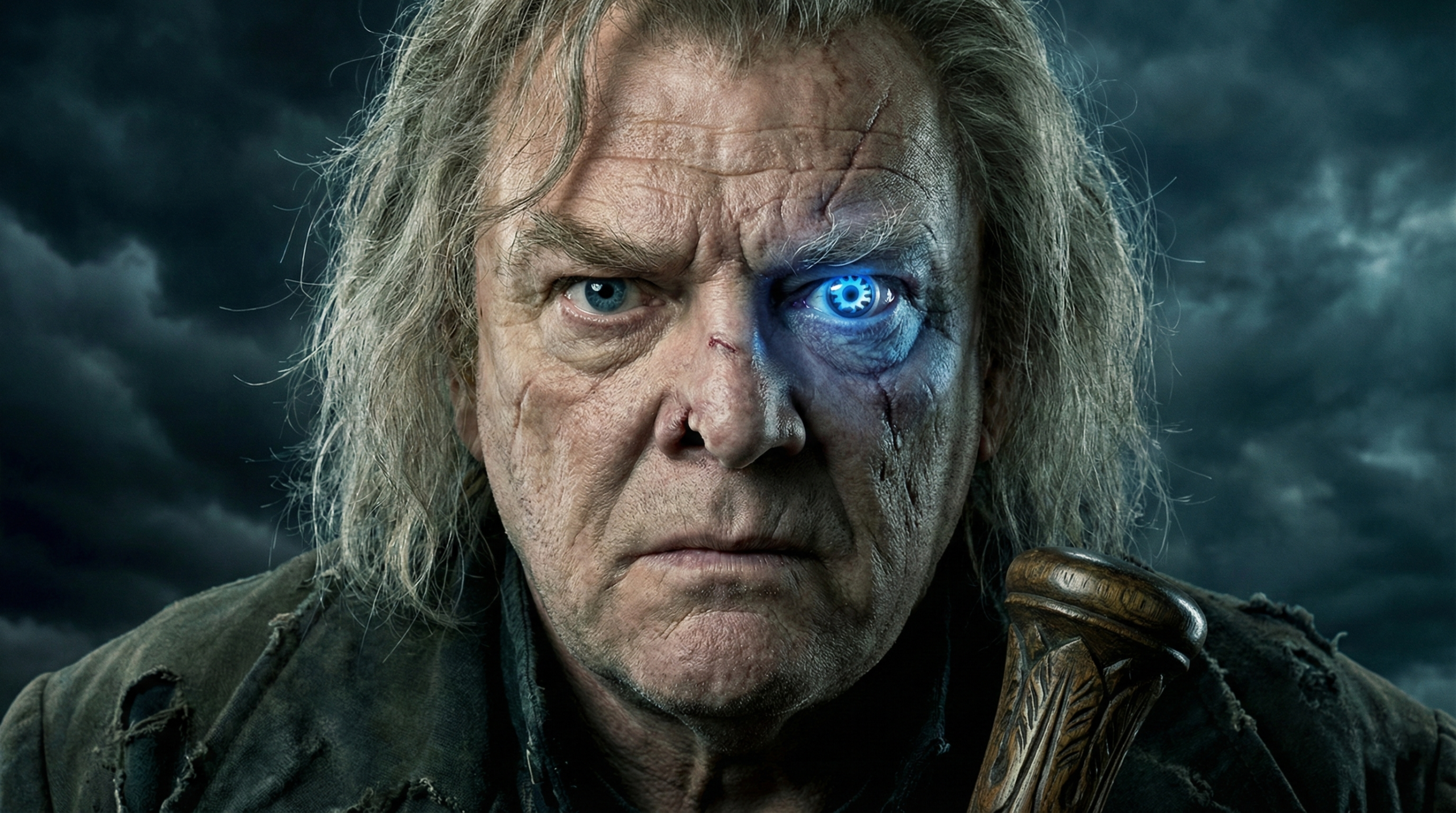
The moniker “Mad-Eye” stems directly from his most famous injury: the loss of his left eye during battles against Dark wizards. Replaced by a magical, electric-blue eye that could rotate 360 degrees, see through invisibility cloaks, walls, and most concealment charms, this prosthetic became both his greatest asset and a symbol of his sacrifices. The eye’s constant movement gave him an unnerving appearance, contributing to perceptions of madness—but in reality, it was the tool that allowed him to detect threats others missed.
Physical Appearance and Personality Traits
Moody’s body bore the marks of countless confrontations: a wooden leg, a large chunk missing from his nose, deep scars across his face, and a grizzled, limping gait. His appearance was intimidating, often described as looking like he’d been carved from weathered wood. Personality-wise, he embodied “constant vigilance”—a phrase he repeated like a mantra. This paranoia wasn’t unfounded; it was forged in the fires of the First Wizarding War, where trust could mean death. Yet beneath the gruff exterior lay a principled man: loyal to Dumbledore, protective of the innocent, and deeply moral, refusing to tolerate those who escaped justice.
His traits—ruthlessness toward Dark wizards, insistence on security measures, and refusal to drink from anything but his own hip flask—made him seem eccentric or overly suspicious to some. But as canon shows, these habits saved lives repeatedly.
Moody’s Early Career – Becoming the Greatest Auror of All Time
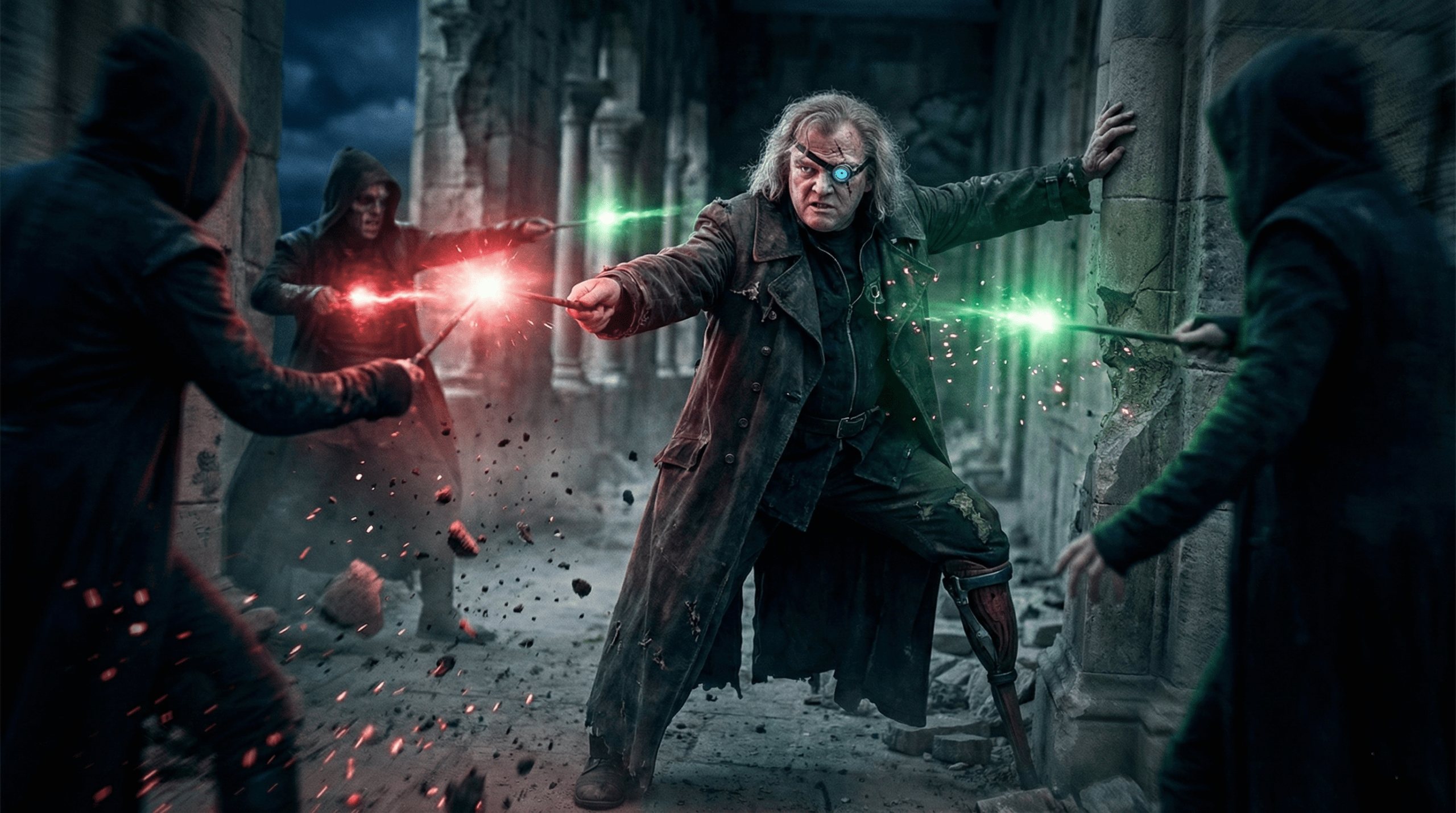
Moody’s reputation as the most famous Auror of his era wasn’t hyperbole. During the First Wizarding War, he captured numerous Death Eaters, with claims that he personally filled half of Azkaban’s cells. His methods were effective, if brutal: unmatched dueling skills, strategic use of Dark detectors (Sneakoscopes, Foe-Glasses, Secrecy Sensors), and a willingness to confront evil head-on.
 Training and Rise in the Auror Office
Entering the Auror department amid Voldemort’s rise, Moody excelled in tracking, combat, and interrogation. He mentored future stars like Nymphadora Tonks, passing on his hard-earned wisdom. His rise was meteoric, earning him respect and fear in equal measure.
Key Battles in the First Wizarding War
Moody’s campaigns involved high-risk captures, often leaving him more scarred with each victory. Losses of limbs and senses were the price paid for imprisoning threats like the Lestranges or other high-profile Death Eaters. He received an Order of Merlin, First Class, for his contributions, cementing his status as a war hero.
Recognition and Honors
Feared by enemies and revered by allies, Moody’s name became synonymous with anti-Dark wizard efforts. Even Voldemort targeted him as a significant threat.
The Impersonation Twist – Why Fans Rarely Saw the Real Moody
One of the most brilliant narrative twists in the entire Harry Potter series is the revelation in Harry Potter and the Goblet of Fire that the Alastor Moody readers had followed for nearly an entire school year was not the real Moody at all. Instead, it was Barty Crouch Jr., a loyal Death Eater, using Polyjuice Potion to impersonate him with chilling accuracy.
Barty Crouch Jr.’s Polyjuice Deception in Goblet of Fire
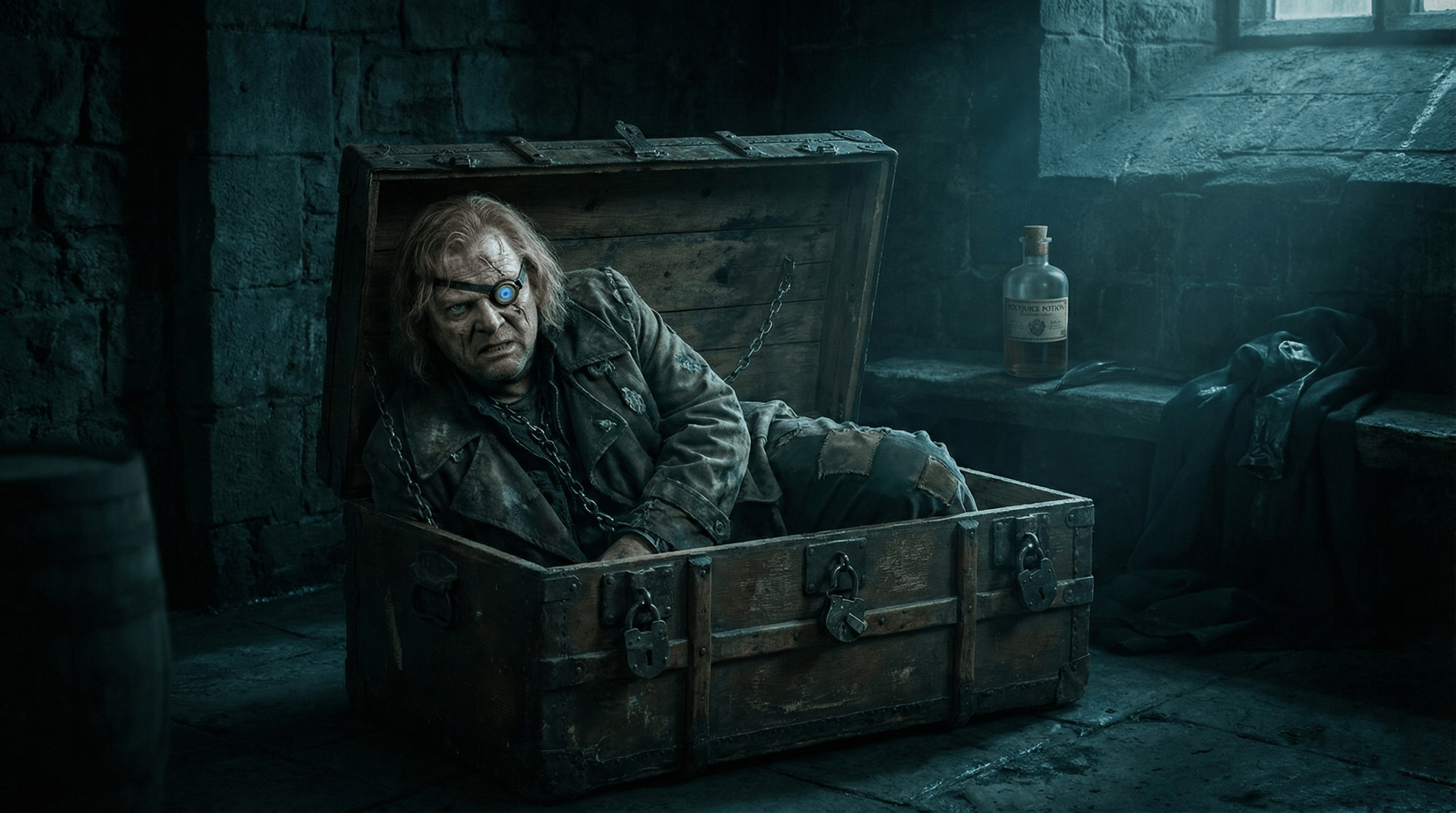
In the summer before Harry’s fourth year, Barty Crouch Jr.—with help from his father (under Imperius Curse) and Peter Pettigrew—kidnapped the real Alastor Moody from his own home. Using the advanced Polyjuice Potion brewed by Wormtail, Crouch Jr. assumed Moody’s appearance, voice, mannerisms, and even his trademark wooden leg and magical eye. The real Moody was imprisoned in a magical trunk with seven compartments, kept alive but weakened, fed only when necessary.
For almost ten months, Crouch Jr. operated under Moody’s identity. He secured the position of Defense Against the Dark Arts professor at Hogwarts through Albus Dumbledore’s trust in Moody’s reputation and the Ministry’s endorsement. This allowed Crouch Jr. to manipulate the Triwizard Tournament, place Harry’s name in the Goblet of Fire, and ensure Voldemort’s return.
Crucially, the “Moody” Harry knew was more aggressive and unhinged than the real man. He demonstrated the three Unforgivable Curses on students (including the Imperius Curse on the entire class), something the genuine Moody—who held a strict moral code against such acts—would never have done in a classroom setting.
 Impact on Harry’s Perception and the Series
This impersonation created a profound transference effect. Harry’s understanding of Moody, his lessons on constant vigilance, and even his trust in the man were built almost entirely on interactions with an impostor. When the real Moody is finally rescued at the end of Goblet of Fire, he is weak, disoriented, and furious—but he quickly proves his loyalty by standing with Dumbledore against Crouch Jr.
The twist adds layers of tragedy: the real Moody’s heroic reputation was exploited to serve Voldemort, and Harry never got the chance to form a genuine, long-term mentorship with the authentic Auror until later books.
The Real Alastor Moody Emerges – Role in the Order of the Phoenix
Once recovered, the true Alastor Moody became one of the most active and indispensable members of the reformed Order of the Phoenix.
Joining Dumbledore’s Renewed Fight
After Voldemort’s return was publicly acknowledged, Moody accepted Dumbledore’s invitation to rejoin the Order. His expertise in security and counter-espionage made him the natural choice to reinforce the protections around 12 Grimmauld Place. He installed advanced wards, Dark detectors, and insisted on constant vigilance protocols that frustrated some members but undoubtedly saved lives.
Key Moments and Contributions
Moody played critical roles in several major events:
- Escorting Harry from the Dursleys at the start of Order of the Phoenix
- Participating in the battle at the Department of Mysteries
- Training Order members and later Harry in advanced defensive magic
- Providing tactical advice and reconnaissance during missions
His presence lent weight and urgency to every meeting. Even when absent from the page, his influence—through the security measures he established—was felt constantly.
Personality Insights – Hero or Broken Man?
Here lies one of the richest aspects of Moody’s character: the tension between heroism and trauma. His paranoia was not mere eccentricity; it was survival instinct honed over decades of war. Every sip from his hip flask (to avoid being poisoned), every scan with his magical eye, every insistence on checking identities—these were rational responses to real threats.
Yet he remained deeply principled. He refused to bend his moral code, showed genuine concern for younger members like Tonks, and never hesitated to place himself in harm’s way. Moody was not broken; he was tempered by fire into something unbreakable—until the final battle.
The Tragic Fate – Death During the Battle of the Seven Potters
The night of July 27, 1997, marked the end of Alastor Moody’s long war.
The Plan and Moody’s Final Mission
To transport Harry safely from Privet Drive to a secure location, the Order devised the “Seven Potters” plan: six members would take Polyjuice Potion to resemble Harry, with seven pairs flying on broomsticks in different directions. Moody volunteered to be one of the escorts, pairing with Mundungus Fletcher disguised as Harry.
The Moment of Sacrifice
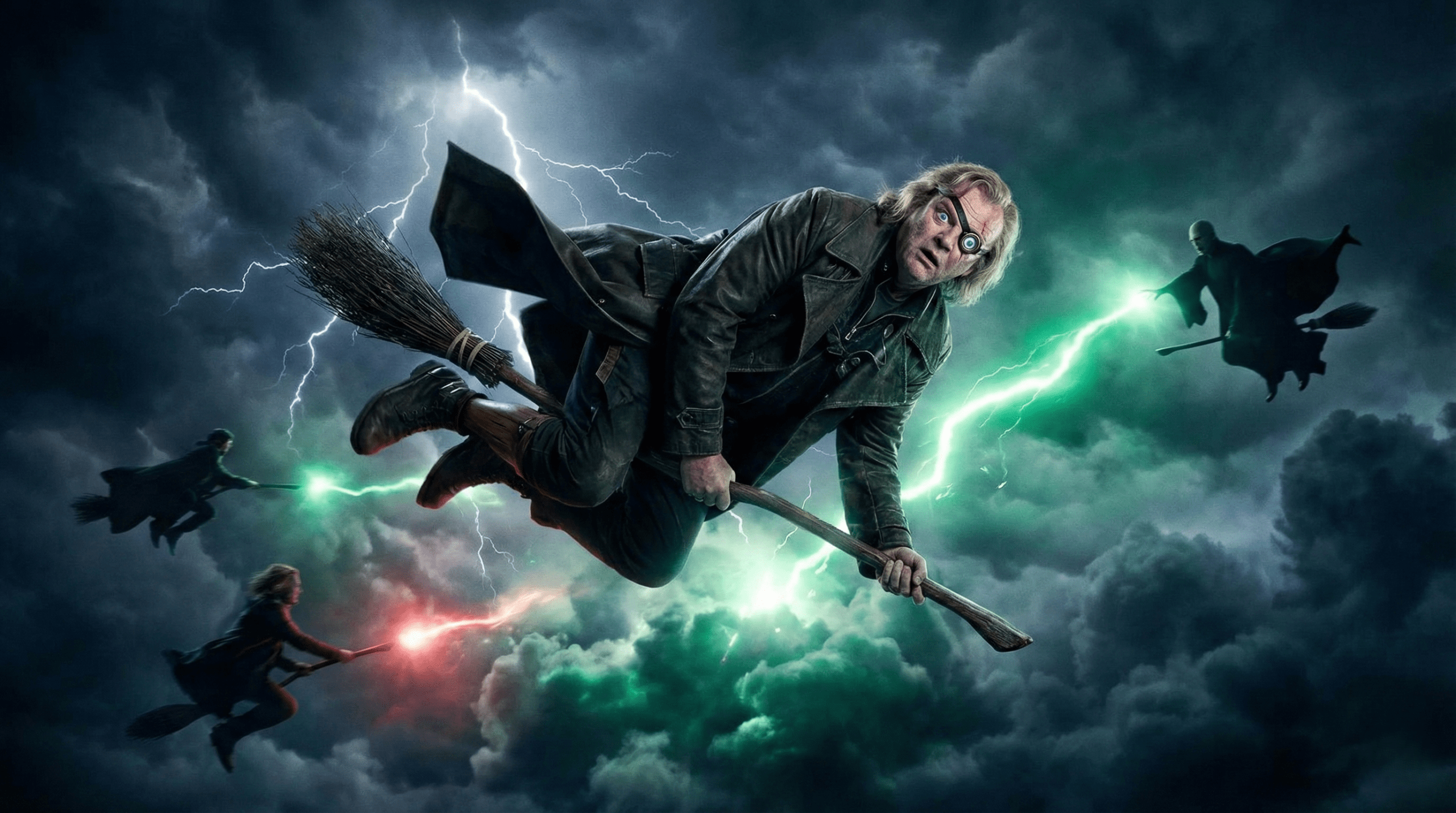
The Death Eaters ambushed almost immediately. Mundungus panicked and Disapparated, leaving Moody exposed. Voldemort himself, riding his borrowed Firebolt, targeted Moody’s broom. A flash of green light struck, and Moody fell backward off his broom, his body tumbling through the night sky. His last words, shouted to Harry moments before, were a grim “I goggled”—a final, ironic acknowledgment of his magical eye’s failure to foresee the fatal strike.
 Aftermath and Burial
Moody’s body was never recovered; it fell somewhere in the English countryside, lost to the war. The Order mourned him deeply. Kingsley Shacklebolt later reflected that “he wouldn’t have wanted a quiet death,” and indeed, Moody died doing what he had always done—protecting the future of the wizarding world.
Mad-Eye Moody’s Legacy – Why He Remains Iconic
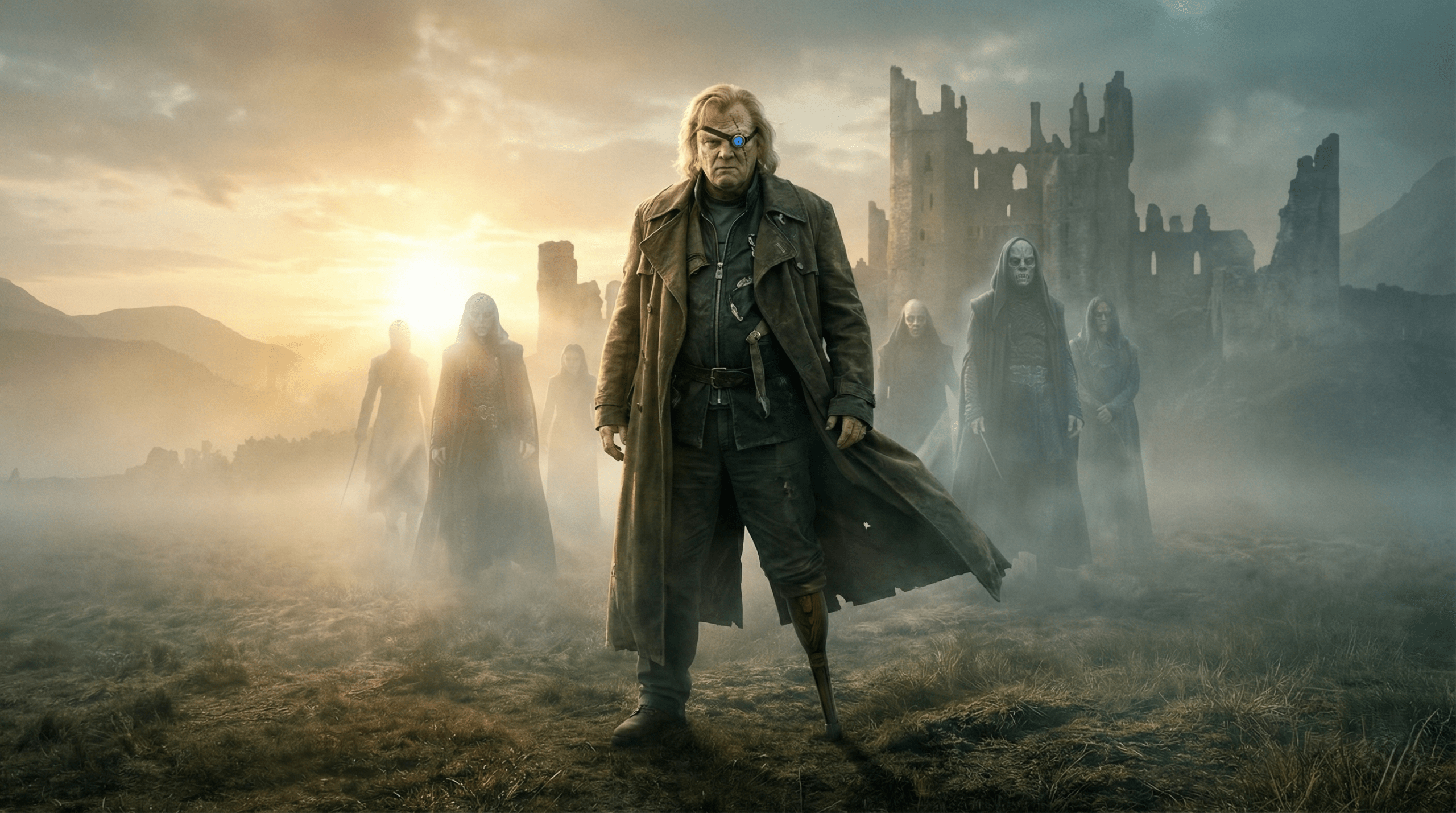
Alastor Moody’s death was not the end of his influence. In many ways, his final act—dying while protecting Harry Potter—cemented his place among the greatest unsung heroes of the Second Wizarding War. His legacy lives on through the lessons he imparted, the standards he set, and the inspiration he continues to provide to fans worldwide.
 Influence on Harry and the Next Generation
Harry Potter never had the luxury of a long, stable mentorship with the real Moody, yet the lessons stuck. The constant vigilance philosophy shaped Harry’s approach to danger throughout the final books. When Harry later becomes an Auror himself (as revealed in the epilogue and supplementary material), he carries forward Moody’s uncompromising stance against Dark magic.
Younger members of the Order, particularly Nymphadora Tonks (whom Moody had trained), and even Kingsley Shacklebolt, internalized his emphasis on preparation and security. In a broader sense, Moody represents the cost of resistance—the physical and psychological toll exacted from those who stand against tyranny.
Comparisons to Other Aurors and Heroes
Moody stands apart from other prominent Aurors like Kingsley Shacklebolt (calm, diplomatic, strategic) or Nymphadora Tonks (adaptable, cheerful despite danger). Where they brought balance or innovation, Moody brought raw, unrelenting force and experience. Unlike Dumbledore, whose power came with mystique and occasional moral ambiguity, Moody’s strength was grounded in gritty realism and sacrifice.
He shares traits with other scarred warriors—Remus Lupin’s quiet endurance, Mad-Eye’s visible battle damage—but Moody’s paranoia and insistence on self-reliance set him apart. He never sought glory; he simply refused to let evil win.
Fan Theories and Debates
The Harry Potter fandom has produced rich speculation about Moody:
- Hogwarts House: Most fans place him in Gryffindor for his courage, though some argue Slytherin due to his cunning and ruthless tactics against Death Eaters. A minority suggest Ravenclaw for his strategic brilliance.
- What if scenarios: What if the real Moody had been Defense Against the Dark Arts professor from year one? Would Harry have learned Occlumency earlier? Would the Triwizard Tournament have unfolded differently?
- Magical eye mechanics: Could the eye have detected Horcruxes? Why didn’t it see through the Polyjuice deception when Crouch Jr. was impersonating him (likely because the eye was removed during captivity)?
- Patronus form: Never revealed in canon, but fans often theorize a bear (for strength and ferocity) or an owl (for vigilance and night vision).
These debates keep Moody alive in fanfiction, artwork, and discussion forums years after the series concluded.
Cultural Impact in the Wizarding World and Pop Culture
Within the wizarding world, Moody is remembered as one of the few who could make even Voldemort take notice. In the Muggle world, Brendan Gleeson’s portrayal in the films brought Moody to vivid life—his gravelly voice, wild eye movements, and commanding presence made “Constant vigilance!” instantly quotable.
Moody has become a cultural shorthand for hyper-vigilance, appearing in memes, security training analogies, and even real-world discussions about trauma-informed preparedness.
Expert Insights and Lesser-Known Facts
As someone who has studied the Harry Potter canon extensively—including Pottermore/Wizarding World archives, J.K. Rowling interviews, and film commentary—here are some deeper, lesser-highlighted details:
- Moody’s magical eye was likely a family heirloom or custom-made; its ability to see through Invisibility Cloaks suggests rare, high-level enchantment.
- He was one of the few characters explicitly stated to have filled “half of Azkaban” — a claim made by multiple characters, underscoring his unmatched capture record.
- His hip flask habit wasn’t just paranoia; during the First War, poisoning attempts on Aurors were common.
- Moody may have been in his late 50s or early 60s during the Second War (based on timeline clues), making his physical feats even more impressive.
- He was among the first to believe Harry about Voldemort’s return, showing trust in evidence over Ministry propaganda.
- The wooden leg clicked when he walked—a detail that made his approach unmistakable and added to his intimidating aura.
- In early drafts and Rowling’s notes (shared in exhibitions), Moody was conceived as an even more extreme figure before being balanced with moral depth.
- His Order of Merlin, First Class, places him in elite company—alongside Dumbledore, Newt Scamander, and others.
- The “I goggled” line in his final moments is both tragic and darkly humorous—his eye “goggled” (stared in shock) even as he fell.
- Moody’s death is one of the few that remains off-page in the books (we only hear about it second-hand), heightening its emotional impact.
These elements combine to make Moody far more than a side character—he is a study in resilience under pressure.
Practical Takeaways for Harry Potter Fans
Re-reading the series with Moody in mind yields new appreciation:
- Notice how often “constant vigilance” is referenced after Goblet of Fire—it becomes almost a leitmotif.
- Pay attention to security details at Grimmauld Place; many are Moody’s handiwork.
- Consider how Harry’s growth into a more cautious, strategic fighter mirrors Moody’s influence.
- Apply the lesson metaphorically: In real life, “constant vigilance” can mean healthy skepticism, preparedness, and protecting those who cannot protect themselves.
FAQs
Was the Moody in Goblet of Fire the real one? No. That was Barty Crouch Jr. impersonating him using Polyjuice Potion for most of the school year.
How did Mad-Eye Moody lose his eye and leg? Both injuries occurred during the First Wizarding War while capturing Death Eaters. The specifics are never detailed in canon.
What was Alastor Moody’s Patronus? Never revealed in the books, films, or supplementary material.
Why is he called Mad-Eye? The nickname derives from his magical, electric-blue eye that constantly rotates and appears “mad” due to its unnatural movement.
Did Moody ever teach at Hogwarts before impersonation? No canon evidence suggests he did. His only official teaching stint was the fake Moody’s year.
Was Moody related to any other characters? No confirmed relations, though his pure-blood Auror family background is noted.
How old was Moody when he died? Likely in his late 50s to early 60s, based on timeline estimates.
Did his body ever get recovered? No. It fell somewhere in the English countryside and was never found.
Alastor “Mad-Eye” Moody was never meant to be the central hero of the Harry Potter saga, yet his life and death encapsulate its core themes: sacrifice, the cost of war, the necessity of vigilance, and the enduring power of loyalty in the face of overwhelming darkness.
From a young Auror filling Azkaban’s cells to a scarred veteran who gave his life escorting the Boy Who Lived to safety, Moody’s journey was one of unrelenting duty. He bore the visible marks of every battle, yet never wavered in his belief that evil must be confronted—however paranoid, however broken it left him.
In an age when many characters sought redemption or glory, Moody simply did what needed doing. His final fall from the sky was not a defeat, but the ultimate expression of his creed: constant vigilance until the very end.
If this deep dive into Alastor Moody has sparked new appreciation for one of the series’ most compelling figures, share your favorite Moody moment in the comments—whether it’s his classroom intensity, his final words, or the quiet way he earned every scar.
Thank you for reading. Constant vigilance.