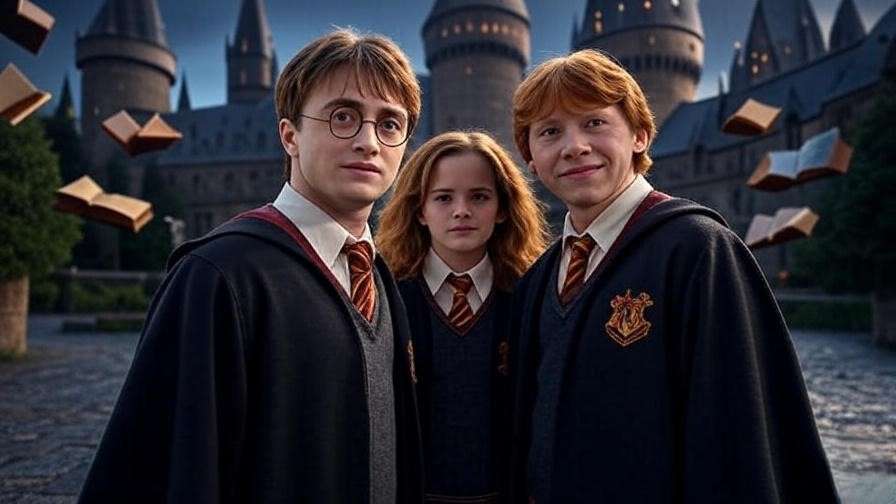
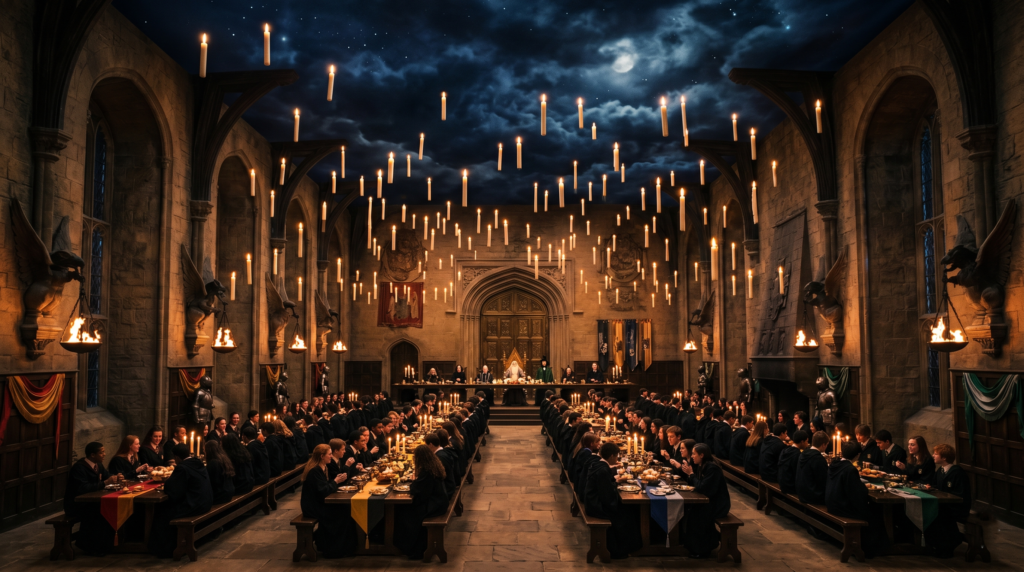
Imagine stepping through the enormous oak front doors of Hogwarts Castle for the very first time. The enchanted ceiling of the Great Hall shimmers above you, dotted with floating candles, and four long house tables stretch out before you — packed with students in black robes, buzzing with excitement. It is one of the most iconic images in all of modern literature. But here is a question that has quietly puzzled Harry Potter fans for decades: how many students are there at Hogwarts, exactly? You might assume the answer is simple. It is not. In fact, the number of Hogwarts students is one of the most debated topics in the entire wizarding world fandom — and for very good reason.
J.K. Rowling herself has given a number. The books imply something quite different. The films paint yet another picture. And when fans dive deep into the textual evidence, running their own meticulous calculations, the results are genuinely surprising. Whether you are a casual reader, a dedicated Potterhead, or a lore enthusiast who loves picking apart the mechanics of the wizarding world, this article is your definitive guide. We are going to examine every piece of canonical evidence, break down the numbers year by year and house by house, explore the broader wizarding population context, and arrive at the most intellectually honest answer possible.
Let us sort this out, once and for all.
The Official Answer — What J.K. Rowling Has Said
Rowling’s Most Cited Statement
When it comes to questions about the Harry Potter universe, most fans instinctively turn to the source: J.K. Rowling herself. And on the topic of Hogwarts enrollment, Rowling has not stayed silent. In a 2000 online chat hosted by Scholastic — one of the most frequently referenced author interviews in the Harry Potter fandom — Rowling stated that there are approximately 1,000 students at Hogwarts School of Witchcraft and Wizardry.
This figure has since become the most widely quoted “official” answer to the question. It appears in fan wikis, encyclopedias, and casual conversations alike. For many fans, Rowling’s word is canonical gospel, and the 1,000-student figure is simply accepted as fact.
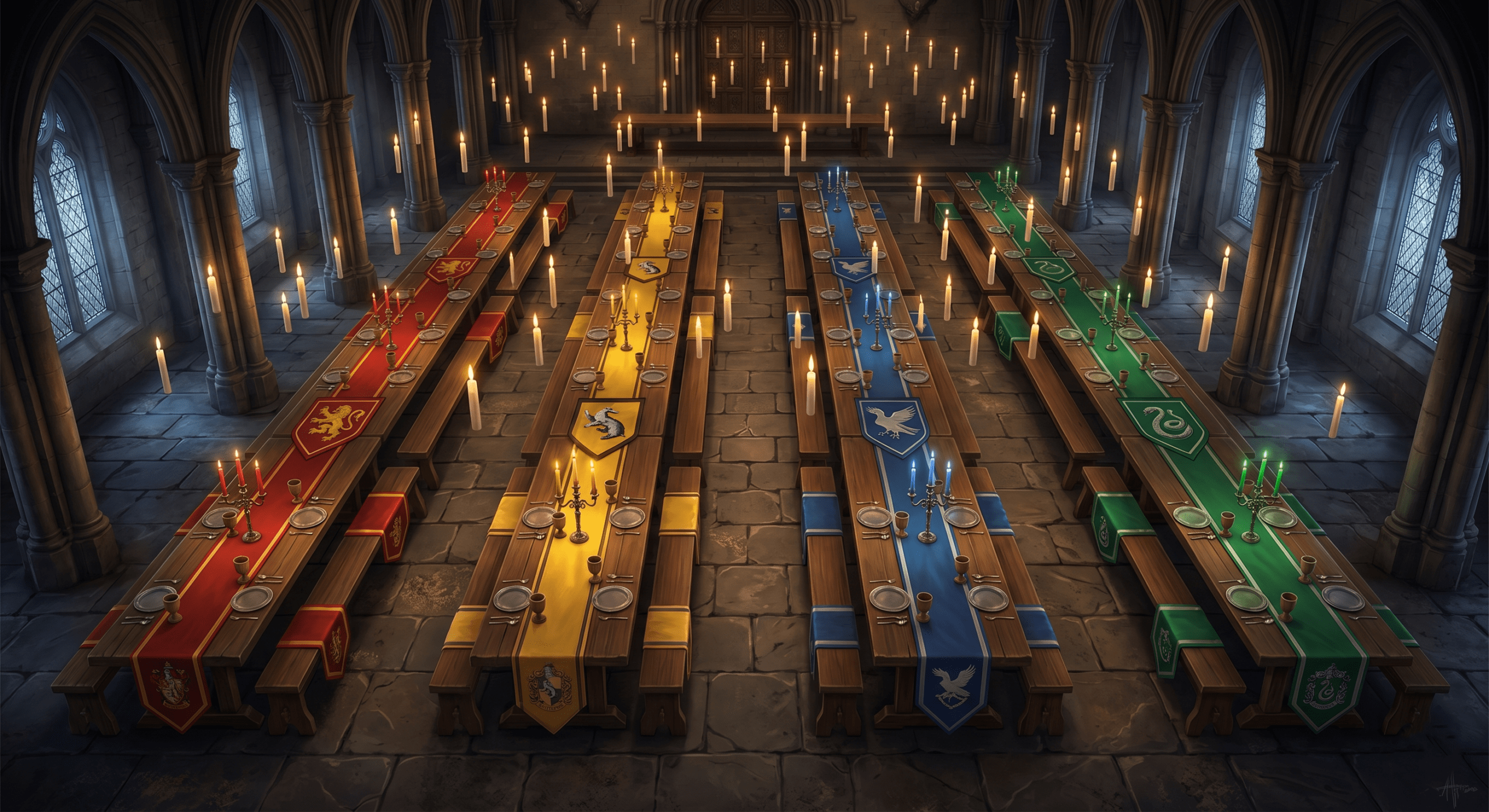
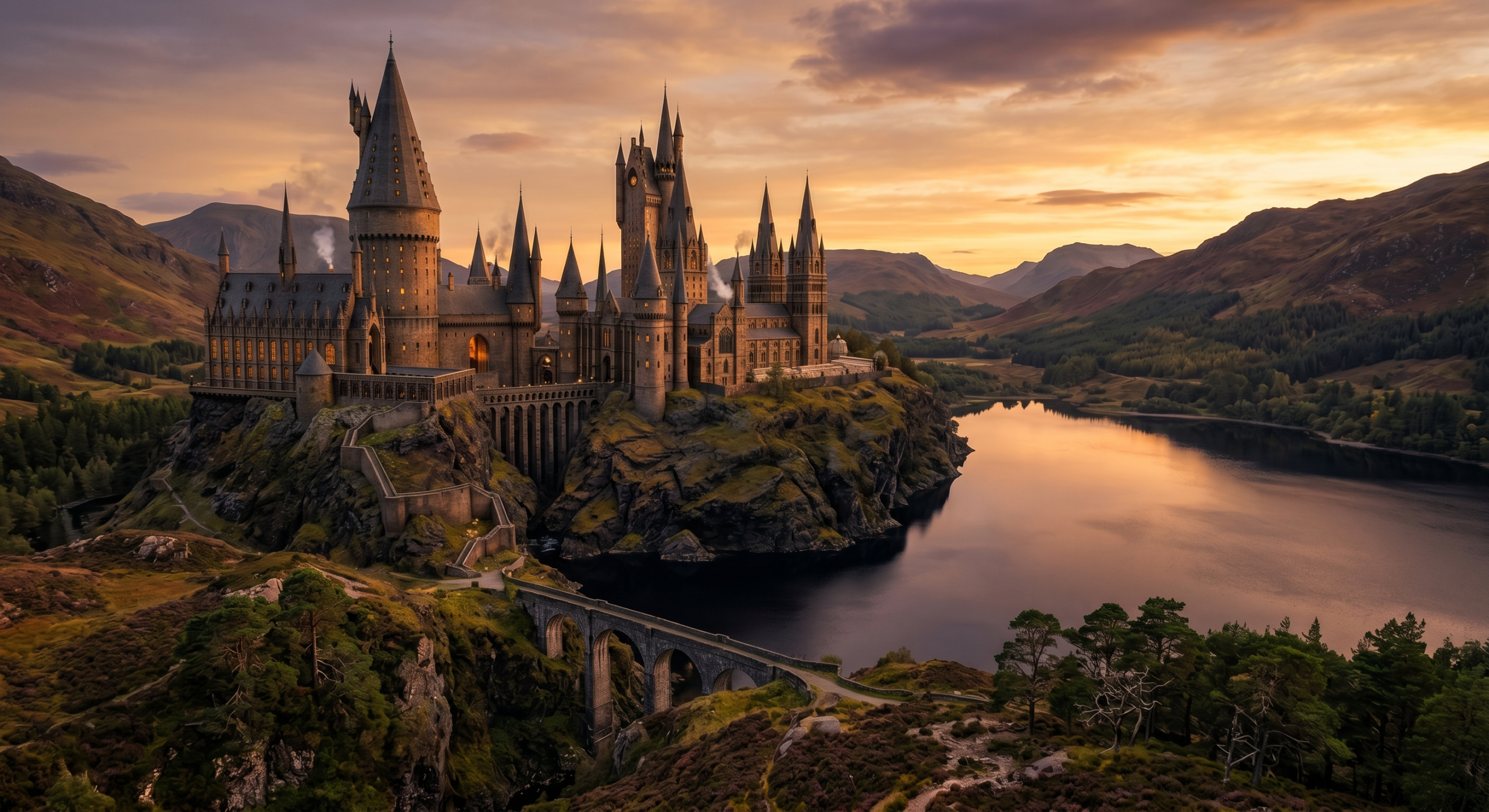
To be fair, it is not an unreasonable number on its face. Hogwarts is described as a vast, sprawling castle with hundreds of rooms, moving staircases, numerous towers, and dungeons that extend deep beneath a Scottish loch. Architecturally, at least, the school seems capable of housing a large student body. The Great Hall, during feast scenes, is depicted as enormous, with four long tables filling the cavernous space. A population of 1,000 students does not feel obviously impossible when you picture the setting.
Furthermore, Rowling’s statement carries significant weight simply because she created the world. Authors are generally considered the highest authority on their own fictional universes, and Rowling has always been unusually generous in expanding on the lore of the wizarding world through interviews, Pottermore (now the Wizarding World website), and social media. When she offers a concrete figure like 1,000, it is reasonable for fans to accept it.
Why Rowling’s Own Books Tell a Different Story
Here is where things get interesting — and where the debate truly begins. Because when you actually read the Harry Potter books carefully, paying close attention to class sizes, dormitory arrangements, and named characters, the portrait of Hogwarts that emerges looks nothing like a school of 1,000 students.
Let us start with the most straightforward calculation. If Hogwarts has 1,000 students spread across seven years, that means each year group contains roughly 143 students. Divide those 143 students among four houses — Gryffindor, Hufflepuff, Ravenclaw, and Slytherin — and you get approximately 36 students per house per year. On its own, that sounds plausible enough for a large school.
 But then you look at Harry’s year in Gryffindor. Over the course of seven books, we are introduced to the following Gryffindor students in Harry’s year: Harry Potter, Ron Weasley, Hermione Granger, Neville Longbottom, Seamus Finnigan, Dean Thomas, Lavender Brown, Parvati Patil, and Fay Dunbar (mentioned briefly). That is roughly nine or ten students in Harry’s year for Gryffindor alone.
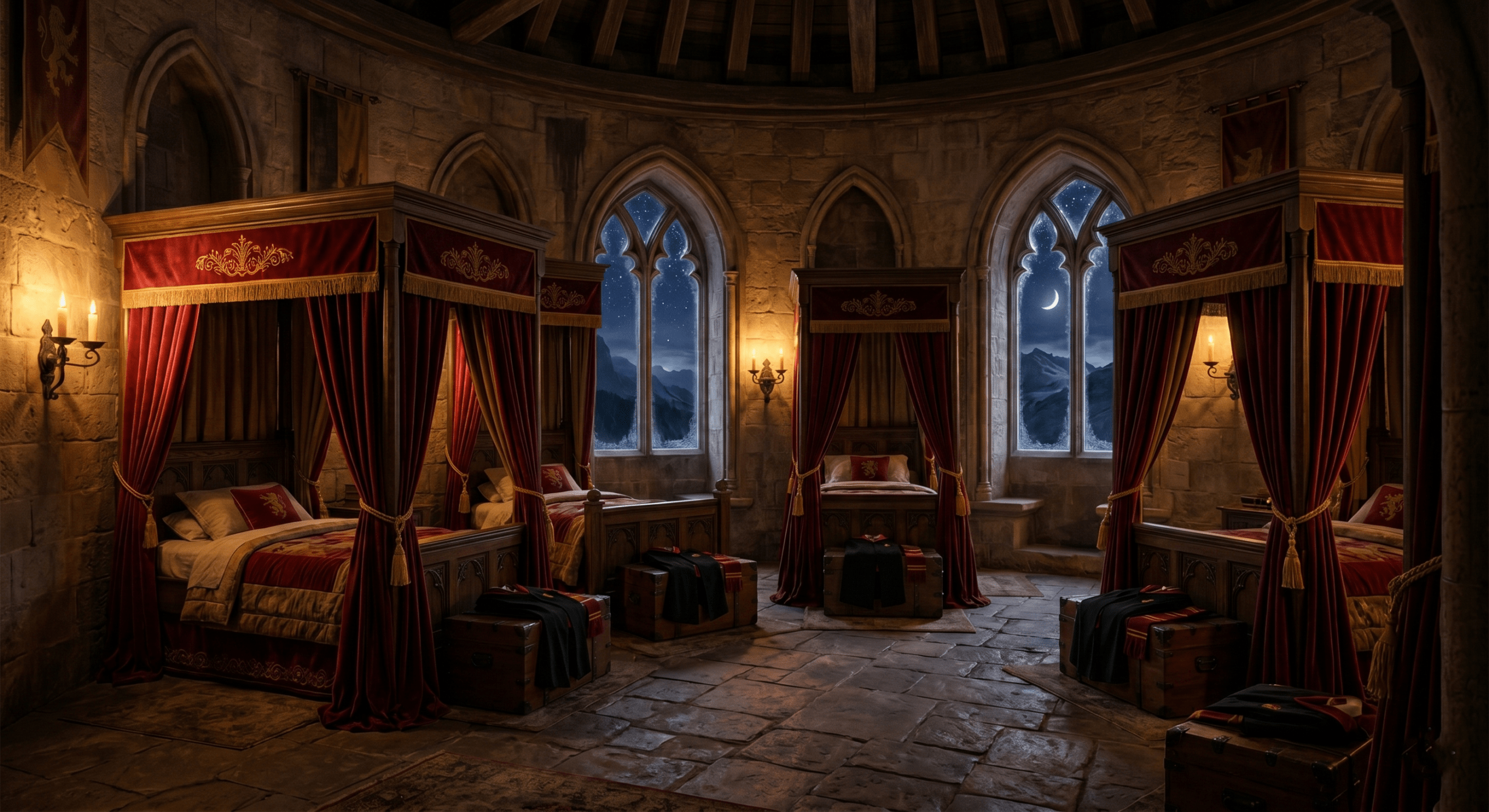
Now, the books do acknowledge that not every student is named or prominently featured. There are background students we never really meet. But even accounting for a generous number of unnamed classmates, the dormitory descriptions in the books are telling. The boys’ dormitory in Gryffindor Tower is described as a circular room with five four-poster beds — one for Harry, Ron, Neville, Seamus, and Dean. Five beds. Five boys. That is not a background-character issue. That is a structural detail of the room itself.
If we generously assume ten students per house per year (five boys, five girls), the mathematics become stark: ten students multiplied by four houses equals 40 students per year. Multiply that across seven years, and you get approximately 280 students total at Hogwarts — less than a third of Rowling’s stated 1,000.
Rowling herself, when this inconsistency was pointed out by fans, offered a characteristically charming and honest response. She admitted, in essence, that she is not particularly strong with mathematics, and that the 1,000-student figure was more of a broad world-building impression than a carefully calculated census. It is one of the most endearing admissions in the history of the fandom — and it transforms what might have been a frustrating continuity error into a beloved quirk of the series.
Breaking Down the Numbers — A Year-by-Year Analysis
How Many Students Per Year?
To understand the true scale of Hogwarts, it helps to work through the numbers systematically, using the books as our primary source. The most reliable data point we have is Harry’s own year group, which is depicted in more detail than any other.
As established above, Gryffindor appears to have roughly five boys and five girls per year, based on dormitory descriptions and named characters. If we apply this consistently across all four houses, we get:
- 10 students per house × 4 houses = 40 students per year
- 40 students per year × 7 years = 280 students total
This is the number that the book evidence most naturally supports. It is, admittedly, a small school by real-world standards — smaller than many British secondary schools. But it is entirely consistent with the intimate atmosphere the books portray. Students and teachers know one another by name. Dumbledore can speak personally with individual students. McGonagall recognizes every child in her house. Harry’s social world, though richly populated, never feels like the chaotic anonymity of a large comprehensive school. Hogwarts, in the books, feels like a close-knit community — and 280 students would explain exactly why.
A House-by-House Breakdown
For readers who like their information presented clearly, here is the estimated breakdown based on textual evidence from the books:
Per Year (estimated): Gryffindor — 10 students | Hufflepuff — 10 students | Ravenclaw — 10 students | Slytherin — 10 students | Total per year: 40 students
Across All Seven Years: Gryffindor — 70 students | Hufflepuff — 70 students | Ravenclaw — 70 students | Slytherin — 70 students | Grand Total: 280 students
It is worth noting that these figures assume roughly equal distribution across houses, which the books seem to support. There is no textual evidence that any one house significantly outnumbers the others in any given year, though minor variation from year to year is certainly plausible.
 The Dormitory and Common Room Evidence
Beyond the dormitory bed count, other physical details in the books quietly reinforce the smaller-school interpretation. The Gryffindor common room, while described as warm and comfortable, is never depicted as a vast hall struggling to contain hundreds of students. It is a single, cozy, firelit room where the entire house gathers — and the atmosphere is always intimate, not crowded.
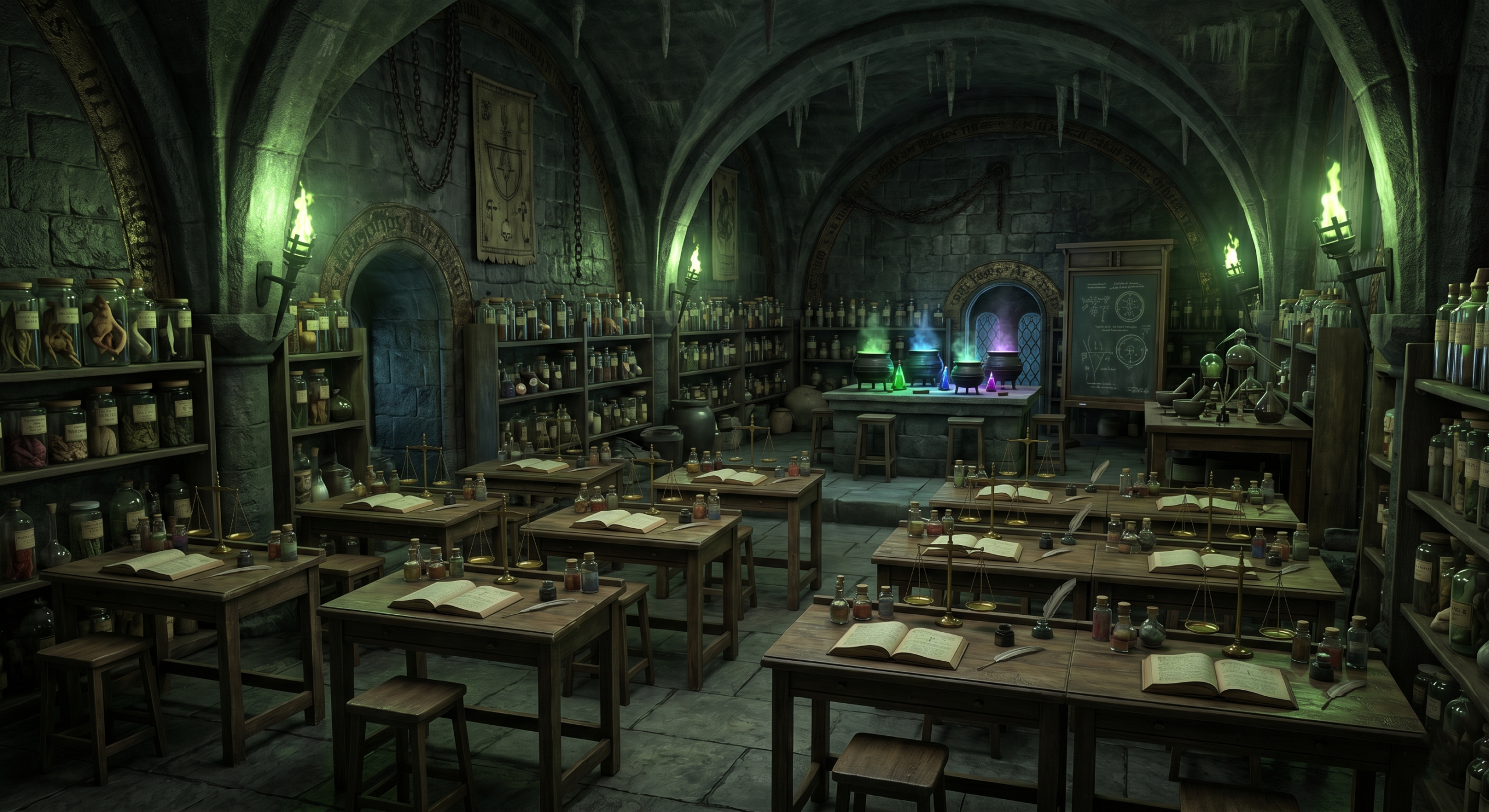
Similarly, classroom scenes throughout the series consistently show small groups. Potions class, one of the most frequently depicted lessons in the series, features only Gryffindors and Slytherins together — a joint class. Even with two houses combined, Snape’s dungeon classroom feels manageable, not overflowing. In Harry Potter and the Philosopher’s Stone, the class is described with enough specificity that we can count the students present, and the number is firmly in the range of 20–25 students for two combined houses — entirely consistent with roughly 10–12 students per house per year.
Care of Magical Creatures, Divination, and other elective classes appear even smaller, which makes sense given that not every student chooses every subject. But even the compulsory subjects do not suggest the class sizes you would expect from a school of 1,000.
The conclusion from the physical and descriptive evidence of the books is consistent: Hogwarts, as written, is a school of approximately 280 students.
The 1,000-Student Theory — Can It Actually Work?
Arguments in Favor of 1,000 Students
Despite what the textual evidence suggests, the 1,000-student figure is not without its defenders — and their arguments deserve a fair hearing.
First and most powerfully: Rowling said it. In the world of Harry Potter canon, the author’s stated intentions carry genuine weight. If Rowling envisioned Hogwarts as a school of 1,000 when she was writing, then 1,000 is the number that exists in her imagination, even if it was never perfectly reflected on the page. Many fans consider authorial intent to be as valid as textual evidence, if not more so.
Second, the physical scale of Hogwarts Castle supports a larger population far better than a smaller one. The castle has dozens of classrooms, multiple towers with dormitories, enormous common rooms (by implication), a Great Hall clearly designed for large gatherings, and a grounds large enough to contain a Quidditch pitch, a Forbidden Forest, greenhouses, and a gamekeeper’s cottage. A building of that scale, built over a thousand years specifically to house a school, seems architecturally designed for more than 280 students.
Third, not every student appears in the narrative. Harry Potter is a first-person-adjacent story told closely from Harry’s point of view. He has a limited social circle. The students he interacts with, knows by name, and shares classes with represent only a fraction of the total student body. There could plausibly be dozens of students in other houses, in other years, living entirely parallel Hogwarts experiences that the books simply never show us. Fiction always involves selective narration.
What 1,000 Students Would Actually Look Like
Granting all of the above, it is still worth examining what a 1,000-student Hogwarts would actually require — and whether it strains the believability of the world Rowling created.
If there are 1,000 students across seven years, that means approximately 143 students per year. Divided across four houses, that is roughly 36 students per house per year. In Gryffindor alone, that would mean around 36 girls and boys combined — or 18 boys and 18 girls — in Harry’s year. With five four-poster beds in the boys’ dormitory, that leaves 13 Gryffindor boys in Harry’s year with nowhere to sleep, unless we imagine multiple dormitory rooms stacked within Gryffindor Tower (which the books never describe or suggest).
It also means that Harry’s Potions class — already a joint Gryffindor/Slytherin session — would contain over 70 students. In a dungeon classroom. Being taught by one professor. That is less a school and more a lecture theatre, and it is entirely at odds with the personal, somewhat menacing dynamic that defines Snape’s classes throughout the series.
The 1,000-student theory, when examined rigorously, does not survive contact with the actual text. It is better understood as Rowling’s aspirational world-building figure — the size she imagined the school to be in a broad, impressionistic sense — rather than a number grounded in the mechanics of her own narrative.
The “Background Student” Argument
A popular middle-ground position among fans is to acknowledge that there are many students at Hogwarts who simply never appear in the narrative — background characters, unnamed classmates, students in years and houses that Harry never encounters. This argument is used to reconcile the book’s apparent small class sizes with Rowling’s 1,000-student claim.
It is a reasonable argument, up to a point. Every fictional school has students who exist beyond the protagonist’s social circle, and Hogwarts is no exception. But the dormitory evidence is genuinely hard to argue away. Five beds in a room are five beds. If there were 18 Gryffindor boys in Harry’s year, the architecture of Gryffindor Tower as described would be physically insufficient.
The most honest verdict on this argument is: yes, there are background students, but not enough to close the gap between 280 and 1,000. The background-student argument might push the total from 280 to perhaps 350 or 400, but it cannot plausibly deliver the full 1,000.
What the Movies Show Us
Visual Clues from the Great Hall Scenes
The Harry Potter film series offers a third data point in this debate, and it sits interestingly between the book evidence and Rowling’s stated figure. If you watch the feast scenes in the films carefully — particularly the opening feast in Philosopher’s Stone and the various holiday feasts in subsequent films — the Great Hall appears to contain somewhere between 400 and 600 students, based on the visible rows and columns of seated figures at the four house tables.
This is notably more than the books suggest, but still considerably less than 1,000. The filmmakers, working with production designer Stuart Craig and director Chris Columbus, presumably made visual decisions about how full the Great Hall should look based on their own interpretation of the source material. The result is a school that feels substantial and bustling, but not overwhelmingly large.
 How the Films Handle Class Sizes
In the classroom scenes, however, the films are surprisingly consistent with the books. Potions classes, Defense Against the Dark Arts lessons, and Transfiguration sessions all feature small groups of students — typically in the range of 15–25 students for combined house classes. This is entirely in keeping with the book’s implied class sizes and is far more consistent with a school of 280–400 students than a school of 1,000.
The filmmakers appear to have made a conscious or unconscious distinction between the grand ceremonial spaces of Hogwarts — where the visual impression of scale and grandeur was desirable — and the functional academic spaces, where smaller, more manageable groups made narrative and dramatic sense.
The Wizarding Population Problem — A Bigger Picture
How Big Is the Wizarding Population in Britain?
To truly understand the scale of Hogwarts, you cannot look at the school in isolation. You have to zoom out and ask a broader, equally fascinating question: how large is the wizarding population of Britain in the first place? Because if the total number of witches and wizards living in the United Kingdom is relatively small, then a school of 1,000 students becomes not just unlikely — it becomes demographically impossible.
Rowling has never provided a precise figure for the total wizarding population of Britain. However, fans and lore analysts have pieced together a remarkably coherent estimate from contextual clues scattered throughout the books, interviews, and the Wizarding World platform.
Consider the Ministry of Magic. As the governing body of the British wizarding community, the Ministry employs a significant portion of the adult wizarding workforce. Based on the departments, divisions, and named employees described across the series, credible fan estimates place Ministry employment at somewhere between 500 and 1,000 workers. If we assume the Ministry employs, say, 20 to 30 percent of the working-age wizarding population — a reasonable assumption for a government body in a small, insular community — then the total adult wizarding population of Britain would sit somewhere in the range of 3,000 to 5,000 people.
Add in children, the elderly, those who work outside the Ministry (in Diagon Alley shops, St. Mungo’s Hospital, Hogwarts itself, as Aurors, as journalists for the Daily Prophet, and so on), and the total wizarding population of Britain likely falls somewhere between 5,000 and 15,000 people — with most serious fan analyses clustering around the 10,000 mark as a reasonable upper estimate.
Now apply that population figure to Hogwarts. Britain’s magical children would represent roughly one-seventh of the total population at any given time (one year group out of seven). If the total magical population is 10,000, and roughly equal numbers of witches and wizards exist across all age groups, then each year’s cohort of school-age magical children might number somewhere between 100 and 200 children across all of Britain.
Even at the generous upper end of that range, 200 students per year across seven years gives you 1,400 total students — barely enough to justify Rowling’s 1,000-student figure, and that assumes every single magical child in Britain attends Hogwarts, which leads us to the next important point.
Hogwarts as the Only Wizarding School in Britain
Here is a fact that significantly strengthens the case for a smaller Hogwarts: according to both the books and the Wizarding World platform, Hogwarts is the only wizarding school in Britain. Every magical child born in the United Kingdom who receives a Hogwarts letter — and we are told in the books that the magical quill records every magical birth and that letters are sent automatically — attends Hogwarts. There is no competing institution, no alternative magical academy, no homeschooling equivalent mentioned for British wizarding children (though some families, like the Weasleys briefly considered for Ron, do educate children at home in exceptional circumstances).
This is actually a crucial piece of the puzzle. It means that the Hogwarts enrollment figure is not a selective intake from a large pool of applicants. It is essentially the entire cohort of school-age magical children in Britain. If that cohort numbers around 40 per year, as the textual evidence suggests, then the total wizarding population of Britain is quite small indeed — and the world-building becomes internally consistent in a way that the 1,000-student figure never quite achieves.
What the Triwizard Tournament Tells Us
Harry Potter and the Goblet of Fire offers one of the most tantalizing pieces of evidence in this entire debate. When Beauxbatons Academy of Magic and the Durmstrang Institute send delegations to Hogwarts for the Triwizard Tournament, the arriving groups are described in a way that strongly implies these are not small representative samples — they are meaningful portions of each school’s student body.
The Beauxbatons carriage, while magically enlarged on the inside, arrives carrying what appears to be a delegation of several dozen students. The Durmstrang ship similarly brings a group of comparable size. These are described as the older students from each school — those old enough to potentially enter the tournament — but the implication is that the delegation represents a substantial cross-section of eligible students.
If Beauxbatons and Durmstrang are schools of 1,000 students each, then a delegation of even 100 students would represent only 10 percent of their enrollment — a relatively minor group. But in the text, the arriving delegations feel significant, even large, relative to the existing Hogwarts population. This makes considerably more sense if all three schools have enrollments in the hundreds rather than the thousands.
 Furthermore, Madame Maxime’s horses and the Durmstrang ship, while impressive, are not transport vessels designed for mass movement of a thousand students. They are ceremonial conveyances scaled for a notable but manageable group. Again, the evidence quietly points toward smaller schools.
Did You Know? According to the Wizarding World platform, there are only 11 wizarding schools worldwide officially recognized by the International Confederation of Wizards. Given the global magical population, this means each school serves an enormous geographic catchment area — but it also confirms that wizarding schools are rare, exclusive institutions, not sprawling educational campuses comparable to large Muggle universities.
Fan Theories and Deep-Dive Analyses
The Most Compelling Fan Calculations
One of the most remarkable things about the Harry Potter fandom is its dedication to rigorous analysis. Over the past two decades, fans have produced some genuinely impressive lore scholarship — and nowhere is this more evident than in the ongoing debate over Hogwarts enrollment figures.
The most thorough fan analyses, found across dedicated Harry Potter forums, Reddit communities like r/harrypotter and r/HPfantheory, and long-form fan essay archives, consistently arrive at figures in the 280 to 400 student range when working from textual evidence. The methodology typically involves cataloguing every named student in each house and year, cross-referencing with classroom scene descriptions, analyzing dormitory architecture, and applying population logic from the broader wizarding world.
Some of the most cited analyses note that the books actually name or acknowledge between 8 and 14 students per year group in Gryffindor alone, depending on how carefully you read. When fans extend this to all four houses and all seven years — with appropriate adjustments for the likelihood of unnamed background students — the consensus estimate tends to land around 300 to 400 students for the full school.
Interestingly, a number of fan analysts have also pointed out that the inconsistency in Rowling’s numbers is not unique to Hogwarts. The Harry Potter books contain several numerical inconsistencies — from the number of Weasley children to the timeline of certain historical events — which scholars of children’s literature have attributed to Rowling’s focus on emotional and narrative truth over mathematical precision. The world of Harry Potter was built to be felt, not audited.
The “Hogwarts Accepts All Magical Children” Clause
One of the most important canonical facts bearing on this question is the nature of Hogwarts admissions. Unlike Muggle schools, which have geographic catchment areas, selection criteria, and application processes, Hogwarts operates on a principle of universal magical admission. As described in the books, a magical quill in Hogwarts records every magical birth in Britain, and the school sends a letter to every qualifying child when they turn eleven. There is no entrance exam. There is no waitlist. If you are magical and British, you get a letter.
This has profound implications for the enrollment debate. It means that Hogwarts is not drawing students from a large pool and selecting a fraction of them. It is accepting 100 percent of eligible magical children in Britain. The Hogwarts enrollment figure, therefore, is essentially identical to the number of eleven-year-old witches and wizards born in Britain in any given year.
If we accept the book evidence that roughly 40 students start at Hogwarts each year, then approximately 40 magical children are born in Britain each year. This is consistent with a total British wizarding population of roughly 10,000 people — a small, tight-knit community, largely hidden from the Muggle world, which is exactly how the books portray it.
This internal consistency is one of the strongest arguments for the smaller enrollment figure. It is not just that the dormitory has five beds. It is that the entire fabric of the wizarding world — its insularity, its reliance on word-of-mouth, its small-town gossip culture, its single newspaper, its single hospital, its single school — coheres beautifully around a community of roughly 10,000 people, not 100,000.
Post-War Enrollment — Did Numbers Change?
For fans who enjoy speculating beyond the seven books, there is a genuinely interesting question lurking at the edges of this debate: did the two Wizarding Wars affect Hogwarts enrollment?
The First Wizarding War, which reached its peak in the years before Voldemort’s first defeat in 1981, presumably caused significant casualties within the British wizarding community. Families in hiding, deaths from Death Eater attacks, and the general terror of the period may well have reduced the birth rate among wizarding families during those years — meaning that the generation entering Hogwarts in the early-to-mid 1990s (Harry’s generation) might have been smaller than average.
If this is the case, then the ~40 students per year we observe in the books might actually represent a depleted cohort rather than a typical one. In more peaceful times — say, the generation before Voldemort’s rise — the annual intake might have been closer to 50 or 60 students, pushing the total enrollment toward the higher end of fan estimates.
This theory has the elegant advantage of partially reconciling the book evidence with Rowling’s 1,000-student claim. If a “normal” Hogwarts year sees 60 students across four houses, and Harry’s generation is smaller due to wartime disruption, then a pre-war Hogwarts might have had closer to 420 students — still well short of 1,000, but notably larger than 280.
As for the next generation — the children of Harry, Ron, Hermione, and their contemporaries — Hogwarts enrollment presumably recovered and possibly grew during the long peace following Voldemort’s final defeat. The wizarding world, freed from decades of fear and persecution, would likely have experienced something of a baby boom. Neville Longbottom teaching Herbology to packed greenhouses full of students is a pleasing image, and probably not far from the truth.
Hogwarts Staff-to-Student Ratio
How Many Teachers Does Hogwarts Have?
Another illuminating angle on the enrollment question is the Hogwarts teaching staff. Over the course of the seven books, we are introduced to the following confirmed teaching staff members: Albus Dumbledore (Headmaster), Minerva McGonagall (Transfiguration and Deputy Headmistress), Severus Snape (Potions, later Defense Against the Dark Arts), Filius Flitwick (Charms), Pomona Sprout (Herbology), Sybill Trelawney (Divination), Rubeus Hagrid (Care of Magical Creatures), Rolanda Hooch (Flying), Irma Pince (Librarian), and a rotating series of Defense Against the Dark Arts teachers. We also know of Professor Binns (History of Magic), Professor Vector (Arithmancy), Professor Babbling (Ancient Runes), and Professor Slughorn (Potions).
That gives us approximately 12 to 15 teaching staff for the full school, plus administrative and support staff like Argus Filch (caretaker) and Madam Pomfrey (school nurse).
Now consider what those staffing numbers imply. In the real world, a reasonable teacher-to-student ratio for a secondary school is approximately 1:15 to 1:20. Applying that ratio to Hogwarts:
- With 280 students, 14 teachers gives a ratio of 1:20 — perfectly normal for a well-staffed school.
- With 1,000 students, 14 teachers gives a ratio of 1:71 — an unworkable, chaotic understaffing situation that would make Hogwarts one of the most poorly resourced schools imaginable.
The staffing evidence, rarely discussed in the enrollment debate, is quietly one of the most compelling arguments for the smaller figure. A school of 280 students with 14 teachers is a well-run, properly staffed institution. A school of 1,000 students with the same staff is an administrative disaster. Everything we know about how Hogwarts actually functions — the personal attention students receive, the ability of teachers to know every student by name, the one-on-one conversations between professors and pupils that drive much of the plot — is consistent with a student body of a few hundred, not a thousand.
What This Tells Us About Hogwarts as an Institution
The staffing ratio reveals something deeper about the nature of Hogwarts as an educational institution. It is not a large, impersonal academy churning students through a standardized curriculum. It is, by all the evidence, a small, intimate boarding school in the finest British tradition — more akin to a specialist independent school than a large comprehensive.
This framing actually enhances, rather than diminishes, the magic of Hogwarts. Small schools are characterized by strong community bonds, intense house loyalties, and the sense that every student matters. The Hogwarts we experience through Harry’s eyes — where Dumbledore knows every child by name, where teachers genuinely invest in their students, where the loss of even one student to Voldemort’s violence is felt as a community tragedy — is precisely the Hogwarts that a student body of 280 would produce.
In a school of 1,000, Harry Potter might have been just another unremarkable first-year, lost in the crowd. In a school of 280, he is immediately known, watched, and significant. The intimacy of the community is not incidental to the story. It is essential to it — and the smaller enrollment figure is what makes that intimacy believable.
The Final Verdict — How Many Students Are There at Hogwarts?
Weighing All the Evidence
We have now examined this question from every available angle: Rowling’s authorial statement, the textual evidence of the books, the visual evidence of the films, the demographic logic of the wider wizarding world, the physical architecture of the castle, the staffing ratios, and the contextual clues from the Triwizard Tournament. It is time to bring all of that evidence together and render a verdict.
The book evidence — dormitory beds, named characters, classroom sizes, and house descriptions — most naturally supports a figure of approximately 280 students.
The film evidence — the visual impression of the Great Hall during feast scenes — suggests something closer to 400 to 600 students, with the filmmakers apparently opting for a grander visual scale while keeping classrooms small.
The author’s stated figure is approximately 1,000 students, offered in a 2000 interview and never formally revised, though Rowling has acknowledged her mathematical inconsistencies with characteristic good humor.
The demographic and population logic of the wizarding world is most consistent with a school of 200 to 400 students, given what we can infer about the total size of the British magical community.
The staffing ratio evidence strongly supports a smaller school of 250 to 350 students, as the known teaching staff would be entirely adequate for this number and wholly insufficient for 1,000.
Taken together, the most defensible and intellectually honest answer is this: Hogwarts most likely has between 280 and 500 students, with the lower end of that range being most consistent with the detailed textual evidence of the books. The 1,000-student figure is best understood as an authorial impression — the feeling of scale and grandeur that Rowling wanted Hogwarts to convey — rather than a precise enrollment statistic.
Why the Inconsistency Doesn’t Diminish the Magic
It would be easy to frame this conclusion as a criticism of J.K. Rowling or as evidence of sloppy world-building. It is neither. The Harry Potter series was written, first and foremost, as a story — a deeply human, emotionally resonant story about love, loss, courage, and belonging. Rowling was not constructing a census database. She was building a world that needed to feel real, warm, and wondrous, and she succeeded beyond almost any author in the history of children’s literature.
The enrollment inconsistency is, in the grand scheme of things, a minor and rather charming imperfection in an otherwise remarkably coherent fictional universe. It has given fans decades of delightful debate, spawned countless essays and forum threads, and demonstrated the extraordinary engagement and intelligence of the Harry Potter readership. Far from diminishing Hogwarts, the mystery of its student population has made it more alive — a place that rewards careful attention and repays curiosity.
 Pick the number that makes Hogwarts feel most real to you. If you want the intimate community of 280 students where every face is known and every voice matters, the books support you. If you want the grand, bustling academy of 1,000 that Rowling imagined, her word supports you. Both versions of Hogwarts are magical. Both are true, in the ways that matter most.
Summary Verdict: 📖 Book Evidence: ~280 students 🎬 Film Evidence: ~400–600 students ✍️ Author’s Statement: ~1,000 students 🏆 Most Likely Real Figure: 280–500 students
Frequently Asked Questions
How many students are in each house at Hogwarts? Based on the textual evidence of the books, each house likely contains approximately 70 students across all seven years, with roughly 10 students per house per year. This gives each of the four houses — Gryffindor, Hufflepuff, Ravenclaw, and Slytherin — a total of around 70 students at any given time.
How many students are in Harry’s year at Hogwarts? Harry’s year appears to contain approximately 40 students in total, spread across four houses. Gryffindor has around 10 students in Harry’s year, and the other houses are implied to be of similar size. This is based on named characters, dormitory descriptions, and classroom scene details across the seven books.
Did J.K. Rowling ever confirm the number of Hogwarts students? Yes. In a 2000 Scholastic online chat, Rowling stated that Hogwarts has approximately 1,000 students. However, this figure is widely considered inconsistent with the detailed evidence of the books themselves, and Rowling has acknowledged that she is not particularly precise with numbers in her world-building.
Is Hogwarts the only wizarding school in Britain? Yes. According to both the Harry Potter books and the Wizarding World platform, Hogwarts School of Witchcraft and Wizardry is the only wizarding school in Britain. Every magical child born in the United Kingdom is eligible to receive a Hogwarts letter upon turning eleven.
How many teachers are there at Hogwarts? The books introduce approximately 12 to 15 teaching staff members over the course of the series, including subject teachers, the Headmaster, and specialist instructors. This staffing level is consistent with a school of around 280 to 350 students and would be entirely insufficient for a school of 1,000.
How big is the wizarding population in the UK? Rowling has never provided an official figure, but fan analyses based on Ministry of Magic staffing levels, the scale of wizarding institutions, and contextual details from the books suggest the total British wizarding population is somewhere between 5,000 and 15,000 people, with approximately 10,000 being the most commonly cited estimate.
How does Hogwarts compare in size to Beauxbatons and Durmstrang? The books do not give explicit enrollment figures for either Beauxbatons Academy of Magic or the Durmstrang Institute. However, the size of the delegations sent to Hogwarts for the Triwizard Tournament suggests both schools have enrollments roughly comparable to Hogwarts — likely in the low hundreds rather than the thousands.
The question of how many students are there at Hogwarts turns out to be far more than a simple trivia query. It is a window into the mechanics of the wizarding world, a test of the internal consistency of the Harry Potter universe, and a testament to the extraordinary depth of engagement that Rowling’s books have inspired in their readers.
The answer, honestly arrived at, is that Hogwarts is almost certainly a school of somewhere between 280 and 500 students — intimate by the standards of a fictional magical academy, but entirely coherent with everything the books tell us about the size of the British wizarding community, the layout of the castle, the composition of the teaching staff, and the close-knit culture of magical Britain.
Rowling’s 1,000-student figure is best understood as the impressionistic scale of a world-builder thinking big, not the precise calculation of a demographer. And that is perfectly fine. The books were never meant to be a census. They were meant to be magic — and on that count, every version of Hogwarts, whether it holds 280 students or 1,000, delivers completely.
Which number do you believe? Are you Team 280, trusting the careful evidence of the text? Or are you Team 1,000, standing by Rowling’s word? Share your thoughts in the comments below — this is one debate the Harry Potter fandom has never quite finished, and probably never will.