Battling Dark Wizards, escaping Acromantulas, and surviving the Forbidden Forest are undeniably terrifying. But if you were to ask a seventh-year Hogwarts student what truly keeps them up at night, the answer might surprise you. For the brightest witches and wizards of their age, nothing induces panic quite like a N.E.W.T. Harry Potter fans are well acquainted with the O.W.L. exams that tormented the Golden Trio in their fifth year, but the lore surrounding the ultimate academic hurdle at Hogwarts remains a confusing mystery to many casual readers and movie watchers.
What exactly does this intimidating acronym stand for? How does the wizarding grading scale actually work—and is scoring a “Troll” a real academic penalty?
In this definitive, expert-level breakdown, we are decoding the Nastily Exhausting Wizarding Tests. We will explore the complete Hogwarts grading scale, detail the strict prerequisites for elite wizarding careers, and reveal the surprising truth about whether the Boy Who Lived ever actually passed his final exams.
The Nastily Exhausting Wizarding Test Explained
To understand the academic pressure cooker of a Hogwarts student’s final year, we first need to define the terminology. N.E.W.T. stands for Nastily Exhausting Wizarding Test. These are the highest-level subject exams taken by witches and wizards at the very end of their seventh year at Hogwarts School of Witchcraft and Wizardry.
The structure of Hogwarts academia is heavily inspired by author J.K. Rowling’s own experiences with the British educational system. In the Muggle UK, teenagers take their GCSEs (General Certificate of Secondary Education) around age 15 or 16, which directly correlates to the fifth-year O.W.L.s (Ordinary Wizarding Levels). Following this, British students specialize in a few select subjects for two years before taking their A-Levels at age 18. The N.E.W.T.s act as the magical equivalent of A-Levels—they are specialized, intensely rigorous, and absolutely critical for a student’s future career prospects.
O.W.L.s vs. N.E.W.T.s: What’s the Difference?
While both sets of exams are administered by the Wizarding Examinations Authority (headed by the ancient and formidable Griselda Marchbanks), the N.E.W.T.s represent a massive leap in difficulty.
-
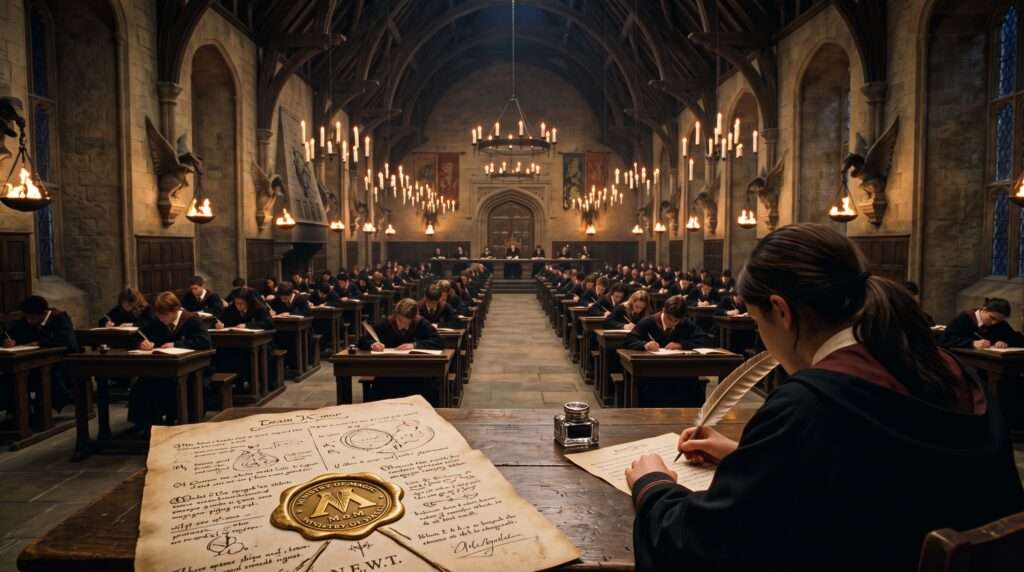
The Format: Both O.W.L.s and N.E.W.T.s generally follow a two-part structure. Students face a grueling theoretical (written) exam in the morning, where anti-cheating quills are strictly enforced. In the afternoon, they endure a practical exam, standing before an examiner to physically cast spells, brew potions, or identify magical flora and fauna.
-
The Workload: During their first five years, Hogwarts students take a wide array of core classes. However, once O.W.L. results are delivered, students drop the subjects they either failed or no longer wish to pursue. A sixth and seventh-year student will typically only take three to five N.E.W.T.-level subjects.
-
The Stress: Because students take fewer classes, they are granted “free periods.” However, as Hermione Granger and any seventh-year Ravenclaw would attest, these are rarely used for leisure. N.E.W.T.s require mastering highly complex, dangerous magic—such as non-verbal spellcasting, human transfiguration, and volatile potion brewing—meaning free periods are usually spent frantically studying in the library or common room.
 From “Outstanding” to “Troll”: The Official Grading System
One of the most uniquely charming (and punishing) aspects of the wizarding world is its grading scale. Unlike the standard A through F letter grades found in many Muggle schools, Hogwarts uses a highly specific metric that measures a student’s magical aptitude.
This same grading scale is also used for the W.O.M.B.A.T.s (Wizards’ Ordinary Magic and Basic Aptitude Tests), a lesser-known set of exams occasionally administered by the Ministry of Magic.
Here is the definitive breakdown of the Hogwarts grading scale, separated by passing and failing marks:
| Grade | Meaning | Status | Description |
| O | Outstanding | Pass | The highest possible honor. Flawless execution of magic. |
| E | Exceeds Expectations | Pass | A strong, highly competent performance. Equivalent to a Muggle ‘B’. |
| A | Acceptable | Pass | The lowest passing grade. The magic worked, but with flaws. |
| P | Poor | Fail | The student failed to complete the magical task satisfactorily. |
| D | Dreadful | Fail | A severe failure, often resulting in magical mishaps or accidents. |
| T | Troll | Fail | The absolute worst score. Total magical incompetence. |
 The Passing Grades (The Ones That Get You Hired)
To continue a subject into N.E.W.T. level, a student must achieve a passing grade on their O.W.L.—though, as we will see, some professors demand perfection.
-
O (Outstanding): This is the pinnacle of magical achievement. Achieving an ‘O’ on a N.E.W.T. proves that the wizard has completely mastered the theoretical and practical applications of that discipline.
-
E (Exceeds Expectations): A highly respectable grade. Most elite Ministry of Magic jobs require at least an ‘E’ in core subjects. Harry Potter notably received an ‘E’ in Potions during his O.W.L.s, which was a massive achievement given his tumultuous relationship with the professor.
-
A (Acceptable): The bare minimum required to pass. While an ‘A’ means you technically succeeded, it rarely opens doors for advanced careers. For example, Neville Longbottom achieved an ‘A’ in his Transfiguration O.W.L., but Professor McGonagall famously refused to let him advance to her N.E.W.T. class, stating bluntly that his work was simply not good enough to handle the advanced coursework.
The Failing Grades (Where Things Get Embarrassing)
If a student fails an exam, they do not receive a certificate for that subject and cannot advance to the N.E.W.T. level under any circumstances.
-
P (Poor): A near miss. The student likely grasped the theory but fumbled the practical application, or vice versa.
-
D (Dreadful): A disastrous attempt. In practical exams, a ‘D’ usually means something caught fire, exploded, or mutated incorrectly.
-
T (Troll): The stuff of Hogwarts legends. Scoring a ‘T’ means your magical execution was so spectacularly abysmal that your intellect and magical capability are on par with a mountain troll. It is a canonical insult built directly into the academic infrastructure of the wizarding world.
How to Qualify for a N.E.W.T. Class
Before a student can even dream of sitting for their N.E.W.T.s, they must first survive the prerequisite gauntlet.
At the end of a student’s fifth year, they undergo a mandatory career advice consultation with their Head of House. During these sessions, students state their desired career paths, and the Head of House outlines exactly which N.E.W.T.s—and what corresponding O.W.L. grades—are required to get there. But the ultimate decision of who gets into a N.E.W.T. class doesn’t rest with the Ministry; it rests with the individual professors.
The “Snape Standard” vs. The “Slughorn Standard”
The most notorious example of professor autonomy regarding N.E.W.T. prerequisites occurred in the Hogwarts dungeons.
Severus Snape, a master Potioneer with notoriously high standards, famously refused to accept any student into his N.E.W.T. Potions class unless they had achieved a flawless ‘Outstanding’ on their O.W.L. This strict barrier effectively barred Harry Potter and Ron Weasley from advancing in the subject, which temporarily crushed Harry’s dreams of becoming an Auror (a career that heavily relies on advanced potion-making).
However, everything changed in Harry’s sixth year when Horace Slughorn reclaimed the post of Potions Master. Slughorn was much more lenient, accepting students who had scored an ‘Exceeds Expectations’. This shift in administrative policy allowed Harry and Ron to hastily purchase their sixth-year materials—leading directly to Harry acquiring the legendary textbook belonging to the Half-Blood Prince.
 Core N.E.W.T. Subjects Ranked by Difficulty
While all N.E.W.T.s are “nastily exhausting,” some require a level of magical fortitude that pushes students to their absolute limits.
-
Transfiguration: Widely considered one of the most dangerous and complex branches of magic. At the N.E.W.T. level, students are expected to perform human transfiguration (altering their own or others’ physical forms) and manage highly complex vanishing and conjuring spells. A single misstep can result in permanent physical mutation.
-
Charms: Under Professor Flitwick, N.E.W.T. Charms students must master the art of non-verbal spellcasting. This requires immense willpower and mental discipline, as the wizard must perform complex enchantments—such as the Protean Charm used by Hermione Granger for Dumbledore’s Army—without speaking a single incantation.
-
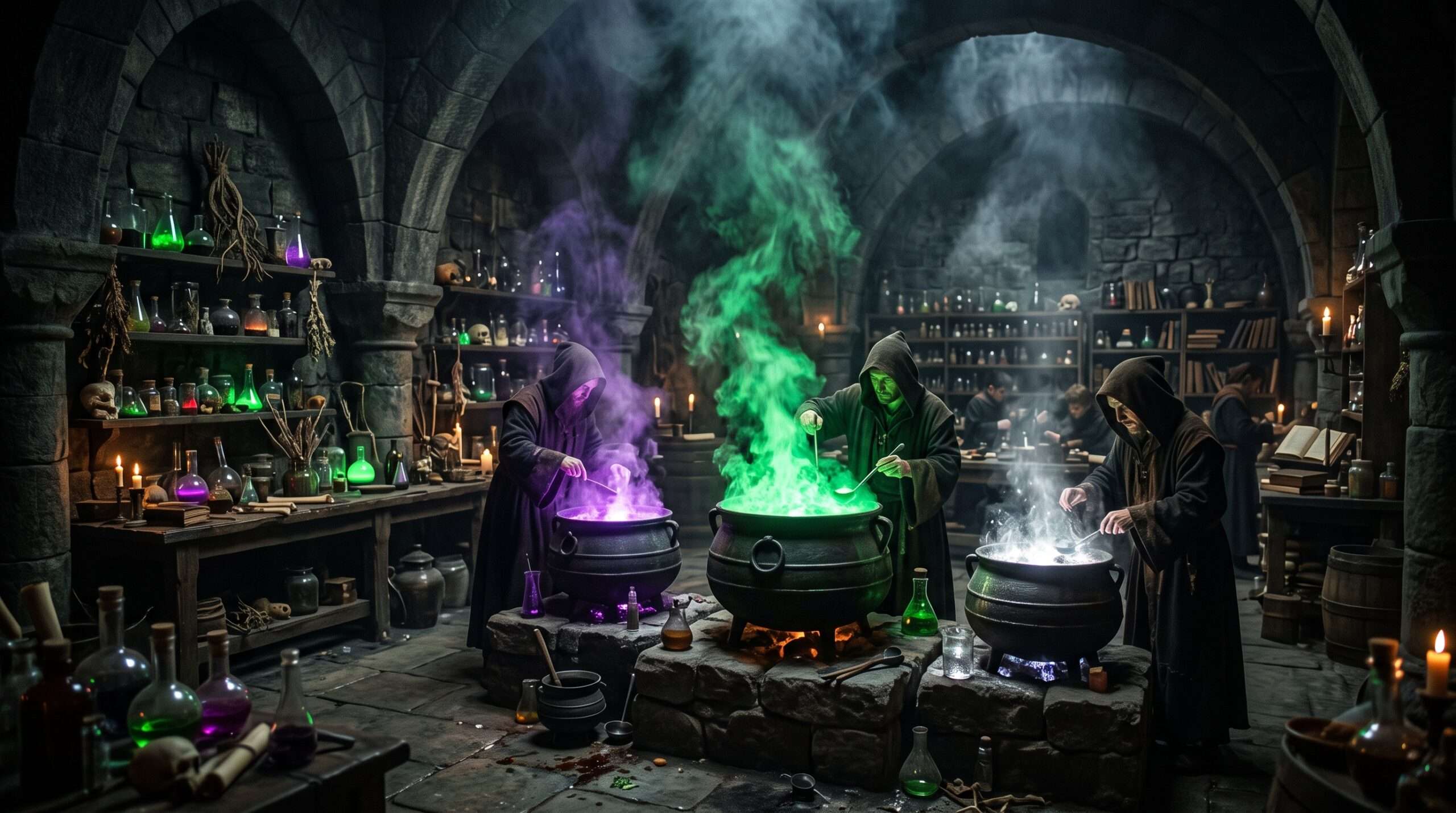
Potions: N.E.W.T. level potions are volatile, complex, and highly dangerous. Brews like the Draught of Living Death or Felix Felicis (Liquid Luck) take months to prepare and require microscopic precision. A failure in a N.E.W.T. Potions exam usually results in the melting of a cauldron, or worse, poisoning the brewer.
No N.E.W.T.s, No Job: Career Requirements in the Wizarding World
Why do Hogwarts students subject themselves to the physical and mental exhaustion of the N.E.W.T.s? Because in the wizarding world, these exam results are your resume. There are no universities or colleges in magical Britain; your N.E.W.T. scores directly determine whether you secure an apprenticeship or an entry-level position at the Ministry of Magic.
If you want a prestigious career, you need the academic credentials to back it up. Here is a look at what it takes to land some of the most sought-after jobs in wizarding society.
Becoming an Auror (The Elite Path)
Aurors are the elite dark-wizard catchers of the wizarding world, operating under the Department of Magical Law Enforcement. Their job is highly dangerous, requiring exceptional dueling skills, tactical thinking, and resilience against the Dark Arts. Because of this, the academic requirements are notoriously brutal.
According to Professor McGonagall, the Ministry of Magic requires an applicant to have a minimum of five N.E.W.T.s, with no grade lower than ‘Exceeds Expectations’. The specific subjects required usually include:
-
Defense Against the Dark Arts (Non-negotiable)
-
Transfiguration
-
Charms
-
Potions (Essential for identifying poisons and antidotes)
Even after achieving these stellar grades, applicants must undergo rigorous physical and psychological testing, and then endure an grueling three-year Auror training program.
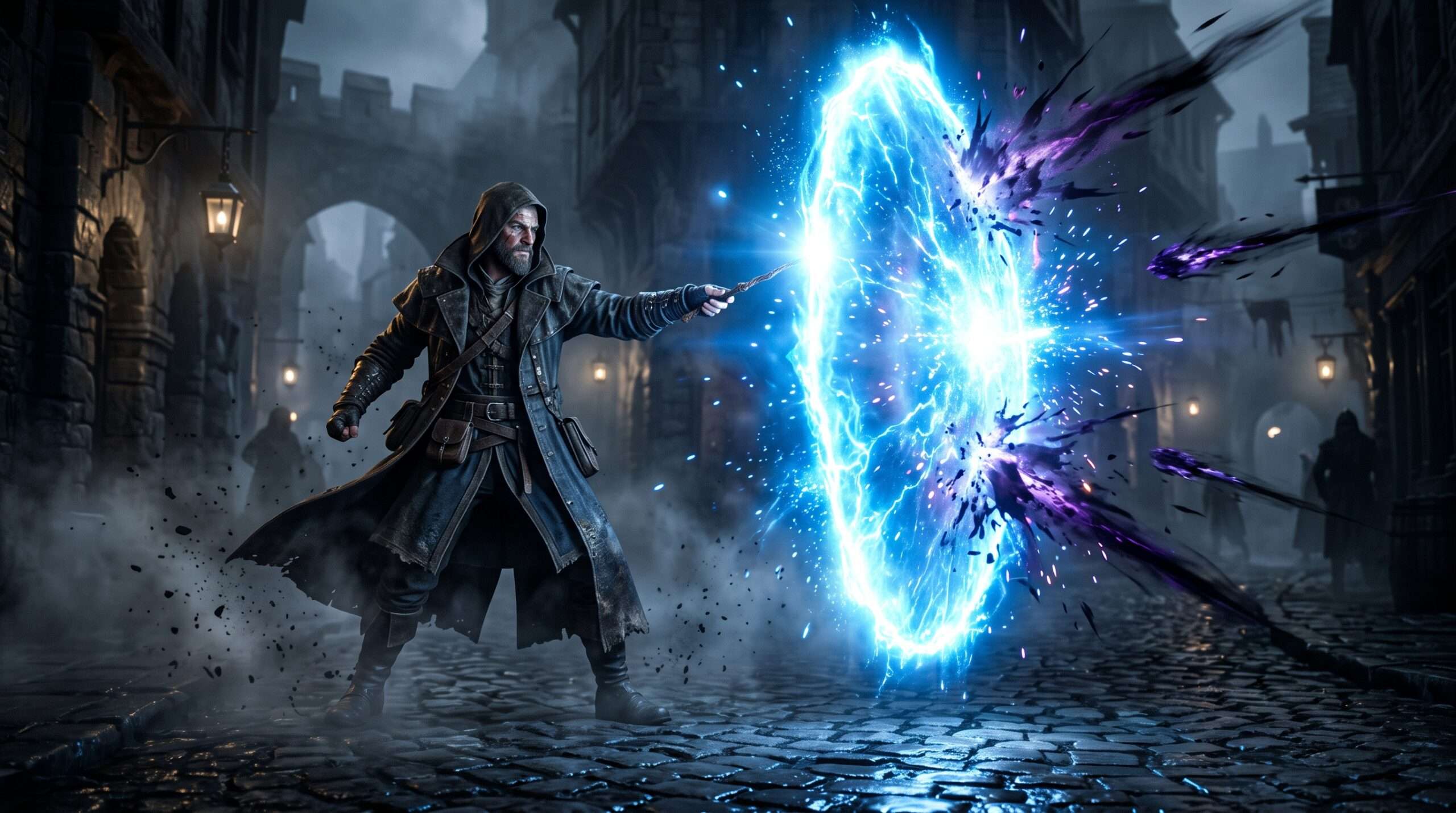 Becoming a Healer at St. Mungo’s
For witches and wizards who wish to save lives rather than fight Dark wizards, becoming a Healer at St. Mungo’s Hospital for Magical Maladies and Injuries is a highly respected path. However, healing magic is incredibly complex, as magic-induced injuries can behave unpredictably.
St. Mungo’s requires a minimum of an ‘E’ (Exceeds Expectations) at the N.E.W.T. level in:
-
Potions (Crucial for brewing medicinal draughts)
-
Herbology (Essential for understanding magical plants used in healing)
-
Transfiguration (Necessary for reversing accidental transfigurations)
-
Charms (Used for restorative enchantments)
-
Defense Against the Dark Arts (To understand and cure dark curses)
Ministry Bureaucrats and Magizoologists
Not every wizard is cut out for the battlefield or the hospital ward. Many opt for administrative roles within the Ministry of Magic or choose to study magical creatures in the wild.
-
Magizoologist: A career studying beasts (like Newt Scamander) heavily relies on an ‘Outstanding’ or ‘Exceeds Expectations’ N.E.W.T. in Care of Magical Creatures and Herbology.
-
The Misuse of Muggle Artifacts Office: Working alongside Arthur Weasley requires a solid N.E.W.T. in Muggle Studies, as officials need to understand non-magical technology to effectively neutralize enchanted objects.
-
Department of Magical Law Enforcement (Standard Administration): Lower-level roles within the Ministry often require decent passing grades (‘Acceptable’ or ‘Exceeds Expectations’) in subjects like Charms and History of Magic, demonstrating a solid foundational education.
Did the Golden Trio Actually Take Their N.E.W.T.s?
This is the question that plagues many fans after finishing Harry Potter and the Deathly Hallows. Because Harry, Ron, and Hermione spent their entire seventh year hunting Horcruxes and battling Lord Voldemort, they entirely missed their final year of schooling. So, how did they fare academically?
The answers, confirmed by J.K. Rowling in post-series interviews and writings, are perfectly aligned with each character’s personality.
Hermione Granger: The Unsurprising Return
In the most “Hermione” move possible, she was the only member of the Golden Trio who chose to return to Hogwarts after the Battle of Hogwarts. She enrolled in an adjusted eighth year alongside other returning students (like Ginny Weasley and Luna Lovegood) specifically to sit for her N.E.W.T.s. Unsurprisingly, she scored ‘Outstandings’ across the board, which paved her way for an illustrious career at the Ministry, eventually culminating in her becoming Minister for Magic.
Harry Potter and Ron Weasley: The Post-War Exception
The big reveal that shocks many fans: Harry Potter and Ron Weasley never took their N.E.W.T.s.
Following the fall of Voldemort, the wizarding world was in shambles, and the Ministry of Magic desperately needed competent, battle-tested wizards to round up remaining Death Eaters. Kingsley Shacklebolt, the new Minister for Magic, instituted an emergency policy: any student who fought in the Battle of Hogwarts was granted an exception to the strict academic requirements for the Auror office.
Because Harry and Ron had unparalleled real-world experience fighting Dark Arts, they were hired as Aurors immediately, bypassing the N.E.W.T.s entirely. Ron worked as an Auror for a few years before leaving to co-manage Weasleys’ Wizard Wheezes, while Harry stayed, eventually becoming the Head of the Auror Office.
Hogwarts’ Biggest Overachievers
While Harry and Ron bypassed the system, the history of Hogwarts is filled with terrifyingly brilliant students who conquered the exams through sheer intellect and obsessive studying.
-
Percy Weasley: Known for his rigid adherence to rules and intense ambition, Percy famously earned top marks in every single one of his N.E.W.T. subjects, securing him a fast-tracked position in the Department of International Magical Cooperation.
-
Bill Weasley: Before becoming a Curse-Breaker for Gringotts Bank (a dangerous job requiring immense skill in ancient magic), Bill achieved twelve O.W.L.s and followed them up with stellar N.E.W.T. scores.
-
Barty Crouch Jr.: Despite becoming a fanatical Death Eater, Barty Crouch Jr. was a terrifyingly intelligent student, achieving twelve O.W.L.s and top-tier N.E.W.T.s before falling in with Voldemort.
-
John Dawlish: An Auror frequently seen working for the Ministry (and frequently getting stunned or hexed in the books). Despite his poor showing against characters like Dumbledore and Neville’s grandmother, it is canonical that Dawlish achieved ‘Outstanding’ on all of his N.E.W.T.s to qualify for his position.
 Frequently Asked Questions (FAQs)
What does N.E.W.T. stand for in Harry Potter?
N.E.W.T. stands for Nastily Exhausting Wizarding Test. It is the final, most difficult set of exams taken by Hogwarts students at the end of their seventh year.
Did Fred and George Weasley take their N.E.W.T.s?
No. The Weasley twins dramatically flew out of Hogwarts during their seventh year in open rebellion against High Inquisitor Dolores Umbridge. They never sat for their N.E.W.T.s, having already opened their highly successful joke shop, Weasleys’ Wizard Wheezes.
Is “Troll” a real grade at Hogwarts?
Yes, “Troll” (T) is the lowest possible failing mark on the official wizarding grading scale. It signifies complete magical incompetence, indicating that a student’s magical execution is as poor as a mountain troll’s.
How old are Hogwarts students when they take N.E.W.T.s?
Students typically sit for their N.E.W.T. exams at the end of their seventh year, meaning they are usually 17 or 18 years old. This correlates with the age Muggle students take their A-Levels in the UK educational system.
The Nastily Exhausting Wizarding Tests are more than just a clever acronym; they are the ultimate proving ground for the magical world. From dodging the dreaded “Troll” grade to surviving non-verbal Charms exams and volatile N.E.W.T.-level Potions, the academic rigor of a seventh-year Hogwarts student is truly terrifying. While heroes like Harry and Ron managed to bypass the system through wartime heroics, for the average witch or wizard, mastering the N.E.W.T.s remains the only path to greatness.
Now, we want to hear from you! If you were a seventh-year student at Hogwarts, which N.E.W.T. subject do you think you could score an “Outstanding” in, and which one would definitely earn you a “Troll”? Let us know in the comments below!