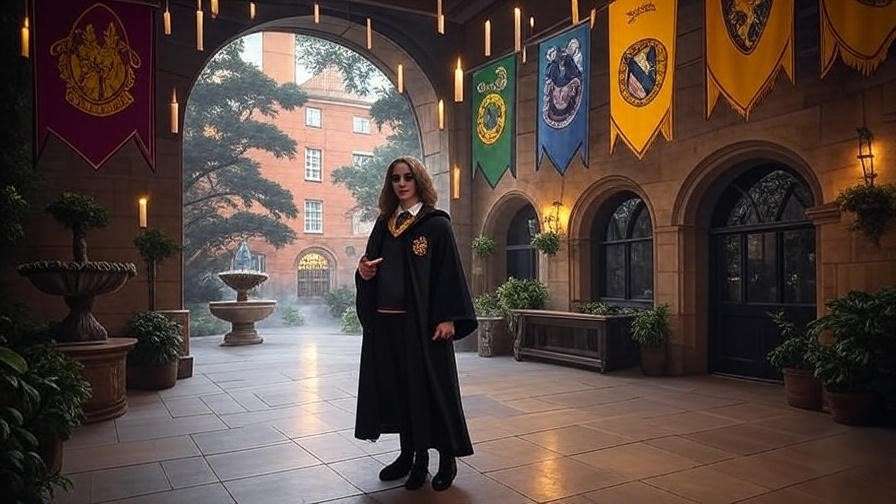
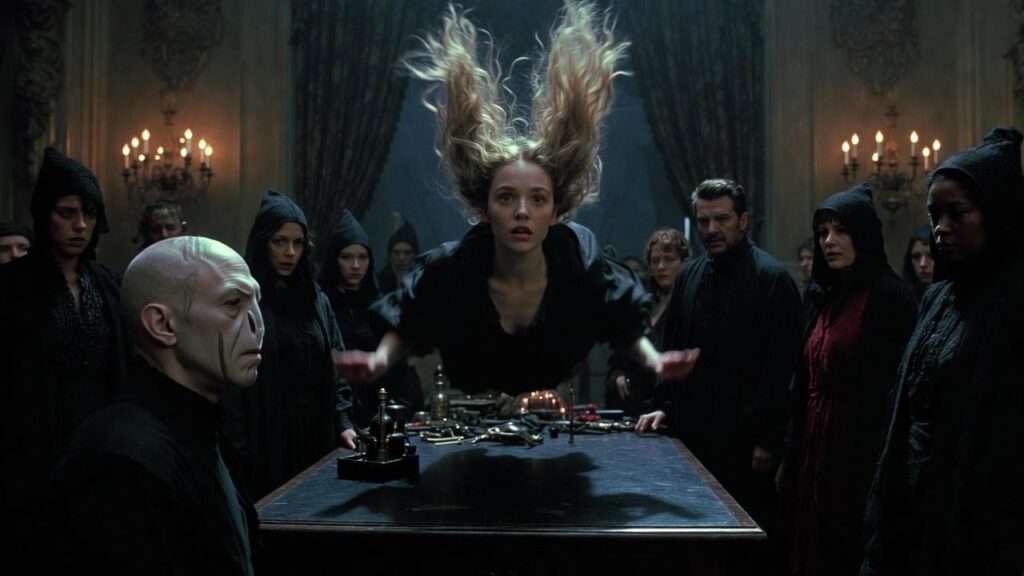
Imagine a dimly lit dining room at Malfoy Manor, where the most feared dark wizard in history presides over a table of masked followers. Above them, suspended helplessly in mid-air, hangs a terrified woman—once a respected Hogwarts professor—begging for mercy before meeting a horrifying end. This chilling scene opens Harry Potter and the Deathly Hallows, setting the darkest tone of the entire series. The victim is Charity Burbage, the Muggle Studies professor whose unwavering belief in equality and tolerance made her a target in Voldemort’s regime of terror.
Though she appears only briefly in the books and films, Charity Burbage in Harry Potter represents one of the most poignant examples of the human cost of prejudice. Her story resonates deeply with fans who want to understand not just the major heroes like Harry, Hermione, and Dumbledore, but also the quieter voices who paid the ultimate price for standing against blood purity ideology. In this comprehensive exploration, we’ll examine her background, beliefs, fateful actions, and tragic death—while uncovering why her sacrifice remains a powerful symbol of courage in J.K. Rowling’s wizarding world.
Who Was Charity Burbage? A Background on the Muggle Studies Professor
Charity Burbage is one of those supporting characters whose limited screen time belies her thematic importance. As the Professor of Muggle Studies at Hogwarts School of Witchcraft and Wizardry, she dedicated her career to bridging the gap between the magical and non-magical worlds.
 Her Role at Hogwarts School of Witchcraft and Wizardry
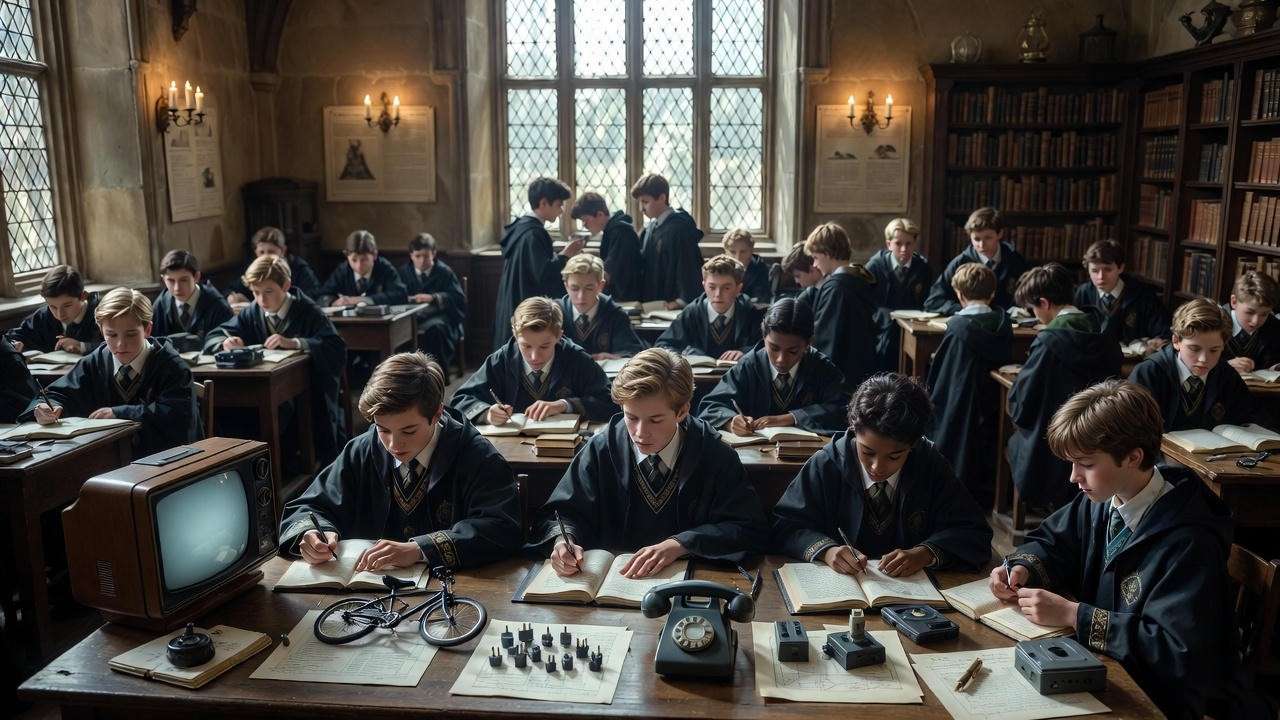
Muggle Studies, an elective subject available to third-year students and above, aimed to educate young witches and wizards about the lives, culture, technology, and society of non-magical people—Muggles. The course covered everything from electricity and transportation to social customs, all designed to foster understanding and reduce fear or contempt toward the Muggle world.
Charity Burbage likely assumed the position sometime after 1992, as the previous professor (an unnamed male wizard) retired or left following the events of Chamber of Secrets. By the mid-1990s, she was firmly established in the role. We get indirect glimpses of her influence through students like Hermione Granger, who chose Muggle Studies as one of her third-year electives despite being Muggle-born herself—perhaps drawn to a professor who treated the subject with genuine respect rather than condescension.
Unlike some earlier incarnations of the class, which occasionally portrayed Muggles as quaint or primitive, Burbage approached the subject with progressive enthusiasm. Her curriculum emphasized equality and integration, challenging the deep-seated prejudices held by many pure-blood families.
Personal Beliefs and Advocacy for Muggle Rights
What truly defined Charity Burbage was her passionate advocacy for Muggle and Muggle-born rights. In an era when blood purity rhetoric was gaining dangerous traction—fueled by Voldemort’s return and the Ministry’s eventual fall—Burbage used her platform boldly.
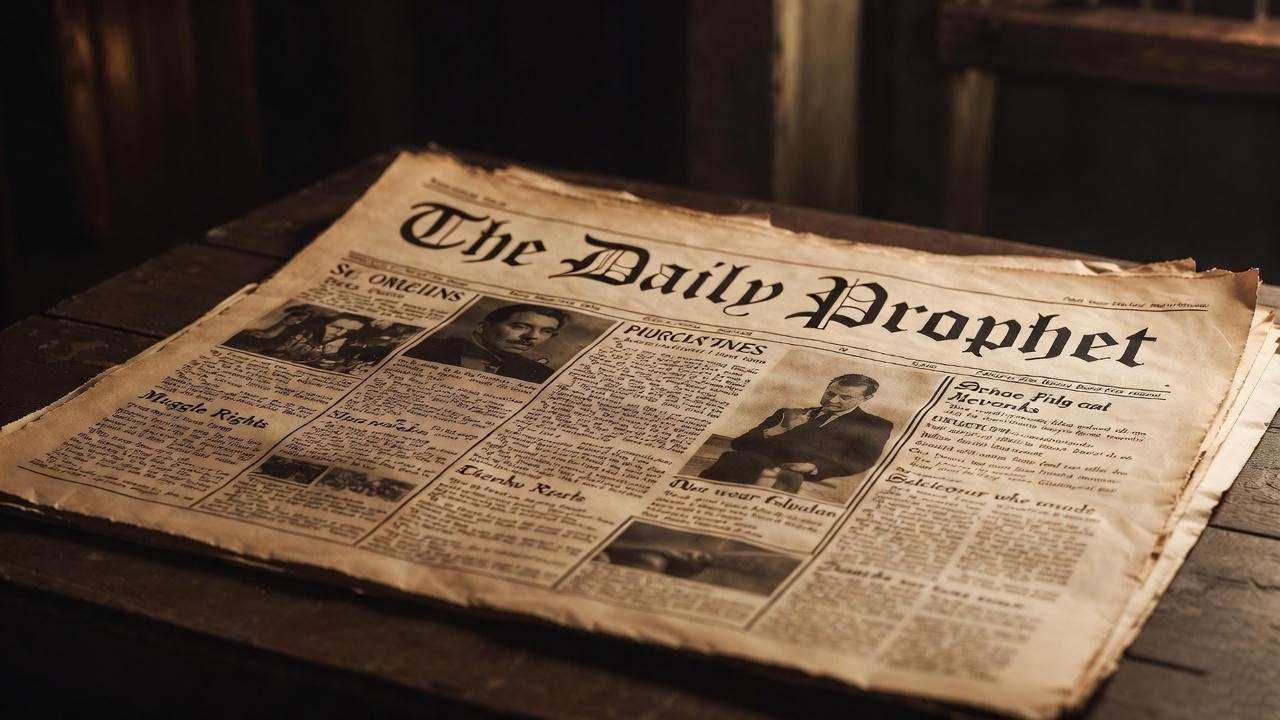
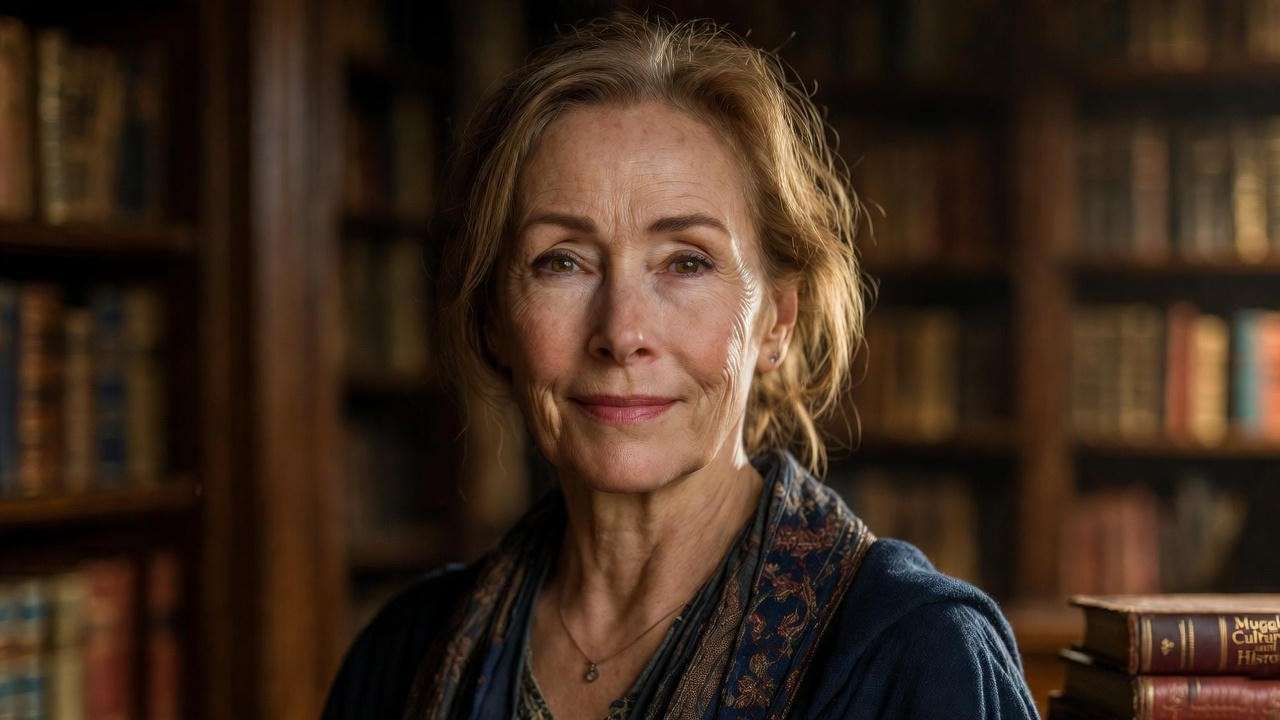 Her most notable act of defiance came in the form of an article published in the Daily Prophet during the summer of 1997. In it, she argued vehemently against the notion that pure-blood wizards were superior or that Muggle-borns were “stealing” magic. She promoted the idea of peaceful coexistence and mutual respect, asserting that the wizarding world could only thrive through understanding rather than isolation or domination.
This stance placed her squarely in opposition to Death Eater ideology, which viewed any sympathy toward Muggles as treason. Her name—Charity—seems deliberately chosen by Rowling as symbolism: in Christian theology, charity is the greatest virtue, representing selfless love. Burbage embodied this through her compassionate worldview.
Blood Status and Personal Life Insights
Canon provides limited details about Burbage’s personal life, but careful reading offers clues. Voldemort refers to her as “Miss Charity Burbage” during the Malfoy Manor scene (in the film adaptation, this is explicit), suggesting she was unmarried. Her blood status is never directly stated, but context implies she was not Muggle-born. When Voldemort kills her, he accuses her of teaching wizards to admire Muggles and advocating intermarriage—crimes in his eyes for a witch of presumed pure or half-blood lineage. Had she been Muggle-born, he likely would have labeled her a “Mudblood” and accused her of stealing magic, as he did with others.
Many fans and analysts conclude she was likely pure-blood or half-blood, making her “blood traitor” status even more egregious to Voldemort. Her betrayal of supposed “pure-blood values” amplified the symbolic weight of her execution.
The Fateful Daily Prophet Article: Catalyst for Tragedy
To fully appreciate Burbage’s fate, we must understand the political climate of 1997.
 Context of the Second Wizarding War
By summer 1997, Voldemort had effectively seized control of the Ministry of Magic through infiltration and coup. The Daily Prophet, once a somewhat independent newspaper, had become a propaganda tool under Death Eater influence. Dissenting voices were silenced, and Muggle-born wizards were forced to register or face imprisonment.
Against this backdrop, Charity Burbage submitted—or perhaps had already published—an article defending Muggle-borns and promoting tolerance. Exact quotes from the piece aren’t provided in the books, but Voldemort paraphrases it mockingly during her captivity.
Voldemort’s Reaction and Propaganda Twist
At Malfoy Manor, as Burbage hangs unconscious above the table, Voldemort awakens her and declares:
“Miss Charity Burbage, who until recently taught at Hogwarts School of Witchcraft and Wizardry… She wished to see Muggles and wizards living in harmony. She even wrote an impassioned defense of Mudbloods in the Daily Prophet.”
He twists her words into a rallying cry for his followers, claiming her views would lead to the “dwindling” of pure-blood lines through intermarriage. This distortion serves as propaganda, reinforcing Death Eater beliefs while justifying her impending execution.
The article almost certainly sealed her fate. Once identified as a vocal opponent of blood supremacy, she became a high-profile target for abduction and public humiliation.
The Chilling Death Scene at Malfoy Manor: A Detailed Breakdown
The opening chapter of Harry Potter and the Deathly Hallows—”The Dark Lord Ascending”—is widely regarded as one of the most disturbing in the series. It serves not only to establish Voldemort’s complete dominance but also to illustrate the brutal consequences for anyone who dares oppose his ideology. Charity Burbage’s death is the centerpiece of this grim tableau.
The Meeting at Malfoy Manor (Deathly Hallows Chapter 1)
The scene unfolds in the opulent yet oppressive dining room of Malfoy Manor. Voldemort sits at the head of the long table, surrounded by his most loyal Death Eaters: Lucius and Narcissa Malfoy, Bellatrix Lestrange, Yaxley, Dolohov, and others. Draco Malfoy, visibly traumatized, sits silently beside his parents. Above the table, suspended upside down by an invisible force and apparently unconscious, is Charity Burbage. A short distance away, the Muggle Studies teacher’s former colleague, Ollivander, lies bound, and a second prisoner—later revealed as the real Ministry employee Pius Thicknesse—is also held captive.
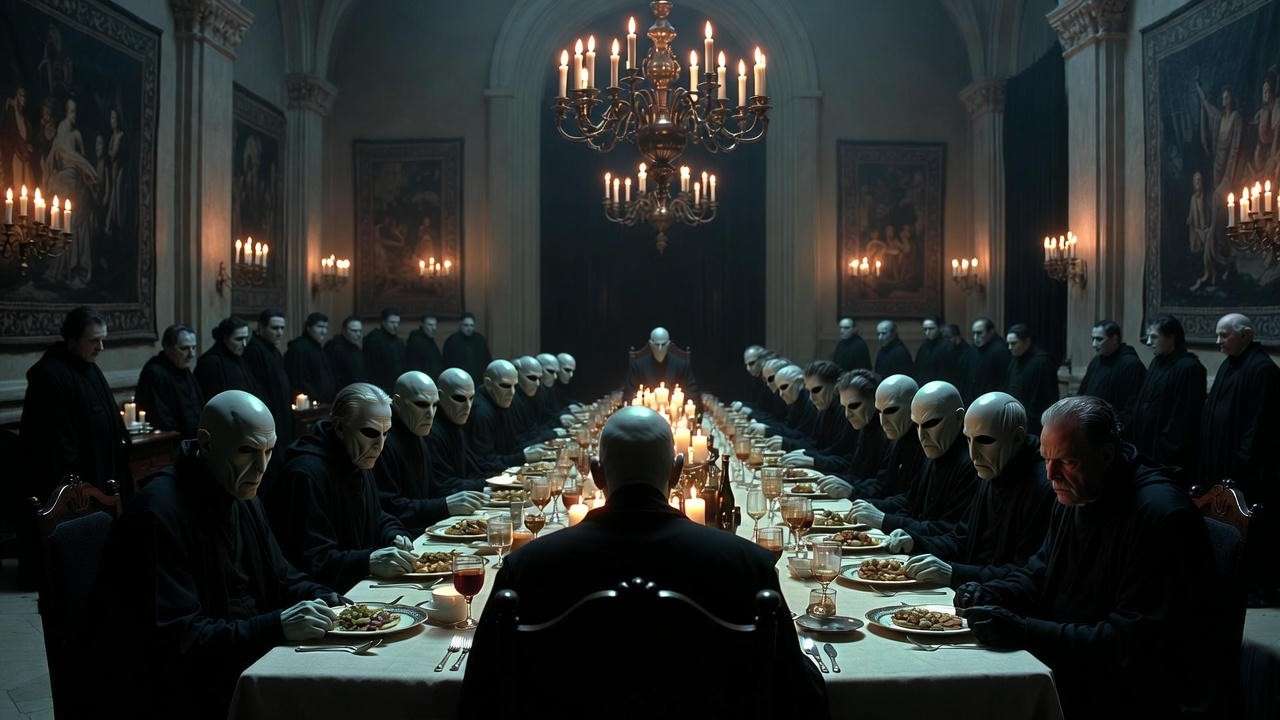 Voldemort uses the gathering to assert control: he mocks Lucius Malfoy for the failure to retrieve the prophecy years earlier, borrows Lucius’s wand (snapping the silver serpent head from the cane in the process), and updates his followers on the status of Harry Potter. Only after this display of power does he turn his attention to the suspended figure.
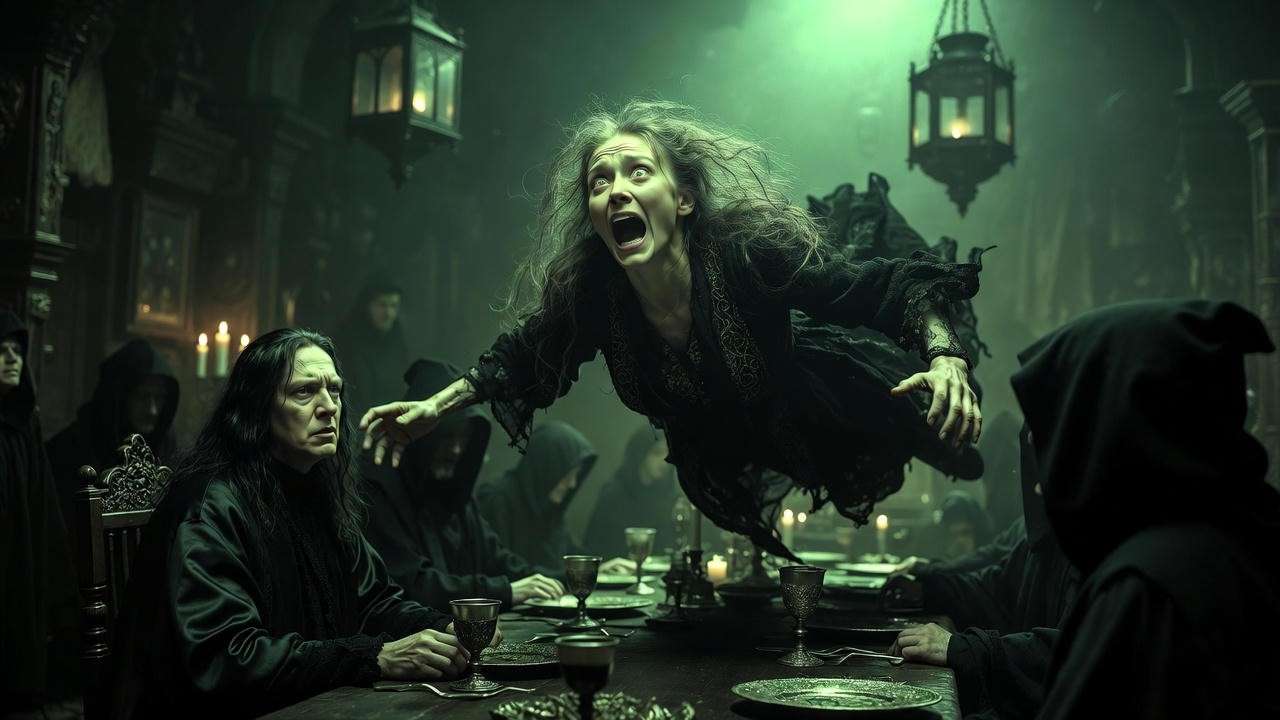
He revives Burbage with a casual flick of his wand. She awakens disoriented, spinning slowly in mid-air, her eyes wide with terror as she realizes where she is and who surrounds her.
Her Final Moments and Plea to Severus Snape
As Voldemort begins his mocking speech, Burbage’s gaze falls on Severus Snape, seated to Voldemort’s right—the position of honor. In a moment that has haunted readers and viewers alike, she cries out:
“Severus… please… please…”
Her voice is described as high-pitched and desperate. She then begs for mercy more generally: “Please… mercy…”
Why did she appeal specifically to Snape? Several layers of interpretation exist:
- Collegial familiarity: As fellow Hogwarts professors for years, they would have attended staff meetings, shared meals in the Great Hall, and collaborated on school matters. Snape, despite his dour reputation, was a known colleague.
- Perceived humanity: Burbage may have believed Snape retained some shred of compassion beneath his cold exterior. Many staff members viewed him as harsh but professional, not overtly sadistic like the Carrows.
- Tragic irony: Readers know Snape is a double agent bound by his unbreakable vow and his love for Lily Potter. He cannot intervene without blowing his cover. Her plea echoes Dumbledore’s final “Severus… please…” in Half-Blood Prince, creating a heartbreaking parallel that underscores Snape’s impossible position.
Voldemort dismisses her appeal with contempt: “Silence,” he says, and then, with deliberate cruelty: “That is enough.”
He accuses her of perverting young wizards’ minds by teaching them to admire Muggles “whose time on this earth should be coming to an end.” He declares that by advocating intermarriage, she would see the pure-blood line “dwindle.” Then, without further ceremony, he casts the Killing Curse:
“Avada Kedavra.”
A flash of green light, and Charity Burbage’s body falls lifeless onto the table, causing glasses to topple and wine to spill. Voldemort then levitates her corpse toward Nagini, commanding the snake to feed—”Dinner, Nagini”—in one of the series’ most visceral displays of horror.
 Book vs. Film Differences
The film adaptation (Harry Potter and the Deathly Hallows – Part 1) remains remarkably faithful to the book but adds visual and emotional weight through performance. British actress Carolyn Pickles portrays Burbage with raw vulnerability. The film explicitly shows her tears and trembling as she spins slowly above the table, heightening the sense of helplessness.
Key differences include:
- In the book, Burbage is suspended upside down; in the film, she is right-side up but still floating horizontally.
- The film adds a brief moment where Burbage sobs uncontrollably after her plea is rejected, amplifying the pathos.
- Voldemort’s line “It is time for you to take your place at the table” is delivered with sardonic politeness in the film, just before the curse.
- The feeding of her body to Nagini is implied rather than shown graphically, preserving the PG-13 rating while retaining the shock value.
Carolyn Pickles’ portrayal earned praise for making an otherwise minor character instantly sympathetic in mere minutes of screen time.
Symbolism and Themes: Charity Burbage’s Stand Against Blood Purity
Though her appearance is brief, Charity Burbage functions as a powerful symbol within Rowling’s broader commentary on prejudice, tolerance, and the dangers of supremacist ideology.
 Representing Prejudice and Intolerance
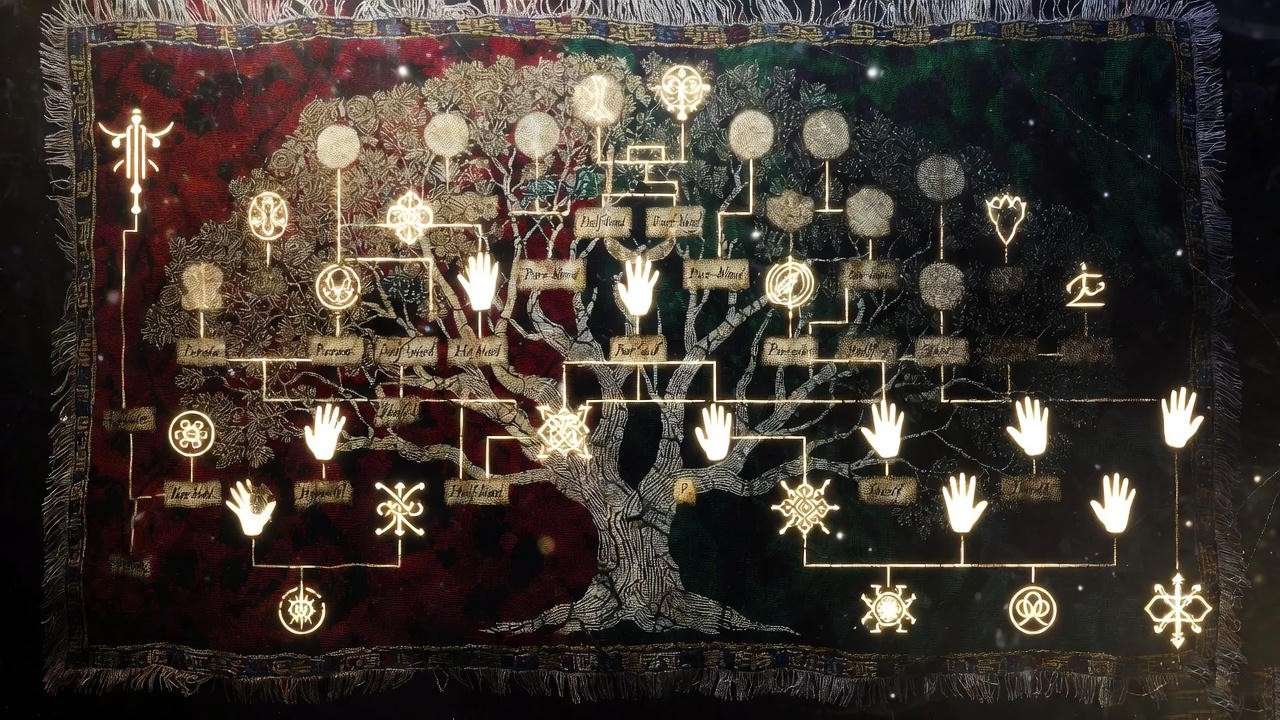
Blood purity in the Harry Potter series is a clear allegory for real-world racism, fascism, and ethnic supremacy movements. Voldemort’s regime mirrors totalitarian states that dehumanize and eliminate perceived “inferior” groups. Burbage’s execution serves as an early warning of how far the Death Eaters will go: not just targeting Muggle-borns, but also pure-blood “traitors” who reject the ideology.
Her death illustrates the regime’s escalating brutality. By killing a Hogwarts professor in front of his inner circle and feeding her body to his snake, Voldemort sends a message: no one is safe if they dissent.
Courage in the Face of Evil
Burbage is an unsung hero—a quiet academic whose weapon was words and education rather than wands or spells. She did not fight on the front lines like members of the Order of the Phoenix, yet her refusal to remain silent in the face of rising hatred cost her everything.
She can be contrasted with other “blood traitors”:
- Sirius Black: Disowned by his family for rejecting pure-blood supremacy.
- Andromeda Tonks: Similarly disowned for marrying a Muggle-born.
- Regulus Black: Turned against Voldemort but acted in secret.
Burbage’s defiance was public—through her teaching and her Daily Prophet article—making her sacrifice arguably more visible and immediate.
Broader Impact on the Harry Potter Series
Her death foreshadows the corruption of Hogwarts itself in the final book. After the Ministry falls, Alecto and Amycus Carrow take over Muggle Studies and transform it into an anti-Muggle propaganda course, complete with torture of students who object. Burbage’s progressive vision is literally erased and replaced with hate.
Thematically, her story reinforces Rowling’s central message: love, understanding, and unity are the true strengths of the wizarding world. Harry ultimately triumphs not through superior blood or power, but through choices rooted in empathy—values Burbage embodied.
Why Charity Burbage’s Story Matters Today: Lessons from Her Tragedy
Charity Burbage’s brief but impactful presence in the Harry Potter series extends far beyond the pages of Deathly Hallows. In an era marked by polarized discourse, rising intolerance, and the spread of misinformation, her story serves as a timeless cautionary tale and a call to action.
Relevance to Modern Issues
The ideology of blood purity that Voldemort espoused mirrors real-world supremacist movements—whether based on race, ethnicity, religion, or nationality. Burbage’s advocacy for understanding and equality, met with brutal silencing, echoes the dangers faced by educators, journalists, and activists who challenge hate speech and discrimination today.
Her Daily Prophet article represents the power— and risk—of using one’s voice in oppressive times. In our digital age, where opinions can spread rapidly but also attract targeted harassment, Burbage reminds us that speaking out against injustice requires courage. She didn’t wield a wand in battle, but her words threatened the regime’s foundation, proving that ideas can be as dangerous to tyrants as spells.
Moreover, the distortion of her message by Voldemort parallels modern propaganda tactics: taking an opponent’s words out of context to demonize them. This tactic is all too familiar in political rhetoric and online discourse, where nuance is often sacrificed for divisive narratives.
Rowling herself has drawn parallels between the Death Eaters’ registry of Muggle-borns and historical atrocities, including the Nuremberg Laws. Burbage’s execution underscores how quickly societies can descend into dehumanization when “othering” becomes normalized.
Legacy in the Wizarding World Post-War
Though Charity Burbage did not live to see Voldemort’s defeat, her death contributed to the broader awakening that led to his downfall. The horrors of the Second Wizarding War, exemplified by scenes like hers, galvanized resistance and ultimately discredited pure-blood supremacy.
In the post-war era under Kingsley Shacklebolt’s Ministry, reforms promoted integration and equality. Muggle Studies likely returned to its original purpose—fostering genuine understanding rather than fear or mockery. While the books don’t explicitly mention a memorial for Burbage, her sacrifice joins those of countless others (like Ted Tonks, Dirk Cresswell, and the many fallen in the Battle of Hogwarts) in reshaping the wizarding world into a more inclusive society.
Fans often speculate that characters like Hermione Granger, who became Minister for Magic, would have ensured voices like Burbage’s were honored in educational reforms.
Expert Reflection: Underappreciated Characters and World-Building
As a long-time analyst of the Harry Potter series, I’ve always believed that Rowling’s mastery lies in her supporting cast. Characters like Charity Burbage—mentioned only in a handful of pages—add profound depth to the world. They show that the war affected everyone, not just the famous trio.
Her story also highlights a subtle evolution in Muggle Studies itself. Earlier books portray the subject as somewhat eccentric or optional, but Burbage elevates it to a vital tool against prejudice. This progression mirrors Rowling’s growing emphasis on social themes throughout the series.
Frequently Asked Questions (FAQs)
Who played Charity Burbage in the Harry Potter films?
Charity Burbage was portrayed by British actress Carolyn Pickles in Harry Potter and the Deathly Hallows – Part 1. Her performance, though brief, is often cited by fans as one of the most emotionally affecting in the entire film series.
Was Charity Burbage Muggle-born?
No direct evidence confirms her blood status, but strong contextual clues suggest she was not Muggle-born. Voldemort’s accusations focus on her teaching wizards to admire Muggles and advocating intermarriage—crimes he associates with “blood traitors” rather than “Mudbloods stealing magic.” Most scholars and fans conclude she was likely pure-blood or half-blood.
Why did she beg Snape for help?
Burbage and Snape were colleagues at Hogwarts for several years, sharing staff duties and professional interactions. In her terror, she likely reached out to the one familiar face in the room, hoping his shared history as a professor might evoke mercy. Tragically, Snape’s position as a double agent made intervention impossible.
What happened to Muggle Studies after her death?
Following the Ministry’s fall, Death Eaters Alecto and Amycus Carrow seized control of Hogwarts. Alecto Carrow took over Muggle Studies, perverting it into compulsory anti-Muggle propaganda. Students were taught that Muggles were inferior and dangerous. After Voldemort’s defeat, the subject presumably reverted to its original educational purpose.
Is there more about Charity Burbage in the books or extended canon?
Burbage appears only in Chapter 1 of Deathly Hallows and briefly in the film adaptation. She receives no further mentions in the main series, Pottermore/Wizarding World writings, or supplementary materials like Cursed Child. Her limited role amplifies her symbolic impact.
How does her death compare to other tragic moments in the series?
Burbage’s death stands out for its cold, public brutality and lack of heroism in the traditional sense. Unlike Sirius falling through the veil or Dumbledore’s calculated end, hers is senseless and dehumanizing. It ranks alongside Cedric Diggory’s murder and the torture of the Longbottoms as one of the series’ darkest moments.
Charity Burbage in Harry Potter may have occupied only a few pages and minutes of screen time, but her story encapsulates the very heart of J.K. Rowling’s message: hatred, left unchecked, destroys everything it touches, while love and understanding—embodied in quiet acts of courage—ultimately prevail.
She was not a chosen one, not a member of the Order, not even a fighter in the conventional sense. Yet by teaching tolerance, writing truth, and refusing to bow to fear, she stood firmly against one of the greatest evils the wizarding world had ever known. Her tragic end at Malfoy Manor serves as both a warning and an inspiration: prejudice thrives in silence, but it crumbles when ordinary people choose compassion over conformity.
Next time you revisit Deathly Hallows, pause during that opening chapter. Look beyond the horror to the woman who believed Muggles and wizards could share the world in harmony—and paid the ultimate price for that belief. Her name was Charity, and in a series filled with acts of bravery, hers remains one of the most profound.
What are your thoughts on Charity Burbage’s role in the series? Do you think she deserves more recognition among fans? Share in the comments below, and explore our other deep dives into lesser-known Harry Potter characters.