Picture the Great Hall of Hogwarts School of Witchcraft and Wizardry during the Start-of-Term Feast. Amidst the floating candles and enchanted ceiling, silver phantoms glide through the walls, greeting wide-eyed first-years. Among them is a famously cheerful, portly spirit who happily wishes the new students luck in being sorted into his former house. To the casual observer, the Fat Friar from Harry Potter is simply the jovial, food-loving House Ghost of Hufflepuff. But beneath his warm smile and welcoming demeanor lies one of the most tragic, grim, and deeply ironic backstories in the entire Wizarding World.
While the Harry Potter books and movies delight audiences with magical whimsy, they often leave the deepest, darkest lore buried in the margins. The cinematic adaptations, in particular, completely sidestep the history of the Hogwarts ghosts, leaving fans to piece together their mortal lives from scattered J.K. Rowling canon, Pottermore (now Wizarding World) archives, and brief textual clues.
If you have ever wondered who the Hufflepuff ghost was in life, why a wizard joined a Muggle religious order, or how he met a gruesome, untimely end, you are in the right place. This comprehensive guide serves as the definitive deep-dive into the lore of the Fat Friar. We will explore his mortal life in the Middle Ages, the fatal mistakes that led to his execution, and the lingering regrets that tethered his soul to Hogwarts castle for eternity.
Quick Character Profile: The Fat Friar at a Glance
Before diving into the historical and psychological depths of his backstory, here is a quick reference guide to the essential facts surrounding Hufflepuff’s resident spirit:
-
House Affiliation: Hufflepuff
-
Status: Ghost (Resident spirit of the Hufflepuff Basement and Hogwarts Castle)
-
Era of Mortal Life: Late 10th to 11th Century (Attended Hogwarts shortly after its founding)
-
Blood Status: Wizard (Specific lineage unknown)
-
Defining Traits: Forgiving, jovial, empathetic, devout, and deeply charitable
-
Fatal Flaw: Naivety regarding Muggle fear of magic
-
Biggest Regret: Never being elevated to the rank of Cardinal within the Catholic Church
The Mortal Life of the Fat Friar: From Hogwarts to the Clergy
To truly understand the tragedy of his death, we must first look at the Fat Friar’s life. Born in the British Isles somewhere around the late tenth century, his life ran parallel to the foundational years of Hogwarts itself.
A True Hufflepuff in the Making
When he arrived at Hogwarts School of Witchcraft and Wizardry, the Sorting Hat placed him into Hufflepuff House. Given the timeline of his life, it is highly probable that he was taught directly by Helga Hufflepuff, one of the four founders of the school.
From an early age, he exemplified the core tenets of Hufflepuff House: hard work, patience, loyalty, and, most importantly, fair play and egalitarianism. Unlike Salazar Slytherin, who valued pure-blood lineage, or Rowena Ravenclaw, who prized elite intellect, Helga Hufflepuff famously declared, “I’ll teach the lot, and treat them just the same.” The young wizard internalized this message of universal acceptance. He possessed a profound empathy for others, a trait that would ultimately dictate his career path—and seal his doom.
 Joining the Mendicant Order
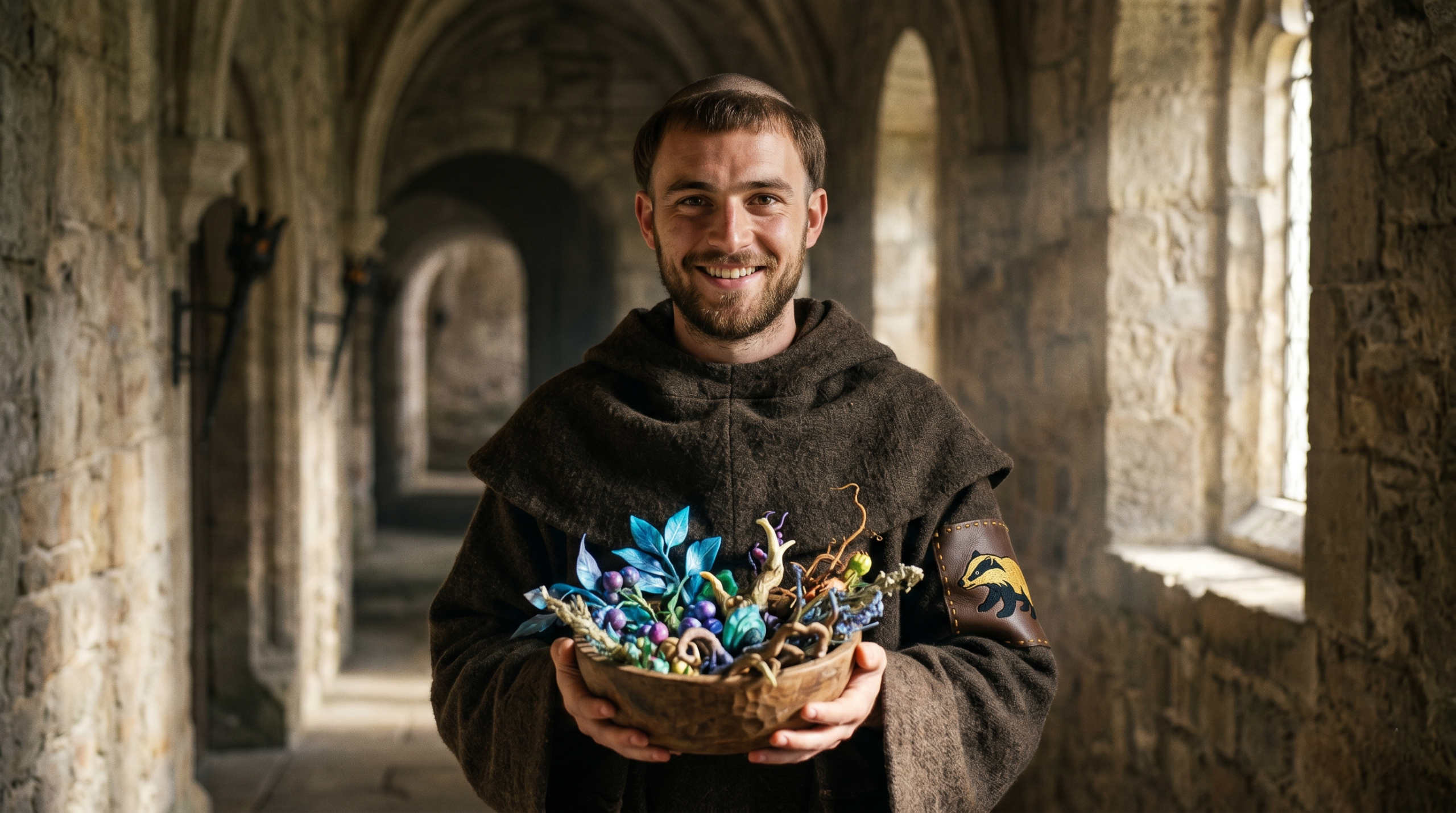
After completing his magical education, the wizard made a highly unusual choice. Rather than retreating into the secretive, insular wizarding community, he entered the Muggle world and joined a mendicant religious order, becoming a friar.
Expert Insight: Wizards and Muggle Religion
In the Middle Ages, the line between the wizarding and Muggle worlds was not yet rigidly enforced. The International Statute of Wizarding Secrecy was not established until 1692. Before this, wizards and Muggles lived side-by-side, albeit with rising tensions. For a wizard possessing Hufflepuff traits—a deep desire to heal, serve, and comfort the less fortunate—joining a monastic order of friars was a logical, albeit dangerous, calling. Unlike monks who isolated themselves in abbeys, friars lived out in the world, directly among the sick, the poor, and the destitute.
By taking vows of poverty and devoting his life to the church, the Fat Friar sought to use his natural gifts (and secretly, his magic) to alleviate human suffering. He spent his days begging for alms, comforting the afflicted, and bringing joy to local villagers. However, mixing wizardry with a deeply superstitious Muggle religious institution during the Middle Ages was a recipe for disaster.
The Tragic Backstory: Why Was the Fat Friar Executed?
The most compelling—and heartbreaking—aspect of the Fat Friar’s lore is the specific manner of his death. He was not killed by a Dark Wizard or a magical beast; he was betrayed and executed by the very Muggles he dedicated his life to serving.
The “Miracles” That Sparked Suspicion
As a friar, he was tasked with tending to the sick. In medieval times, Muggle medicine was primitive, often relying on bloodletting or ineffective herbal poultices. When faced with peasants dying of the “pox” (which could have been a Muggle disease like smallpox, or a mild magical ailment like dragon pox), the Friar could not simply stand by and watch them suffer when he had the power to heal them.
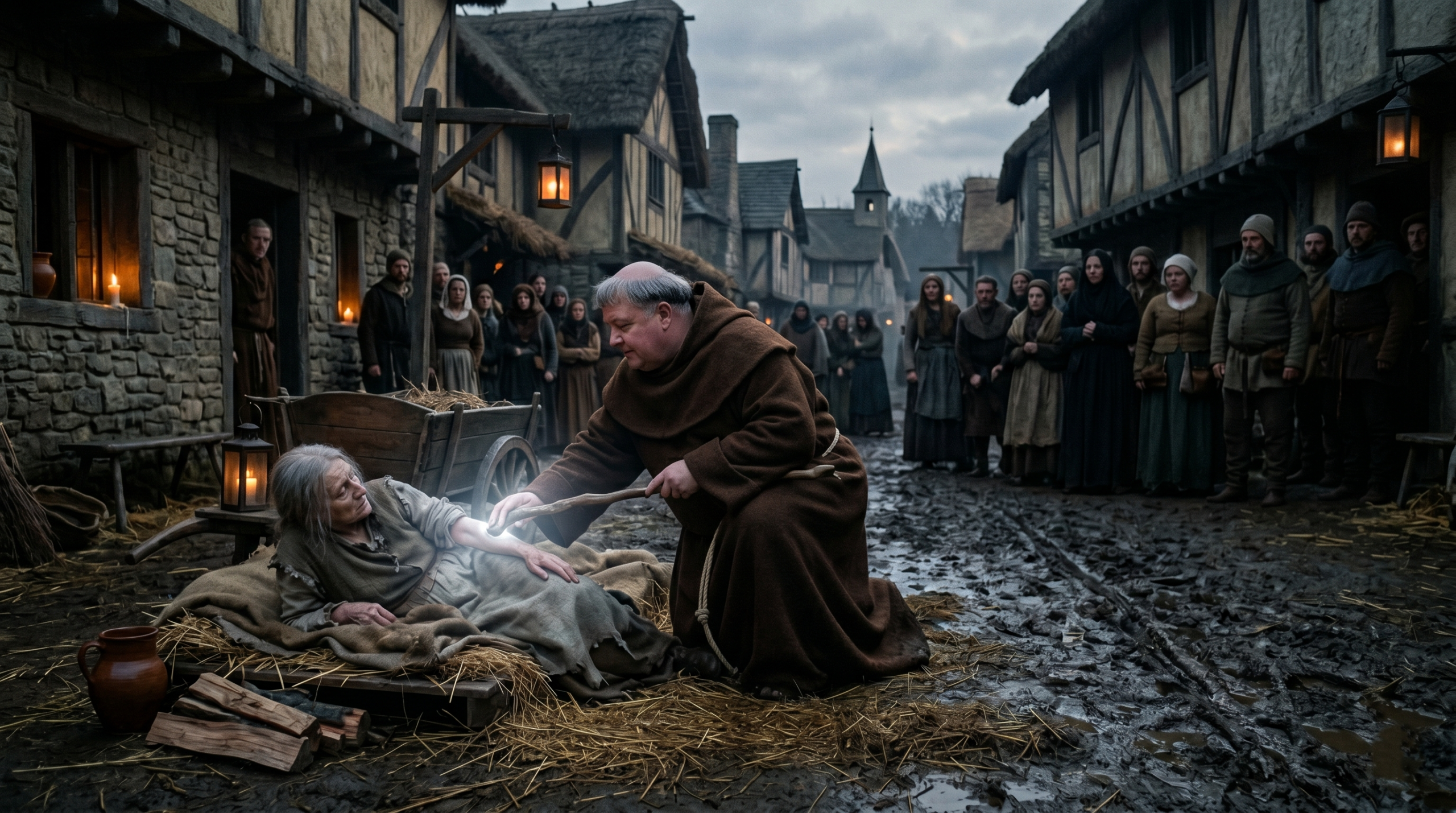
He began using magic to cure the villagers. To hide his wizardry, he disguised his wand as an ordinary wooden walking stick. When visiting the sick, he would simply poke the afflicted peasants with his “stick,” instantly curing them of the pox.
While the peasants likely viewed these instantaneous healings as divine miracles, senior churchmen grew deeply suspicious. The Fat Friar was a bit too successful at his job. In an era where plague and disease were viewed as divine punishment, a single friar miraculously wiping out disease with a wooden stick quickly drew the dangerous gaze of the Inquisition-minded clergy.
 The Communion Cup Incident
If the miraculous healings lit the match of suspicion, the communion cup incident poured fuel on the fire. The Fat Friar was a man of immense joy and humor. He loved food, he loved peace, and he loved making children smile.
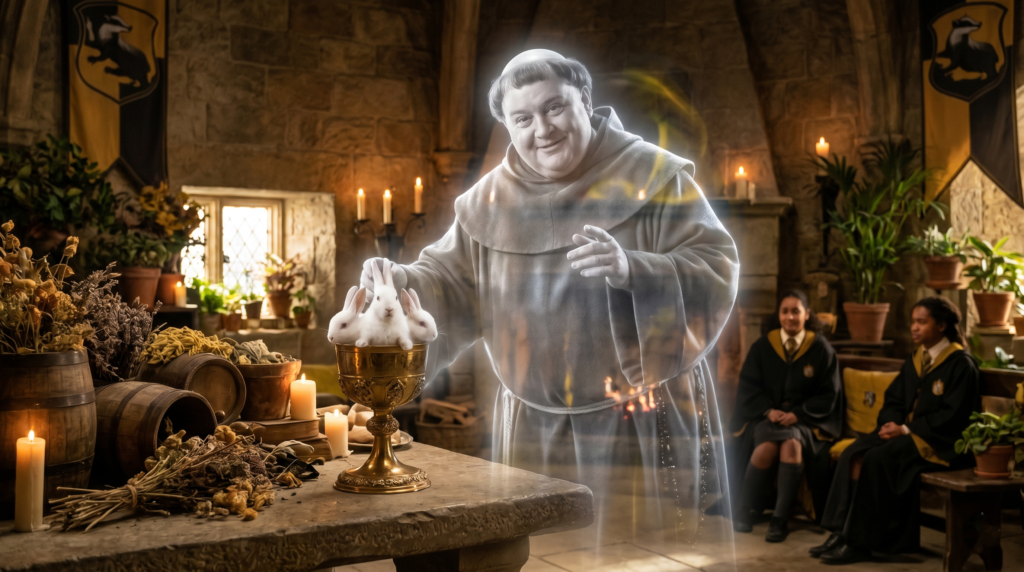
According to Wizarding World canon, the Friar was caught performing a highly ill-advised bit of Transfiguration (or Conjuration) for entertainment. To amuse the local children, he used his magic to pull live rabbits out of the church’s sacred communion cup.
This act, while entirely innocent and born of classic Hufflepuff playfulness, was viewed by the senior clergy as sheer blasphemy. Using a holy relic to perform inexplicable, seemingly demonic tricks crossed a line that the church could not ignore.
Betrayal and Execution
The combination of his suspicious, instantaneous cures and the blasphemous communion cup trick led his fellow clergymen to turn against him. He was arrested, tried, and subsequently executed by the Muggle authorities for witchcraft.
The tragic irony of his death is profound. The Fat Friar was killed for performing the exact duties his religion preached: healing the sick, comforting the poor, and bringing joy to the world. Because he refused to abandon Muggles to their suffering, he paid the ultimate price. His execution highlights the brutal reality of Muggle-Wizard relations prior to the Statute of Secrecy, underscoring exactly why the wizarding world eventually chose to go into hiding to protect themselves from Muggle witch hunts.
Life After Death: The Fat Friar’s Eternal Residence at Hogwarts
When a wizard dies, they have a choice: they can “go on” to the afterlife, or they can leave behind a feeble imprint of themselves to walk the earth as a ghost.
Why Did He Choose to Become a Ghost?
In Harry Potter and the Order of the Phoenix, Nearly Headless Nick explains to a grieving Harry Potter that wizards become ghosts because they are “afraid of death” or because they have “a very strong connection to the locations they haunt.”
For the Fat Friar, his return as a ghost was fueled by a mixture of lingering resentment and unfinished business. Despite his jovial exterior, he harbored a deep, eternal grievance: he was utterly furious that he was executed before he could be made a Cardinal in the Catholic Church. He firmly believed his charitable works (and perhaps a bit of his magical “miracles”) had earned him the promotion. This unfulfilled ambition and his unjust, sudden execution tethered his spirit to the mortal plane. He returned to the one place he had truly felt safe and accepted for who he was: Hogwarts Castle.
Interactions in the Harry Potter Books
For readers of the series, the Fat Friar is a comforting, albeit peripheral, presence in the background of Harry’s adventures. He is first introduced in Harry Potter and the Sorcerer’s Stone during the chaotic moments before the Sorting Ceremony. As the terrified first-years wait in the antechamber, a group of ghosts glides through the walls, engaged in a heated debate. The Friar immediately breaks the tension, cheerfully greeting the students and expressing his sincere hope that many of them will join Hufflepuff, his “old house.”
We see his character shine even brighter in Harry Potter and the Goblet of Fire. During the Start-of-Term Feast, the ghost council convenes to discuss a pressing issue: whether Peeves the Poltergeist should be allowed to attend the feast.
The Defender of Peeves: A Study in Forgiveness
Peeves is notorious for causing chaos, dropping water balloons on students, and insulting the faculty. The other house ghosts—particularly the Bloody Baron and Nearly Headless Nick—are thoroughly exhausted by his antics and vote to banish him from the festivities.
The Fat Friar, however, is the sole voice of mercy. He argues passionately for giving Peeves another chance, firmly stating that they should “forgive and forget.” This interaction is a masterclass in characterization by J.K. Rowling. Even after being betrayed and murdered by the very Muggles he tried to save, the Friar never lost his capacity for forgiveness. He remains the eternal optimist, embodying the Hufflepuff ethos that everyone, no matter how disruptive or flawed, deserves grace and a second chance.
Comparing the Fat Friar to the Other Hogwarts House Ghosts
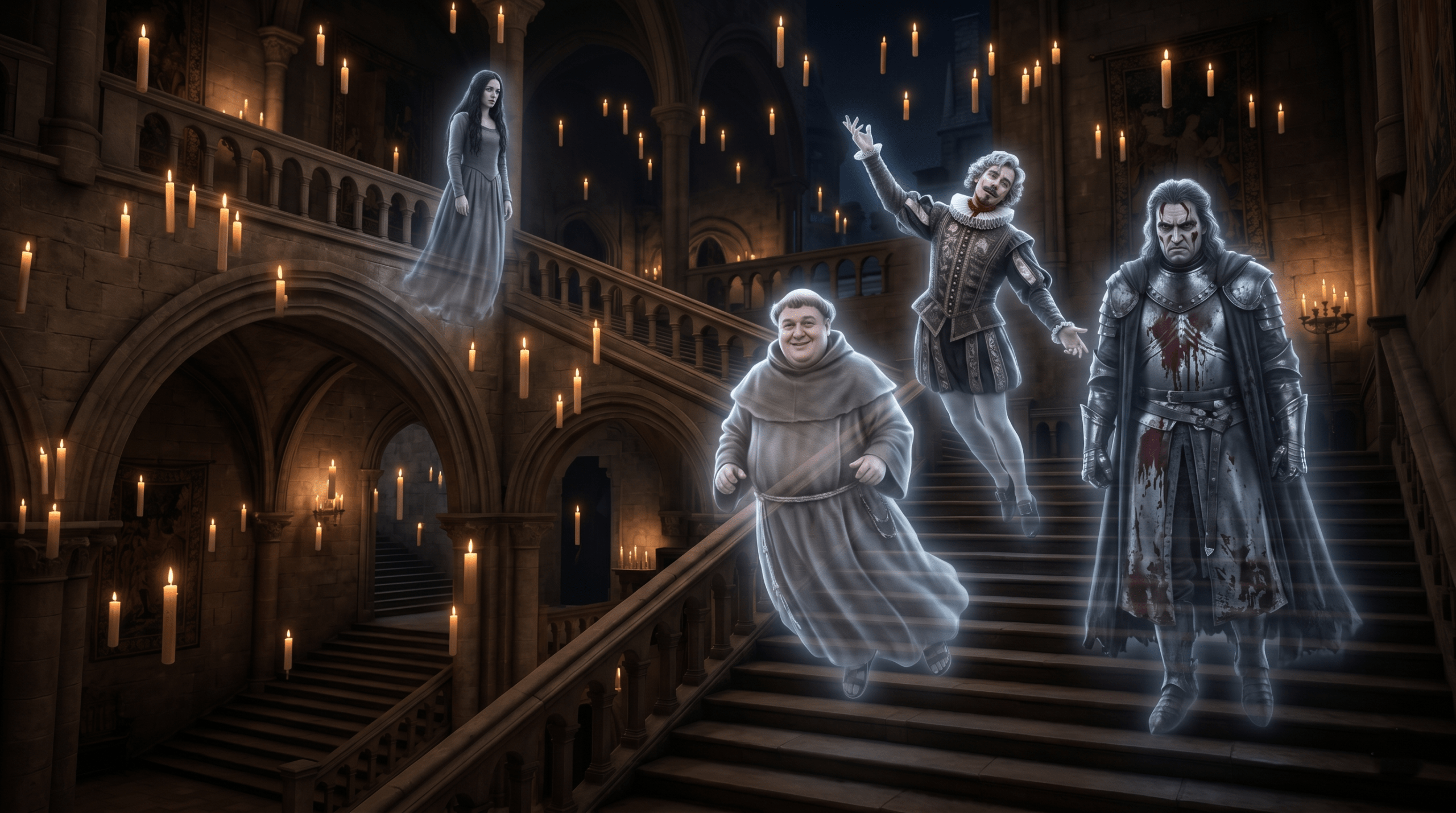
To fully appreciate the narrative brilliance of the Hogwarts house ghosts, we must look at how each spirit perfectly mirrors both the greatest strengths and the fatal flaws of their respective founders. When compared to his spectral peers, the Fat Friar’s unique nature becomes undeniably clear.
-
Nearly Headless Nick (Gryffindor): Sir Nicholas de Mimsy-Porpington represents Gryffindor’s bravery but also its inherent vanity and pride. He is obsessed with his status, deeply hurt by his rejection from the Headless Hunt, and prone to dramatic displays. In contrast, the Fat Friar is entirely devoid of ego, happy to mingle with the newest, most frightened students.
-
The Bloody Baron (Slytherin): The Baron embodies Slytherin’s intense ambition and dark, obsessive passions. Covered in the silver blood of the woman he murdered in a fit of rage, he rules the dungeons through intimidation. The Friar is the polar opposite: non-violent, welcoming, and entirely approachable.
-
The Grey Lady / Helena Ravenclaw (Ravenclaw): Helena Ravenclaw reflects her house’s intellectual elitism and secrecy. She is aloof, fiercely guarded, and deeply ashamed of stealing her mother’s diadem. The Friar, however, is an open book. He holds no dark secrets, preferring the egalitarian camaraderie of the Great Hall over silent isolation.
The Takeaway: The Fat Friar is the only house ghost whose mortal downfall was born of too much kindness. While the others died due to pride, rage, or envy, the Hufflepuff ghost died because he cared too deeply for the suffering of others.
 The Fat Friar on Screen: Movie Portrayal and Cut Content
For fans whose primary exposure to the Wizarding World comes from the cinematic adaptations, the Fat Friar is a highly recognizable visual, even if his screen time is brief.
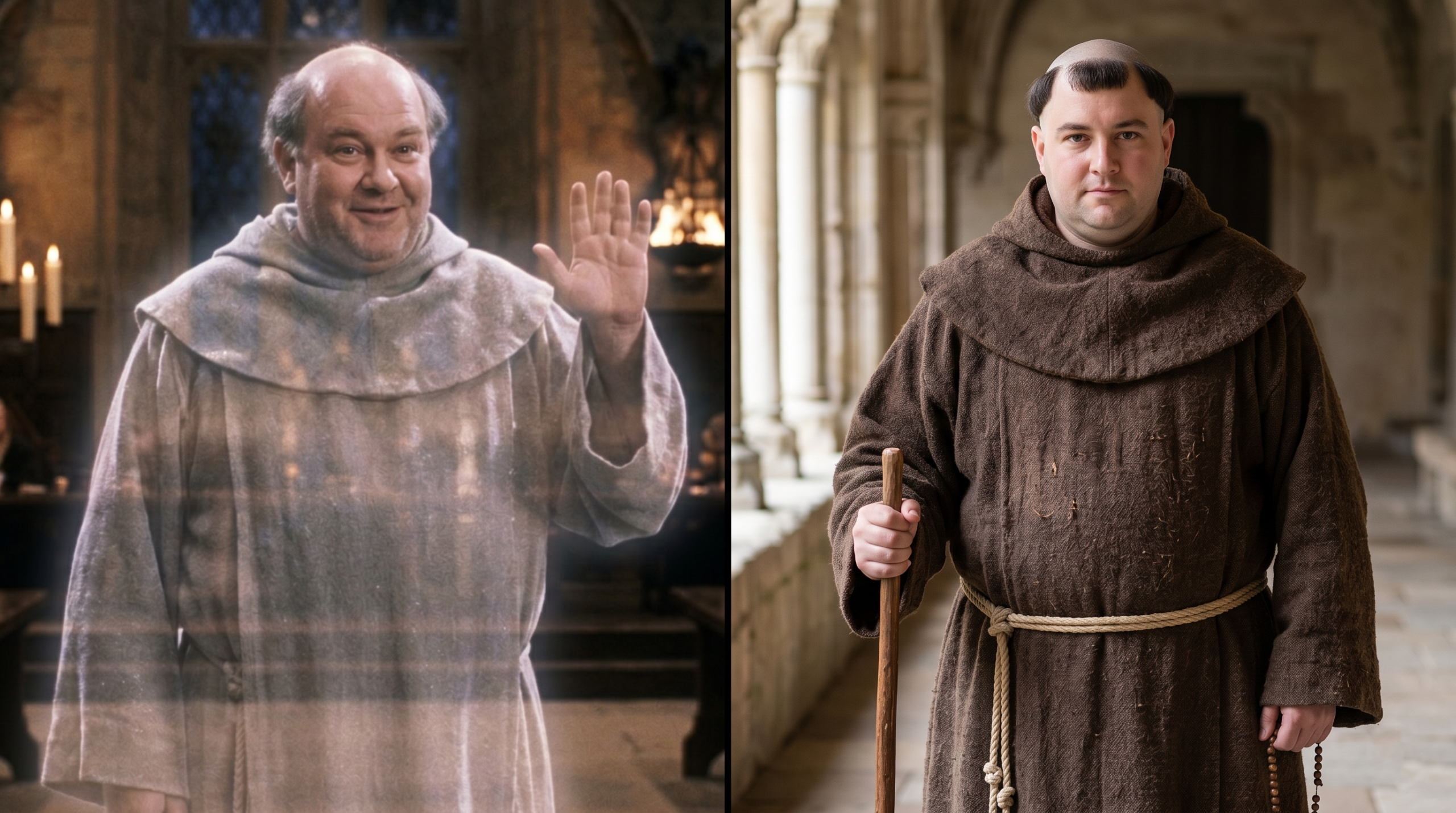
Played by Simon Fisher-Becker
In Harry Potter and the Sorcerer’s Stone (2001), the character was brought to life by British actor Simon Fisher-Becker. He perfectly captured the essence of the character in his short appearance, bringing a boisterous, welcoming energy to the screen as he floated through the Great Hall on the night of Harry’s sorting.
Costume and Visual Design
The film’s costume and makeup departments meticulously designed his look to reflect his medieval Muggle roots. He is dressed in a traditional monastic habit—a heavy, belted robe worn by mendicant friars. Most notably, he sports a classic tonsure, the traditional haircut for monks and friars where the scalp is shaved at the top of the head as a sign of religious devotion and humility.
 Why Didn’t We See More of Him?
Unfortunately, the Fat Friar, much like the other house ghosts, was largely sidelined in the later films. As the overarching plot surrounding Lord Voldemort’s return grew darker and more complex, director David Yates and screenwriter Steve Kloves had to cut significant subplots to maintain a reasonable runtime. This meant the fascinating dynamics of the Hogwarts ghost council—and the Friar’s defense of Peeves (who was cut from the films entirely)—never made it to the silver screen, leaving movie-only fans completely unaware of his rich backstory.
Frequently Asked Questions (FAQs) About the Fat Friar
What was the Fat Friar’s real name?
In official Harry Potter lore, his birth name remains completely unknown. He is referred to exclusively by his title and physical description, highlighting how fully he adopted his religious, charitable identity over his individual ego.
How did the Hufflepuff ghost die?
He was executed by senior churchmen in the Muggle world during the Middle Ages. He was suspected of witchcraft after performing unexplainable “miracles.”
Why was the Fat Friar executed?
The execution was triggered by two main offenses: using his wand (disguised as a walking stick) to instantly cure peasants of the pox, and using Transfiguration to pull live rabbits out of the church’s sacred communion cup to entertain local children.
Did the Fat Friar know Helga Hufflepuff?
Yes, given the timeline of his life (late 10th or 11th century), he attended Hogwarts School of Witchcraft and Wizardry during its foundational years and was almost certainly taught and sorted by Helga Hufflepuff herself.
Is the Fat Friar in the Harry Potter movies?
Yes, he makes a brief but memorable appearance in the first film, Harry Potter and the Sorcerer’s Stone, portrayed by actor Simon Fisher-Becker.
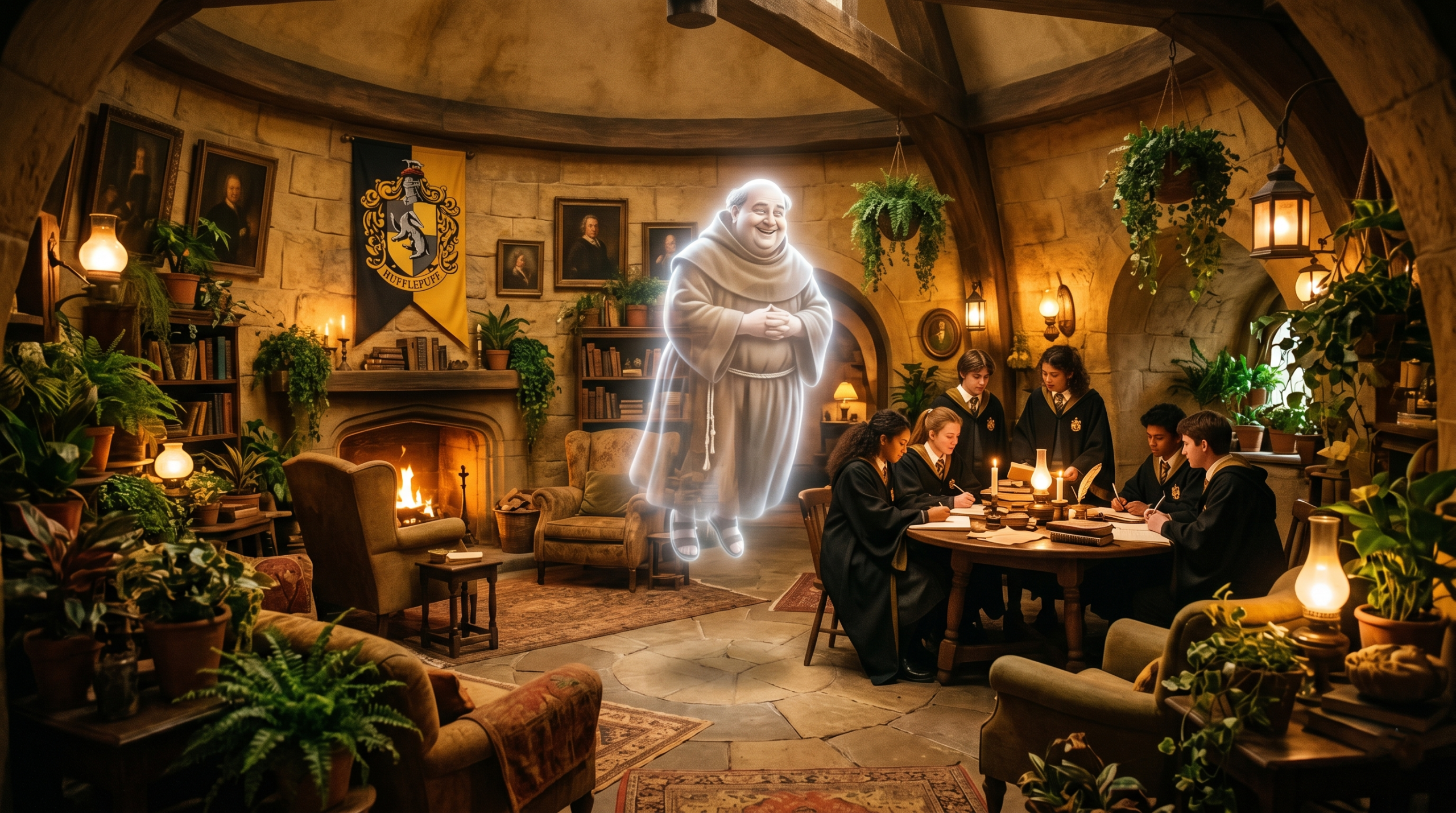
The story of the Fat Friar from Harry Potter is a masterful blend of historical world-building and character-driven tragedy. He went from a gifted wizard handpicked by Helga Hufflepuff to a humble servant of the poor, only to become a tragic victim of Muggle fear and suspicion.
Yet, the true beauty of his character lies in his resilience. Despite suffering a brutal and unjust execution, he refused to let darkness consume his spirit. He carried his jovial nature, his unwavering faith in people, and his immense capacity for forgiveness into the afterlife. By choosing to return to Hogwarts, he ensured that generations of frightened first-years would always have a warm, smiling face to welcome them home. He is, without a doubt, the ultimate embodiment of Hufflepuff House.
Join the Conversation:
Did learning the Fat Friar’s dark backstory change how you view the Hufflepuff ghost? Which Hogwarts house ghost’s history should we explore next—the bloody tragedy of Slytherin’s Baron, or the aristocratic secrets of Ravenclaw’s Grey Lady? Let us know your thoughts in the comments below!