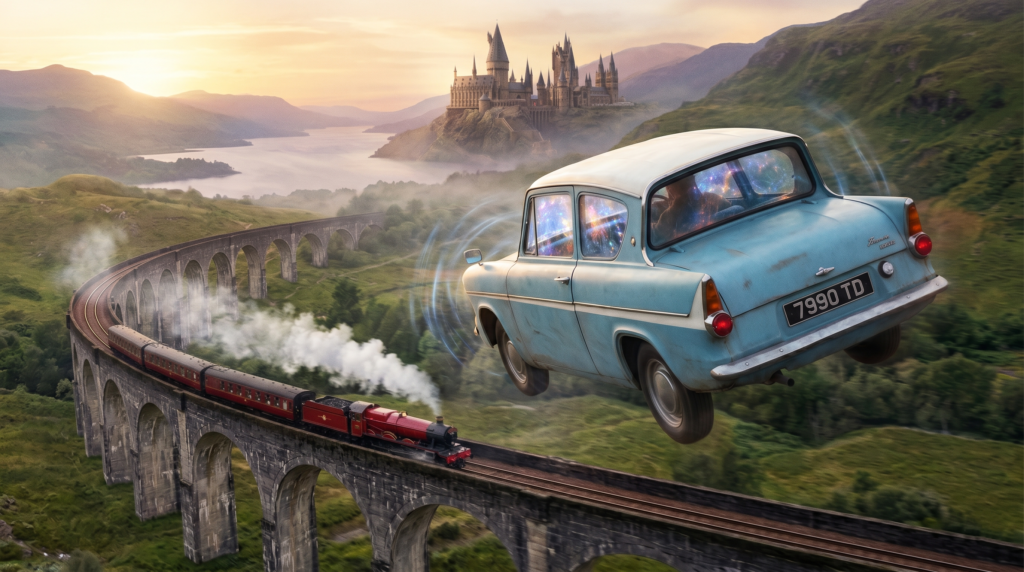
The sputtering cough of a flooded engine. The sudden, terrifying failure of the invisibility booster. The sheer drop toward the scarlet steam engine of the Hogwarts Express. For millions of fans around the globe, the Ford Anglia from Harry Potter is far more than just a vehicle; it is a cinematic icon that perfectly encapsulates the chaotic, magical wonder of the wizarding world. However, while audiences know every twist and turn of Harry and Ron’s disastrous flight to Hogwarts in Harry Potter and the Chamber of Secrets, very few know the extraordinary reality behind the scenes.
Bringing Arthur Weasley’s enchanted, light-blue car to life was an engineering marvel that required a blend of old-school practical effects, innovative camera rigging, and a surprising number of sacrificed vintage automobiles.
In this comprehensive guide, we will dive deep into the untold history of the magical Ford Anglia. From the specific reasons J.K. Rowling chose this modest Muggle car, to the closely guarded secrets of the special effects department, to a bizarre real-world prop heist, this is the definitive story of the little blue car that stole the show. Plus, for the ultimate Potterheads, we have included a complete travel guide on exactly where you can see the surviving authentic prop cars in real life today.
1. Why J.K. Rowling Chose the Ford Anglia 105E
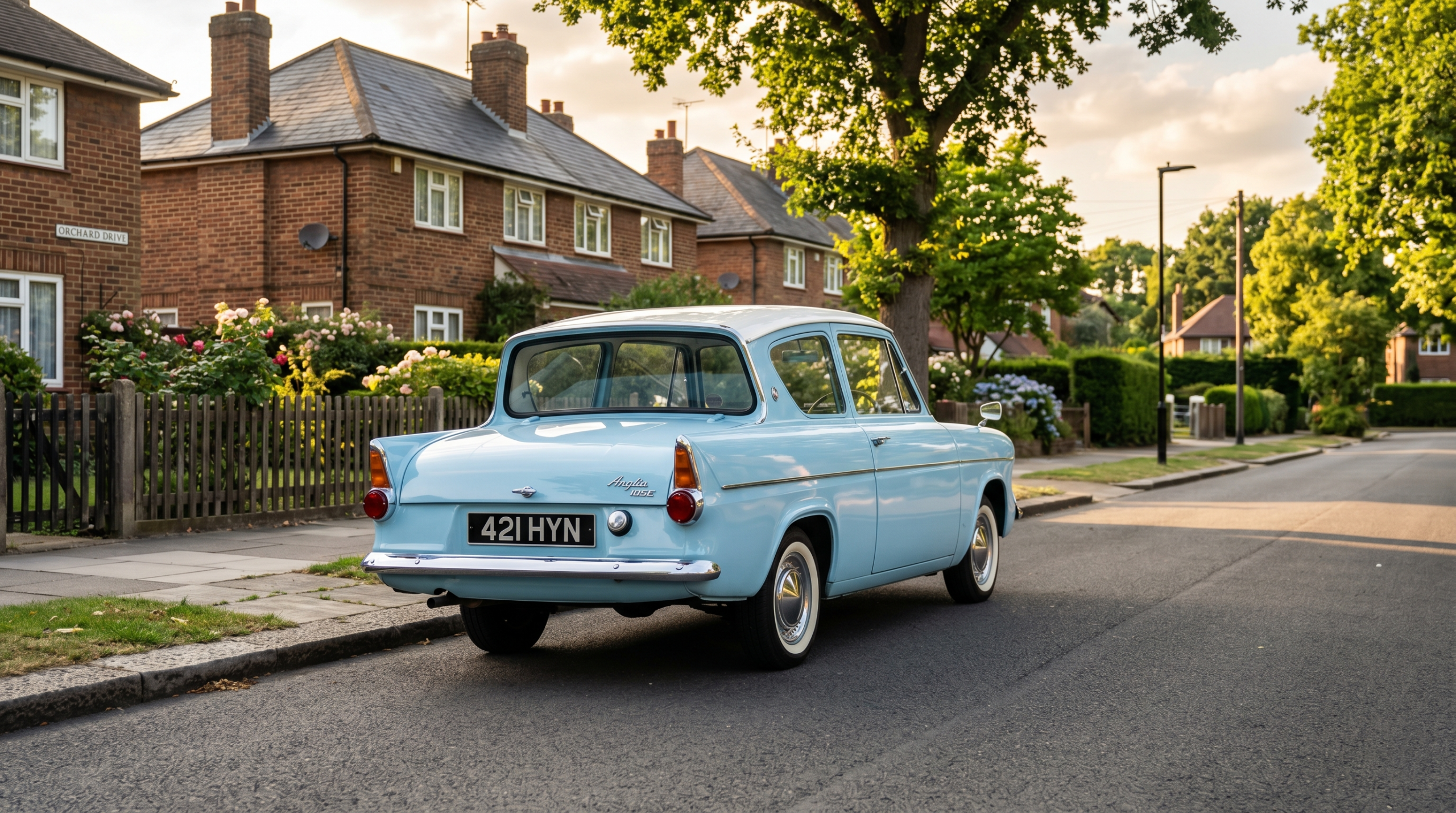
To understand the magic of the flying car, you first have to understand its Muggle origins. The specific model featured in the films and books is a 1962 Ford Anglia 105E. Today, it is recognized globally as a magical artifact, but in mid-century Britain, it was the quintessential, modest family car.
The Muggle Origins
Manufactured by Ford UK between 1959 and 1967, the Anglia 105E was an incredibly popular, affordable vehicle. Its design was heavily influenced by American styling of the era, featuring a distinctive swept-back nose, prominent eye-like headlamps, and, most famously, a reverse-slanted rear window. This unique rear window was marketed as a practical feature that would stay clear of rain and snow, but it gave the car a quirky, slightly awkward charm. It was not a sports car, nor was it a luxury vehicle. It was a sensible, everyday machine—which makes its transformation into a flying, invisible, sentient rescue vehicle all the more brilliant.
 The Personal Connection
The choice of the Ford Anglia was not random. J.K. Rowling infused the Harry Potter series with countless details from her own life, and the flying car is one of the most prominent examples. During her teenage years, Rowling’s close friend, Sean Harris (to whom Harry Potter and the Chamber of Secrets is dedicated), drove a turquoise-and-white Ford Anglia. For Rowling, that car represented freedom, independence, and the rebellious thrill of youth. When it came time to write a scene where Harry is rescued from his miserable existence at the Dursleys’ house on Privet Drive, Harris’s little blue car was the natural inspiration.
The Weasley Aesthetic
From a narrative perspective, the Ford Anglia fits perfectly into the aesthetic of the Weasley family. Arthur Weasley, the patriarch of the family and head of the Misuse of Muggle Artefacts Office at the Ministry of Magic, has a deep, enduring fascination with how non-magical people manage their lives. His obsession with spark plugs, batteries, and engineering makes it entirely believable that he would purchase a battered, second-hand 1962 Ford Anglia just to take it apart in his shed at The Burrow. By enchanting it to fly, expand its interior dimensions, and turn invisible, Arthur unknowingly created a magical artifact of immense power out of a humble, outdated Muggle machine.
2. Behind the Magic: How the Filmmakers Made the Car Fly
When production began on the film adaptation of Harry Potter and the Chamber of Secrets, director Chris Columbus and his team were faced with a monumental challenge. In the early 2000s, Computer Generated Imagery (CGI) was advancing rapidly, but it still struggled to create physical weight and realistic lighting for extended daylight sequences. To make the flight of the Ford Anglia convincing, the team had to rely heavily on practical special effects.
The Mastermind: John Richardson
Enter John Richardson, the Oscar-winning Special Effects Supervisor for the Harry Potter film franchise. Richardson knew that simply rendering a digital car would look cartoonish, especially when the camera needed to capture the panicked expressions of young Daniel Radcliffe (Harry Potter) and Rupert Grint (Ron Weasley) inside the vehicle. The solution was an intricate, highly engineered blend of physical rigs and digital compositing.
The Gimbal Rig
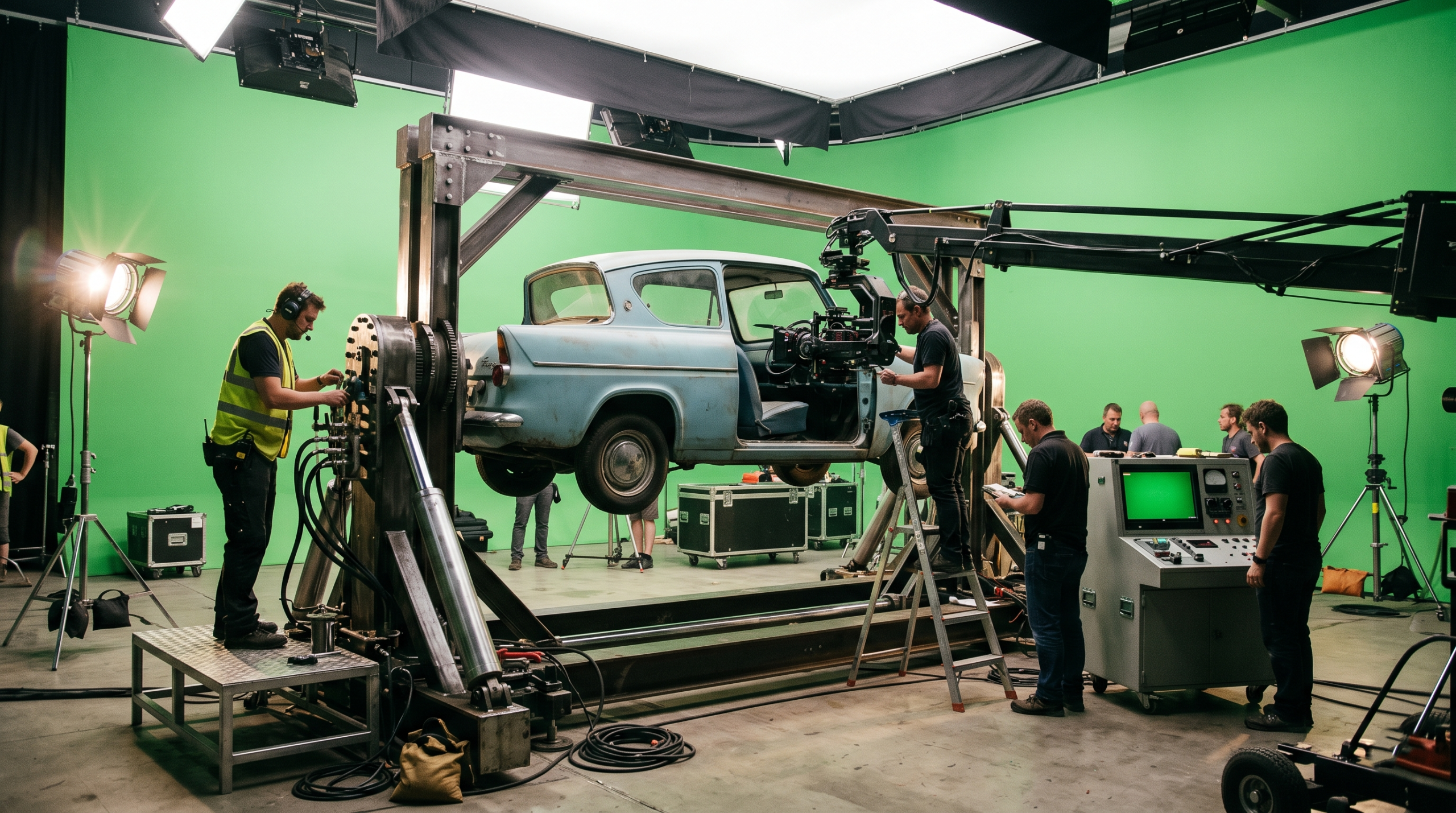
To simulate the erratic, pitching, and rolling motion of a flying car, Richardson’s team completely gutted the engine and heavy internal components of a real Ford Anglia to make it as light as possible. This hollowed-out shell was then mounted onto a custom-built gimbal—a massive, multi-axis pivoting mechanical rig.
This gimbal was attached to the bed of a heavy-duty American pickup truck. The production team then drove this truck down the two-mile-long runway at Leavesden Studios (a former aircraft factory where much of the series was filmed). As the truck hurtled down the tarmac, operators manipulated the gimbal to make the Ford Anglia dive, bank, and shudder in the wind. Radcliffe and Grint were inside the car acting out the scene, allowing the cameras to capture real sunlight reflecting off the windshield, real wind blowing through their hair, and genuine physical reactions to the movement. The truck and the gimbal rig were later digitally erased in post-production and replaced with the soaring landscapes of the Scottish Highlands.
 Creating the Interior Shots
Not all scenes could be filmed on the runway. For the tight, claustrophobic dialogue scenes inside the cabin, the special effects team had to get creative. Standard film cameras are incredibly bulky, and the interior of a 1962 Ford Anglia is notoriously cramped. To solve this, the production team literally sliced several Ford Anglias down the middle. By cutting the cars in half or making the roofs entirely removable, they could pull back the camera far enough to frame the actors perfectly, all while maintaining the illusion that the boys were trapped in a tiny, flying tin can.
3. The Whomping Willow Casualties: How Many Cars Were Used?
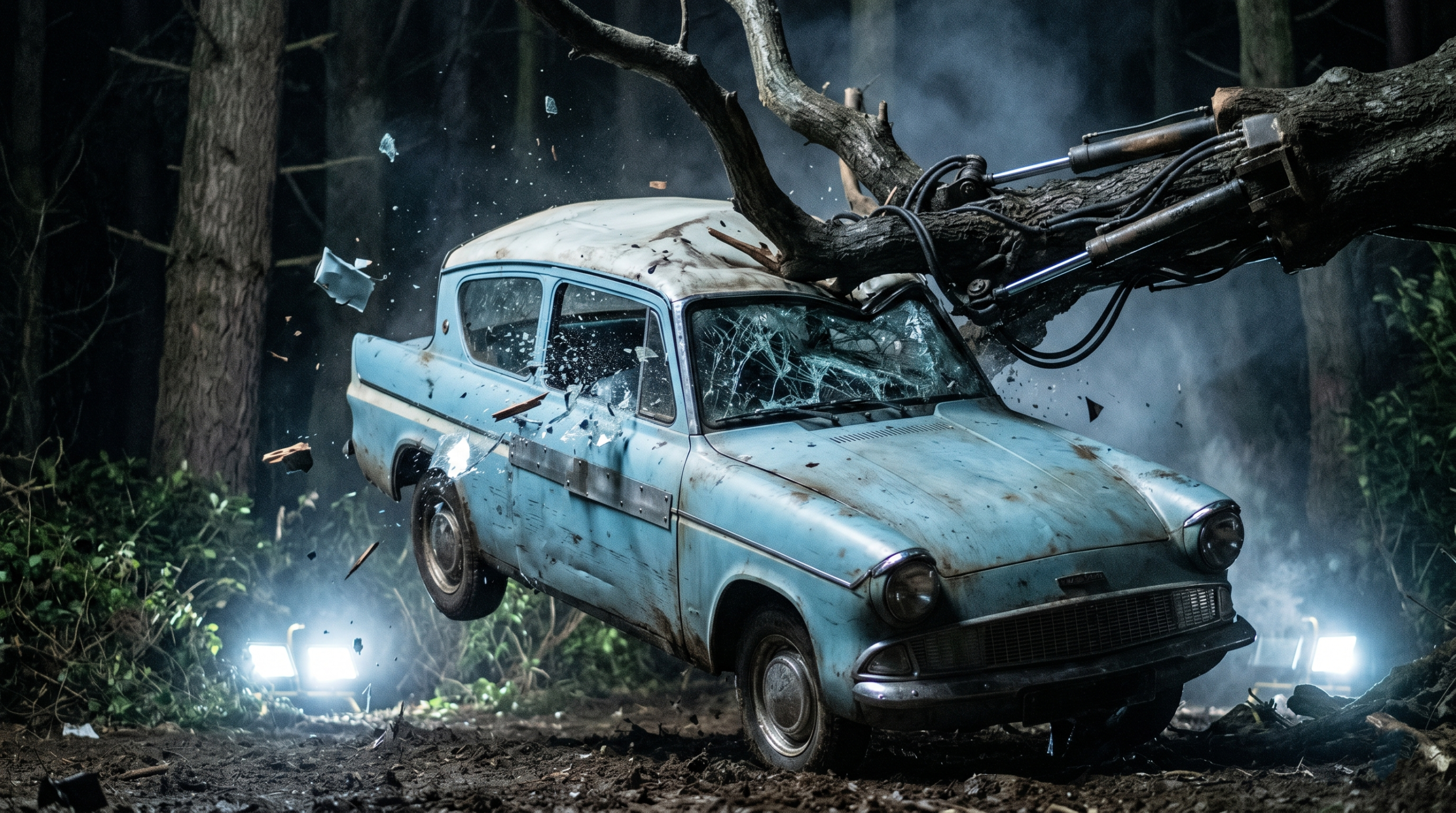
One of the most thrilling and violent sequences in the entire franchise is the crash landing at Hogwarts. After the engine fails, Harry and Ron plummet from the sky and crash directly into the Whomping Willow—a massive, sentient, and highly aggressive magical tree. The tree proceeds to batter the car mercilessly, smashing the glass, denting the roof, and nearly crushing the boys inside.
Filming this sequence was a spectacular exercise in vehicular destruction.
 The “Hero” vs. “Rambo” Cars
The special effects department could not simply use one car for the entire film. In total, the production sourced between 16 and 17½ different Ford Anglias from across the United Kingdom. Many of these cars were found rusting in scrapyards or purchased from classic car collectors, and all of them had to be stripped, rebuilt, and painted the exact same specific shade of light blue.
The fleet of cars was divided into different categories based on their purpose:
-
The “Hero” Cars: These were the pristine, perfectly polished vehicles used for close-ups, promotional photography, and the early scenes at The Burrow. They looked exactly as they would have when they rolled off the factory floor in 1962.
-
The “Rambo” Cars: These were the heavy-duty stunt cars built specifically for the Whomping Willow scene. To prevent the roof from instantly collapsing under the massive weight of the mechanical tree branches (which were real, hydraulic props built on set), the “Rambo” cars were internally reinforced with heavy steel roll cages.
Despite the reinforcements, the Whomping Willow scenes were brutal on the props. Multiple cars were entirely flattened and destroyed during the takes. Every time a car was smashed beyond use, the team would wheel in the next identical, reinforced Ford Anglia to continue filming.
The “Wild” Cars
After the car spits Harry, Ron, and their luggage out onto the Hogwarts lawn, it drives off into the Forbidden Forest. In the film’s climax, it returns as a feral, wild beast of a machine to save the boys from the Acromantulas. For these scenes, the props department created the “Wild” cars. These versions were artificially rusted, covered in moss, scratched, and battered to look as though they had survived months fending for themselves in the dark, magical woods.
4. The Strange Real-Life Mystery: The 2005 Prop Theft
The story of the magical Ford Anglia doesn’t end when the cameras stopped rolling. In 2005, the car became the center of a bizarre, real-world criminal investigation that felt ripped straight from the pages of a mystery novel.
The Cornwall Heist
Following the completion of filming, several of the surviving prop cars were stored in various locations. One of these authentic, screen-used cars was being stored under a tarpaulin at South West Film Studios in St. Agnes, Cornwall, England. In October 2005, the car mysteriously vanished.
Thieves managed to bypass the studio’s security, hook the engineless prop car to a tow truck, and drag it away in the dead of night. Because the car lacked a functioning engine, it could not be driven, making the logistics of the heist highly suspicious and thoroughly planned.
The Recovery
The theft immediately made international headlines. The intense media scrutiny and police investigation seemingly panicked the thieves, who realized that fencing one of the most famous, easily identifiable movie props in the world would be nearly impossible.
A few months later, the police received an anonymous tip. The Ford Anglia was found abandoned at the ruins of Carn Brea Castle, a 14th-century site not far from where it was stolen. The car was recovered intact and safely returned. The real-world value of authentic Harry Potter props has skyrocketed in the decades since the films were released, and this surviving car is considered an invaluable piece of cinema history.
5. Lore vs. Reality: What Ultimately Happened to the Car in the Wizarding World?
While the real-world props were being exhibited or stolen, fans have long debated the canonical, in-universe fate of Arthur Weasley’s enchanted car.
The Canon Fate
In both the book and the film version of The Chamber of Secrets, the car’s final appearance is a heroic one. After living wild in the Forbidden Forest, the car suddenly bursts into the clearing in the Acromantula hollow. Honking its horn and blasting its headlights, it allows Harry, Ron, and the cowardly dog Fang to dive inside before speeding backward out of the hollow, fighting off giant spiders along the way. Once it safely deposits them at the edge of the forest, it revs its engine and disappears back into the darkness.
Fan Theories and J.K. Rowling’s Original Plan
What happened to the car after 1993? The Harry Potter fandom has spawned dozens of theories. Some believe it lived out its days peacefully among the centaurs and unicorns. Others theorize that it eventually ran out of magical energy and rusted away into the soil of the forest.
One of the most popular fan theories was that the car would make a triumphant return during the Battle of Hogwarts in The Deathly Hallows, bursting from the treeline to run over Death Eaters and defend the castle. In fact, J.K. Rowling herself once hinted in an interview that she originally intended for the car to make a reappearance in the final books. However, as the tone of the final book became significantly darker and more serious, the whimsical inclusion of a flying Ford Anglia no longer fit the narrative, and its ultimate fate was left to the fans’ imaginations.
6. The Ultimate Fan Guide: Where Can You See the Flying Ford Anglia Today?
If reading about the filming secrets has sparked your desire to see this cinematic icon in person, you are in luck. Several of the surviving, authentic prop cars (and incredibly accurate replicas) are currently on public display around the world. Here is your definitive guide to tracking them down.
Warner Bros. Studio Tour London (The Making of Harry Potter)
The ultimate destination for any Potterhead is the studio where the magic was actually filmed in Leavesden, just outside of London.
-
The Exhibits: There are actually multiple Ford Anglias here. You can find a battered, feral version suspended in the spectacular Forbidden Forest exhibit. Another version is permanently crashed into a massive replica of the Whomping Willow on the studio backlot.
-
The Green Screen Experience: Inside the studio, there is a hollowed-out replica set up against a green screen. Visitors can sit inside the car and have professional photos and videos taken, making it look as though they are flying over the Hogwarts Express.
Universal Studios Theme Parks (Hollywood & Orlando)
Universal Studios has meticulously recreated the Wizarding World, and the car makes prominent appearances in both major US locations.
-
Universal’s Islands of Adventure (Orlando): If you join the queue for Hagrid’s Magical Creatures Motorbike Adventure coaster in the Hogsmeade section, you will encounter a beautifully detailed, heavily rusted Ford Anglia abandoned just off the pathway. It is a fantastic photo opportunity.
-
Universal Studios Hollywood: Similar to Orlando, guests exploring the Wizarding World in California can find the crashed car nestled near the queue for the Harry Potter and the Forbidden Journey ride inside the castle.
 The National Motor Museum (Beaulieu, UK)
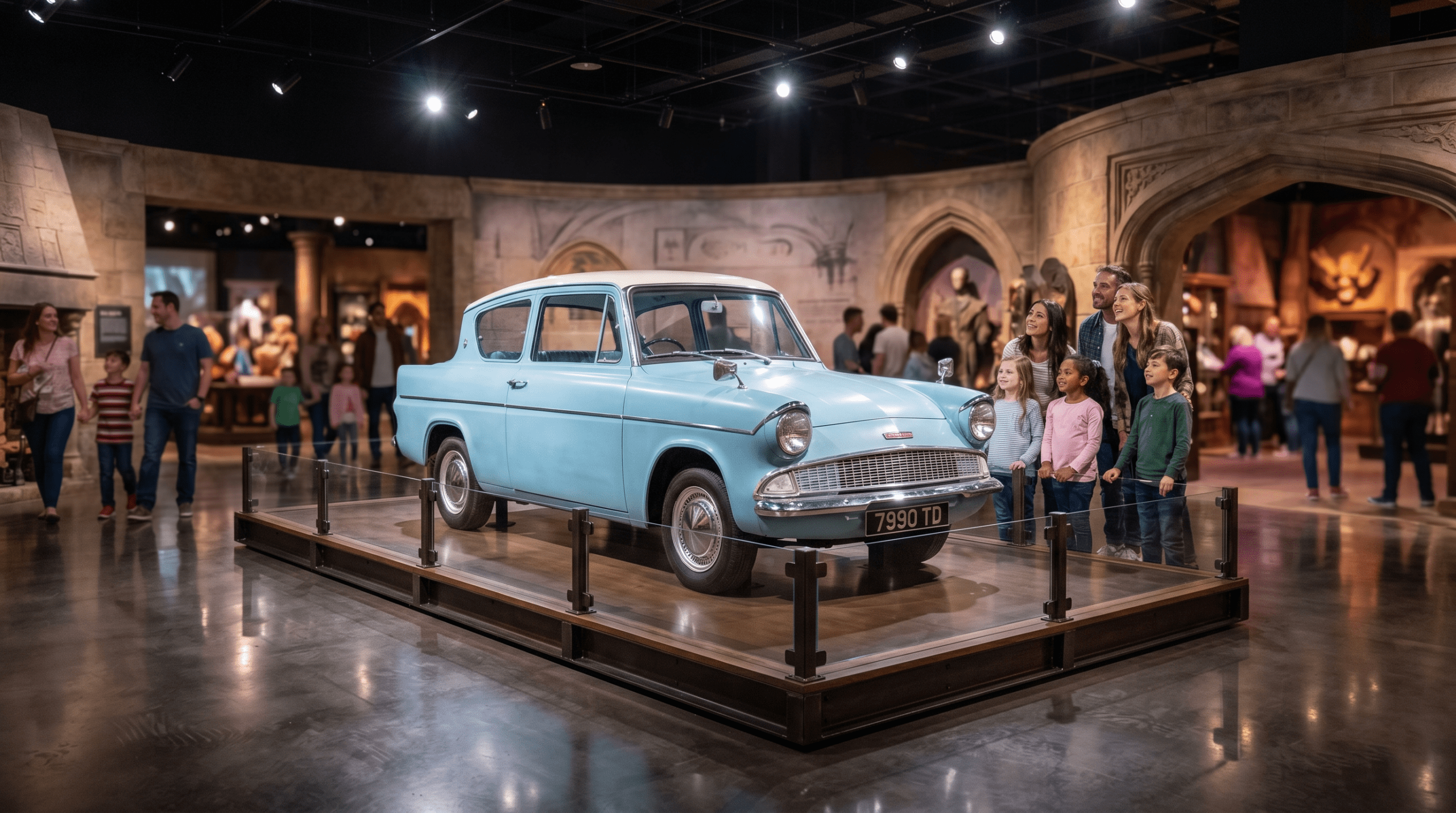
For fans who appreciate both cinema history and classic British automobiles, the National Motor Museum in Beaulieu, Hampshire, is a must-visit. The museum houses an extensive collection of famous screen vehicles, and they proudly display one of the authentic, screen-used Ford Anglias from The Chamber of Secrets. Because it is preserved in a museum environment rather than an outdoor theme park queue, this is one of the best places to see the vehicle’s intricate details up close.
Travel Tip: Whether you are visiting the Warner Bros. Studio Tour or Universal Studios, tickets routinely sell out weeks (and sometimes months) in advance. Always book your tickets online well ahead of your travel dates. For the Universal Studios photo ops, try visiting the queues early in the morning or during parade times for fewer crowds and better lighting!
7. Frequently Asked Questions (FAQ)
To round out our deep dive, here are the answers to some of the most highly searched questions about the iconic flying car.
Q: What color is the Ford Anglia in Harry Potter?
A: The car is a very specific, vintage shade of light blue, complemented by a white roof and chrome detailing. J.K. Rowling specifically requested this color because it perfectly matched the car her friend Sean Harris drove when they were younger.
Q: What is the license plate number of the flying car?
A: The license plate reads 7990 TD. In a brilliant piece of continuity, the authentic props on display around the world all bear this exact same registration number.
Q: Did they destroy real Ford Anglias for the movie?
A: Yes. The special effects team purchased between 16 and 17.5 real, vintage Ford Anglias. Several of these were completely destroyed during the filming of the Whomping Willow sequence. While it breaks the hearts of some classic car enthusiasts, many of the cars purchased were already derelict or salvaged from scrapyards.
Q: How many people can fit in the enchanted Ford Anglia?
A: Canonically, thanks to the Undetectable Extension Charm placed on it by Arthur Weasley, the interior is massive. It comfortably fits the entire Weasley family (Arthur, Molly, Percy, Fred, George, Ron, and Ginny), plus Harry Potter, all of their heavy Hogwarts trunks, and two owls (Hedwig and Errol) without anyone feeling cramped.
From its humble beginnings on the assembly lines of post-war Britain to its immortalization as a magical artifact soaring over the Scottish Highlands, the story of the Ford Anglia from Harry Potter is a testament to the power of cinematic storytelling. It proves that with a bit of mechanical ingenuity, a lot of dedication from special effects teams, and a touch of narrative brilliance from J.K. Rowling, a simple 1962 family car can become one of the most beloved and recognizable vehicles in film history.
Whether it is still roaming the dark woods of the Forbidden Forest or preserved carefully under the bright lights of a studio tour, Arthur Weasley’s flying car continues to capture the imaginations of fans worldwide.
Now we want to hear from you! What is your favorite moment involving the flying car in the books or films? Have you ever had the chance to visit one of the real prop cars at Universal Studios or the Warner Bros. Studio Tour? Let us know in the comments below!
For more deep dives into the magic of the wizarding world, check out our comprehensive Guide to Arthur Weasley’s Muggle Artifacts or explore our history of The Hogwarts Express: From Kings Cross to Hogsmeade.