

Imagine this: It’s a cozy weekend in 2026, rain pattering against the window, your favorite blanket wrapped around you like a cloak, and the familiar swell of John Williams’ theme filling the room as the Warner Bros. logo fades into the Hogwarts Express chugging through misty countryside. For the next 19+ hours, you’re not just watching films—you’re reliving an entire magical era. But here’s the reality many Potterheads face: what starts as pure excitement often ends in eye strain, snack regret, or falling asleep right before the Battle of Hogwarts.
A full Harry Potter marathon—all eight films back-to-back—totals roughly 19 hours and 39 minutes (based on standard theatrical runtimes), not counting breaks, pauses, or the inevitable debates over plot points. It’s an epic commitment that rewards careful planning. Whether you’re a solo rewatcher craving nostalgia, a parent introducing the series to kids, a couple reliving first-date vibes, or a group of friends turning it into a themed party, this guide turns potential burnout into an unforgettable, immersive experience.
As a lifelong Potterhead who’s hosted multiple full-series marathons (including one legendary 48-hour virtual event during lockdown), analyzed every frame for Easter eggs, and stayed active in global fan communities, I’ve refined this approach over years. This isn’t a quick list—it’s the comprehensive blueprint to watch like a true wizard: smart scheduling, immersive setup, thematic treats, strategic breaks, and deeper insights that make each rewatch richer. Let’s make your next Harry Potter marathon legendary.
Why a Harry Potter Marathon Is the Ultimate Fan Experience
In a world of endless scrolling and short-form content, dedicating time to the full Harry Potter saga feels almost rebellious. The series isn’t just entertainment—it’s a coming-of-age journey that mirrors our own growth. Rewatching all eight films lets you spot foreshadowing (like the locket in Chamber of Secrets), appreciate character arcs (Snape’s redemption hits harder the fifth time), and notice production magic (the evolving practical effects and aging makeup).
Benefits go beyond nostalgia: it strengthens friendships through shared laughs and gasps, creates family traditions, and offers pure escapism. For many, it’s therapeutic—returning to Hogwarts during tough times feels like coming home.
Who is this for? Solo viewers seeking quiet reflection, families bonding over wonder, friend groups competing in trivia, or virtual parties across time zones. With the Wizarding World still thriving (HBO’s upcoming series on the horizon), 2026 is the perfect time to revisit before new adaptations arrive.
The challenge? That massive runtime. Without structure, fatigue sets in around film 5. This guide solves that by breaking it into manageable, magical pieces.
Step 1: Choose Your Viewing Order – The Right Way in 2026
Stick to chronological release order—it’s the gold standard for emotional impact and how the story was intended:
- Harry Potter and the Sorcerer’s Stone (2001)
- Harry Potter and the Chamber of Secrets (2002)
- Harry Potter and the Prisoner of Azkaban (2004)
- Harry Potter and the Goblet of Fire (2005)
- Harry Potter and the Order of the Phoenix (2007)
- Harry Potter and the Half-Blood Prince (2009)
- Harry Potter and the Deathly Hallows – Part 1 (2010)
- Harry Potter and the Deathly Hallows – Part 2 (2011)
This preserves surprises, builds tension naturally, and mirrors the books’ progression from whimsical to dark.
Alternatives? Book-chronological tweaks are minor (e.g., minor timeline shifts), so skip them unless you’re a completionist. Fan “Machete” orders exist but disrupt pacing—save them for niche discussions.
In 2026, streaming is straightforward: All eight films (plus extended editions where available) are currently on Max (formerly HBO Max) and Peacock in the US, with regional variations (e.g., Netflix in some countries like the UK or Australia). Check your local platform for the latest—Warner Bros. rotates licenses, but Max/Peacock bundles often include them. For the fullest experience, opt for extended cuts on Peacock if possible—they add deleted scenes that deepen lore.
Pro tip: Queue them in a dedicated playlist to avoid mid-film buffering.
Step 2: Plan Your Marathon Schedule Like a Pro
Total runtime breakdown (standard versions):
- Sorcerer’s Stone: 152 minutes (2h 32m)
- Chamber of Secrets: 161 minutes (2h 41m)
- Prisoner of Azkaban: 142–144 minutes (2h 22–24m)
- Goblet of Fire: 157 minutes (2h 37m)
- Order of the Phoenix: 138 minutes (2h 18m)
- Half-Blood Prince: 153 minutes (2h 33m)
- Deathly Hallows Pt. 1: 146 minutes (2h 26m)
- Deathly Hallows Pt. 2: 130 minutes (2h 10m)
Grand total: ~19 hours 39 minutes.
Best formats to avoid exhaustion:
- Recommended: Weekend Warrior (2–3 days) — Ideal for most. Example 2026 schedule (Friday start to dodge weekday fatigue):
- Friday evening (after work/school): Films 1–3 (~7.5 hours + breaks). End around midnight.
- Saturday: Films 4–6 (~7.5 hours + breaks). Afternoon start if recovering from Friday.
- Sunday: Films 7–8 (~4.5 hours). Finish by evening for recovery Monday.
- One-Day Epic — For die-hards. Start at 8 AM, end around 4–5 AM with breaks. Not recommended for beginners.
- Extended Casual — Spread over 1 week (1–2 films per night). Great for families or busy schedules.
Factors to consider: Energy levels (teens handle longer sessions), family/kids’ bedtimes, caffeine tolerance, and post-marathon recovery (Monday blues are real).
Use this customizable table as your base (adapt times):
| Day/Session | Films | Approx. Runtime | Suggested Start | End (with ~30–45 min total breaks) |
|---|---|---|---|---|
| Day 1 | 1–3 | ~7h 35m | 6 PM | ~2 AM |
| Day 2 | 4–6 | ~7h 28m | 11 AM | ~8 PM |
| Day 3 | 7–8 | ~4h 16m | 10 AM | ~3 PM |
Add buffer for snacks, stretches, and “just one more chapter” discussions.
Step 3: Create a Magical Viewing Environment
Transforming your living room (or bedroom, if it’s a solo marathon) into a slice of Hogwarts is half the fun and keeps immersion high throughout those long hours.
Start with lighting: Dim the main lights and use warm, flickering alternatives. Battery-operated LED tea lights or fairy string lights mimic floating candles without fire hazards—perfect for safety during late-night sessions. Drape sheer fabric over lamps for a soft glow.
Seating and comfort: Pile on cushions, blankets in house colors (red/gold for Gryffindor, green/silver for Slytherin, etc.), and bean bags or recliners. If possible, face a large TV or projector screen for that cinema feel. Surround sound or a good soundbar enhances John Williams’ score and spell-casting effects.
Tech setup: Create a watchlist/playlist on your streaming app (currently, as of March 2026, all eight films are widely available on Max (formerly HBO Max) in many regions, including the US and parts of Europe, with extended versions often on Peacock—check your local availability as licenses rotate). Enable subtitles for catching subtle dialogue or spells. Test audio levels early.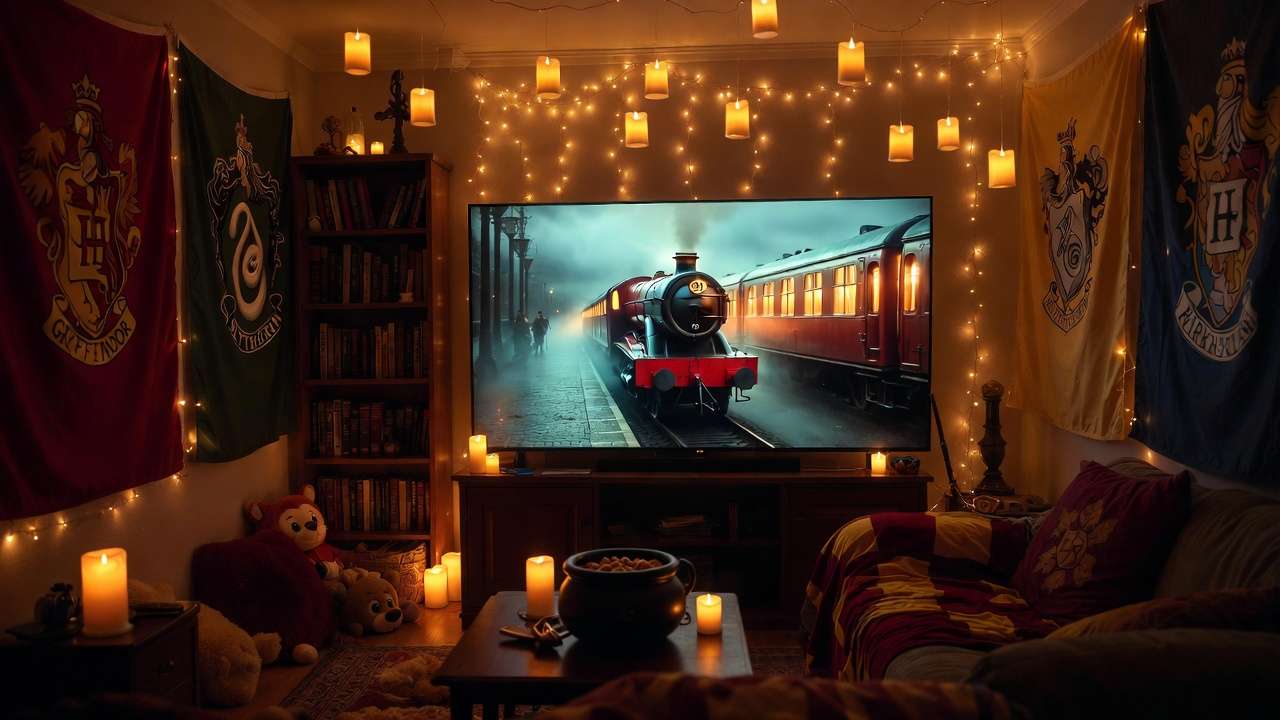
Themed decor touches:
- Hang a “Platform 9¾” sign near the door.
- Place a toy Sorting Hat or wand collection on a side table.
- Project the Marauder’s Map onto a wall (apps or simple projectors work wonders).
- Add house banners, Quidditch posters, or a faux cauldron for snacks.
These elements make pauses feel like stepping into the wizarding world rather than breaking immersion.
Step 4: The Ultimate Harry Potter Marathon Snacks & Drinks Guide
Snacks are crucial for energy without crashing—aim for balanced, thematic options that are easy to grab during short breaks. Focus on finger foods, pre-portioned items, and make-ahead recipes to minimize kitchen time.
Movie-by-movie pairings keep things exciting:
- Sorcerer’s Stone & Chamber of Secrets (early, whimsical films): Pumpkin pasties (puff pastry filled with spiced pumpkin), chocolate frogs (melted chocolate molds with frog shapes), Bertie Bott’s Every Flavor Beans (jelly beans in weird flavors—play the game!).
- Prisoner of Azkaban: Chocolate (for Dementor scenes), treacle tart (Harry’s favorite comfort food).
- Goblet of Fire: Dragon egg deviled eggs or golden snitch treats (Ferrero Rocher balls with edible gold wings).
- Order of the Phoenix & Half-Blood Prince: Treacle tart again, plus savory meat pies or bangers and mash for hearty British vibes.
- Deathly Hallows: Lighter options like pumpkin juice and cauldron cakes (cupcakes with chocolate frosting “cauldrons”).
Signature drinks:
- Butterbeer — The crowd-pleaser. Non-alcoholic version: Cream soda + butterscotch syrup + whipped cream topping. Alcoholic: Add vanilla vodka or butterscotch schnapps. Recipe (serves 4): 4 bottles cream soda, 1/4 cup butterscotch syrup, whipped cream, caramel drizzle.
- Pumpkin juice — Apple juice + pumpkin puree + cinnamon + ginger for a fall twist.
- Polyjuice Potion — Green-colored lime sherbet punch with floating “eyes” (grapes).

Healthy swaps: Veggie sticks as “wand” dippers with hummus, fruit skewers for lighter energy.
Shopping list template (scale as needed):
- Sweets: Chocolate, jelly beans, Ferrero Rocher, cupcakes.
- Savory: Puff pastry, ground meat for pies, cheese, crackers.
- Drinks: Cream soda, apple juice, whipped cream, syrups.
- Extras: Food coloring, edible glitter, house-themed plates.
Prep most items the day before—store in labeled containers for quick access.
Step 5: Smart Breaks & Activities to Keep the Magic Alive
Breaks prevent fatigue and make the marathon sustainable. Plan 10–15 minute pauses every 1–2 films, or at natural cliffhangers (e.g., after the Triwizard Tournament or Snape’s memories).
Why breaks work: They allow bathroom runs, stretching (eye strain from screens is real), and re-energizing snacks without losing momentum.
Fun intermission ideas:
- Quick trivia: “What house was Nearly Headless Nick in?” (Gryffindor). Use phone apps or pre-made cards.
- Sorting debates: “Which house would you be in now vs. as a kid?”
- Light physical: “Wand duel” with glow sticks or toy wands, or a quick “Hogwarts hallway walk” around the house.
- Photo ops: Pose with props for marathon progress pics.
For groups: Assign houses and award points for spotting details. For solo: Journal predictions or favorite moments.
Keep it spoiler-free if anyone is new—have separate chat threads for veterans.
 Step 6: Deep Dive – What to Watch For in Each Film
To elevate your marathon from simple viewing to true wizard-level appreciation, pay attention to these key details, foreshadowing moments, production Easter eggs, and changed book elements. (Spoiler warning: The sections below contain plot details. Skip or skim if you’re watching with first-timers.)
- Harry Potter and the Sorcerer’s Stone Watch for: Every early hint of the larger story—Dumbledore’s “It does not do to dwell on dreams…” line, the Mirror of Erised scene (foreshadows Harry’s orphan pain), and the subtle introduction of the Philosopher’s Stone’s protection spell. Notice the child actors’ raw charm and the warm, storybook cinematography that shifts dramatically in later films. Production note: The Hogwarts Great Hall set was built practically and remains one of the largest sets ever constructed for a film.
- Harry Potter and the Chamber of Secrets Watch for: Tom Riddle’s diary (first Horcrux reveal in hindsight), the Polyjuice Potion scene (Hermione’s cat transformation is comedy gold), and the flying car sequence’s practical effects. Easter egg: The “Heir of Slytherin” message written in blood uses a very specific shade that matches later blood motifs.
- Harry Potter and the Prisoner of Azkaban Widely regarded as the artistic peak. Alfonso Cuarón’s direction brings a darker, more mature tone. Watch for: The time-turner sequence (rewatch it frame-by-frame later to catch every detail), Sirius Black’s true nature reveal, and the stunning Patronus scene. Hidden gem: The Whomping Willow’s design changes slightly between shots to show its living, breathing quality.
- Harry Potter and the Goblet of Fire Watch for: The Yule Ball outfits and dancing (Ron’s jealousy arc begins), Barty Crouch Jr.’s polyjuice impersonation (David Tennant’s performance is chilling), and the graveyard resurrection scene. Production insight: The dragon fight used a mix of animatronics, CGI, and a stunt performer in a motion-capture suit.
- Harry Potter and the Order of the Phoenix The shortest film, but emotionally dense. Watch for: Umbridge’s pink office (a masterclass in oppressive set design), the prophecy reveal, and Sirius’s death (devastating on rewatch). Note the shift: This is where the color palette darkens permanently—less warm candlelight, more cold blues and grays.
- Harry Potter and the Half-Blood Prince Watch for: Dumbledore’s memories in the Pensieve (crucial Horcrux exposition), the Half-Blood Prince’s book annotations (Snape’s handwriting is a clue), and the cave inferi scene (visually stunning). Emotional peak: The Astronomy Tower sequence—pause and appreciate the score and silence.
- Harry Potter and the Deathly Hallows – Part 1 The “road trip” film. Watch for: The Ministry infiltration, Godric’s Hollow visit, the locket Horcrux possession scene (intense acting by the trio), and the quiet moments of friendship. Easter egg: Xenophilius Lovegood’s home is filled with subtle Deathly Hallows symbols.
- Harry Potter and the Deathly Hallows – Part 2 The finale. Watch for: The 19 years later epilogue (emotional payoff), Neville’s heroic moment, Snape’s memories (the single most rewatchable sequence), and the final duel. Production note: The final battle used over 400 visual effects shots, blending practical destruction with CGI.
Pausing briefly after major emotional beats (Snape’s death, Fred’s death) to process makes the experience richer.
 Step 7: Solo vs. Group Marathon – Tailored Tips
- Solo Marathon
- Focus on personal immersion: Journal predictions before each film, keep lights low, and allow yourself to cry or laugh freely.
- Use noise-canceling headphones for maximum score impact.
- Take reflective breaks: Meditate on a favorite character arc or re-read a corresponding book chapter.
- Group / Family Marathon
- Assign houses at the start (Sorting Hat quiz apps are perfect). Award house points for correct trivia answers or spotting details.
- Rotate snack-bringing duties.
- Set ground rules: No phones during key scenes, spoiler policy for newcomers.
- Virtual Marathon
- Use Teleparty (formerly Netflix Party) or similar sync tools (works with Max/Peacock via browser extensions).
- Discord or Zoom for live reactions.
- Share themed backgrounds or wear house scarves on camera.
Step 8: Common Mistakes to Avoid & Pro Survival Tips
Mistakes to dodge:
- Starting too late on Day 1 → leads to falling asleep during Prisoner of Azkaban.
- Overloading on sugar early → crash by Order of the Phoenix.
- No breaks → eye strain and reduced enjoyment.
- Wrong streaming setup → mid-film buffering kills momentum.
Pro survival tips:
- Hydrate constantly (keep water nearby, not just butterbeer).
- Use the 20-20-20 rule for eyes: Every 20 minutes, look 20 feet away for 20 seconds.
- Caffeine strategically: Coffee or tea before films 5–7, not after 8 PM if ending late.
- Post-marathon recovery: Plan a light Monday (no early alarms), maybe a walk in nature to ease out of the wizarding world.
 FAQ
FAQ
How long is a full Harry Potter marathon? Approximately 19 hours and 39 minutes for the theatrical versions, plus breaks. Extended editions add roughly 30–40 minutes total.
What is the best order for a Harry Potter marathon? Release order (Sorcerer’s Stone through Deathly Hallows Part 2) is strongly recommended for emotional impact and surprise preservation.
What are the best snacks for a Harry Potter marathon? Butterbeer, chocolate frogs, golden snitches (Ferrero Rocher), pumpkin pasties, treacle tart, and Bertie Bott’s Every Flavor Beans.
Can kids handle a full Harry Potter marathon? Yes, but spread it over 3–4 days. The later films (5–8) are darker and may be intense for younger viewers.
Where can I stream the Harry Potter movies in 2026? As of March 2026, widely available on Max (US/Europe) and Peacock (extended editions). Check local platforms like Netflix in other regions.
Quick Reference Checklist
- Choose dates & schedule
- Confirm streaming access & create playlist
- Prep viewing space (lights, seating, decor)
- Make/buy themed snacks & drinks
- Plan breaks & activities
- Gather props (wands, house scarves)
- Charge devices & test sound/subtitles
- Invite friends or set solo mood
- Prepare recovery plan for Monday
A perfectly executed Harry Potter marathon isn’t just watching eight movies—it’s stepping back into a world that shaped generations, laughing at Ron’s one-liners, crying over Dobby, and cheering when Neville stands up. With this guide—smart scheduling, immersive setup, thematic treats, meaningful breaks, and deeper viewing insights—you’re equipped to make your next marathon legendary.
The magic never truly ends. It simply waits for you to press play again.
Now go brew some butterbeer, gather your friends (or your wand), and let the adventure begin.