
When millions of readers first cracked open a book about a bespectacled orphan living in a cupboard, they were immediately transported. The true magic of the Wizarding World, however, is not found merely in the wands, the spells, or the fantastical beasts. It is hidden within the meticulous, almost invisible craftsmanship of the prose itself. For fans craving a deeper understanding of the lore, and for authors seeking to decode a global phenomenon, examining the writing style of JK Rowling reveals a masterclass in narrative architecture.
Why are these books so unputdownable? How did a story about a boy wizard scale into a multi-generational, cultural touchstone?
The answer lies in structural brilliance. Rowling’s work goes far beyond standard world-building. By analyzing her specific literary techniques—from her tightly controlled narrative perspectives to her linguistic etymology and grid-based plotting—we can uncover the precise mechanics of her storytelling. This article serves as a comprehensive breakdown of the seven core pillars of Rowling’s stylistic framework. Whether you are a lifelong fan looking to appreciate the books on a richer level, or a writer aiming to engineer your own immersive universe, these behind-the-scenes secrets will change the way you read forever.
Secret #1: The Mastery of “Close Third-Person” Perspective
One of the most defining characteristics of the series is how the reader experiences the world. While the books are populated by a massive cast of characters, the narrative lens is incredibly disciplined.
The Information Filter
Rowling primarily utilizes a “Third-Person Limited” point of view, locked almost exclusively onto Harry. We do not get a god-like, omniscient narrator explaining the grand machinations of the universe. Instead, the world is filtered through Harry’s eyes, his biases, and his distinct lack of knowledge. If Harry does not know about a magical creature, a historical wizarding war, or a hidden agenda, neither does the reader.
This stylistic choice achieves two critical goals. First, it forces the world-building to unfold naturally through exposition disguised as education. Because Harry is new to the magical world, the reader learns the rules alongside him—in classrooms, through textbooks, and via mentors like Hagrid and Dumbledore.
Building Empathy Through Blind Spots
More importantly, this tight perspective allows for devastating plot twists. Because Harry is often an unreliable or uninformed narrator, the reader inherits his blind spots. We suspect who he suspects, and we trust who he trusts.
💡 Expert Insight Box:Maintaining this close third-person perspective is what made the series’ biggest reveals so structurally impactful. When Harry finally views Severus Snape’s memories in the Pensieve during The Deathly Hallows, the narrative lens briefly shatters its own rules. We are suddenly plunged into a reality Harry—and the reader—had been entirely blind to for seven books. The emotional weight of this twist is earned precisely because Rowling restricted our viewpoint for so long.
Secret #2: Etymology as Character Destiny (The Naming Convention)
If you want to understand a character’s role in the Wizarding World, look no further than their name. Rowling’s background in classical languages and mythology heavily informs her prose, making her naming conventions one of her most recognizable stylistic signatures.
Latin Roots and Literary Allusions
Rowling rarely chooses a name simply because it sounds pleasant. Her names are meticulously crafted breadcrumbs that foreshadow character traits, destinies, and hidden alignments.
-
Remus Lupin: “Remus” refers to one of the mythical founders of Rome who was raised by a wolf. “Lupin” is derived from lupinus, the Latin word for wolf. His identity as a werewolf is baked into his very title.
-
Sirius Black: Sirius is the “Dog Star,” the brightest star in the constellation Canis Major. Naturally, his Animagus form is a large black dog.
-
Severus Snape: “Severus” is Latin for stern, harsh, or severe, perfectly encapsulating the Potions Master’s rigid and unforgiving exterior.
 Whimsy vs. Menace in Phonetics
Beyond direct translation, her writing style relies heavily on the phonetic feeling of words. She balances the whimsical with the menacing purely through sound. Consider the bouncy, mundane, and almost comedic sounds of “Flourish and Blotts,” “Hufflepuff,” or “Fortescue.”
Contrast those with the sharp, hissing sibilance and heavy consonants of the darker elements: “Slytherin,” “Salazar,” “Cruciatus,” and “Voldemort” (which famously utilizes the French vol de mort, meaning “flight of death”). Her prose manipulates the reader’s subconscious, signaling safety or danger before a character even takes an action.
📝 Writer’s Takeaway:When building your own world, create a foundational glossary. Do not just pull names out of thin air; anchor them in historical, linguistic, or thematic roots that reflect the core essence of your characters. This adds a layer of subconscious depth that rewards close reading.
Secret #3: Micro-Foreshadowing and the “Grid System”
Perhaps the most awe-inspiring element of Rowling’s writing style is her unparalleled ability to plot longitudinally. The series is famous for its intricate, interwoven storylines that span thousands of pages. This is not achieved by accident or spontaneous writing; it is the result of obsessive micro-foreshadowing.
Hiding Plot Twists in Plain Sight
Rowling operates on a principle of planting seeds books in advance of their harvest. She seamlessly embeds crucial plot devices into mundane descriptions, ensuring the reader glosses over them initially, only to realize their significance years later.
In The Order of the Phoenix, while cleaning out the drawing-room at Grimmauld Place, the characters find a “heavy locket that none of them could open.” It is mentioned in a single, passing sentence. Two books later, in The Deathly Hallows, that exact locket is revealed to be Salazar Slytherin’s Horcrux—the central object of their ultimate quest. Similarly, the fact that Ron’s pet rat, Scabbers, is missing a toe is established early on, serving as the physical proof needed to unravel the mystery of Peter Pettigrew three books later.
 The Spreadsheet Method
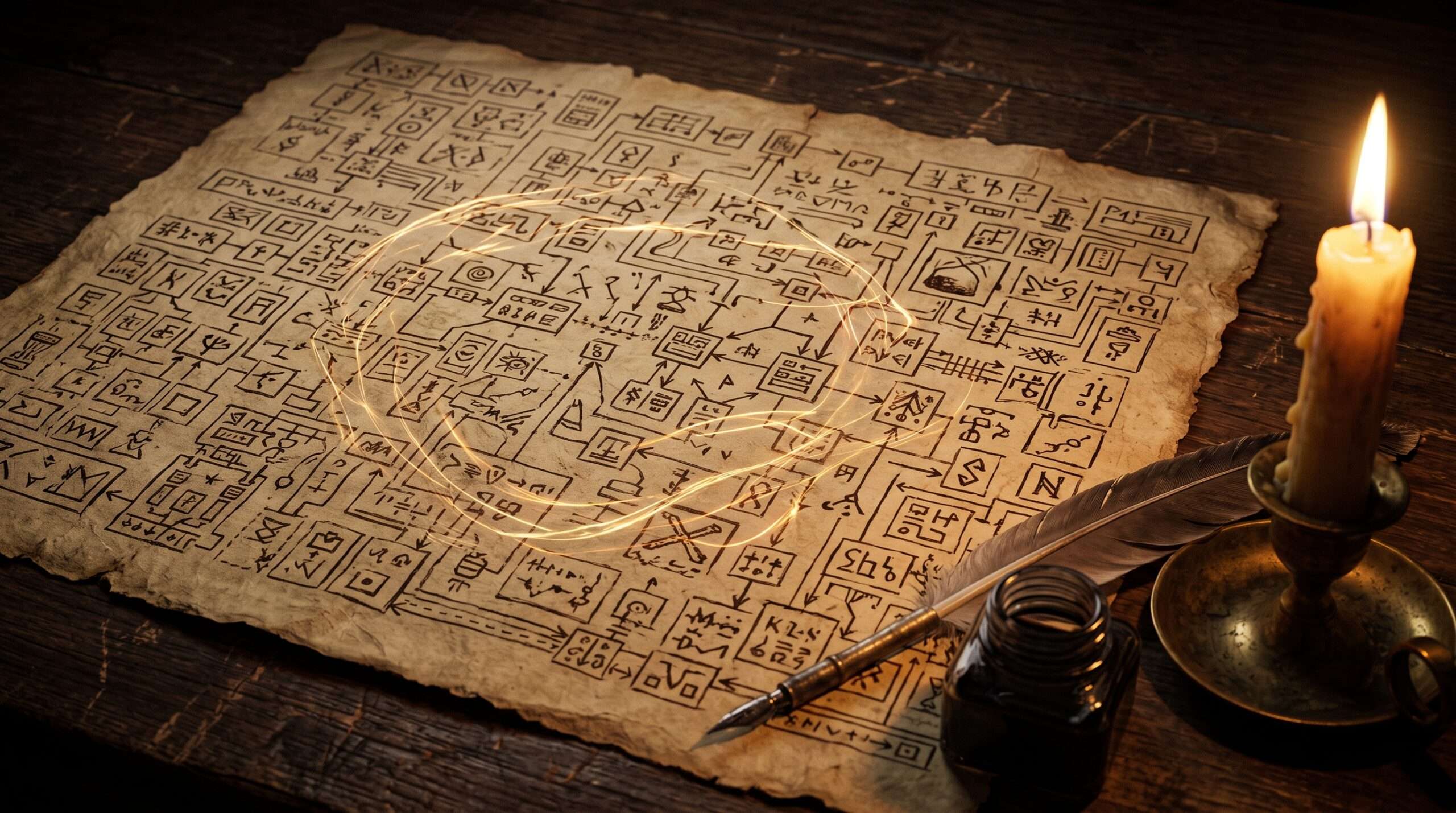
To maintain this level of continuity, Rowling famously utilized a highly organized, hand-drawn grid system. Behind the scenes, she created literal spreadsheets on lined paper.
These grids tracked the timeline of a school year month-by-month, cross-referencing the main plot, the progression of secondary subplots (like Hermoine’s S.P.E.W. campaign or the DA meetings), and the movements of antagonists who were operating off-page. This architectural approach to plotting ensures that every seemingly random event has a structural purpose.
📌 High-Contrast Callout:The unspoken rule of Rowling’s prose: If a seemingly innocuous object, location, or background character is described in more than two sentences, it will likely save—or threaten—a life three books later.
Secret #4: The Slow-Burn Tonal Shift (Maturing the Narrative)
A common pitfall in long-running series is a static tone that eventually alienates a growing readership. The writing style of JK Rowling masterfully avoids this through a deliberate, book-by-book maturation of the narrative voice.
From Middle-Grade Whimsy to Young Adult Warfare
When the series begins, the prose is firmly rooted in the middle-grade genre. The stakes, while high for an eleven-year-old, are relatively contained. The villains are often comically inept (like the Dursleys) or temporarily defeated. However, as Harry ages, the world around him loses its innocence, and the prose reflects this darkening reality. The structural genius of the series lies in its ability to seamlessly transition from a whimsical tale of a magical boarding school into a gritty, high-stakes war narrative.
Shifting Vocabulary and Themes
You can trace this tonal shift directly through Rowling’s changing vocabulary and thematic focus. The Sorcerer’s Stone relies on colorful, lighthearted descriptions, focusing on the sheer wonder of moving staircases and infinite feasts. By the time we reach The Half-Blood Prince and The Deathly Hallows, the vocabulary is bleak, visceral, and complex. The narrative wrestles with heavy, adult themes: systemic prejudice, political corruption, the realities of torture, and the finality of death.
💡 Expert Insight Box:This calculated pacing is exactly what kept the original generation of readers hooked. Because the prose matured at the exact rate the audience was aging, the books never felt outgrown. The narrative treated its readers with increasing intellectual respect, refusing to shelter them from the devastating consequences of the encroaching war.
Secret #5: Grounding Fantasy in Satirical Reality
High fantasy can often feel alienating or overly dense. Rowling solved this by anchoring her magical world in a bedrock of highly recognizable, often satirical reality.
The British Boarding School Trope Reimagined
At its core, the early series relies heavily on the classic British boarding school trope—complete with strict headmasters, rival houses, sneaking out after curfew, and end-of-term exams. By placing extraordinary magical elements within this highly structured, familiar institutional setting, she provides a grounding anchor for the reader. We understand the stress of a history exam; therefore, we can empathize with the characters, even if that exam happens to be about goblin rebellions.
 Bureaucracy and the Mundane Magic
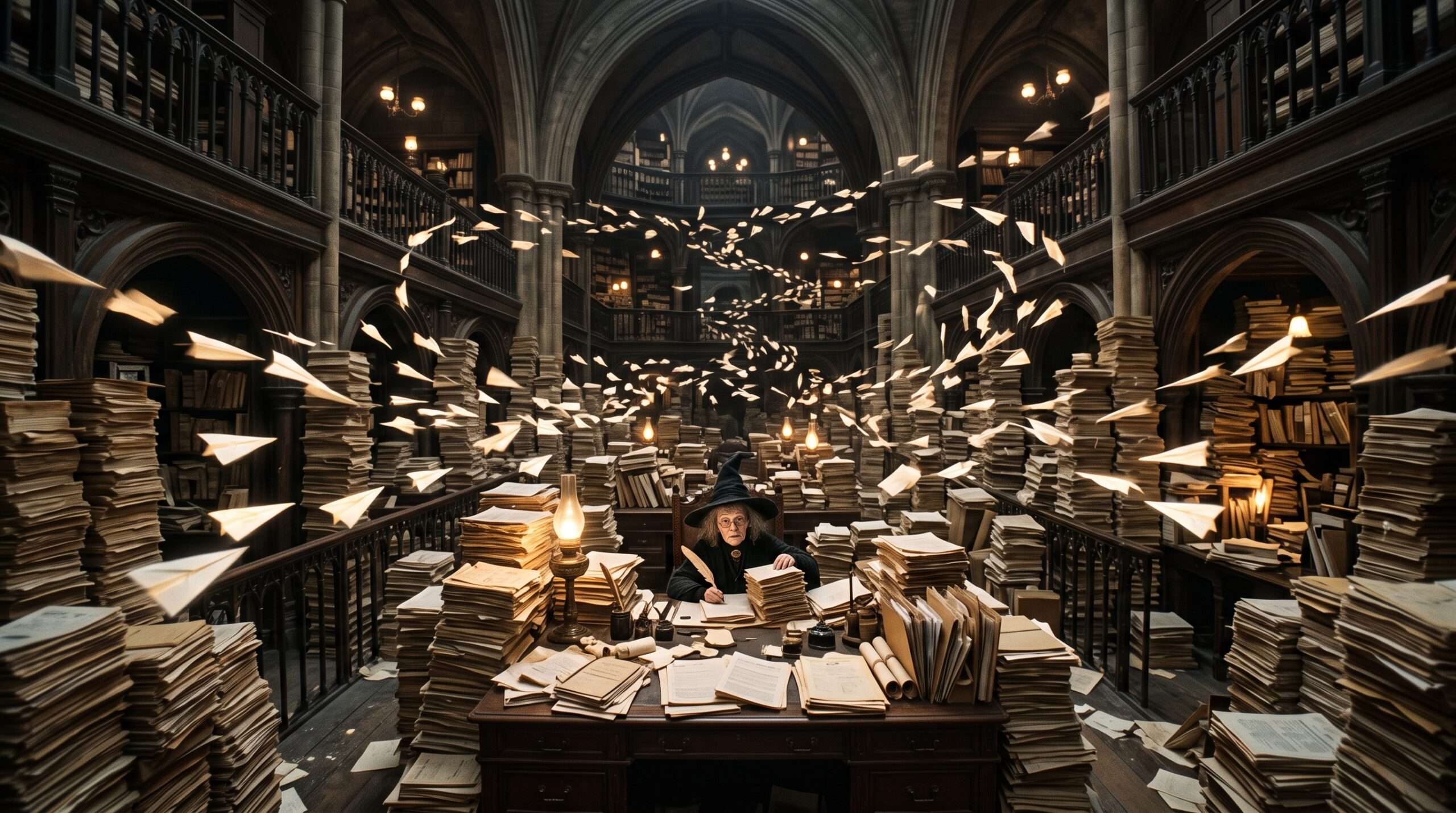
Furthermore, her world-building is deeply satirical of modern society. Rather than making magic an ethereal, flawless force, she makes it bureaucratic and mundane. The Ministry of Magic is plagued by red tape, inter-departmental memos (flown as paper airplanes), and petty regulations regarding the thickness of cauldron bottoms.
By detailing the mundane frustrations of the magical world, the prose creates a profound sense of authenticity. It is a universe where magic solves the problem of transportation, but creates the problem of magical traffic and regulatory fines. This grounds the fantasy, making it feel remarkably real, flawed, and utterly believable.
Secret #6: The “Show, Don’t Tell” Approach to Morality and Grief
As the narrative matures, so does its treatment of the human condition. Rowling abandons the binary “good versus evil” paradigm early on, opting instead for a prose style that thrives in the gray areas.
Writing the Gray Areas
The evolution of character arcs is handled through a strict “show, don’t tell” methodology. We are not simply told that good people are capable of cruelty; we are forced to witness it. The revelation of James Potter’s history as an arrogant bully, or Albus Dumbledore’s dark, power-hungry youth, shatters the idealistic pedestals Harry placed them on. Rowling’s style forces the reader to sit with the discomfort of moral ambiguity, proving that heroism is often messy and deeply flawed.
 The Visceral Description of Emotion
Perhaps her most profound stylistic achievement is her ability to use the fantastical to manifest complex psychological states. The physical descriptions of magic are frequently used to symbolize deeply internal struggles.
The Dementors are the prime example. Rowling does not spend pages explaining clinical depression; instead, she creates a creature that visually and physically enacts it. The chilling cold, the rotting scent, and the sensation that “you will never be cheerful again” provide a visceral, external representation of grief and trauma.
📝 Writer’s Takeaway:Do not rely on internal monologues to explain a character’s emotional state. Use your setting, your world’s lore, or its creatures to symbolize internal psychological battles. Make the abstract emotions tangible.
Secret #7: Structuring a Mystery Novel Inside a Fantasy Shell
If you strip away the wands, the dragons, and the enchantments, the fundamental writing style of JK Rowling is not purely fantasy. Structurally, she is a mystery writer.
The “Whodunit” Framework
Every single book in the series functions as a classic detective novel. They all feature a central question or crime (Who opened the Chamber of Secrets? Who put Harry’s name in the Goblet of Fire?), a list of suspects, a trail of clues (and red herrings), and a grand, drawing-room reveal in the final chapters where the detective (Harry) confronts the perpetrator.
By housing a tightly plotted mystery within a sprawling fantasy universe, Rowling ensures that the narrative always has a propulsive forward momentum. The reader is not just exploring a magical world; they are actively trying to solve a puzzle.
The Misdirection Tactic
To execute these mysteries, her prose relies heavily on character-driven misdirection. She expertly uses Harry’s emotional prejudices to distract the reader from the true threat.
A masterclass in this misdirection occurs in Harry Potter and the Goblet of Fire. The intricate unmasking of Barty Crouch Jr.—a fanatic hiding in plain sight—is shielded from the reader because the narrative forces us to focus on rival schools, Igor Karkaroff’s dark past, and Harry’s typical suspicions of Severus Snape. By playing on established biases, the prose actively guides the reader to look the wrong way, making the final twist both shocking and, in hindsight, brilliantly inevitable.
 Frequently Asked Questions
What is JK Rowling’s main writing style?
Her fundamental writing style is a blend of close third-person limited perspective, rich sensory description, and tight structural plotting. She uniquely merges the sprawling, imaginative elements of high fantasy with the sharp, satirical tone of British literature and the rigid framework of classic mystery novels.
How does JK Rowling plan her novels?
Rowling is famous for being a meticulous outliner. Before drafting the prose, she created extensive backstories, character dossiers, and hand-drawn grid spreadsheets. These grids mapped out the progression of the school year alongside main plots, secondary character arcs, and hidden villain movements, ensuring airtight continuity across thousands of pages.
What makes JK Rowling’s world-building so effective?
Her world-building thrives on a paradox: it grounds the extraordinary in the exceedingly ordinary. By filtering magic through a lens of mundane bureaucracy, school exams, and recognizable social prejudices, the fantastical elements feel authentic. Additionally, her heavy use of linguistic roots (like Latin) gives the world a subconscious feeling of historical depth.
The enduring legacy of the Wizarding World is no accident. It is the result of architectural plotting, precise psychological mapping, and a narrative perspective that tightly controls the flow of information. The writing style of JK Rowling proves that true literary magic requires immense, behind-the-scenes discipline.
From the subtle etymology of her character names to the intricate grid systems that tracked every subplot, the mechanics of her prose offer endless lessons for writers and analysts alike. By studying how she grounds high fantasy in satirical reality, shifts the tonal weight of her narrative, and disguises complex mysteries as children’s literature, we can better understand the anatomy of a global phenomenon.
Now, it’s your turn to analyze the text: Which of these seven structural secrets surprised you the most? Have you ever noticed a tiny piece of micro-foreshadowing on a re-read that blew your mind?
If you are looking to dive deeper into the mechanics of the Wizarding World, be sure to explore our other deep-dive articles breaking down specific character evolutions and behind-the-scenes cinematic adaptations across the blog!