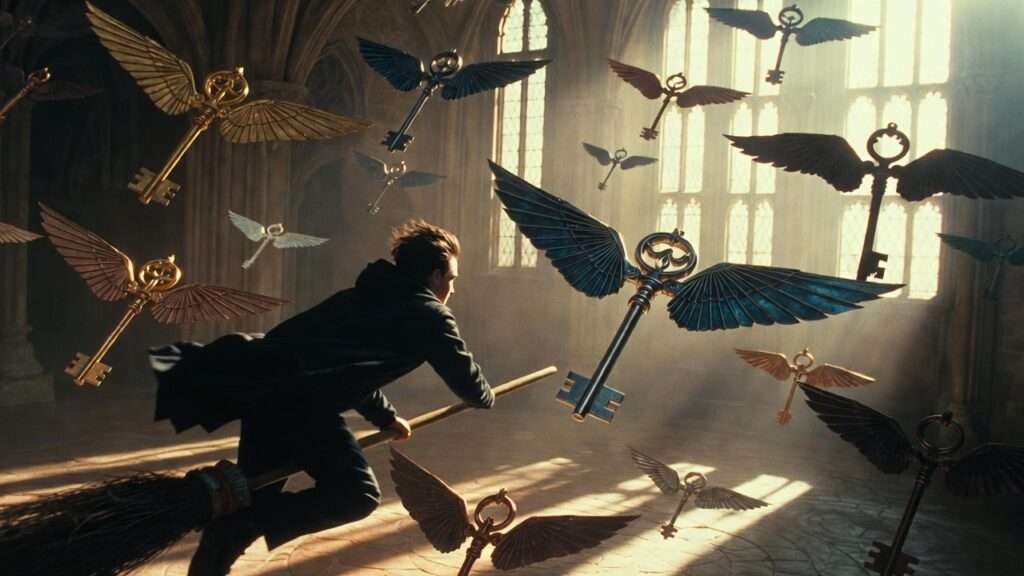
Imagine stepping into a vast, brightly lit chamber at the heart of Hogwarts, expecting silence after the gripping terror of Devil’s Snare—only to be greeted by a whirlwind of glittering motion. What looks like a flock of colorful birds fills the air, darting and fluttering with impossible speed. But these aren’t birds at all. They’re Harry Potter flying keys—enchanted, winged, and fiercely protective of the path to the Philosopher’s Stone.
This iconic scene from Harry Potter and the Philosopher’s Stone (also known as Harry Potter and the Sorcerer’s Stone) is one of the series’ most thrilling moments. It blends clever puzzle-solving, high-flying action, and a perfect showcase of Harry’s unique talents. Fans often search for details on the winged keys challenge: how the puzzle works, why brute-force spells fail, how Harry identifies and captures the correct key, and what this test reveals about his destiny. This comprehensive guide dives deep into the mechanics, symbolism, and lasting significance of the Harry Potter flying keys, drawing directly from J.K. Rowling’s original text, the film adaptation, official Wizarding World insights, and broader lore. Whether you’re revisiting the scene for nostalgia or seeking a clearer understanding of its clever design, you’ll find the answers here.
What Are the Harry Potter Flying Keys?
The Harry Potter flying keys, officially called Winged Keys (and sometimes referred to as Flying Keys), are a brilliant magical creation by Professor Filius Flitwick, the Charms Master at Hogwarts. Enchanted to fly—likely through a specialized Flying Charm or a variant of levitation spells like Wingardium Leviosa—these keys serve as the third obstacle in the series of protections guarding the Philosopher’s Stone.
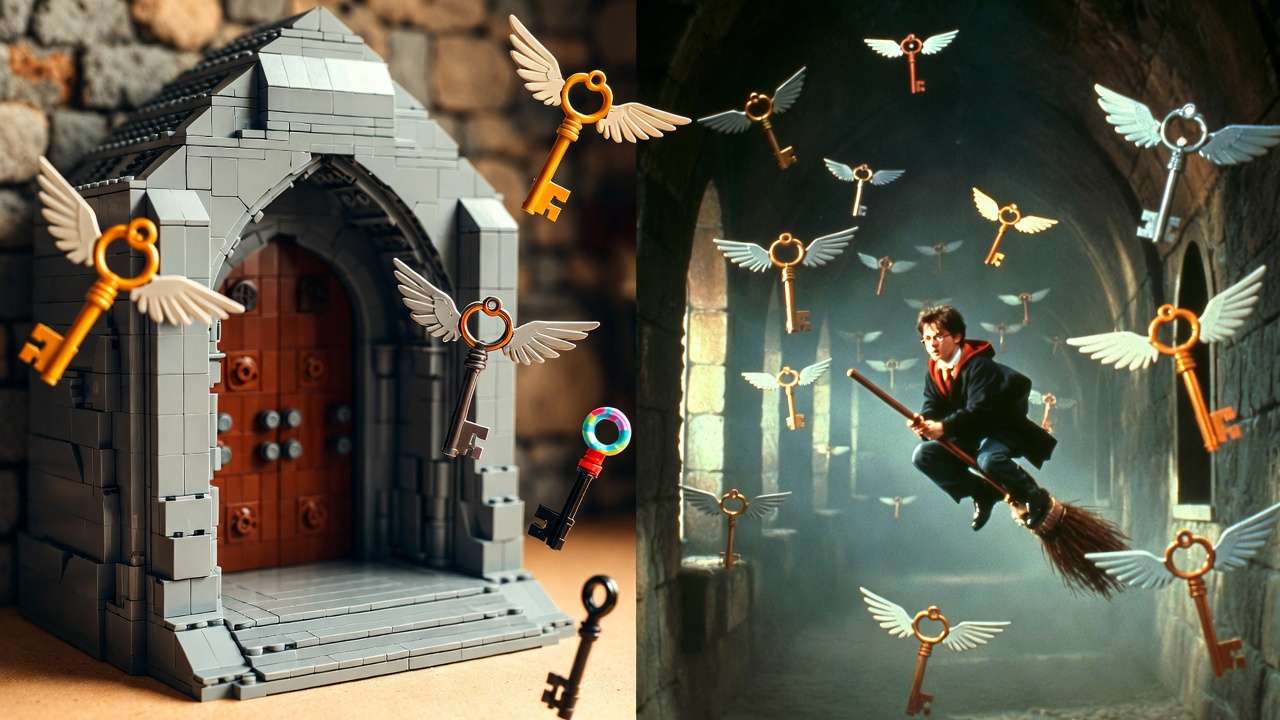
As Harry, Ron, and Hermione enter the chamber after escaping the three-headed dog Fluffy and Professor Sprout’s Devil’s Snare, they initially mistake the swarm for birds. The room is filled with hundreds of keys, each fitted with brightly colored, jewel-like wings that shimmer in the light. Most appear modern in design, but one stands out: an old-fashioned silver key with bright blue wings, noticeably damaged with a broken wing.
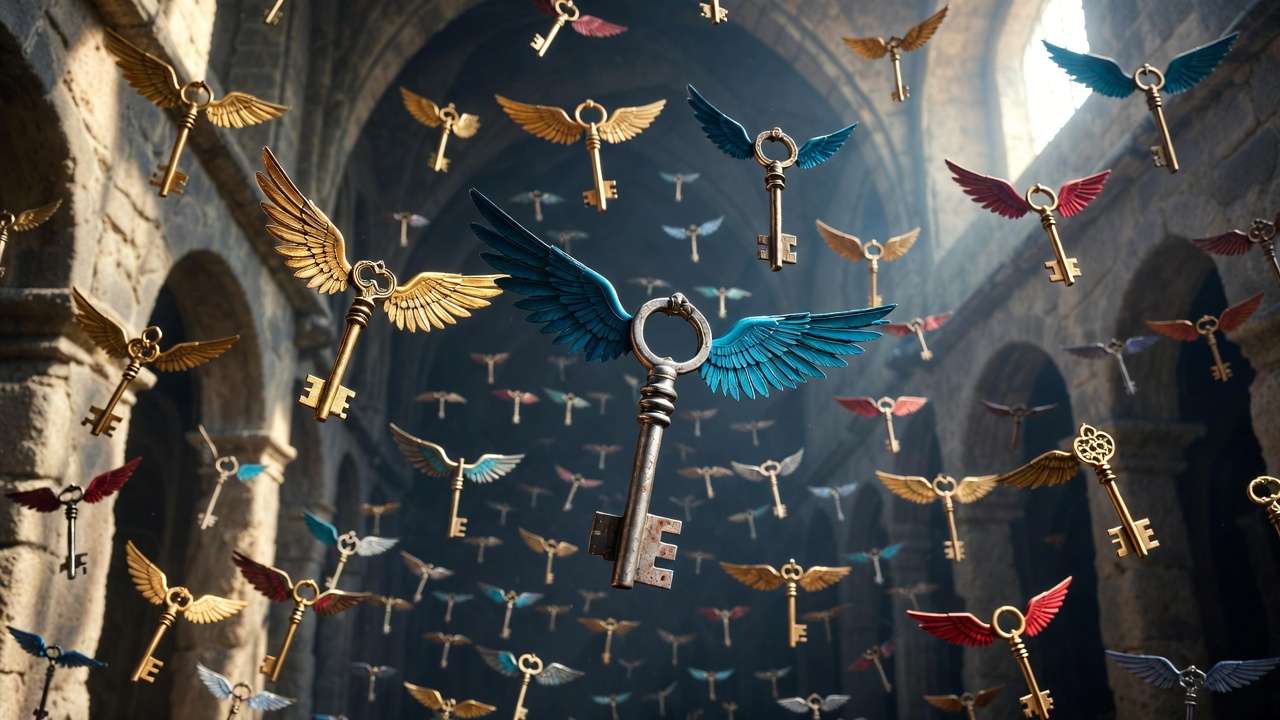 The purpose is straightforward yet ingenious. A heavy wooden door at the far end of the chamber is locked and impervious to standard Unlocking Charms like Alohomora. Only one specific key in the entire flock will fit the ancient lock and grant passage to the next challenge. The rest are decoys, designed to confuse and exhaust any intruder.
This protection reflects Flitwick’s expertise in Charms—precise, elegant, and deceptively simple. Unlike more aggressive obstacles, it rewards observation, skill, and a touch of daring rather than raw power.
The Chamber Setup and Puzzle Mechanics Explained
Entering the Chamber – Initial Confusion
After wrestling free from the strangling tendrils of Devil’s Snare, the trio emerges into a spacious, well-lit room. The air hums with movement. At first glance, the “birds” seem harmless, but as Harry points out, “They’re not birds! They’re keys! Winged keys—look carefully.” This moment highlights the group’s teamwork: Harry’s quick observation, combined with Hermione’s analytical mind, shifts their perspective instantly.
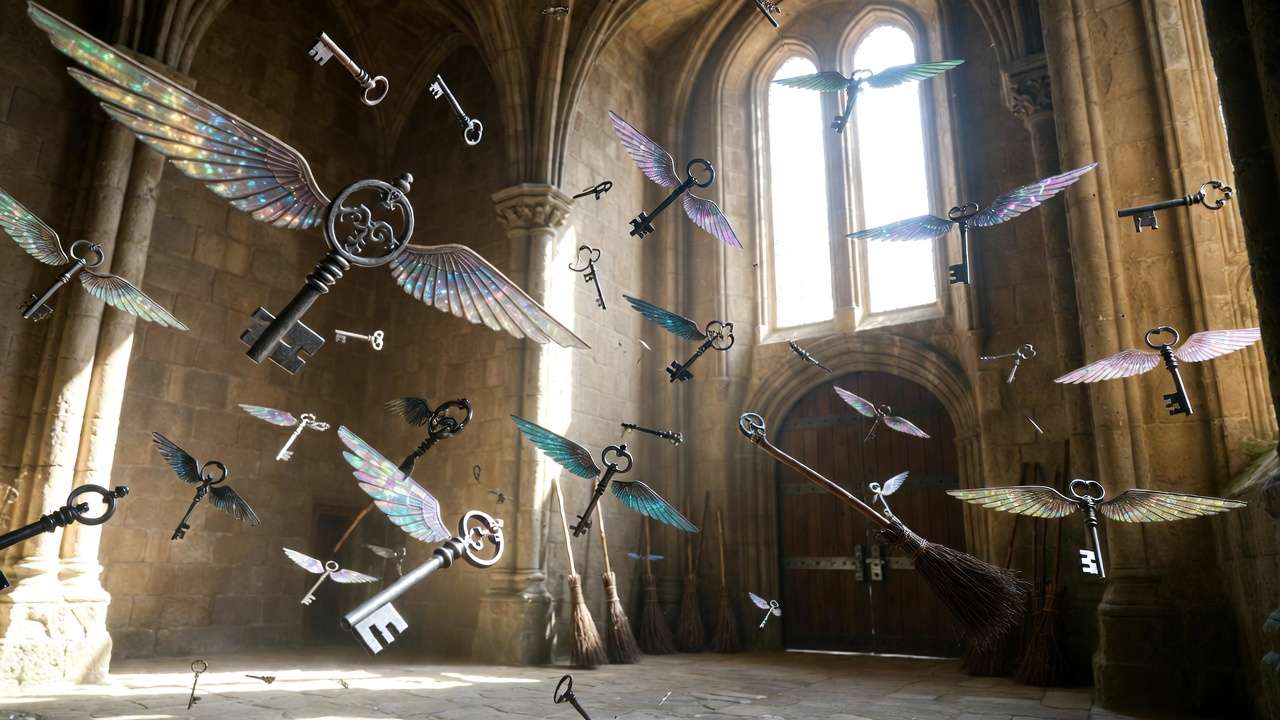
The chamber features high ceilings to accommodate flight, and—crucially—a collection of old-fashioned broomsticks leaning against one wall. No other tools or spells appear available, hinting that physical pursuit is the intended solution.
 The Clues and Deduction Process
The locked door resists Hermione’s Alohomora attempt, confirming that conventional magic won’t work. The trio quickly deduces the rules of the puzzle:
- The correct key must match the old, heavy lock—likely large, antique, and silver.
- Among the flock, only one fits this description: the old silver key with bright blue wings.
- Its broken wing is a subtle clue—evidence that someone (Quirrell, possessed by Voldemort) has already passed through, forcing the key into the lock and damaging it in the process.
Hermione’s logic shines here: “It must be that one—the old-fashioned silver one with blue wings.” This deduction turns a chaotic swarm into a targeted hunt.
The Challenge Dynamics
Once the broomsticks are mounted, the keys react defensively. The entire flock scatters in a frenzy, making the correct key even harder to spot and catch. This isn’t a static puzzle; it’s dynamic and skill-based, requiring aerial agility to navigate the chaos.
Why broomsticks specifically? They tie into Hogwarts’ flying curriculum and Quidditch tradition, ensuring only someone proficient in broom flight can succeed. Flitwick’s design assumes intruders might lack this skill—or that the test filters for those who do. It’s a clever “honeypot” element: the tools are provided, but using them triggers the full defensive response.
In puzzle terms, this resembles real-world escape rooms or logic challenges where observation (spotting the key) combines with execution (catching it mid-flight). It’s deceptively elegant, relying on talent over force.
How Harry Caught the Right Key – Step-by-Step Breakdown
Harry’s Instant Recognition and Decision
The moment the puzzle clicks, Harry’s Seeker instincts take over. “We’ve got to catch the key to the door!” he declares, already reaching for a broom. While Ron and Hermione hesitate or struggle with the concept, Harry sees it as a natural extension of Quidditch—chasing a fast-moving object in the air.
The Chase and Capture
In the book, all three grab brooms and kick off, but the keys go berserk. Harry, with his innate flying talent, spots the damaged blue-winged key weaving through the flock. He dodges diving keys, maneuvers sharply, and executes a swift dive to snatch it.
The capture is dramatic: Harry closes in, hand outstretched, and grabs the key just as it tries to evade. The broken wing makes it slightly slower, aiding the catch, but Harry’s precision seals the victory.
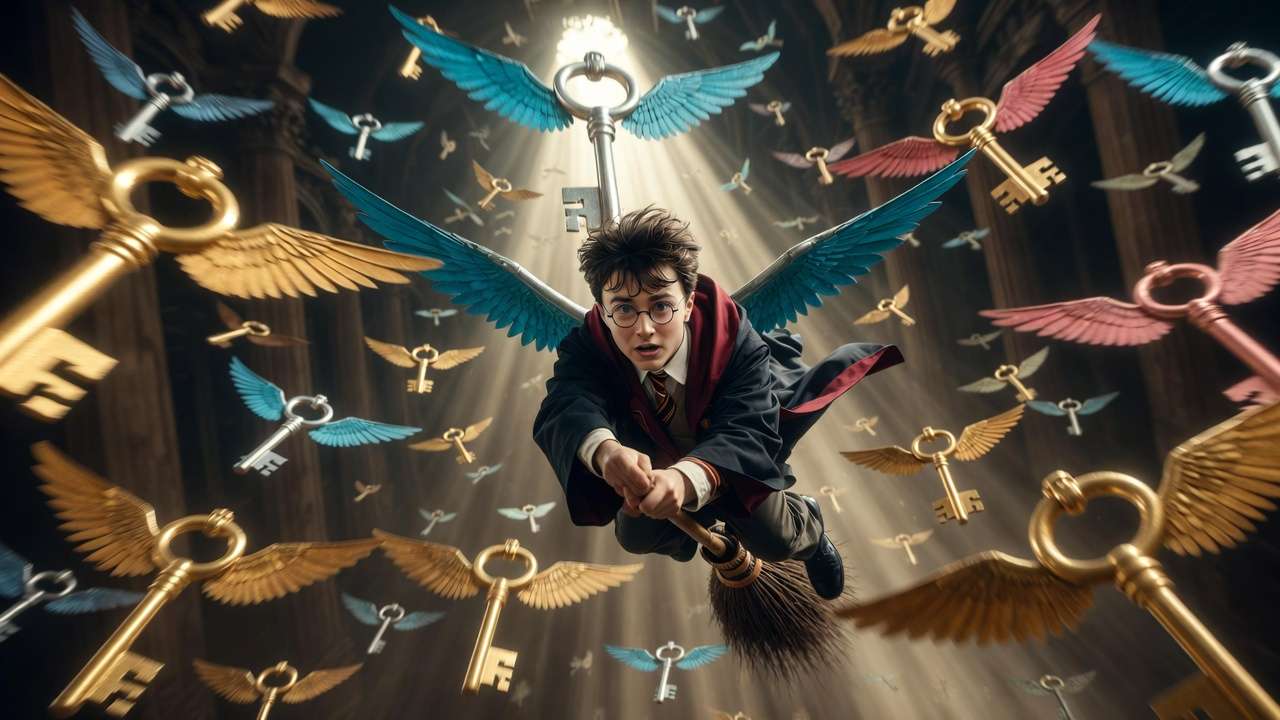
The film amps up the tension—focusing solely on Harry (with one broom for dramatic clarity), adding visual flair like keys swarming aggressively and dramatic music. Harry’s catch feels even more heroic, emphasizing his solo skill.
 Why Harry Specifically Succeeded
Harry’s success isn’t luck—it’s foreshadowed destiny. From his first flying lesson, where he catches Neville’s Remembrall in a stunning dive, McGonagall recognizes his Seeker potential. The Harry Potter flying keys challenge mirrors that exactly: pursuing a small, fast object on a broom.
Ron and Hermione, brilliant in their domains (strategy and spells), lack Harry’s aerial prowess. The puzzle tests innate talent, revealing Harry’s “chosen” qualities—courage, instinct, and flying skill—early in the series.
Book vs. film differences highlight this: the novel shows teamwork in mounting brooms, while the movie isolates Harry’s heroism for cinematic impact.
Symbolism and Deeper Meaning of the Harry Potter Flying Keys
The Harry Potter flying keys are far more than a clever obstacle—they carry rich symbolic weight that enriches the entire series. Keys, in literature and mythology, almost universally represent access, secrets, freedom, and the unlocking of hidden potential. In the wizarding world, this motif appears repeatedly: the massive Gringotts vault keys, the Daedalian Keys scattered across Hogwarts in the Hogwarts Legacy game, and even the tiny key that opens the locket Horcrux in later books.
The fact that these keys have been given wings transforms a static object into something alive, elusive, and dynamic. To possess the correct key, one must actively pursue it through skill and determination. This mirrors a central theme of the Harry Potter series: true power and knowledge are not handed over—they must be earned through courage, talent, and persistence. The flying keys challenge embodies the idea that some doors (literal and metaphorical) can only be opened by those who are willing and able to chase what others might dismiss as impossible.
 The broken wing on the correct key is one of the most poignant details. It serves as silent evidence that someone dangerous has already passed through—Quirrell (controlled by Voldemort) caught and forced the key into the lock, damaging it in the struggle. This imperfection in an otherwise elegant protection subtly underscores Dumbledore’s layered defense strategy: no single charm is infallible, but together they create a formidable barrier. The damage also foreshadows the theme of corruption and violation that runs through the entire series.
Most importantly, the flying keys scene is an early, powerful demonstration of Harry as “the Chosen One.” The puzzle is perfectly tailored to reveal his innate gifts—his extraordinary flying ability, quick instincts, and fearless pursuit of a goal. While Hermione’s logic identifies the target and Ron’s courage helps mount the brooms, only Harry can complete the task. In this moment, readers (and the characters themselves) begin to see why Harry, an eleven-year-old boy raised by Muggles, is destined to face Voldemort.
The challenge also ties into the recurring motif of flight as liberation and destiny in the wizarding world. From broomsticks to Thestrals, flying often symbolizes rising above ordinary limits—something Harry does both literally and figuratively throughout the books.
The Flying Keys in Broader Harry Potter Lore and Adaptations
The winged keys are not isolated to one scene. They represent Professor Flitwick’s contribution to Dumbledore’s multi-layered defense of the Philosopher’s Stone. Each obstacle reflects the teacher who created it:
- Hagrid’s three-headed dog (Fluffy) – loyalty and brute strength
- Professor Sprout’s Devil’s Snare – Herbology knowledge
- Flitwick’s flying keys – Charms precision and skill
- Professor McGonagall’s giant chess set – strategic brilliance
- Professor Snape’s logic puzzle – Potions intellect
- Professor Quirrell/Voldemort’s Mirror of Erised – pure desire and selflessness
This collaborative protection showcases the depth of Hogwarts faculty and Dumbledore’s trust in his colleagues.
In the 2001 film adaptation directed by Chris Columbus, the flying keys sequence receives a dramatic upgrade. The chamber feels more cinematic: sweeping camera angles, dramatic lighting, and a tense musical score accompany Harry’s solo flight. The keys appear more aggressive, swarming and diving at him like living opponents. While the book emphasizes the trio working together to mount the brooms and identify the target, the film isolates Harry’s heroism for maximum visual impact—reinforcing his status as the series’ central hero.
The scene has inspired countless adaptations and merchandise:
- LEGO Harry Potter sets faithfully recreate the chamber, complete with minifigure Harry on a broom chasing a winged key.
- Video games (especially the early console versions and the Hogwarts Legacy tie-ins) feature similar flying-key mechanics or collectible winged keys.
- Fan communities have created DIY enchanted key necklaces, floating key decorations using clear thread and LED lights, and escape-room-style puzzles based on the scene.
These cultural echoes demonstrate the enduring appeal of the Harry Potter flying keys as a moment of pure magical wonder.
 Common Questions About the Harry Potter Flying Keys (FAQs)
Why were broomsticks conveniently placed in the room?
The brooms are part of the test. Flitwick’s puzzle assumes that only someone familiar with Hogwarts flying lessons—or naturally gifted—would think to use them. Some fans theorize it’s another layer of Dumbledore’s “honeypot” strategy: providing the tools invites the intruder to trigger the full defensive chaos.
How did Quirrell/Voldemort get past the flying keys?
Quirrell (possessed by Voldemort) likely caught the key on his first attempt but damaged it when forcing it into the lock. The broken wing is the physical proof that an intruder had already succeeded once.
Could anyone else have caught the key?
Theoretically yes, but practically no. The challenge requires exceptional broom-flying skill—something very few first-years possess. Ron and Hermione, despite their intelligence and bravery, struggle in the air. The puzzle is deliberately designed to favor someone with Harry’s exact talents.
Is the flying keys challenge the easiest of the protections?
It appears deceptively simple compared to giant chess or the Mirror of Erised, but its difficulty is highly situational. For a non-flier, it would be nearly impossible. For Harry, it’s the most natural test of all.
Are there any hidden details or popular fan theories about the flying keys?
Some fans speculate that Flitwick enchanted the keys to recognize “worthy” flyers, explaining why Harry’s catch feels almost fated. Others point out that the blue wings may symbolize Ravenclaw (wisdom and air), subtly nodding to Flitwick’s own house. There’s also a theory that the broken wing was left intentionally as a warning to Dumbledore that someone had breached the defenses—yet another layer of cunning in the overall plan.
The Harry Potter flying keys scene remains one of the most exhilarating and thematically rich moments in the entire series. It combines clever magical engineering, high-stakes action, and profound character revelation in a single, unforgettable sequence. Through this challenge, J.K. Rowling masterfully shows readers that destiny is not merely thrust upon Harry—he earns it, one daring dive at a time.
The winged keys remind us why the wizarding world feels so alive: even the smallest details are imbued with meaning, skill, and wonder. They also serve as an early promise of the hero Harry will become—someone who chases the impossible, catches it, and uses it to open the next door.
If this deep dive has rekindled your love for the Philosopher’s Stone, consider revisiting Chapter 16 (“Through the Trapdoor”) or rewatching the film scene with fresh eyes. You’ll likely notice new layers of brilliance.
What’s your favorite protection in the underground chambers? Did the flying keys challenge stand out to you on your first read or watch? Share your thoughts in the comments—I’d love to hear from fellow Potter fans.