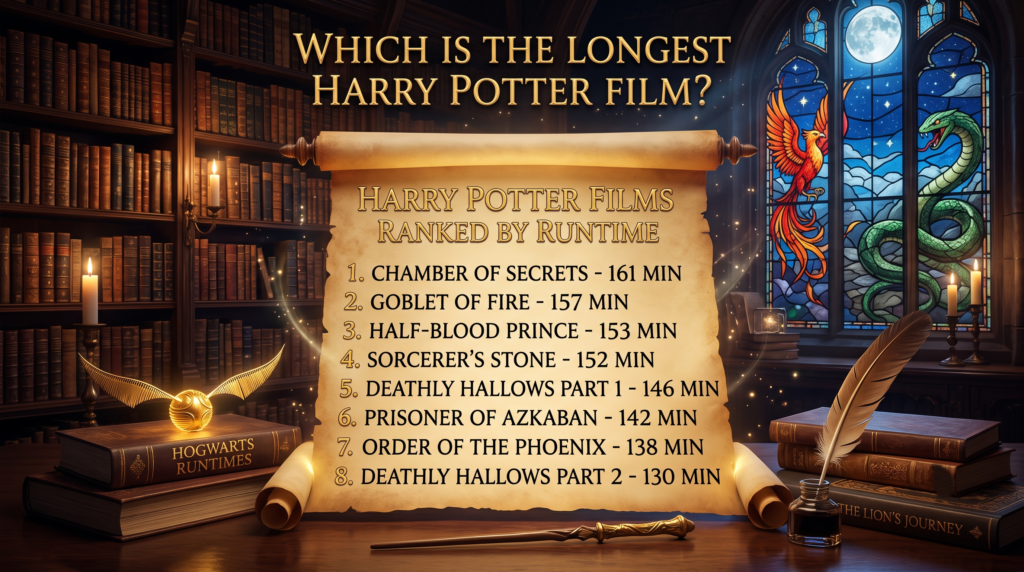
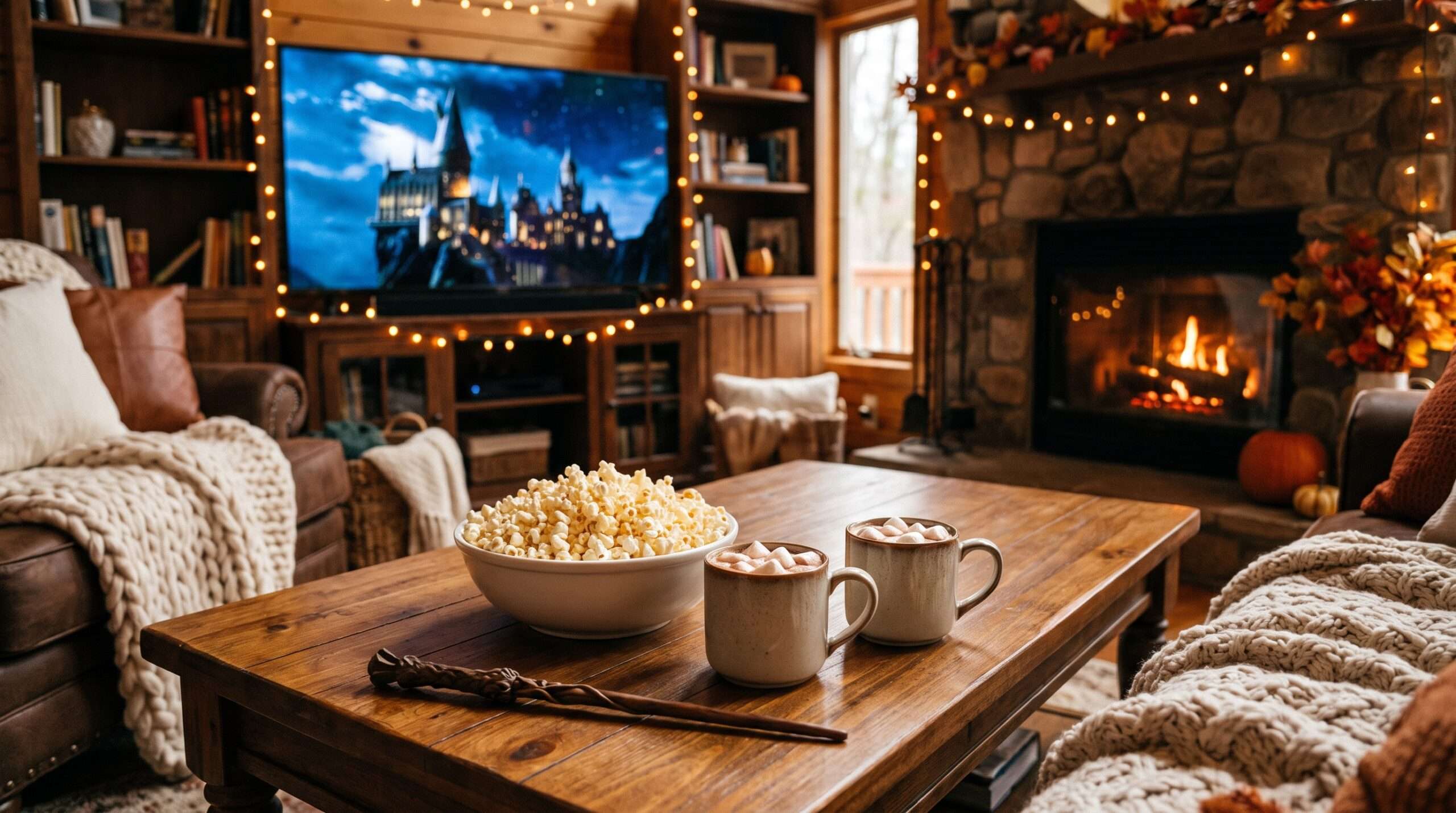
Binge-watching the Wizarding World has become a global tradition. Whether it is the holiday season, a cozy autumn weekend, or just a nostalgic escape, returning to Hogwarts requires a serious time commitment. As you prepare your snacks and settle in for a magical movie marathon, you might find yourself wondering: which is the longest Harry Potter film?
The definitive answer is Harry Potter and the Chamber of Secrets, which runs for a staggering 161 minutes (2 hours and 41 minutes).
However, knowing the longest movie is only half the magic. The Harry Potter franchise is a fascinating case study in cinematic adaptation. As the original J.K. Rowling novels grew exponentially thicker with each new release, the movies did not necessarily follow suit. In fact, some of the longest books resulted in the shortest theatrical cuts.
In this comprehensive guide, we will explore the complete franchise runtimes, rank all eight Harry Potter movies from longest to shortest, and dive into the cinematic reasons behind these pacing decisions.
The Quick Data: Harry Potter Runtimes at a Glance
Before we break down the specifics of each film’s production and pacing, here is the complete data. This table compares the cinematic runtimes with their source material, highlighting the fascinating discrepancies between page count and screen time.
| Rank | Movie Title | Release Year | Runtime (Minutes) | Runtime (Hours) | Book Length (Pages) |
| 1 | Chamber of Secrets | 2002 | 161 mins | 2h 41m | 341 pages |
| 2 | Goblet of Fire | 2005 | 157 mins | 2h 37m | 734 pages |
| 3 | Half-Blood Prince | 2009 | 153 mins | 2h 33m | 652 pages |
| 4 | Sorcerer’s Stone | 2001 | 152 mins | 2h 32m | 309 pages |
| 5 | Deathly Hallows: Part 1 | 2010 | 146 mins | 2h 26m | 759 pages (Total) |
| 6 | Prisoner of Azkaban | 2004 | 142 mins | 2h 22m | 435 pages |
| 7 | Order of the Phoenix | 2007 | 138 mins | 2h 18m | 870 pages |
| 8 | Deathly Hallows: Part 2 | 2011 | 130 mins | 2h 10m | 759 pages (Total) |
Franchise Total Runtime: 1,179 minutes (19 hours and 39 minutes).
All 8 Harry Potter Movies Ranked by Runtime (Longest to Shortest)
To truly understand why the Wizarding World translates to the screen the way it does, we must look at the directors, the screenwriters, and the narrative challenges they faced. Here is the complete ranking of every Harry Potter movie by length.
1. Harry Potter and the Chamber of Secrets (161 Minutes / 2h 41m)
Taking the crown as the longest Harry Potter movie, Chamber of Secrets is a masterclass in faithful adaptation. Directed by Chris Columbus, who also helmed the first film, this installment attempts to translate nearly every single chapter, subplot, and character interaction from the 341-page novel directly to the silver screen.
Why it’s so long:
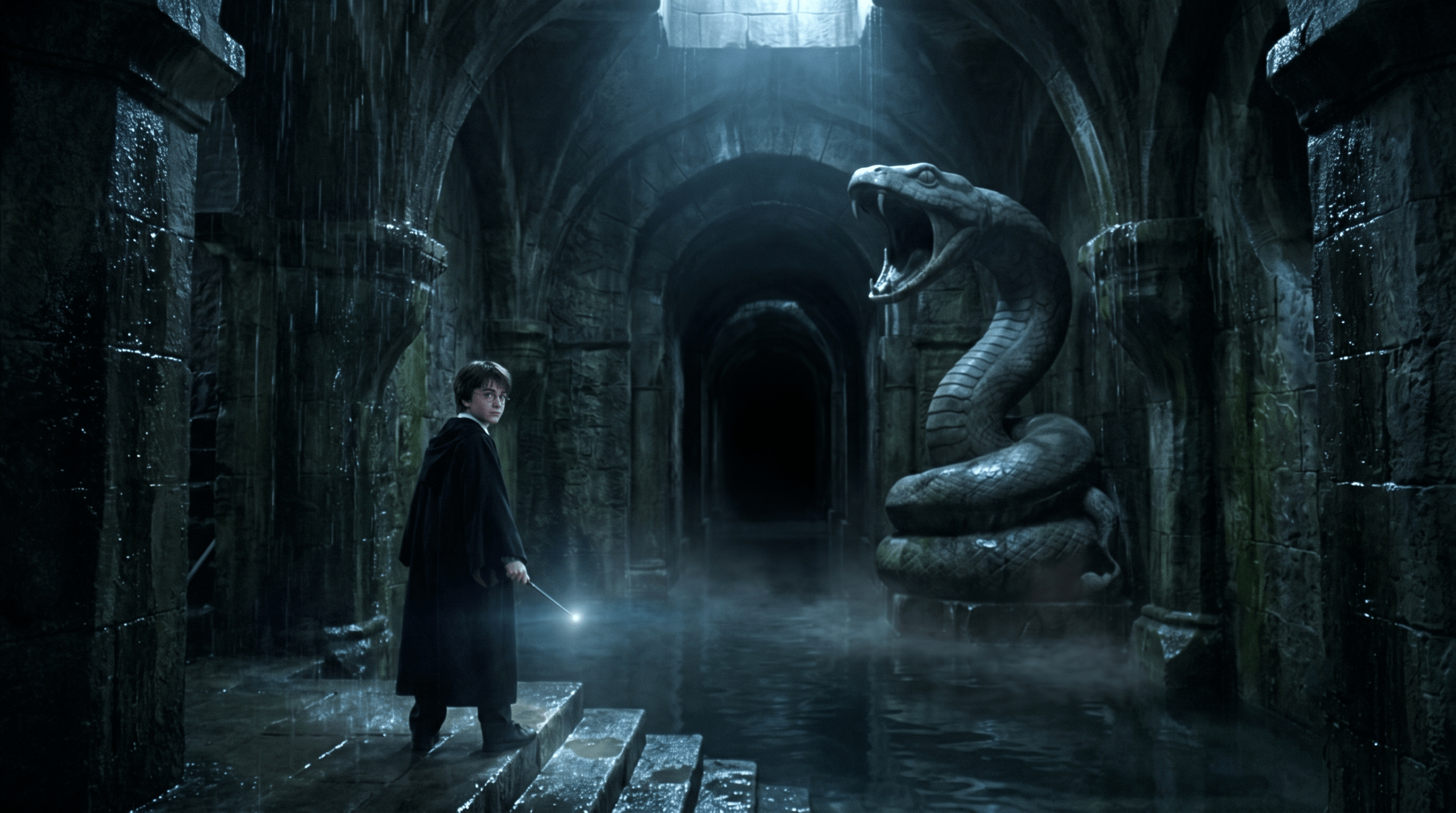
Chris Columbus had a distinct philosophy for the early Potter films: give the fans exactly what is on the page. Because the book is relatively short compared to later entries, it was actually possible to include almost everything. The 161-minute runtime accommodates the lengthy introduction of Dobby the House Elf, the flying Ford Anglia sequence, a detailed look at Kenneth Branagh’s hilariously narcissistic Gilderoy Lockhart, the haunting history of Tom Riddle, and a massive, multi-stage final battle with the Basilisk.
Furthermore, the mystery of the Heir of Slytherin required careful pacing. The film had to establish multiple red herrings—making the audience suspect Draco Malfoy, Rubeus Hagrid, and even Harry himself—which inherently demands a longer, more unhurried narrative structure.
 2. Harry Potter and the Goblet of Fire (157 Minutes / 2h 37m)
Coming in second is Goblet of Fire, directed by Mike Newell. This film represents the franchise’s first massive adaptation hurdle. At 734 pages, the fourth book is more than double the length of the previous installments. The sheer volume of plot forced the filmmakers to make a grueling choice: make a four-hour movie, split it into two parts, or ruthlessly cut subplots.
The Content Squeeze:
They chose to condense it into a single, tightly packed 157-minute film. Even as the second-longest movie in the franchise, Goblet of Fire moves at a breakneck pace. It has to introduce the Quidditch World Cup, the arrival of two foreign wizarding schools (Beauxbatons and Durmstrang), the complex mechanics of the Triwizard Tournament, the hormonal drama of the Yule Ball, and the chilling resurrection of Lord Voldemort.
To achieve this runtime, screenwriter Steve Kloves had to abandon several beloved book storylines. Hermione’s elf-rights organization (S.P.E.W.) was entirely scrapped, Ludo Bagman was erased from the narrative, and the Dursleys were completely cut from the opening act.
 3. Harry Potter and the Half-Blood Prince (153 Minutes / 2h 33m)
Directed by David Yates, Half-Blood Prince utilizes its hefty 153-minute runtime to execute a brilliant, slow-burn balancing act between two wildly different cinematic tones: lighthearted teenage romantic comedy and intense, dread-inducing psychological thriller.
Pacing & Tone:
A significant portion of this film is dedicated to the awkward, humorous realities of teenagers coming of age in a boarding school. We watch Ron Weasley’s disastrous relationship with Lavender Brown, Hermione’s quiet heartbreak, and Harry’s growing feelings for Ginny Weasley.
However, juxtaposed against this teenage drama is the deeply dark exploration of Voldemort’s past. The film takes its time lingering on the Pensieve memories, slowly unraveling the mystery of Horcruxes with Professor Slughorn, and building unbearable tension leading up to the tragic climax on the Astronomy Tower. The length allows the movie to breathe, creating a melancholic, atmospheric dread that sets the stage for the final war.
 4. Harry Potter and the Sorcerer’s / Philosopher’s Stone (152 Minutes / 2h 32m)
The film that started it all had the heaviest lifting to do. As the fourth-longest movie, Sorcerer’s Stone (or Philosopher’s Stone outside the US) carries the massive burden of cinematic worldbuilding.
The Burden of Worldbuilding:
When a franchise introduces a completely new universe to an audience, it cannot afford to rush. The 152-minute runtime was an absolute necessity. Director Chris Columbus had to dedicate the entire first hour just to introducing the concept of magic, establishing Harry’s miserable life with the Dursleys, navigating Diagon Alley, explaining the Hogwarts houses, and teaching the audience the rules of Quidditch.
The pacing is deliberately wondrous and methodical. Every time Harry sees something magical for the first time, the camera lingers, allowing the audience to share in his awe. A shorter runtime would have made the Wizarding World feel small and transactional, rather than grand and immersive.
5. Harry Potter and the Deathly Hallows – Part 1 (146 Minutes / 2h 26m)
When Warner Bros. decided to split the final 759-page book into two separate films, it was a controversial decision that ultimately changed franchise filmmaking forever. Deathly Hallows – Part 1 runs for 146 minutes and is entirely unique in its structure, often referred to by critics as an indie “road movie” set within a blockbuster fantasy franchise.
The Slow Burn:
Because the filmmakers didn’t have to rush to the final battle, this film slows the narrative down to a crawl—in the best way possible. It is a character study of Harry, Ron, and Hermione isolated in the wilderness, hunting for Horcruxes while wearing a dark magical object that slowly poisons their minds. The extended runtime is dedicated to silence, tension, radio broadcasts of missing wizards, and the heavy burden of war. It relies on emotional resonance rather than CGI spectacles.
6. Harry Potter and the Prisoner of Azkaban (142 Minutes / 2h 22m)
Widely considered by critics and fans to be the cinematic peak of the franchise, Prisoner of Azkaban marks a radical shift in style. Directed by visionary filmmaker Alfonso Cuarón, the third installment clocks in at a lean 142 minutes.
A Shift in Style:
Cuarón was the first director to realize that page-for-page accuracy does not always make for good cinema. He prioritized visual storytelling, thematic motifs (like time, seasons, and darkness), and cinematic pacing over including every minor detail from the book.
Despite dealing with complex narrative mechanics like the Marauder’s Map, Sirius Black’s backstory, and a highly intricate time-travel sequence in the third act, the movie never feels bloated. The tighter runtime creates a propulsive, highly engaging thriller that revolutionized how the rest of the series would be filmed.
7. Harry Potter and the Order of the Phoenix (138 Minutes / 2h 18m)
Here lies the greatest irony of the Harry Potter franchise. Order of the Phoenix is notoriously the longest book in the series, boasting a massive 870 pages. Yet, it was adapted into the second shortest movie in the entire franchise.
The Great Irony:
How did director David Yates and screenwriter Michael Goldenberg condense the largest novel into a brisk 138 minutes? By aggressively trimming the fat and focusing entirely on a single narrative spine: Harry’s internal trauma and the student rebellion against the tyrannical Dolores Umbridge.
Dense chapters of Ministry of Magic politics, the extensive subplot at St. Mungo’s Hospital, Quidditch matches, and Percy Weasley’s estrangement from his family were entirely excised. Instead of getting bogged down in exposition, the film utilizes brilliant montage sequences (like the educational decrees falling from the walls or Dumbledore’s Army training in the Room of Requirement) to convey massive amounts of information in mere minutes.
8. Harry Potter and the Deathly Hallows – Part 2 (130 Minutes / 2h 10m)
The shortest film in the franchise is, fittingly, the grand finale. At just 130 minutes (barely over two hours), Deathly Hallows – Part 2 is a masterclass in narrative economy.
The Sprint to the Finish:
The reason this film can afford to be so short is directly tied to the existence of Part 1. Because the previous movie handled all the heavy exposition, worldbuilding, and emotional setup, Part 2 essentially acts as one massive, relentless third act.
From the moment the opening title card fades, the film operates at a sprint. A heist at Gringotts Bank immediately transitions into the Battle of Hogwarts, resulting in a two-hour war movie that never overstays its welcome. It is a lean, emotionally devastating, and action-packed conclusion that proves longer runtimes are not always necessary for an epic finale.
 Expert Insight: Why Don’t the Movie Lengths Match the Books?
If you map the page count of J.K. Rowling’s novels on a graph, the line goes steadily up, peaking at book five before slightly dipping for books six and seven. However, if you map the runtimes of the theatrical cuts, the line trends downward. Why does this happen?
-
The Evolution of Adaptation Theory: In the early 2000s, adapting a beloved book meant pleasing the purists. Chris Columbus operated under the fear that omitting a single scene would cause fan backlash, resulting in bloated runtimes for the shortest books. By the time David Yates took over, the cinematic language of the franchise had evolved. The filmmakers realized that a movie’s job is to capture the spirit of the book, not to serve as a visual audiobook.
-
Attention Spans and Studio Pressure: Warner Bros. was acutely aware that these were, at their core, four-quadrant blockbuster films meant to appeal to families. Pushing a theatrical release past the two-and-a-half-hour mark severely limits the number of screenings a movie theater can run in a single day, which directly impacts box office revenue. Studio mandates forced the screenwriters to master the art of the montage and the cinematic shortcut.
-
Internal vs. External Narrative: Books like Order of the Phoenix are incredibly long because they deal heavily with Harry’s internal monologue, his psychological angst, and deep-rooted lore. While that takes hundreds of pages to write, a skilled actor like Daniel Radcliffe can convey that internal angst with a single lingering look, saving hours of potential screen time.
 Planning the Ultimate Harry Potter Marathon
Knowing the runtimes isn’t just for trivia—it is essential for planning the perfect marathon. The entire franchise runs for 19 hours and 39 minutes. Attempting to watch this in a single sitting is a recipe for extreme fatigue, and frankly, it detracts from the magic.
Here are two highly recommended, actionable ways to structure your Wizarding World binge-watch:
Strategy 1: The Golden Weekend Binge (Highly Recommended)
This is the most popular way to tackle the franchise without ruining your sleep schedule. It splits the series perfectly in half over a standard two-day weekend.
-
Saturday (The Early Years): Start at 12:00 PM. Watch Sorcerer’s Stone, Chamber of Secrets, Prisoner of Azkaban, and Goblet of Fire. Factoring in 15-minute breaks between movies for bathroom trips and dinner, you will finish around 11:30 PM.
-
Sunday (The Dark Years): Start at 12:00 PM. Watch Order of the Phoenix, Half-Blood Prince, Deathly Hallows Part 1, and Part 2. Because these films are generally shorter, you will finish closer to 10:30 PM, leaving you plenty of time to wind down before the work week begins.
Strategy 2: The Eight-Day Slow Burn
If you prefer to savor the story and analyze the details, limit yourself to one movie per night.
-
The Benefit: Watching one film an evening prevents franchise fatigue. You get to process the thematic shifts—such as the stark visual transition between Chamber of Secrets and Prisoner of Azkaban—much more clearly when you have 24 hours to digest each chapter.
 Frequently Asked Questions (FAQs)
Are there extended versions of the Harry Potter movies?
Yes. While the theatrical cuts are the standard, there are “Ultimate Editions” (often aired on networks like Syfy and USA Network) that integrate deleted scenes back into the films. For example, the extended cut of Sorcerer’s Stone adds about 7 minutes of footage, bringing its runtime closer to 159 minutes. However, even with extended cuts, Chamber of Secrets (which also has an extended version pushing it past 170 minutes) remains the longest film.
Which is the longest Harry Potter book?
Harry Potter and the Order of the Phoenix is the longest book in the series, with the standard US hardcover edition clocking in at 870 pages.
How do the Fantastic Beasts movie runtimes compare?
The prequel series generally adheres to standard blockbuster lengths, but they do not reach the heights of Chamber of Secrets. Fantastic Beasts and Where to Find Them runs for 132 minutes, The Crimes of Grindelwald runs for 134 minutes, and The Secrets of Dumbledore runs for 142 minutes.
To answer the ultimate trivia question: Harry Potter and the Chamber of Secrets is the longest film in the franchise at 161 minutes, while Deathly Hallows – Part 2 is the shortest at 130 minutes.
The varying lengths of these films serve as a brilliant timeline of cinematic history. They show a franchise growing up, an adaptation process maturing, and filmmakers learning how to perfectly distill thousands of pages of rich, complex lore into an emotionally resonant, action-packed visual medium. Whether you are settling in for the slow-paced, magical wonder of the early films, or bracing yourself for the tightly-wound tension of the later years, those 19 hours and 39 minutes remain some of the best-spent time in modern cinema.